First: there is no single Korean opinion of foreigners
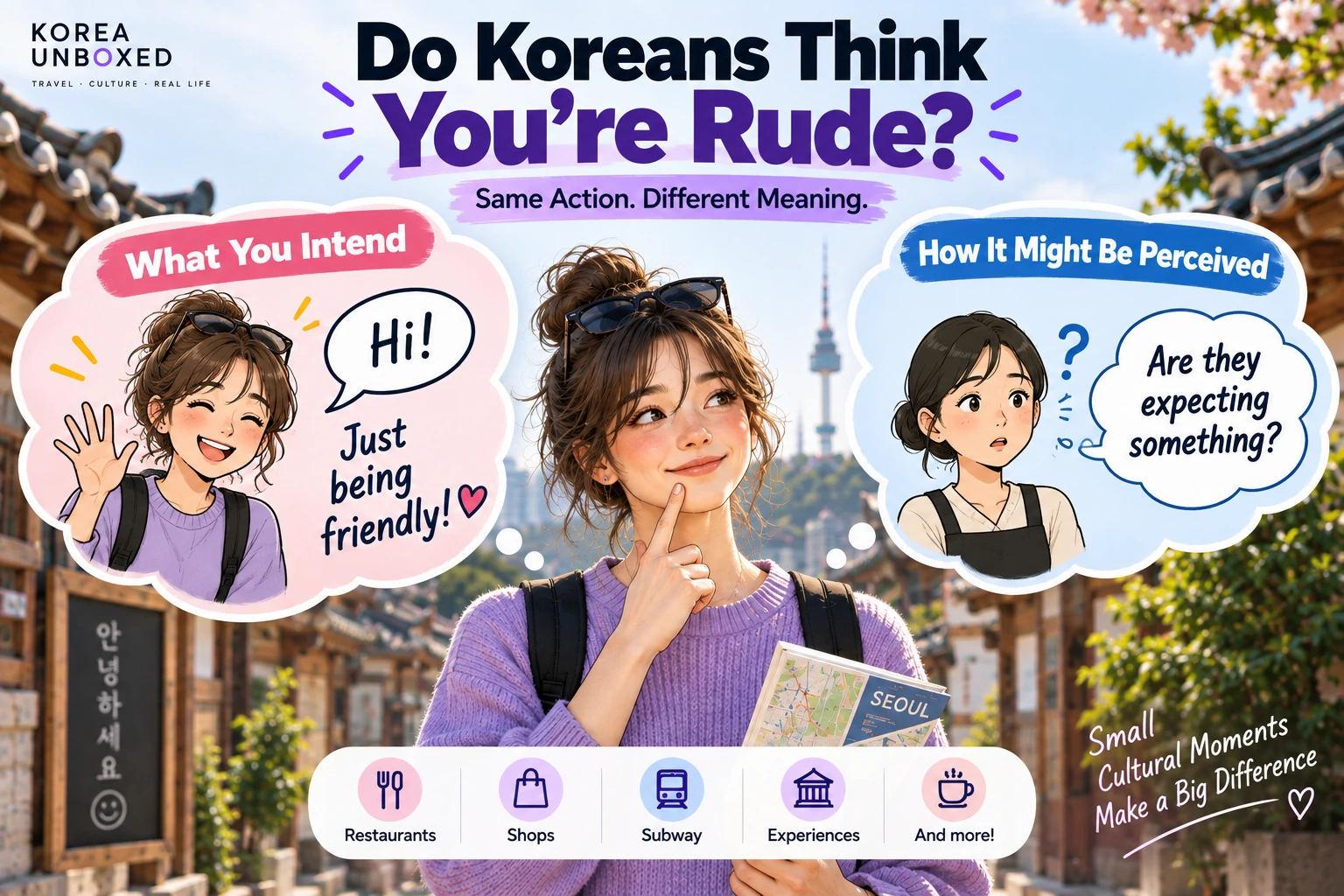
It would be ridiculous to say that “Koreans think foreigners are rude” for the same reason it is ridiculous to say that “Koreans are rude.”
A university student in Seoul, a 60-year-old manager in Daejeon, a bartender in Hongdae, and someone who spent ten years living overseas may all read the same interaction differently.
Age matters. Personality matters. The setting matters. How internationally minded someone is matters. Whether you are friends, coworkers, customers, strangers, or family matters.
There are cultural patterns, but there is no universal Korean reaction.
Most people also understand that someone who did not grow up in Korea will not automatically know every social convention. If you make a small mistake, life will continue.
Still, understanding the logic behind those conventions makes Korea easier to navigate because you start noticing that what looks like a small action can sometimes be carrying more information than you realized.
The biggest difference may be how much is left unsaid
This is where 눈치, nunchi becomes useful.
“Reading the room” is probably the simplest English translation, although nunchi involves more than just noticing what is happening around you. Research on the concept describes both recognizing social cues and adjusting your behavior in response to them.
You can see this constantly in ordinary Korean life.
Nobody announces that the subway car is unusually quiet, but you notice it.
Nobody needs to explain that the dinner with your boss is more formal than dinner with your college friends. The relationship already tells you that.
Nobody necessarily says, “I am uncomfortable rejecting this invitation directly.” You are expected to notice what the person is trying to communicate.
This is one of the places where communication styles can collide.
Someone raised with a strong preference for explicit communication may think, “I respect you enough to tell you exactly what I mean.”
Someone else may think, “I respect you enough not to put you in an unnecessarily uncomfortable position.”
Both people can be trying to be considerate while doing almost opposite things.
1. Being very direct can look honest or unnecessarily harsh
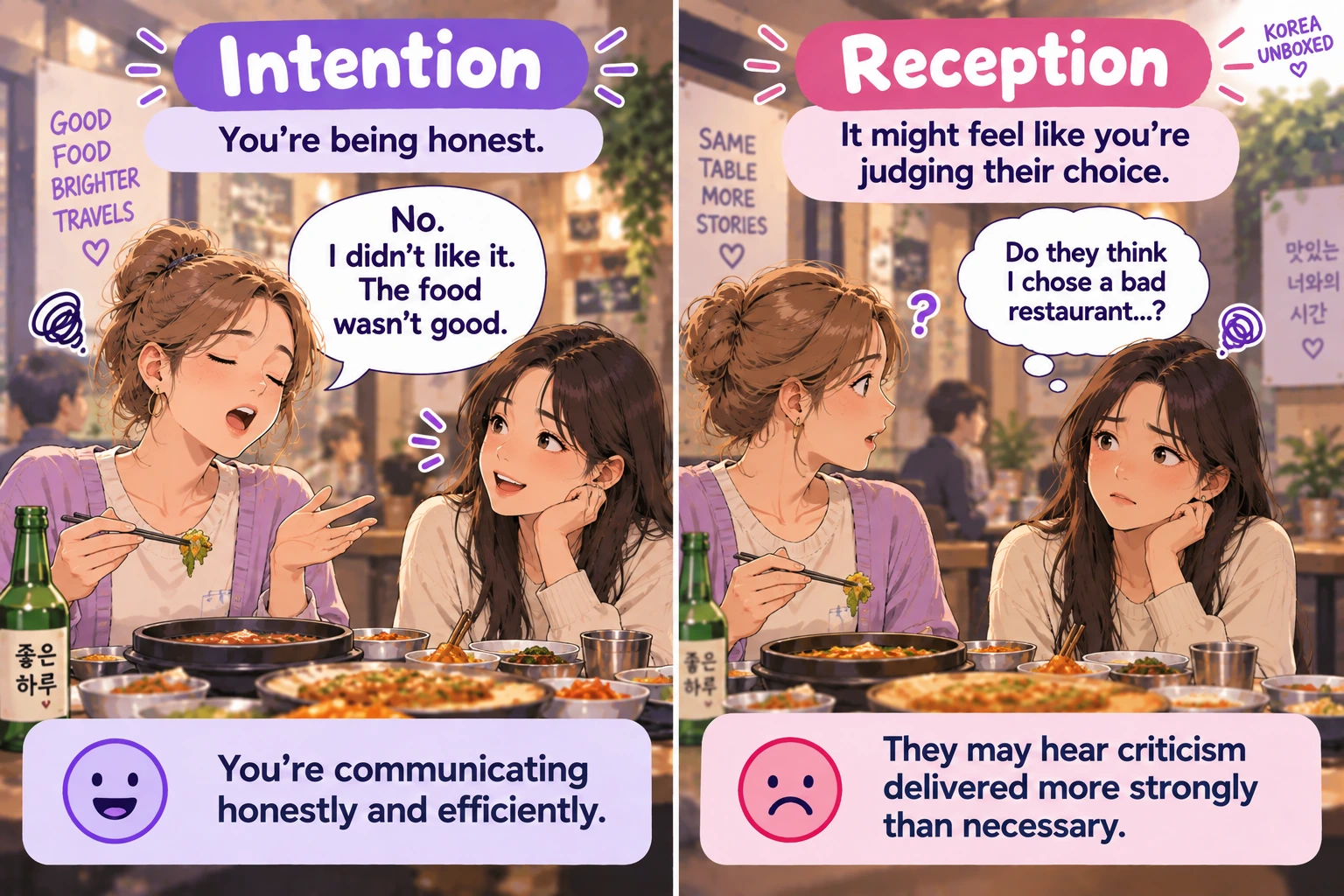
Imagine a Korean friend chooses a restaurant and asks what you thought of it afterward.
You answer honestly:
“No. I didn’t like it. The food wasn’t good.”
There is nothing mysterious about what you mean. You were asked for your opinion and you gave it.
In plenty of cultures, that kind of directness is a positive quality. Nobody has to guess what you think, and you are not pretending to enjoy something that you did not.
But your Korean friend may hear a little more than a restaurant review.
They chose the place.
Maybe they recommended it because they thought you would enjoy it. Maybe they wanted to introduce you to something they like.
Now “the food wasn’t good” can accidentally sound a little like “you chose a bad restaurant.”
Nobody has to be deeply offended for the conversation to become slightly awkward.
A Korean speaker might communicate essentially the same opinion with something like:
“It wasn’t really my style.”
The meaning is still there. The edges are simply softer.
This does not mean directness is rude in Korea. Koreans can be extremely direct, especially with people they know well. It means that direct criticism can carry more weight when the relationship or situation makes saving face important.
You do not need to become vague about everything. It is just useful to recognize when honesty about the subject may also be heard as criticism of the person.
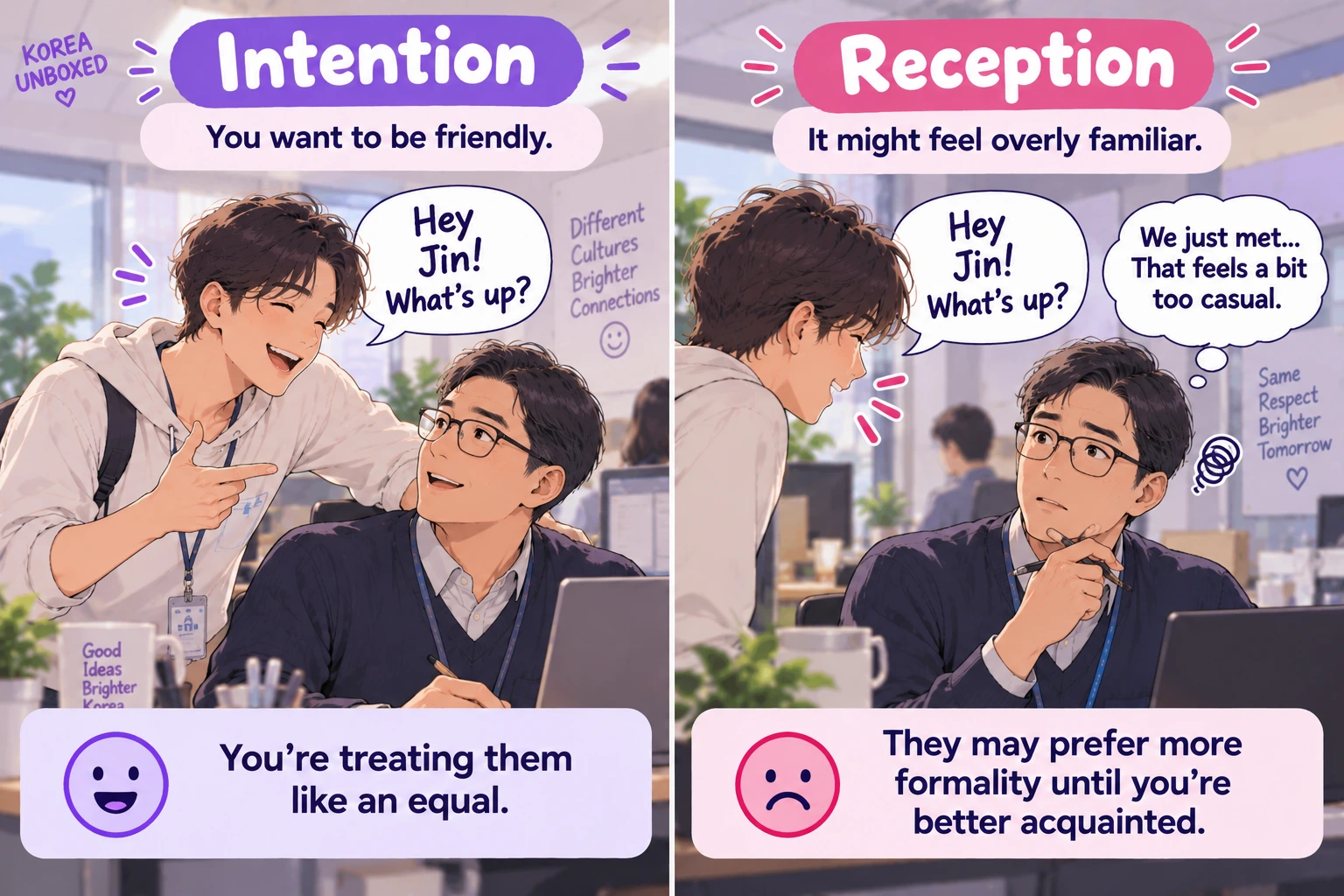
2. Confidence can look friendly or overly familiar
Informality often signals warmth in English-speaking cultures.
You use someone's first name. You joke around. You skip the formalities because being casual communicates, “You can relax around me.”
That works in Korea too once the relationship reaches that point.
The difference is that Korean relationships often pay more attention to when that point has actually been reached.
Imagine a young foreign employee meeting an older Korean coworker for the first time.
“Hey, Jin! What’s up?”
The foreign employee may be deliberately trying to remove distance between them. From his perspective, treating someone casually means treating them as an equal.
The older coworker may hear something different: we have known each other for thirty seconds and you have already decided how familiar we are.
Age, professional rank, and relationship still influence Korean speech and forms of address, particularly in workplaces and more traditional environments. Younger Koreans are not constantly walking around calculating hierarchy either, but the basic awareness is still there.
Fortunately, you do not need to memorize an organizational chart before speaking to anybody.
Pay attention to how people introduce themselves and how the people around them address them.
If someone says, “Just call me Jin,” then call him Jin.
The familiarity becomes natural because it was invited rather than assumed.
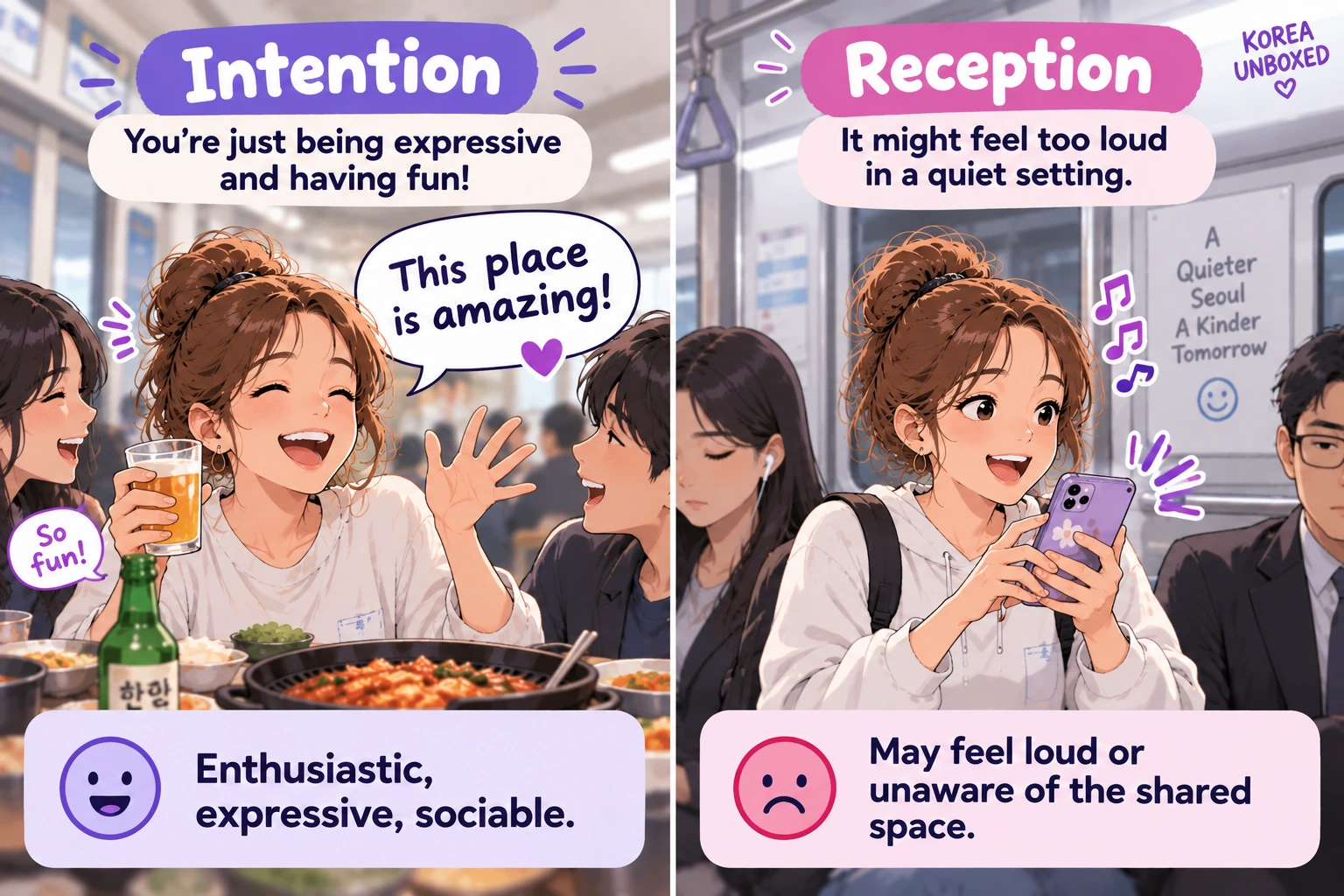
3. Being expressive can feel warm or loud
Korea is not a quiet country.
Walk through a busy barbecue restaurant on Friday night or down a nightlife street in Seoul and that becomes obvious very quickly.
Friends laugh loudly. Tables shout across restaurants. People drink, argue, celebrate, and occasionally become the loudest person you have heard all week.
So the idea that speaking loudly is somehow universally un-Korean does not make much sense.
The important part is the setting.
The same person who is shouting over a grill with friends might sit almost silently on the subway home.
That distinction matters if you come from somewhere where animated speech naturally communicates enthusiasm. You may be having a great conversation and not notice that everybody else in the train car can hear it.
The same applies to speakerphone calls, videos, and music. In 2025, Seoul Metro ran a campaign asking passengers to use earphones after receiving thousands of complaints about people playing audio aloud on public transportation.
Those complaints were not aimed at foreigners. Koreans annoy other Koreans all the time.
The useful cultural instinct is simply to notice the volume of the room you are in.
If the restaurant is roaring, enjoy yourself.
If the subway sounds like a library, that is information too.
That is nunchi in a very ordinary form.
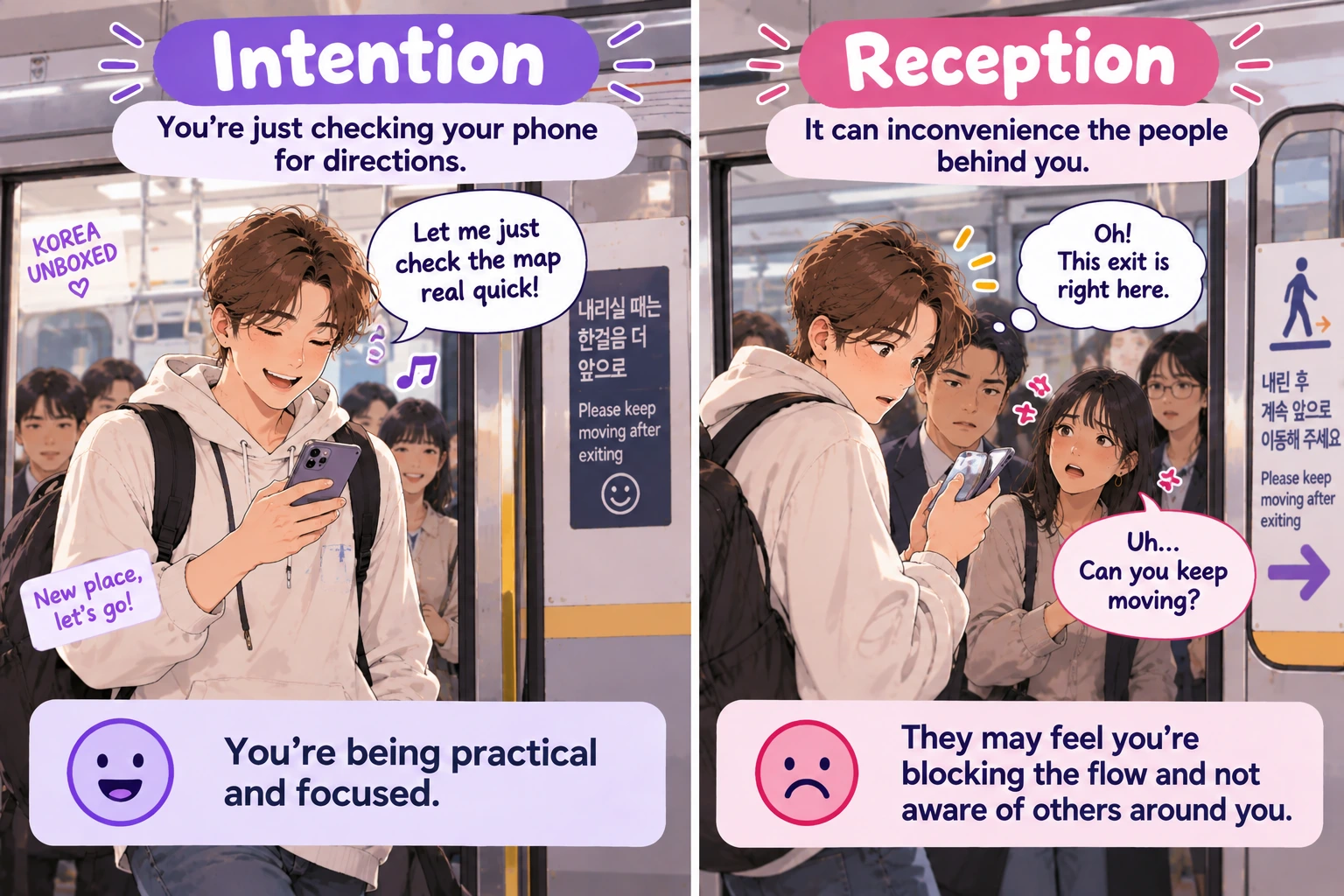
4. Being lost is fine. Stopping in the middle of the flow is less fine.
This scene happens every day in Seoul.
You step off the subway, check NAVER Map, realize you need Exit 7, and immediately stop to figure out which direction Exit 7 is.
Meanwhile, an entire train is trying to get off behind you.
From your perspective, you are doing something completely practical. You need ten seconds to figure out where you are going.
From the perspective of the people behind you, you have become an unexpected piece of furniture.
Seoul's subway system has a strong sense of movement around doors, stairs, escalators, and transfer corridors. People wait for passengers to get off, file out quickly, and then sort themselves out once they have cleared the bottleneck.
Tourists do not need to understand the station immediately.
Just keep moving for another few steps before checking the map.
The same principle works at the top of escalators, in narrow doorways, and in busy sidewalks.
It is less an etiquette rule than a bit of urban choreography. Once you notice it, Seoul becomes easier to move through.
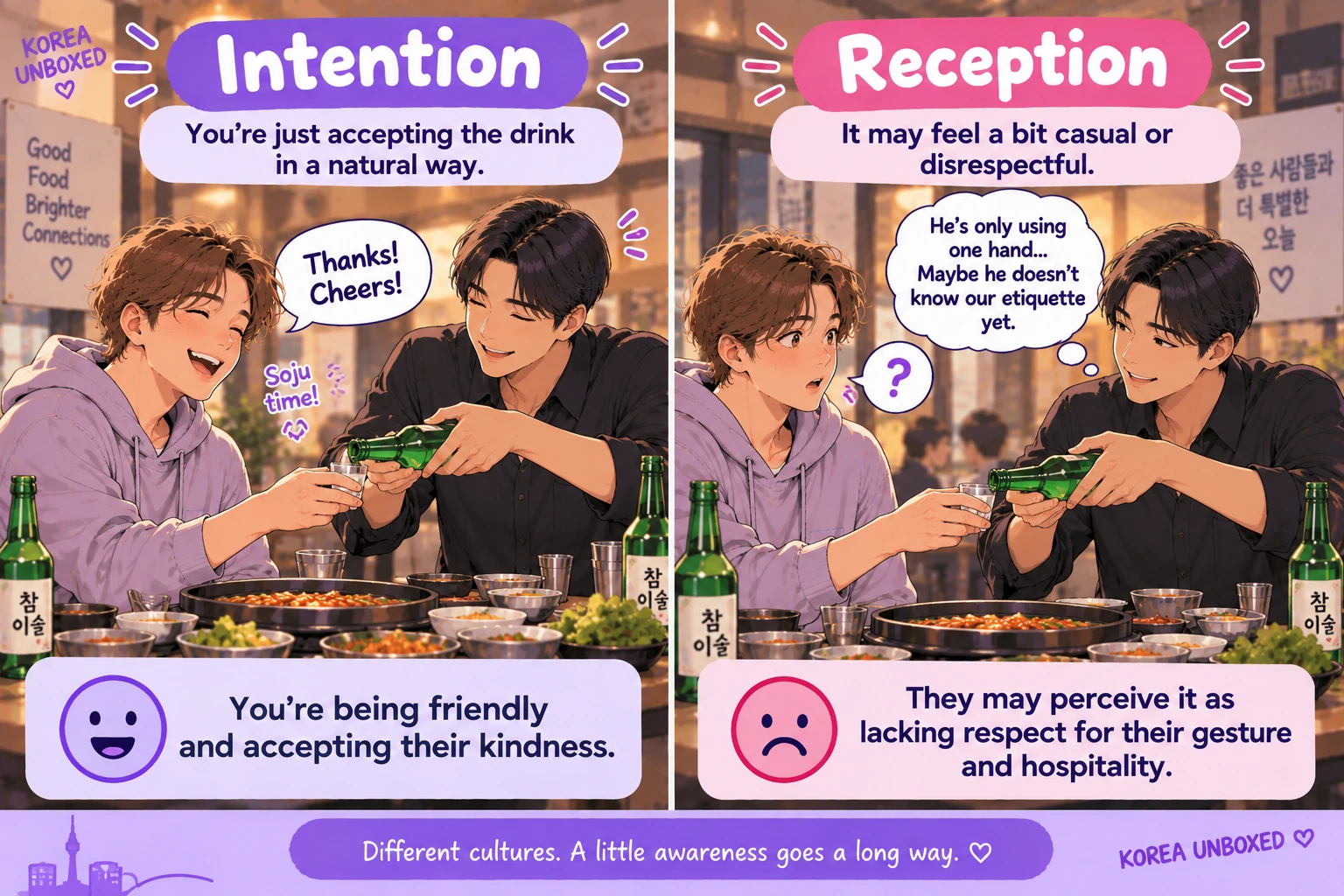
5. One hand can mean “casual” to you and something different to someone else
Imagine you are having dinner with a Korean acquaintance.
He picks up the soju bottle with both hands and pours you a drink.
You smile, say thanks, and hold your glass out with one hand.
You probably do not think anything happened.
To you, accepting the glass is the respectful part. Whether your other hand was involved barely registers.
But in Korea, using two hands when giving or receiving something can add a small layer of respect, particularly when age, seniority, hospitality, or formality is involved.
The contrast becomes more noticeable when the other person is already using two hands while you are not.
It can make an otherwise friendly gesture feel strangely one-sided.
This does not mean Koreans use two hands every time they pass someone a pencil. Watch people for five minutes and you will see plenty of one-handed exchanges.
The more formal or meaningful the interaction becomes, the more useful the convention becomes.
When someone older pours you a drink, hands you a gift, or gives you something with both hands, returning the gesture is an easy signal that you understood the moment.
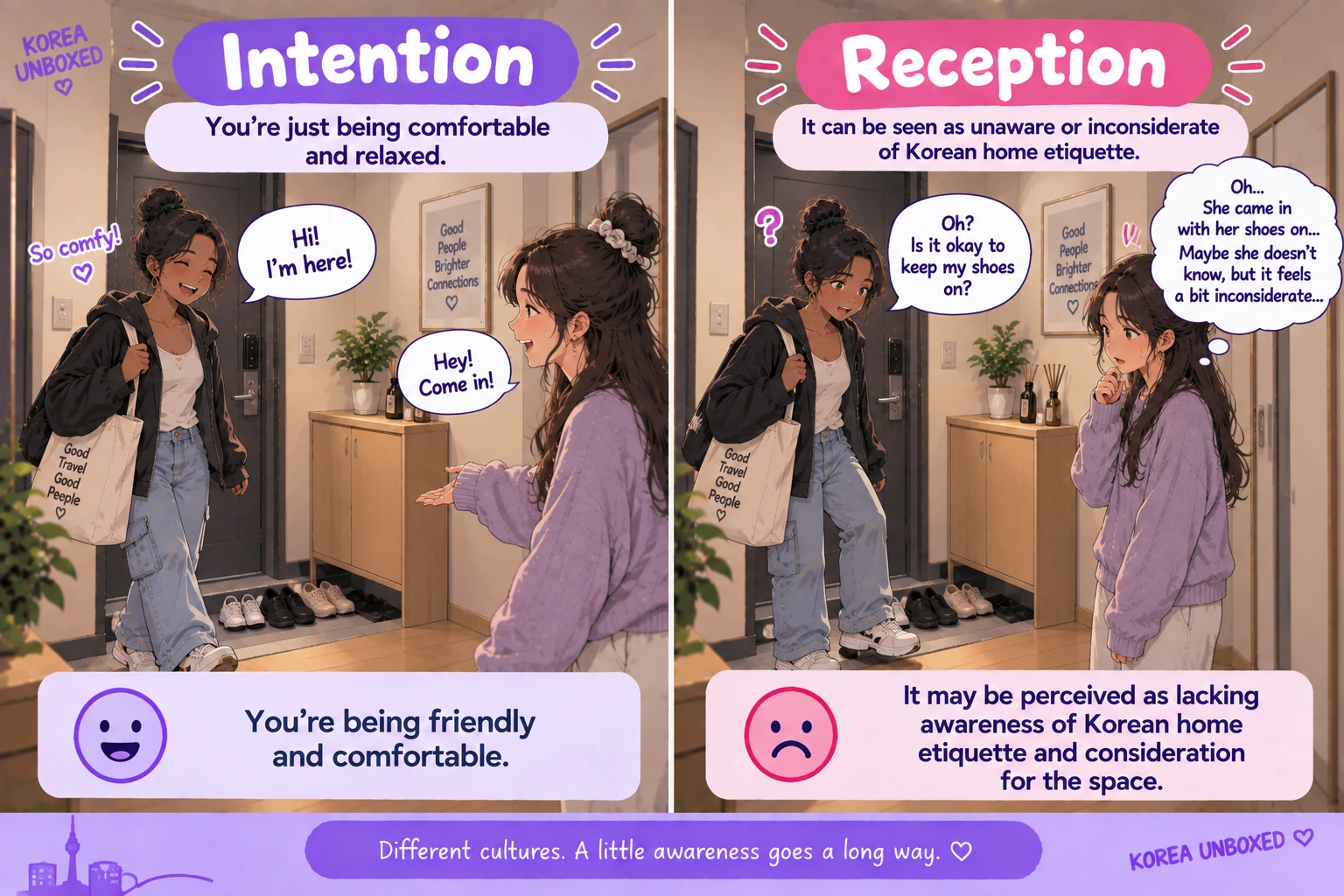
6. Walking into someone's home with your shoes on can make a stronger impression than you expect
Some cultural differences are subtle.
This is not one of them.
Imagine visiting a Korean friend's apartment for the first time. She opens the door, you walk inside, and you continue straight across the raised floor wearing the same shoes you had outside.
You may not even notice what happened.
She probably will.
Korean apartments usually make the boundary fairly obvious. There is commonly a lower entrance area where shoes are removed before stepping onto the interior floor. There may be a shoe cabinet, slippers, or several pairs of shoes already sitting there.
For someone accustomed to that separation between outside and inside, outdoor shoes crossing onto the interior floor can feel less like a quirky cultural difference and more like someone walking dirt through the house.
You do not need to study the architecture.
Look at the entrance.
If everyone else's shoes ended there, yours probably should too.
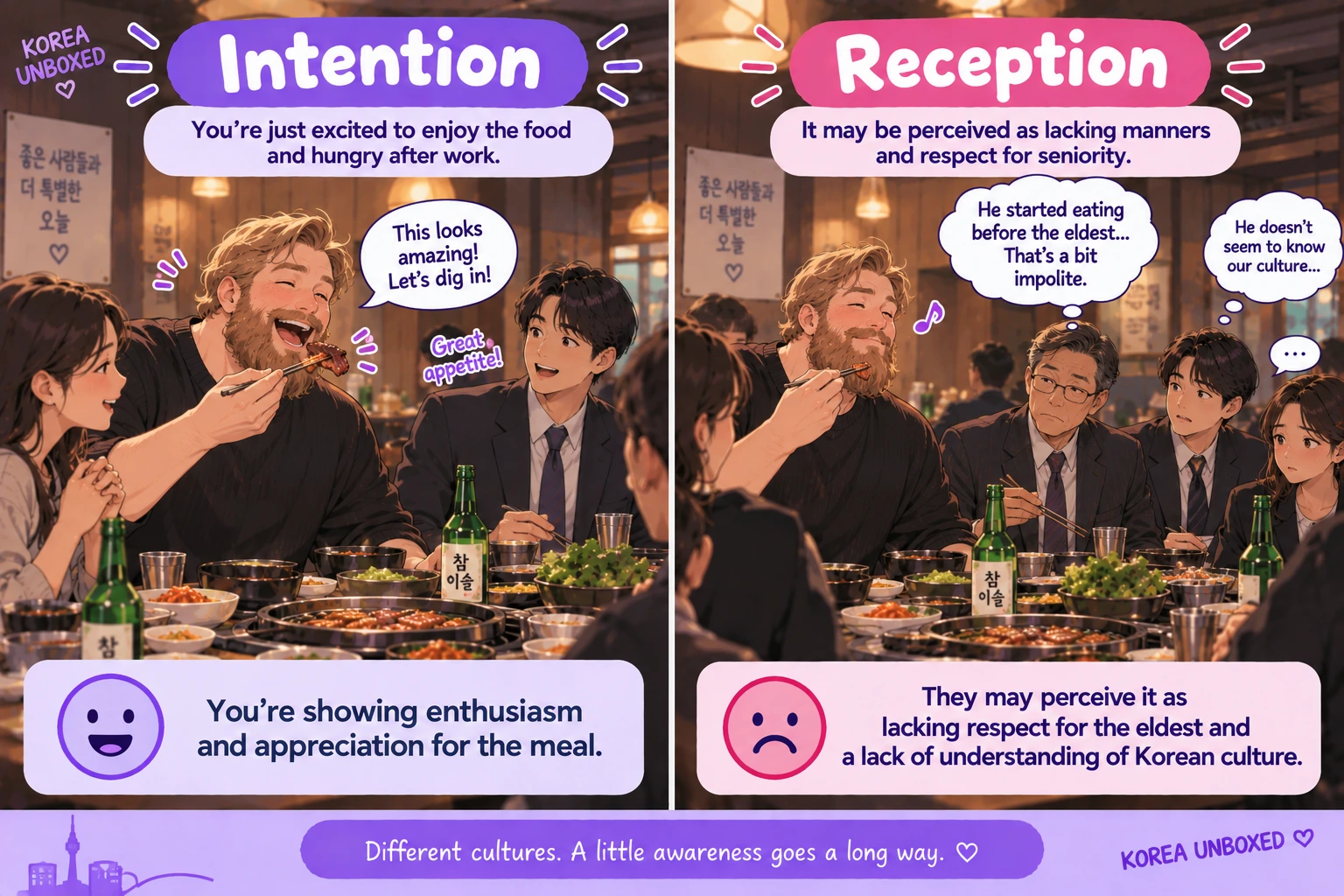
7. Table manners can communicate more than hunger
Now imagine a Korean company dinner.
Everyone sits down, the grill is hot, the food arrives, and the large Scandinavian guy at the table thinks it looks fantastic.
So he picks something up and starts eating.
He is hungry. He likes the food. His enthusiasm is genuine.
Then he notices that everyone else was waiting.
In many Korean groups, particularly more traditional ones or situations with clear age and seniority differences, people wait for the eldest or most senior person to begin eating before they start.
It is one of those conventions that can be almost invisible until someone breaks it.
The foreign coworker was not trying to put himself first. He may actually have thought eating enthusiastically showed appreciation for the meal.
The Korean coworkers may simply see somebody who did not notice the rest of the table.
How strongly anyone cares about this varies enormously. A casual dinner among twenty-somethings is not the same thing as dinner with senior management.
That difference is the larger point.
Korean dining can be quite group-oriented. People share side dishes, cook from the same grill, pour drinks for one another, and pay attention to what is happening around the table.
Good table manners are often less about performing a perfect sequence of rules and more about noticing that you are eating as part of a group.
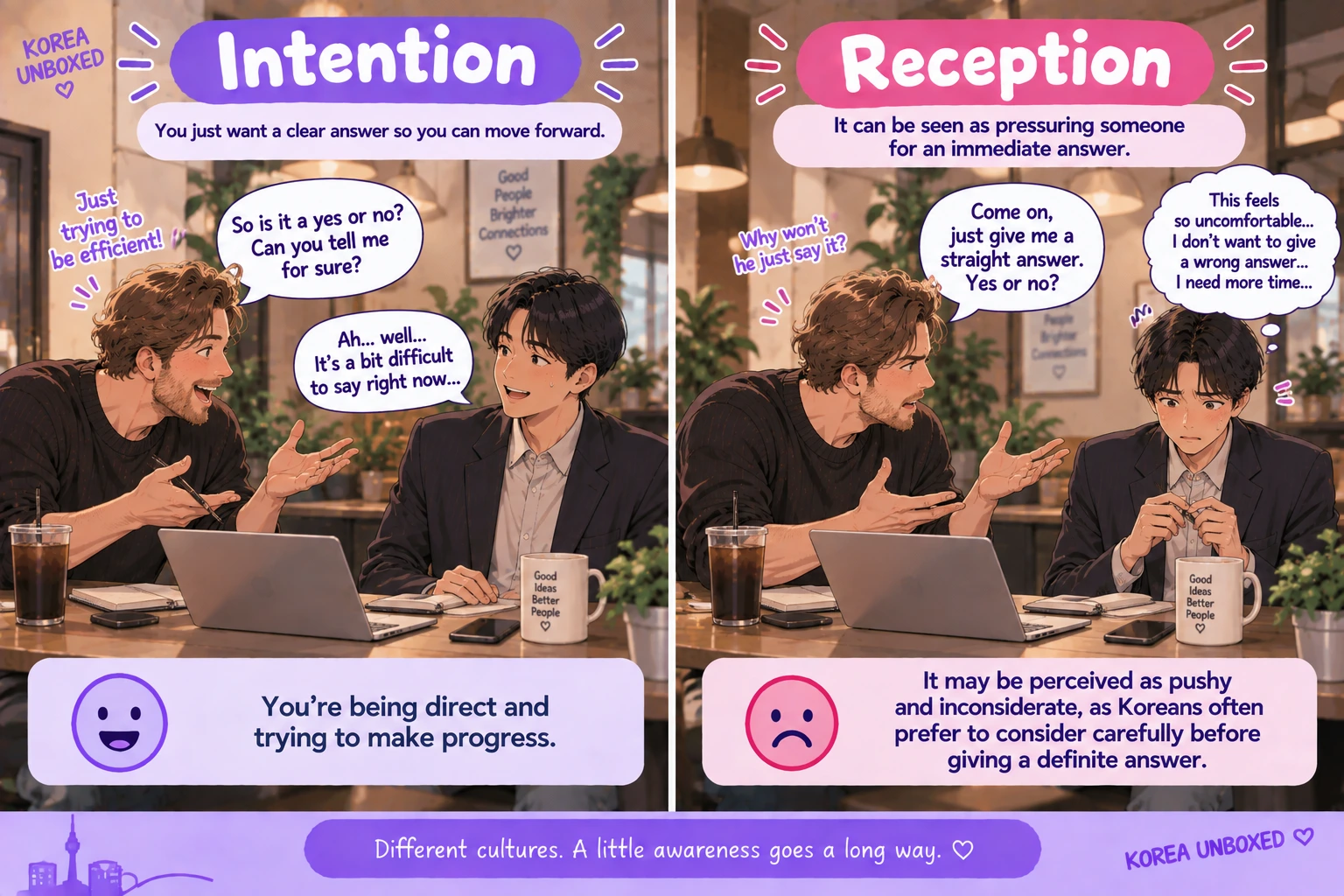
8. Pushing for a clear yes or no can create pressure
This is one of the cultural differences that can frustrate both sides because each person thinks they are making the conversation easier.
Suppose you ask a Korean coworker whether something can be finished by Friday.
They answer:
“Friday might be a little difficult.”
You want to know what that actually means.
“So is that a no?”
They hesitate.
“Maybe. I’ll have to see.”
Now you are even less sure than before.
From your perspective, a definite answer would solve the problem immediately.
From theirs, they may already have communicated quite a lot.
Korean communication often leaves room for context, especially when a direct refusal could create tension or when the person does not feel comfortable giving an absolute answer yet.
That does not mean every “maybe” secretly means no. It does not.
It means the conversation is sometimes carrying information through hesitation, wording, timing, and context rather than through a single definitive word.
When someone repeatedly tells you that something “might be difficult,” pushing harder for an immediate yes or no can make them feel cornered rather than clarified.
Sometimes you really do need a firm answer, especially at work. In that case, giving someone a little room can work better than repeating the question.
“Could you check and let me know by tomorrow?”
Now everyone knows what happens next.
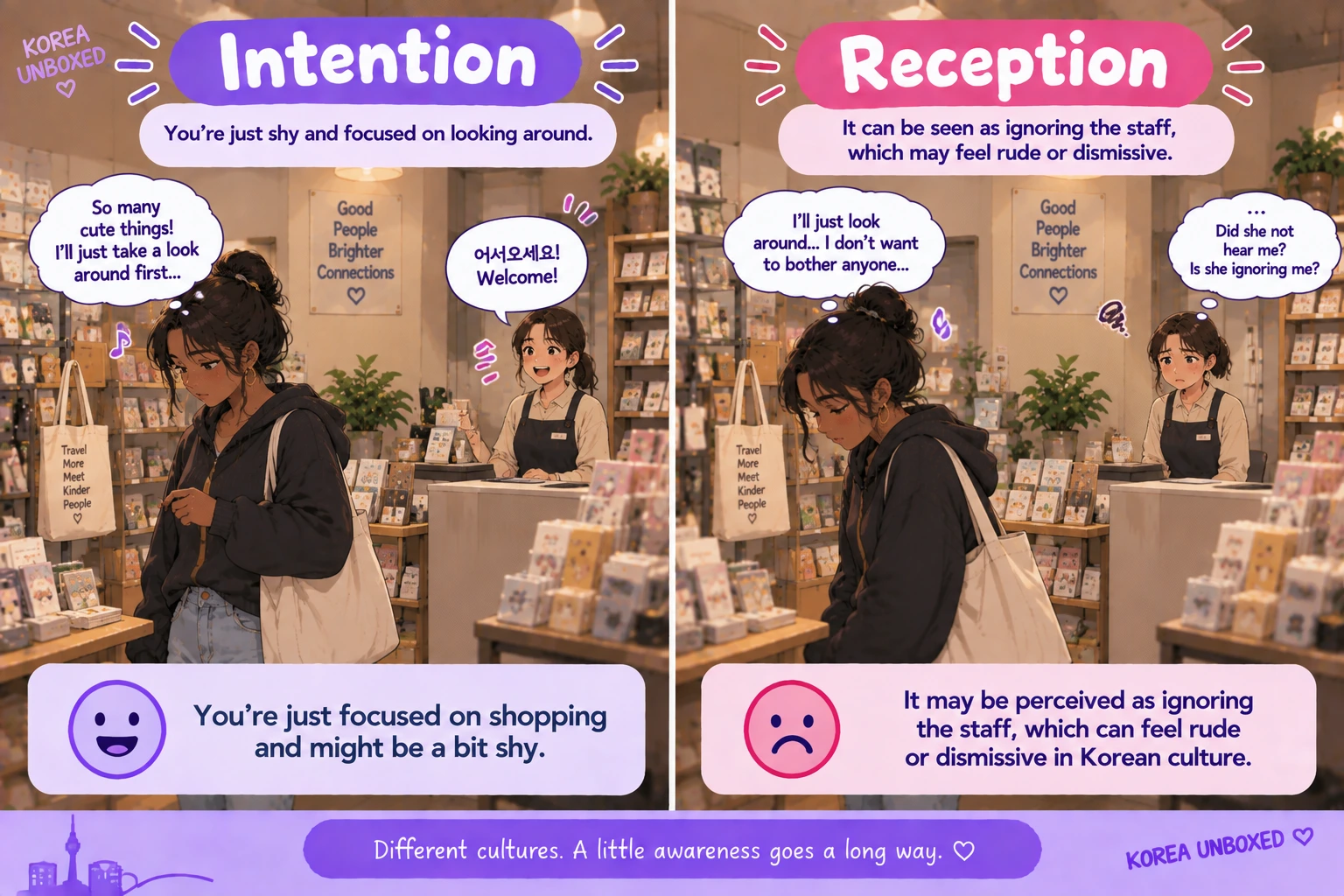
9. Not acknowledging someone may feel neutral to you
A shy visitor walks into a small Korean shop.
The employee says:
“어서오세요.”
The visitor hears it but does not know what to say; maybe she doesn't speak Korean. She avoids eye contact and quietly begins browsing because she does not want to bother the employee.
In her mind, she is being low-maintenance.
From behind the counter, the interaction can look very different.
The employee acknowledged her. She did not acknowledge them back.
That silence can sometimes read as dismissive even though the visitor's actual problem is the exact opposite. She is nervous and trying not to impose.
You do not need to suddenly become outgoing.
A small nod is enough. If you are comfortable saying 안녕하세요, even better.
The point is not demonstrating your Korean ability. It is simply returning the acknowledgement.
What Koreans may actually like about foreign communication styles
None of this means the foreign side of these interactions needs to be edited out.
Quite the opposite.
Direct communication has advantages. So does openness.
Someone who openly says, “This is delicious,” leaves very little room for misunderstanding.
A person who introduces themselves easily can make a group feel less stiff.
Someone who states a preference clearly can rescue six people from spending twenty minutes saying, “Anything is fine.”
Foreign friends and coworkers can also make Korean social groups more informal in ways that people genuinely enjoy.
Cross-cultural adjustment is not a process of replacing your original instincts with Korean ones. It is closer to gaining another set of instincts and learning when each is useful.
Korea has a responsibility in this conversation too
There is an easy trap in conversations about etiquette where every misunderstanding becomes the foreigner’s homework.
That is not how cross-cultural interaction works.
Koreans misread foreigners too.
Someone who speaks loudly may be excited, not inconsiderate.
Someone who immediately uses a first name may be expressing equality, not disrespect.
Someone who asks for a direct answer may be trying to prevent a misunderstanding rather than challenging the other person’s authority.
Foreign residents also deal with situations that cannot be solved by having better nunchi. Research on expatriate adjustment in Korea has documented problems including discrimination, legal difficulties, and a continuing sense of being an outsider even among people who arrived with substantial knowledge of Korean culture.
Knowing the culture helps.
It does not make every problem the foreigner’s responsibility.
The useful version of cultural literacy goes in both directions.
You do not need to become Korean to be polite in Korea
Most Korean etiquette becomes much less complicated once you stop thinking of it as a list of rules.
Watch the situation.
Notice how formal everyone else is.
Notice whether the room is loud or quiet.
Notice where people put their shoes.
Notice whether somebody is offering something to you with two hands.
Notice whether forty people are trying to walk through the place where you decided to check NAVER Map.
You will get some things wrong. Koreans get Korean etiquette wrong too.
And sometimes a person who seems offended is simply having a bad day. Sometimes someone really is rude. Culture does not explain every unpleasant interaction.
But it does explain a surprising number of small misunderstandings.
That is why the most useful question is usually not:
“Which culture is more polite?”
It is:
What meaning did each person think they were sending?
Once you start asking that question, a lot of strange interactions in Korea become much easier to understand.
Keep exploring Korea
Understanding Korea gets easier once you start noticing the small things people usually do without explaining.
If you want to keep going, these are good next reads.
Are Koreans Rude? Understanding Korean Culture and Social Etiquette
This article looked at how your behavior might be interpreted in Korea. Now flip the perspective.
Why do some completely ordinary Korean behaviors feel rude, blunt, or confusing to foreigners?
10 Apps to Download Before Visiting Korea
Culture is only half the learning curve. The other half is figuring out how to actually get around, translate things, book restaurants, call a taxi, and navigate daily life.
Read: 10 Apps to Download Before Visiting Korea →
Why Are There Gym Machines in Korean Parks?
One of our favorite kinds of Korea question: you see something everywhere, nobody explains it, and eventually you have to ask what is going on.
Here is the story behind those colorful exercise machines you see in parks across Korea.
Read: Why Are There Gym Machines in Korean Parks? →
References & further reading
This article describes broad cultural patterns, not rules that apply to every Korean or every interaction. Age, personality, relationship, region, workplace culture, and individual experience all matter.
For readers who want to explore the research and official guidance behind some of the topics discussed:
- Visit Seoul: The Basics of Korean Etiquette
A practical overview of greetings, seniority, shoes indoors, two-handed exchanges, dining conventions, and other common Korean etiquette. - Visit Seoul: Public Transportation Etiquette in Korea
Guidance on subway behavior, boarding and exiting, priority seating, and consideration in shared public spaces. - Seoul Metropolitan Government: Public Service Announcement to Promote Earphone Use on the Subway
Background on Seoul Metro’s 2025 campaign following thousands of complaints about passengers playing audio without earphones. - Nunchi Across Cultures: Cultural Interpretation and Psychometric Validation in South Korea and the United States
Cross-cultural research examining nunchi as both recognizing social cues and adjusting behavior in response to them. - Characteristics of Koreans’ Indirectness
Research examining indirect communication and contextual meaning in Korean communication. - From Screens to Streets: Interpretations of English-Speaking Expatriates in Korea
Research on cultural knowledge, adjustment to life in Korea, and the challenges that remain even when foreigners arrive with substantial familiarity with Korean culture.
Last fact-checked: September 21, 2026.