If you have spent any time searching for information about visiting or living in Korea, you have probably seen some version of the question: “Are Koreans rude?” It is a common question, especially from people who have just arrived and experienced behavior that would be considered impolite in their home country.
The answer is more complicated than yes or no. Korean social norms are different enough from those in many Western countries that ordinary behavior can sometimes feel blunt, cold, impatient, intrusive, or even aggressive to a foreigner. At the same time, Koreans absolutely can be rude. Cultural differences explain behavior, but they do not magically make every bad interaction polite.
The useful part is learning how to tell the difference.
Summary
This guide looks at why Korean behavior can sometimes be perceived as rude by foreigners, even when the person involved is behaving normally by Korean standards. It covers everything from personal questions and direct comments to public transportation, customer service, age hierarchy, conversation, dating, and workplace interactions. It also looks at the other side of the issue: situations where something really is considered rude in Korea and should not simply be dismissed as “cultural differences.”
The goal is not to decide which culture is more polite. It is to understand that different societies have different ideas about consideration, respect, privacy, efficiency, and social responsibility.
In this article
We will look at what “rude” actually means across cultures, why Korean behavior can feel harsh to foreigners, the everyday situations that cause the most confusion, how hierarchy and age affect interactions, and how to tell when something is cultural versus genuinely inconsiderate.
Why Do People Ask If Koreans Are Rude?
There is a reason this question comes up so often.
A person arrives in Korea expecting that familiar signs of politeness will work the same way they do at home. Instead, they encounter a cashier who barely acknowledges them, someone who pushes past them on the subway, an older person who speaks to them very bluntly, a coworker who asks their age almost immediately, or a stranger who comments on their appearance.
The foreigner thinks, “That was rude.”
The Korean person may not think anything unusual happened.
Both people can be sincere.
This is one of the most important things to understand about culture. Politeness is not a universal list of behaviors that every society follows in the same way. Different cultures put different values on things like personal space, indirectness, efficiency, hierarchy, privacy, friendliness, and deference.
In one culture, saying exactly what you think can be considered honest and helpful. In another, saying it without softening the statement can be considered unnecessarily harsh.
In one culture, keeping your distance from strangers can be respectful. In another, asking personal questions early can be a normal way of establishing a relationship.
Neither side necessarily feels like it is breaking a social rule.
That is where many misunderstandings begin.
“Rude” Depends on What You Were Taught to Expect
When people say that someone is rude, they are usually comparing that person's behavior against a set of expectations they learned while growing up.
For example, many English-speaking cultures teach people that saying “excuse me,” “sorry,” and “thank you” frequently is part of being polite. Holding doors, giving people personal space, making small talk, and avoiding comments about someone's appearance can also be deeply ingrained.
Korean society has its own expectations, but they are not identical.
Korean politeness is often much more connected to context and relationships. Age, social position, familiarity, and the situation can influence how people speak to each other. There can be a stronger distinction between how you behave with a stranger, a friend, a coworker, a customer, an older person, and someone younger than you.
That means a behavior can look inconsistent if you are judging it using the rules you brought with you.
A Korean person may be extremely careful about showing respect to an older person's social position while being much less concerned about smiling at a stranger. A customer-service interaction may feel very efficient rather than warm. A friend may tell you directly that you look tired or have gained weight without understanding why that would necessarily be offensive.
The behavior is not random. It is being measured against a different set of social rules.
Korean Communication Can Be More Direct Than You Expect
One of the biggest adjustments for foreigners is communication style.
Korean conversation can be quite direct, particularly between people who have an established relationship or where there is a clear difference in age or status.
Someone may tell you that your Korean is bad, that you look tired, that you should lose weight, that your clothes do not suit you, or that you are doing something incorrectly.
In many Western cultures, people are taught to soften these comments because being technically honest is not necessarily considered more important than protecting someone's feelings.
Korean communication does not always make the same tradeoff.
A person might genuinely believe that pointing out a problem is more helpful than pretending it does not exist.
This does not mean Koreans have no concept of tact. They obviously do. It means the boundary for what needs to be softened can be different.
There is another important detail here: the same comment can mean very different things depending on who is saying it.
A close Korean friend telling you that you look exhausted may simply be showing concern. A stranger saying exactly the same thing can still feel intrusive.
That distinction matters.
Culture explains why a comment might be normal. It does not require you to pretend that every context feels equally comfortable.
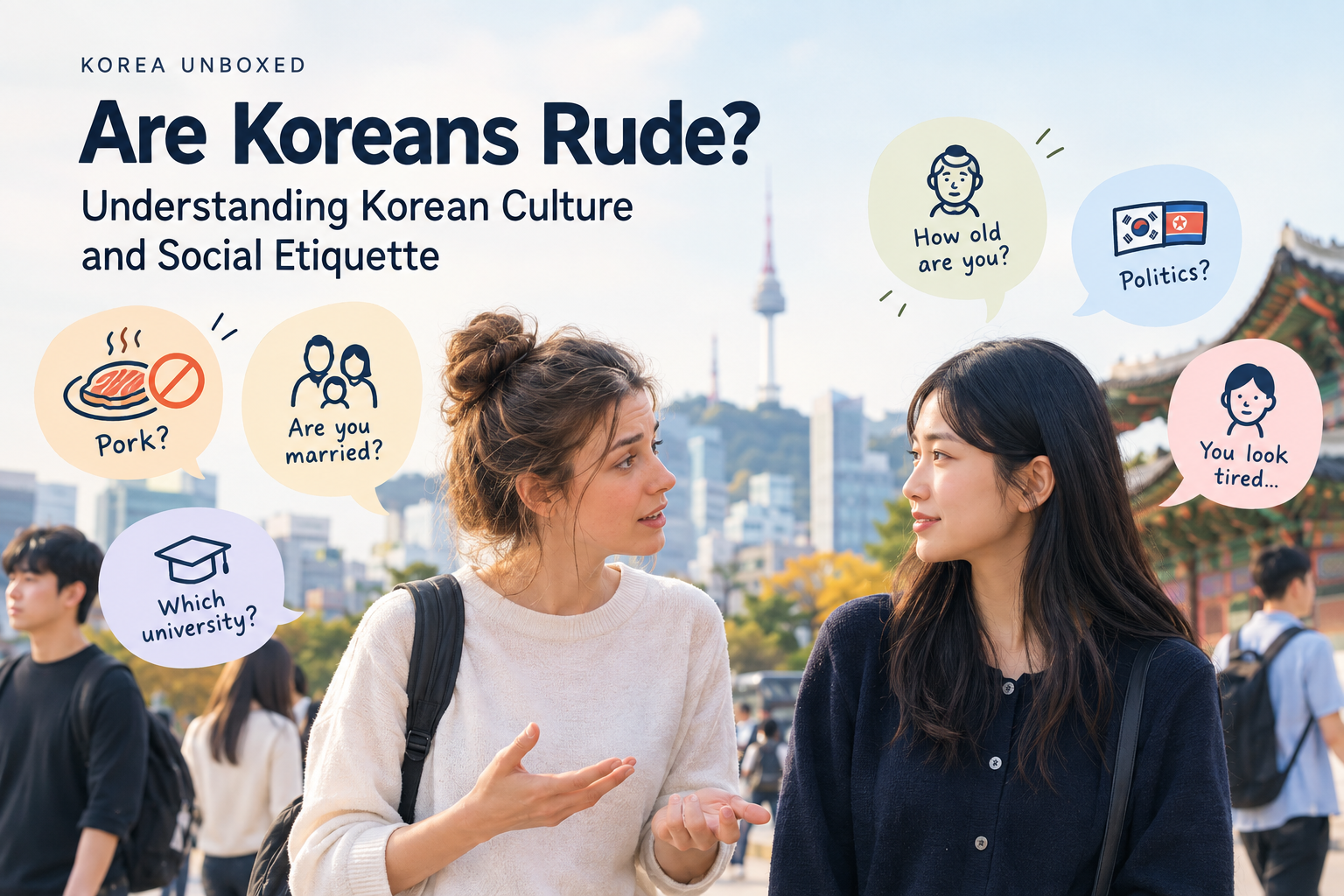
Why Are Koreans Comfortable Asking Personal Questions?
You may meet someone for the first time and be asked your age almost immediately.
You might also be asked whether you are married, whether you have a boyfriend or girlfriend, what you do for work, where you live, or how long you have been in Korea.
For someone from a culture where privacy is emphasized, this can feel extremely personal.
In Korea, these questions can serve a practical social purpose.
Age is particularly important because it can influence language and behavior. Korean has different speech levels, and the relationship between two people affects which form is appropriate. Knowing someone's approximate age helps establish how the two people should interact.
That does not mean every Korean person is entitled to know your personal information. It simply explains why asking something that would be considered inappropriate in another culture can be surprisingly ordinary in Korea.
You are also allowed to be uncomfortable.
You can answer briefly, decline to answer, or change the subject. You do not need to become Korean overnight just because you are visiting Korea.
The important thing is not assuming bad intentions immediately.
“Why Isn't Anyone Saying Sorry?”
Another common complaint from foreigners involves bumping into people.
Korea is densely populated, especially in major cities. Subways, buses, sidewalks, shopping areas, elevators, restaurants, and cafés can put large numbers of people into very small spaces.
You will sometimes get bumped.
You will sometimes bump someone else.
And you may not hear “sorry” every time it happens.
To someone from a culture where even a minor collision usually produces an apology, this can seem incredibly rude.
But think about the alternative. In a packed subway station, dozens or hundreds of tiny collisions can happen in a few minutes. Not every physical contact is treated as a social event that requires acknowledgment.
The same thing can happen when someone walks around you, squeezes past you, or moves through a crowded restaurant.
This does not mean Koreans never apologize. They certainly do when they feel an apology is appropriate. The difference is that the threshold for when an apology is necessary can be lower in some Western cultures than it is in Korea.
There is an important practical lesson here.
If you are waiting for someone to apologize for every small bump, you may spend your entire trip feeling offended by things that nobody around you considers significant.
Every Culture Has Its “Sacred Cows”
There is an old expression in English, “sacred cow,” for something that people consider so important or sensitive that you are not supposed to question, criticize, or interfere with it.
The interesting thing is that every society has its own version of sacred cows.
Some are religious. Some are related to family, age, politics, history, national identity, money, appearance, or social status. Many are so deeply embedded in a culture that people who grew up there do not even think about them. They simply know what you are and are not supposed to say.
This is one of the reasons cultural misunderstandings can happen even when both people have good intentions.
Imagine someone meeting a Muslim person for the first time and enthusiastically recommending a great pork restaurant without knowing anything about their dietary restrictions. The person making the recommendation may genuinely be trying to help. They are not necessarily trying to offend anyone.
Or imagine someone offering beef to a Hindu person without knowing that beef may be religiously prohibited for them. Again, the intention might simply be, “I thought you would like this.”
The problem is not necessarily the intention. The problem is that the person has unknowingly crossed a cultural boundary they did not know existed.
The same thing can happen in Korea.
Korea Has Its Own Cultural Boundaries
Korean society has plenty of subjects and behaviors that carry more weight than a foreigner might realize.
Age is one obvious example. Asking someone's age is not necessarily offensive, but speaking to an older person too casually, ignoring an established age hierarchy, or treating someone with less respect because they are older can be taken seriously in the right context.
Family can be another sensitive area. In Korea, questions and opinions about marriage, children, parents, education, and family responsibilities can carry much more social weight than a foreigner may expect. A comment that sounds like casual conversation to you might touch on something deeply personal to the other person.
Education and career can also be sensitive. What school someone attended, what university they graduated from, what kind of job they have, and whether they are considered successful can be closely connected to social status. Asking a simple question about someone's career may be harmless in one situation and surprisingly uncomfortable in another.
There are also historical and political subjects that can be particularly sensitive in Korea, especially when they involve Japan, North Korea, the Korean War, or periods of Japanese colonial rule. A foreigner who makes an offhand joke or casually repeats something they heard online may not realize that they have walked into a subject with considerable historical and emotional weight.
Appearance is another interesting example.
Korean people can be much more direct about appearance than foreigners from many Western countries are used to, and this often gets interpreted as rudeness by outsiders. Comments about weight, skin, hair, age, or looking tired can sometimes be made quite casually. At the same time, there are still limits. Publicly humiliating someone, deliberately insulting their appearance, or making a sensitive comment in the wrong setting can absolutely be considered rude.
This is where it gets complicated. The existence of a cultural norm does not mean every behavior is acceptable. It means the boundary is drawn differently.
What Seems Obviously Polite to You May Not Be Obvious to Someone Else
The deeper point is that people generally learn these boundaries by growing up around them.
You probably know, without having to think about it, which subjects are inappropriate at a dinner table, which jokes should not be made around certain people, when it is acceptable to disagree with someone older, how much personal information is appropriate to ask a stranger, and what kinds of comments will make people uncomfortable.
You learned those rules gradually.
Most Korean people did the same thing with the social rules of Korea.
This becomes particularly important when a Korean person has had limited interaction with foreigners.
A person who has spent their entire life around Korean friends, coworkers, classmates, relatives, and neighbors may have very little experience with the boundaries of people from other cultures. They may not know that asking an American woman how old she is, commenting on a foreigner's weight, asking whether someone is married, or making a joke about a foreigner's appearance can be interpreted very differently in another country.
That does not automatically make the behavior malicious.
Sometimes the person genuinely has no idea.
Intent and Cultural Knowledge Are Two Different Things
It is useful to separate two questions.
“What did this person intend?”
And:
“How did their behavior come across?”
Those are not always the same.
Someone can be curious rather than insulting.
Someone can be trying to include you rather than embarrass you.
Someone can be trying to help rather than overstep.
That does not guarantee that you will experience the interaction positively.
This is actually one of the hardest parts of living abroad. You are constantly encountering people who are applying their own social rules to situations that involve you, while you are applying your own social rules to them.
Sometimes everyone is acting in good faith and someone still gets offended.
That is not necessarily a failure. It is simply what happens when two different sets of cultural expectations meet.
The Same Thing Happens in Reverse
Foreigners can just as easily walk into Korean cultural boundaries without realizing it.
A visitor might casually joke about someone's age, criticize an older person's behavior, refuse something in a way that sounds too blunt, speak casually to someone who expects more formal language, or make an insensitive comment about Korea's history.
The person may have no intention of causing offense.
From their perspective, they are simply behaving normally.
From the other person's perspective, they may have crossed a line.
This is why learning a little about Korean etiquette before visiting is useful. You are not trying to memorize hundreds of arbitrary rules. You are learning where some of the bigger boundaries are so that you have a better idea of what carries extra weight.
And the same principle should be applied to Koreans interacting with foreigners.
Neither side automatically understands the other's sacred cows.
That is one of the reasons cultural awareness matters. It does not mean assuming everyone from another country is fragile or easily offended. It means recognizing that the things people consider obviously acceptable are not always universal.
Public Space Is Often More Practical Than Social
Korean public life can feel surprisingly impersonal to newcomers.
People generally do not need to acknowledge every stranger around them. You may not get a smile from the cashier. A person standing next to you in an elevator probably will not make conversation. Someone sitting beside you on the train may not react when you get up and leave.
This can feel unfriendly if you come from a culture where small interactions are used to signal warmth.
But silence is not necessarily hostility.
In many Korean public settings, the expectation is simply to let people go about their business.
This is one reason cafés can feel different too. Sitting quietly for a long period is completely normal. Someone working alone on a laptop is not necessarily inviting conversation. A group of strangers sitting nearby may never acknowledge each other.
The lack of social interaction does not necessarily mean people are unhappy or unfriendly. It can simply mean that public space is not always treated as a place for casual social connection.
Why Do People Sometimes Push?
This is particularly noticeable in transportation.
At a busy subway station, people may move quickly around you, stand close behind you on an escalator, or move toward a train before everyone has fully exited.
This can look impatient.
Sometimes it is impatient.
But there is also a broader culture of efficiency in Korea often associated with the expression “빨리빨리” (ppalli-ppalli), meaning “quickly” or “hurry up.”
You will hear the phrase used casually to describe the fast pace of many parts of Korean life. The expectation is often that things should move along rather than taking unnecessary time.
That mindset shows up everywhere from food delivery to construction to public transportation.
Again, it can produce behavior that a foreigner experiences as inconsiderate.
Understanding the reason does not mean you have to enjoy being shoved toward a subway door. It simply gives you a better explanation than “these people are angry.”
Customer Service Can Feel Cold
This one is especially interesting because foreigners sometimes expect Korean service to be both extremely attentive and extremely friendly.
You may get one without the other.
Many Korean businesses are very focused on speed and getting the transaction completed correctly. A restaurant employee may not spend much time making small talk. A cashier may not smile constantly. A worker may communicate with you in a straightforward way and immediately move to the next customer.
That can feel cold to someone from a culture where customer service is strongly associated with friendliness.
But friendliness and competence are not the same thing.
A Korean employee may not perform warmth in the way you are accustomed to while still doing their job well.
There are also Korean situations where the opposite happens. In smaller businesses, cafés, restaurants, markets, and neighborhood stores, you may encounter a tremendous amount of friendliness once some familiarity develops.
The first interaction and the fifth interaction may feel completely different.
Age and Hierarchy Change the Rules
One of the easiest ways for foreigners to misunderstand a Korean interaction is to ignore age and hierarchy.
Korean society traditionally places considerable importance on age and social position. Modern Korean culture is changing, and younger generations may approach hierarchy differently than previous generations, but it remains an important part of everyday communication.
Korean language itself reflects this.
You may hear the terms “존댓말” (jondaetmal), meaning respectful or formal speech, and “반말” (banmal), meaning casual speech used between people with an appropriate level of familiarity or equality.
The important point is that Korean people are not necessarily using the same communication rules with everyone.
An older person speaking casually to someone younger can be completely normal. A younger person speaking casually to someone older may be considered disrespectful depending on the relationship.
To a foreigner, this can sometimes look like one person is being rude to the other.
From inside the Korean social system, the behavior may be perfectly ordinary.
This is also why someone asking your age can happen so quickly. Age can literally help determine how the relationship is supposed to work.
“Why Did They Talk to Me Like That?”
This is where foreigners sometimes make the mistake of interpreting tone without understanding the relationship.
A Korean person who is older than you may speak in a way that sounds blunt or authoritative.
A Korean coworker may give you instructions without the amount of verbal cushioning you would expect.
A restaurant employee may tell you directly that you cannot do something instead of spending thirty seconds explaining the reason.
This can feel aggressive.
Sometimes it is.
But in other cases, the person is simply using a communication style that is normal for the relationship.
It is worth remembering that Korean politeness is not always expressed through friendliness, softness, or verbal reassurance. Respect can be expressed through speech level, behavior toward hierarchy, helping someone practically, remembering obligations, or fulfilling the role expected of you.
Those signals can be easy to miss when you are looking for the signs of politeness you grew up with.
“괜찮아요” Doesn't Always Mean “I'm Fine”
Even simple Korean phrases can create misunderstandings.
“괜찮아요” (gwaenchanayo) literally means something like “it's okay” or “I'm okay,” but its meaning depends heavily on context and tone.
It can mean that something is fine. It can also be a polite refusal, such as when someone offers you something you do not want.
Imagine a restaurant worker offers you something and you respond “괜찮아요.” You are not necessarily saying that everything is wonderful. You may simply be saying, “No, thank you. I'm okay.”
This matters because Korean communication often relies on context more than a literal translation suggests.
The same principle applies to invitations.
Someone might say “다음에 밥 한번 먹어요” (daeume bap hanbeon meogeoyo), which literally means “Let's eat together sometime later.”
Sometimes they genuinely want to meet you.
Sometimes it is a polite social expression that does not represent a firm plan.
Foreigners can interpret these statements too literally and then conclude that Koreans are being dishonest or fake.
Usually the reality is more ordinary. Different cultures have different ways of maintaining social harmony without making every interaction a concrete commitment.
Indirect Doesn't Always Mean Fake
This can be especially confusing for people from cultures that value direct yes-or-no answers.
Korean communication can sometimes avoid a blunt refusal, particularly when refusing directly might create unnecessary discomfort.
You might hear:
“나중에요” (najungeyo), meaning “later.”
“생각해볼게요” (saenggakhaebolgeyo), meaning “I'll think about it.”
“다음에요” (daeume-yo), meaning “next time.”
The literal meaning may not tell you what the person actually intends.
In some situations, these are genuine statements. In others, they function as a soft decline.
This is not necessarily an attempt to deceive you. It reflects a different idea about how to handle social friction.
The important skill is learning to read the situation rather than treating every sentence as a literal contractual promise.
Dating Can Be Misread Too
Cultural differences become even more confusing in romantic relationships.
Some foreigners interpret frequent communication as controlling when their Korean partner sees it as normal attentiveness. Others may interpret indirect communication as a lack of interest when the person is actually trying to avoid creating discomfort.
Even small questions can carry different meanings.
“밥 먹었어?” (bap meogeosseo?) literally means “Did you eat?” In many contexts it is simply a practical question. Between people who are close, it can also function as a small expression of care.
Similarly, asking what you are doing or where you are going may feel unusually personal to someone from a culture with a stronger emphasis on individual independence.
That does not mean every behavior in a Korean relationship should automatically be accepted as cultural.
Jealousy, controlling behavior, disrespect, and manipulation are still those things regardless of nationality.
Culture can explain why certain relationship habits are common. It should never be used as an excuse to ignore unhealthy behavior.
Koreans Staring at Foreigners
Foreigners, particularly those who do not look East Asian, sometimes notice people looking at them in public.
This can be uncomfortable.
In Seoul and other major cities, international visitors are common enough that most people are not surprised by them. Outside tourist-heavy areas, however, some foreigners can still attract attention.
People may look longer than you would expect.
Sometimes they are curious. Sometimes they are trying to identify where you are from. Sometimes they are simply looking because you stand out.
A stare is still a stare. You do not have to enjoy it.
But it is usually a mistake to assume that someone is trying to insult you.
The same applies to children who stare, older people who look openly, or groups of people who glance at you repeatedly. What might feel socially unacceptable in your home country may not carry the same meaning in Korea.
Does Korea Have Rude People?
Of course; every country does.
This part is important because cultural explanations can go too far, and there's a distinct difference between intentional rudeness and culturally learned behaviors, habits, and ways of thinking and communicating.
Koreans can be impatient, inconsiderate, arrogant, aggressive, selfish, judgmental, or simply having a bad day, just like everyone else.
There are also behaviors that are recognized as rude within Korean culture.
Cutting in line is rude.
Being disrespectful to someone is rude.
Ignoring an important social obligation can be rude.
Being unnecessarily loud in an inappropriate setting can be rude.
Treating service workers badly can be rude.
Disrespecting someone's age or status in a situation where those distinctions matter can be rude.
Someone being Korean does not automatically transform bad behavior into cultural etiquette.
This is why the idea that “it's just Korean culture” should be used carefully.
Sometimes it really is cultural.
Sometimes the person is just being a jerk.
Cultural Difference and Bad Behavior Are Not the Same Thing
A useful way to think about this is to separate three different situations.
The first is behavior that seems rude to you but is completely ordinary in Korea. A stranger not making small talk would be a good example.
The second is behavior that depends heavily on context. An older person speaking very directly to a younger person may be normal in one relationship and inappropriate in another.
The third is behavior that is considered rude in Korea too. Someone intentionally pushing you out of the way, insulting you, cutting a line, or treating you badly for no reason can fall into this category.
The mistake is treating all three situations as the same.
A foreigner who assumes everything is rude can spend their entire trip feeling offended.
A foreigner who assumes nothing can ever be rude because “it's cultural” can end up tolerating behavior that even Koreans would consider unacceptable.
Neither approach is particularly useful.
There Is Also a Difference Between Intent and Impact
One of the best ways to survive cultural differences is to separate someone's intention from your experience of the interaction.
Someone can make you uncomfortable without intending to offend you.
A person asking your age may not be trying to invade your privacy.
Someone bumping into you may not be trying to disrespect you.
A blunt comment about your appearance may not be intended as an insult.
A coworker giving you a very direct instruction may not be angry.
At the same time, your reaction is still real.
You can think, “I understand why they did that, but I still don't like it.”
That is completely reasonable.
Understanding another culture does not require you to stop having your own cultural preferences.
You Don't Need to Become Korean
The purpose of learning Korean culture is not to erase your own.
You do not need to stop saying “thank you.”
You do not need to enjoy being crowded on the subway.
You do not have to answer every personal question.
You can still prefer more indirect communication.
You can still value personal space.
What changes is the interpretation.
Instead of immediately thinking, “That person is rude,” you start thinking, “That behavior is normal here. I may not be used to it.”
That small distinction makes a huge difference.
It also makes it easier to respond appropriately.
If you know a person is probably not trying to insult you, there is less reason to become defensive. If someone really is crossing a line, you can recognize that too.
The Best Way to Handle Cultural Differences
The easiest approach is to give people a little room before deciding what an interaction means.
Pay attention to context.
Look at how the person behaves with other people.
Notice whether the behavior is specific to you or something they do with everyone.
Consider the relationship between the people involved.
Think about whether the behavior is actually harmful or simply different from what you expected.
Most importantly, remember that you are seeing Korea from the outside.
There are social rules you will understand quickly and others that take years to fully appreciate. Even foreigners who have lived in Korea for a long time still occasionally misunderstand a situation.
That is normal.
You do not need to agree with every Korean social norm. You just need to understand enough of them to stop interpreting every unfamiliar behavior as a personal insult.
So, Are Koreans Rude?
Sometimes.
Koreans are human beings, and some of them are rude.
But if you are asking because Korea felt unusually blunt, crowded, quiet, direct, hierarchical, or impersonal compared with your home country, there is a good chance that at least some of what you experienced was not rudeness at all.
It was a different idea of what normal behavior looks like.
That distinction is worth learning because it changes the entire experience of being in Korea.
The person who did not hold the door may not have been ignoring you.
The person who asked your age may not have been invading your privacy.
The person who bumped into you may not have been angry.
The cashier who barely spoke to you may not have disliked you.
The friend who told you that you look tired may not have been insulting you.
Once you understand the social rules underneath those interactions, Korea becomes easier to read.
You will also become better at recognizing the occasions when someone really is being rude.
That is probably the most useful answer to the question.
You do not have to decide whether Koreans are polite or rude as a group.
You just have to learn what ordinary behavior looks like here.
And once you do, a lot of things that initially feel strange become pretty easy to understand.