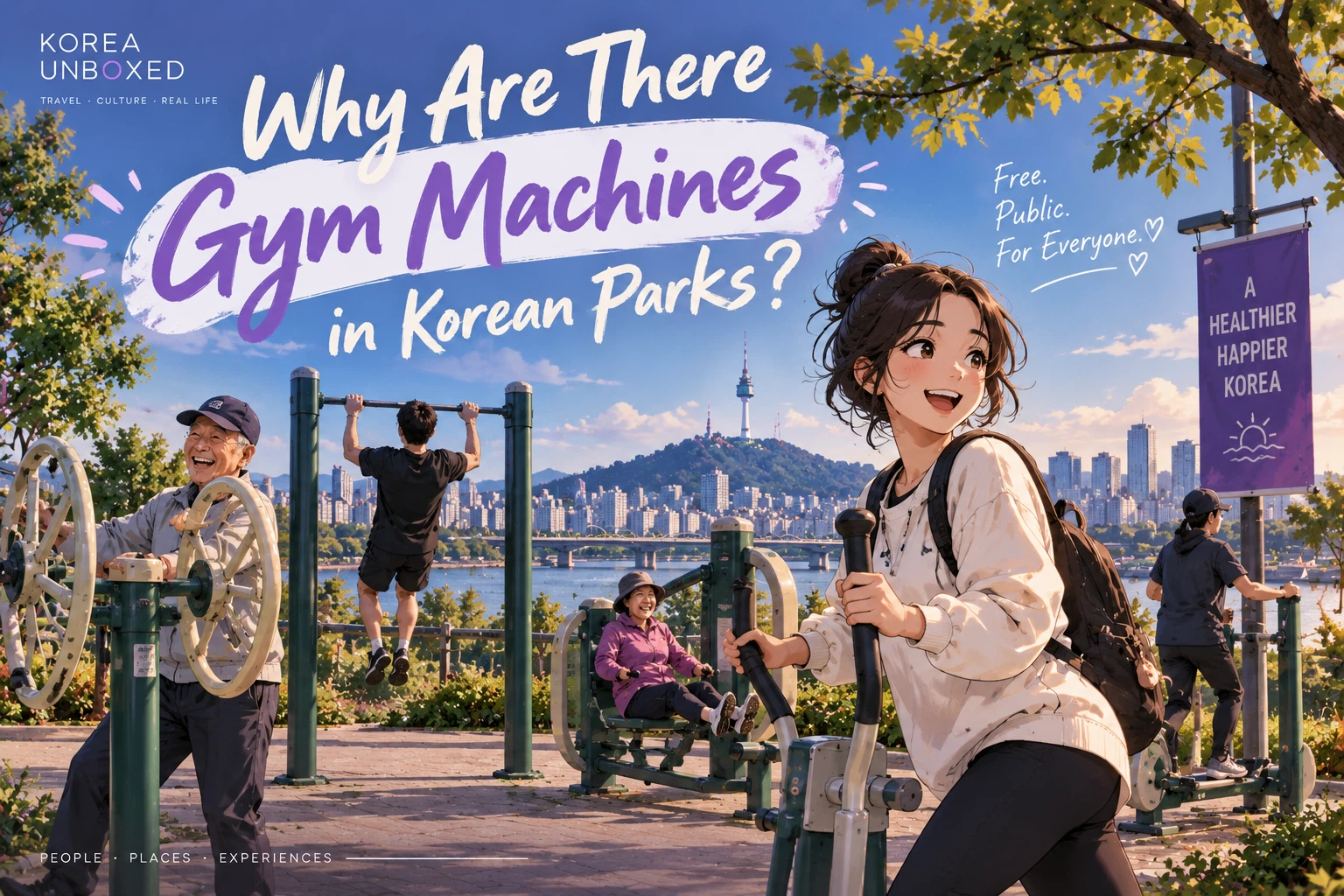
What are these outdoor gyms?
Think of them as exercise areas built into public space, rather than commercial gyms that happen to be outside.
Two useful Korean terms are 야외운동기구, meaning outdoor exercise equipment, and 체력단련장, meaning a fitness training area. Korea’s public equipment dataset records installations managed by local authorities, including walking machines, waist twisters, and other exercise stations.
The important distinction is public access. Don’t assume equipment belongs to everyone just because it is outdoors. Check the entrance and signs before using a facility inside an apartment complex, school, or other restricted property.
At a public park, look for any opening hours, restrictions, or maintenance notices. Treat nearby courts, classes, and staffed facilities separately; permission to use one area does not establish the rules for another.
For the free public installations covered here, plan around the posted rules rather than a membership signup. You don’t need to turn a short park visit into another account-registration project.
Why are they part of everyday life in Korea?
The attraction is easy to understand: you can add some exercise to a walk instead of organising a separate gym visit.
There is research supporting that everyday role. A 2024 Korean study interviewed 27 outdoor-equipment users aged 65 and older. Participants described convenience, regular activity, and opportunities for social interaction, with different experiences in parks, mountain areas, and playground settings. This was a small qualitative study, not a survey of everyone in Korea.
It is also worth looking beyond the idea that these are only gentle exercise stations for older people. Seoul’s newer Hangang gyms include adjustable-resistance strength equipment and bodyweight exercise rigs, expanding on the stretching-focused equipment described in the city’s launch announcement.
And no, these are not ancient Korean exercise devices. Similar outdoor gyms exist elsewhere, including installations supplied by outdoor-equipment manufacturers in the UK. The interesting part is how they fit into a Korean park visit, not a claim that Korea invented exercising outdoors.
Seven machines you might encounter
Names and mechanisms vary between manufacturers. Use the descriptions below to recognise a type of equipment, then follow the instructions on the actual model. A familiar-looking handle does not guarantee a familiar movement.
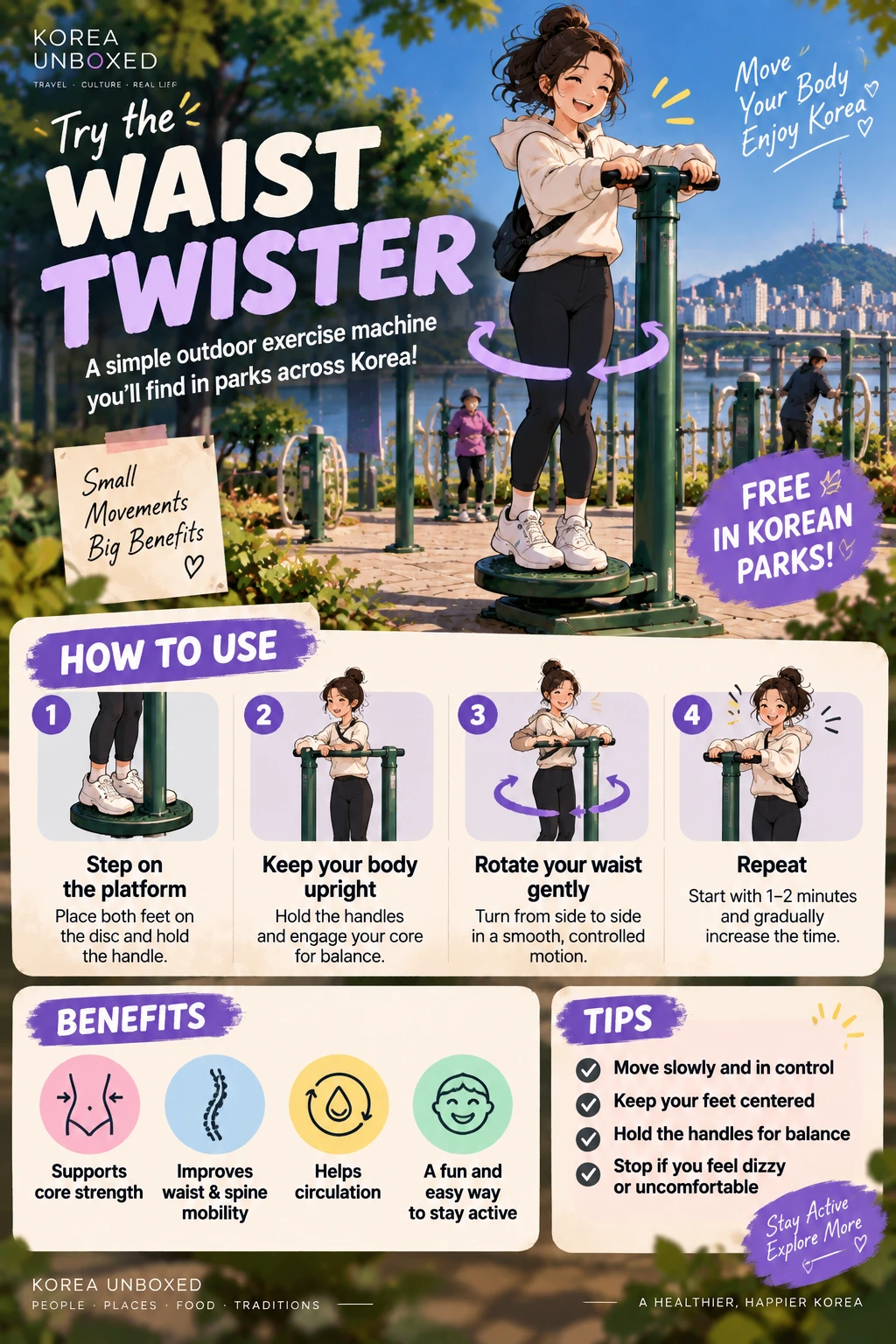
1. The waist twister
This is the small rotating platform with a handhold. On a typical standing twister, the user stands on the disc and turns from side to side while holding the support.
It may look like a standing dance move, but don’t treat it as a challenge to twist as far or as quickly as possible. Our advice is to keep any movement controlled and comfortable, and skip it when you are unsure about your balance or the instructions.
Think of it as a movement station, not a promise of a smaller waist.
The waist twister is one of the most recognizable machines in Korean parks. You stand on a rotating platform, hold the support, and turn gently from side to side.
Why include something this simple?
Because everyday movement is mostly forward and backward. A waist twister introduces controlled rotation while also requiring you to stay balanced on a moving platform.
Research on outdoor exercise equipment has grouped waist-twisting stations with balance-oriented movement rather than heavy strength training. The machine is best thought of as a light mobility and balance station, not a fat-burning device.
Why you might care: it adds a movement pattern you may not otherwise use during a walk and requires almost no setup.
Best use: slow, comfortable rotation rather than trying to twist as far as possible.
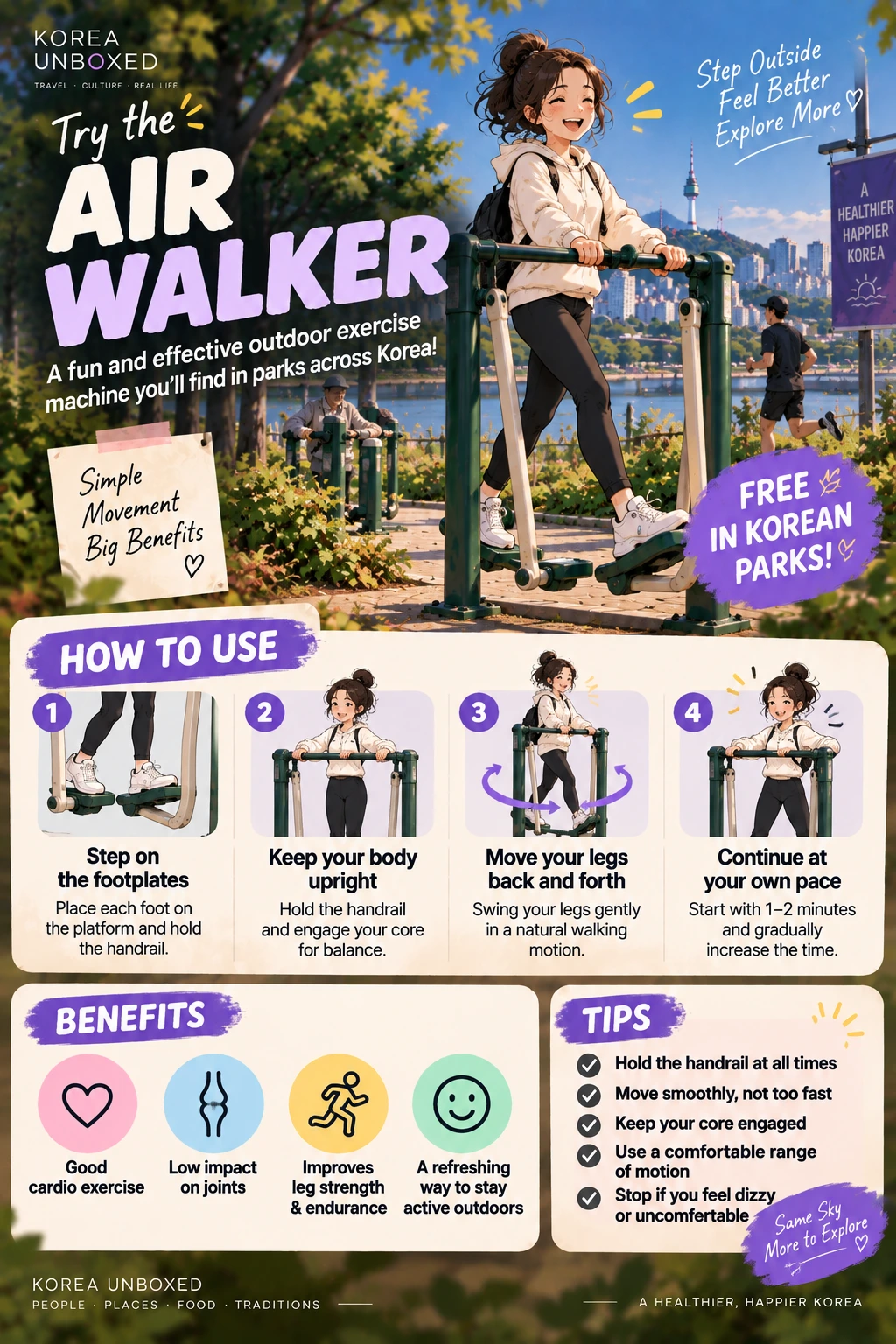
2. The air walker
An air walker has separate suspended foot platforms that swing forward and backward in a walking-like motion. Unlike walking around the park, you stay in one place.
The floating footplates are the feature to notice before stepping aboard. Find the intended handholds and read how to mount and dismount the machine.
For a first try, resist the temptation to make enormous strides or copy someone swinging both legs together. Familiarise yourself with the basic movement, and bring the platforms to a stop before getting off.
The air walker is essentially a walking motion performed on suspended footplates.
Your feet stay on the machine while the legs swing forward and backward, allowing continuous movement without repeatedly striking the ground as you would while running.
Outdoor-exercise research has used air walkers as endurance equipment, which helps explain why they are so common in parks. They give people a simple way to add more sustained movement without needing to jog.
Why you might care: it is easy to adjust the intensity yourself. Small, gentle strides feel very different from larger, faster ones.
It is particularly useful when someone wants to move for a few minutes after walking but does not want another complicated exercise station.
Best use: controlled, comfortable aerobic movement.
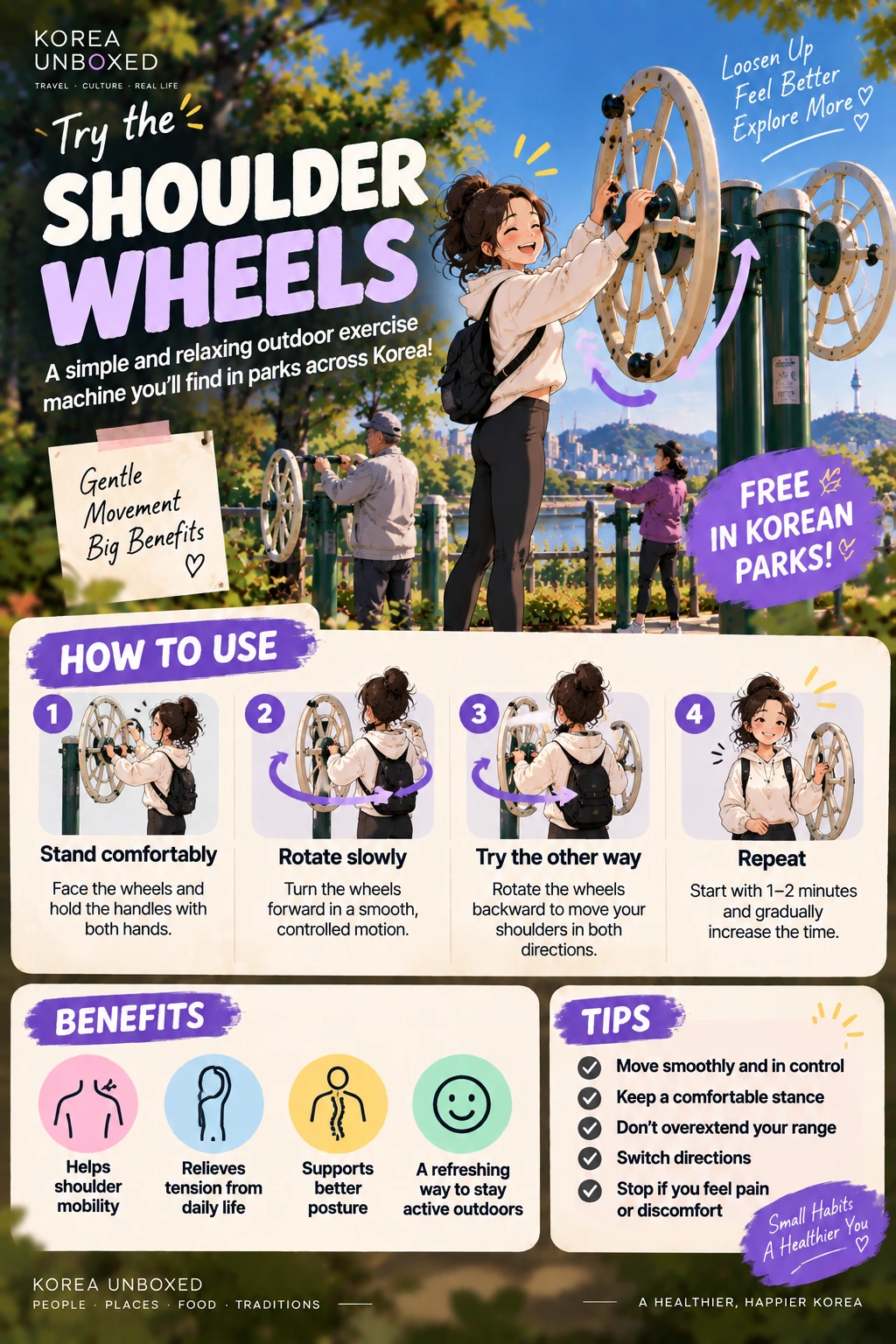
3. Shoulder wheels
These are the large wheels or rotating discs positioned around upper-body height. Users turn them with their hands, moving the arms through circles. Some manufacturers call related designs T’ai Chi Spinners, although turning a wheel is not a lesson in a traditional martial art.
This is different from lifting a loaded bar. Focus on understanding the intended movement rather than expecting every device to provide substantial resistance.
Check whether the handles are within a comfortable reach. Don’t stretch awkwardly to fit equipment that is too high, and don’t force your shoulder through a painful circle.
Those giant wheels mounted at shoulder height are primarily mobility equipment, not strength machines.
You hold the handles and guide the wheel around, moving the shoulders and arms through a large circular range.
That matters because many everyday activities keep our arms in a fairly limited position: typing, driving, carrying a phone, or sitting at a desk.
Outdoor-exercise research has included shoulder wheels in flexibility and mobility programs, although the evidence is not strong enough for us to claim that a park wheel will fix shoulder problems or posture.
Why you might care: it is an easy way to move the shoulders before other exercise or simply break up a long walk.
Best use: smooth circles within a comfortable range.
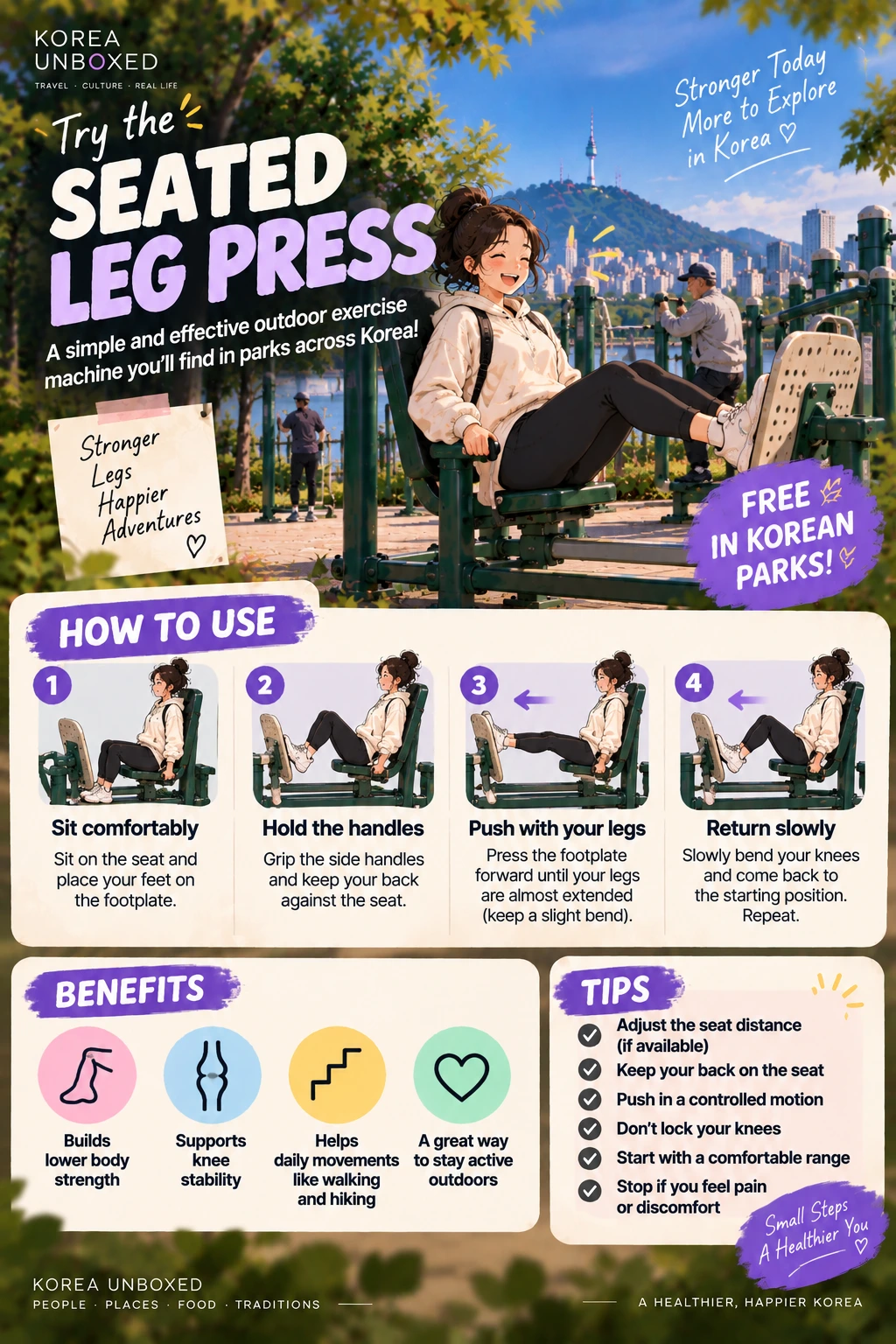
4. The seated leg press
This looks closer to familiar gym equipment: a seat, a foot support, and a pushing movement. On one common outdoor design, extending the legs moves the seat away from the frame. Other models use different mechanisms or adjustable resistance.
Before sitting down, identify what moves and how to get in and out. Check the starting resistance where adjustment is available.
Don’t assume “public park” means “light enough for everyone.” If the seat, foot position, or movement does not fit you comfortably, choose something else rather than improvising a position.
The seated leg press is where a Korean outdoor gym starts to feel much more like a conventional gym.
You sit down, place your feet against a platform, and push using the muscles of the hips and legs.
Lower-body strength matters for very ordinary things: stairs, hills, standing up from a chair, carrying luggage, and walking for long periods.
And some of Seoul’s newer park equipment is not especially light. The city says its newer Hangang Gym lower-body machines can offer resistance from roughly 20 to 130 kg, depending on the station.
Why you might care: walking is easy to do in a park, but resistance training is harder without equipment. A leg press adds that missing piece.
Best use: controlled repetitions using a resistance and range you can manage comfortably.
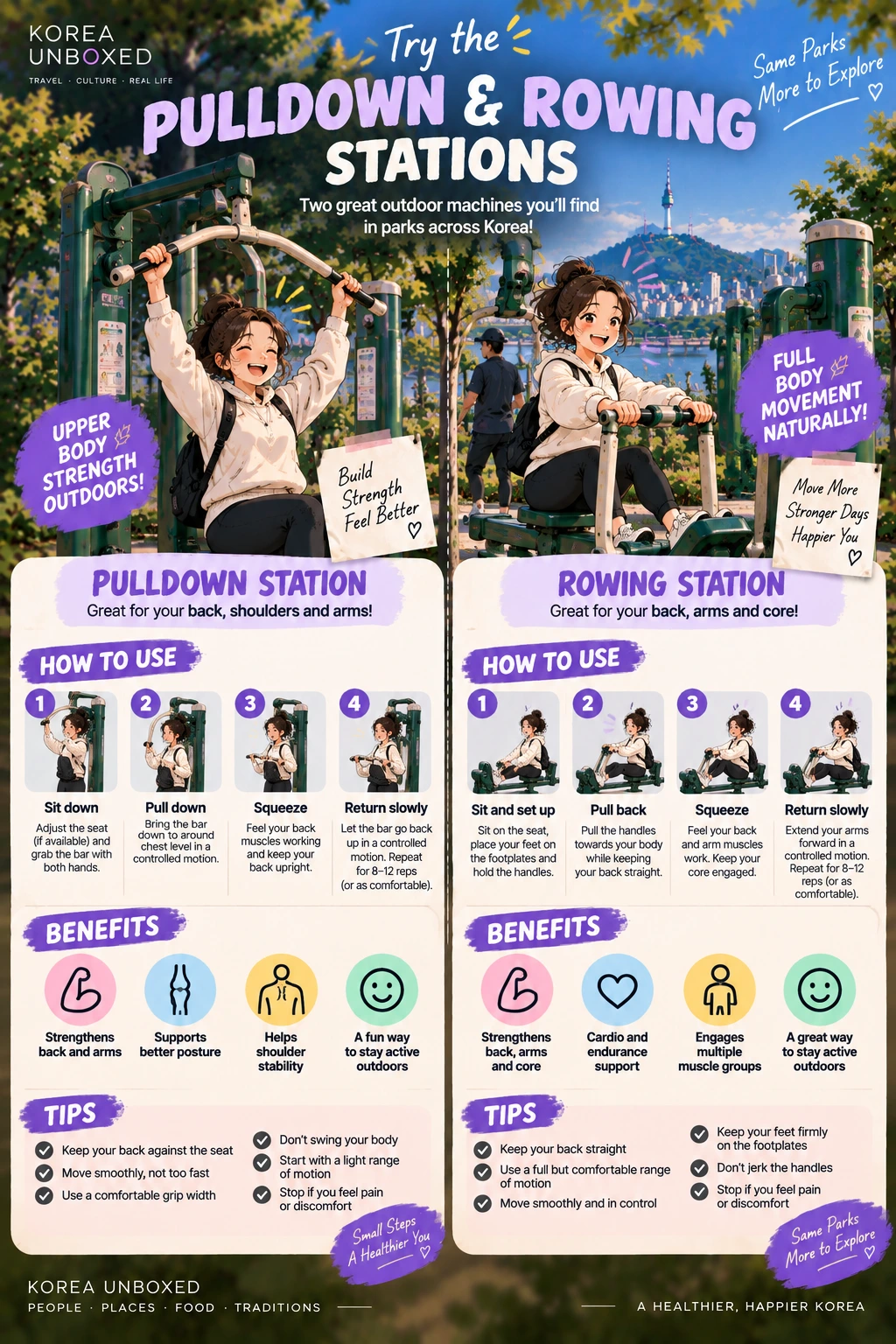
5. Pulldown and rowing stations
Pulldown equipment involves bringing handles down from overhead; rowing equipment involves a pulling movement toward the body. They belong in the strength-training conversation rather than being mistaken for decorative park furniture. Seoul’s coverage of its Hangang gyms shows both equipment types.
Watch out for shared frames with different exercises on opposite sides. A manufacturer’s pulldown and chest-press combination, for example, has a pulling station and a pushing station. Read the label (or use a translation app) for the seat you are using, not just the name on the other side.
Walking, running, and cycling are easy to do outdoors. Training the muscles used for pulling is much harder without something to pull against.
That is why pulldown and rowing machines are useful additions to a public gym.
A pulldown brings resistance downward from above. A rowing station brings the handles toward your body. Both train muscles through the back and arms, while also requiring control around the shoulders.
Seoul specifically includes pulldown and horizontal-row equipment in its newer Hangang Gym installations.
Why you might care: these machines add genuine upper-body resistance training to a park environment where most natural activity focuses on the legs.
Best use: smooth pulling motions without jerking or swinging the torso.
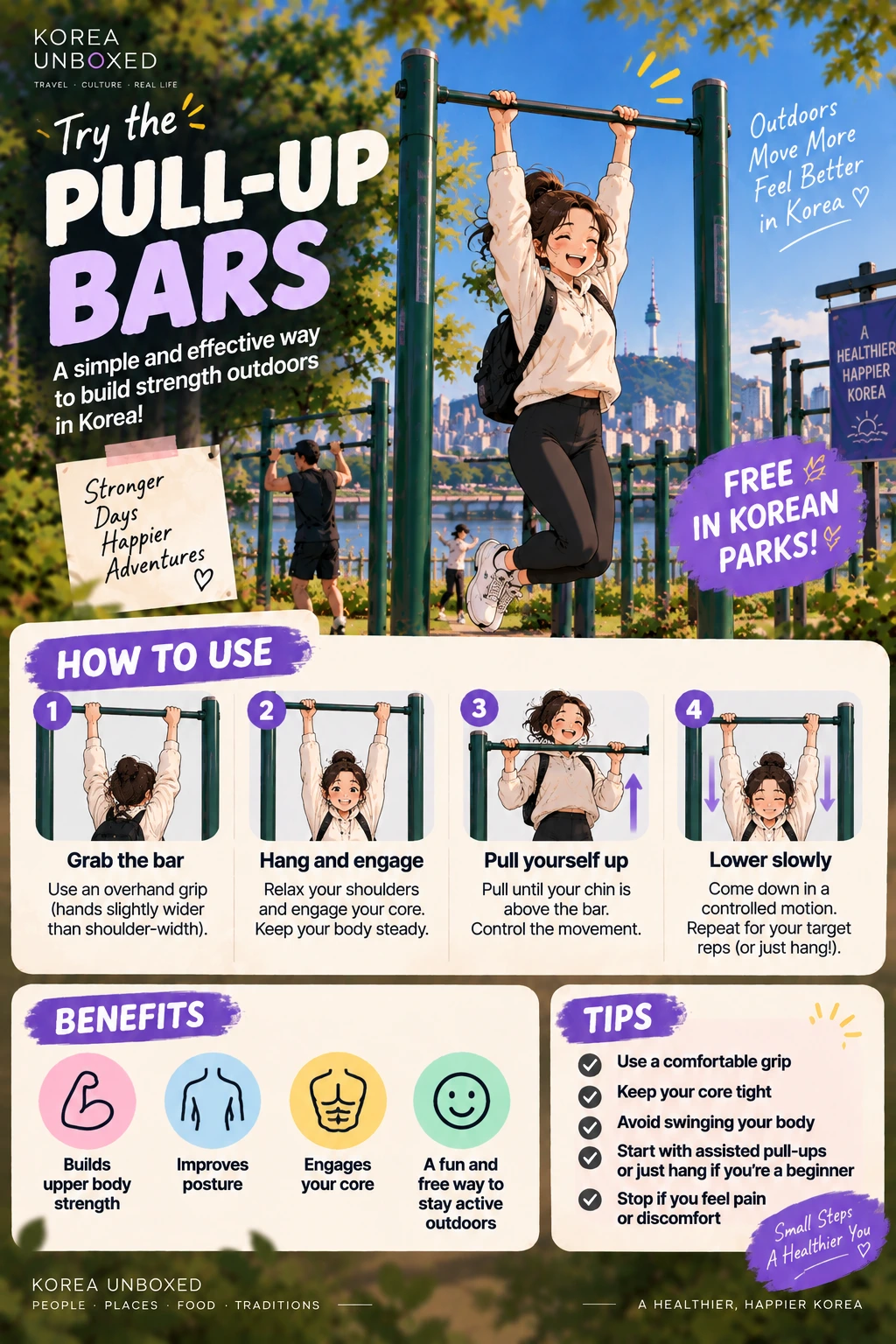
6. Pull-up bars and bodyweight rigs
Sometimes the simplest-looking equipment offers the biggest challenge. Seoul’s Hangang Gym installations include rigs intended for movements such as pull-ups and hanging, alongside other bodyweight exercises.
A bar is not automatically a beginner station because it has no weight selector. Choose an exercise you already understand and a bar you can access and leave under control.
Pull-up bars may be the simplest-looking equipment in the entire park, but that does not make them easy.
They allow bodyweight movements such as pull-ups and hanging, while larger rigs may support several different exercises.
Seoul’s newer outdoor gyms include bodyweight structures alongside machine-based equipment, giving more experienced users something substantially more challenging than stretching stations.
Why you might care: a pull-up requires very little equipment but trains a lot at once, including the back, arms, grip, and trunk.
The catch is that moving your own body weight can be harder than using a light machine.
Best use: movements you already understand. Beginners can start with supported variations or simply choose another station.
There is no requirement to do a pull-up just because one exists beside the walking path.
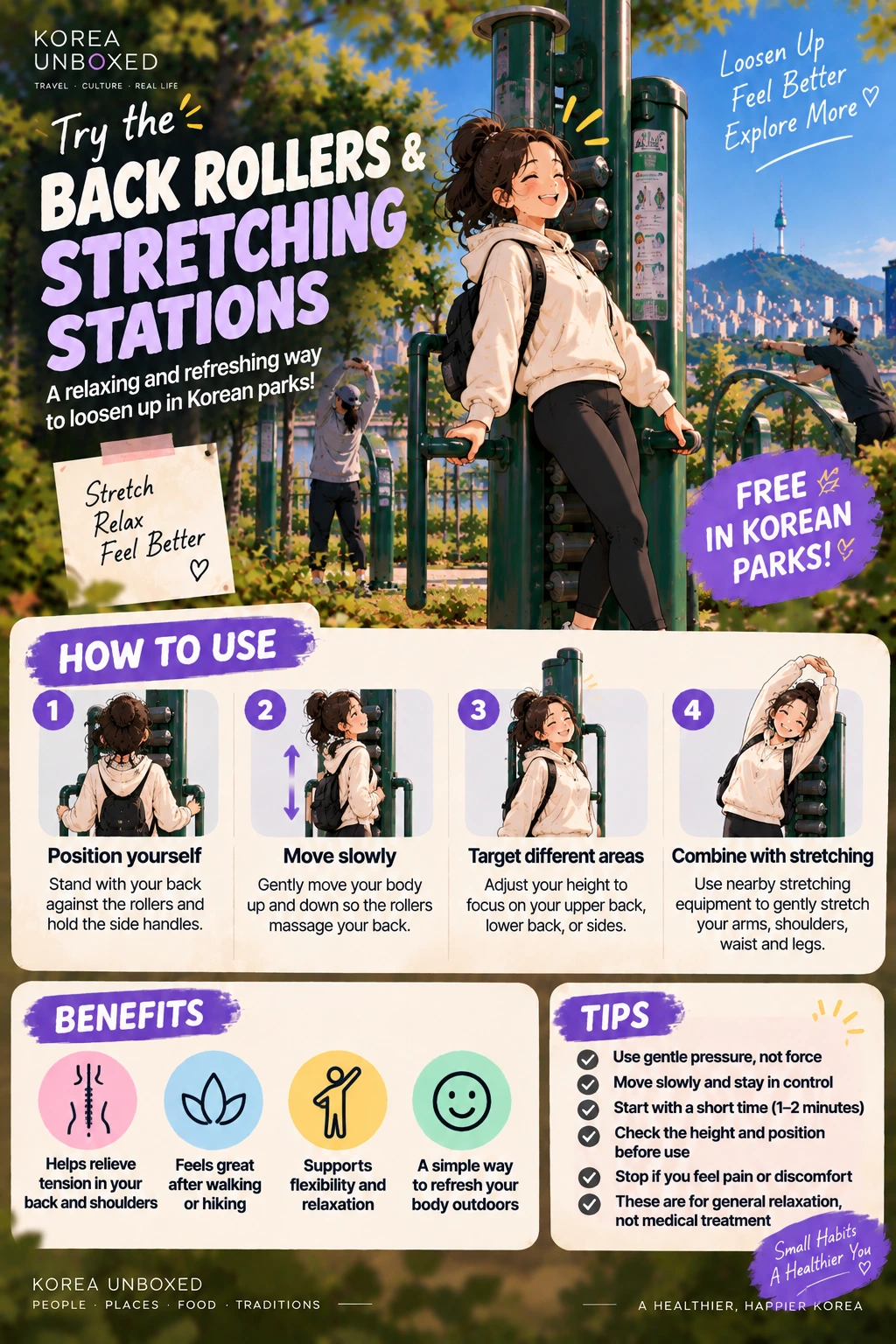
7. Back rollers and stretching stations
The mysterious frame with rollers may be a back-massage device rather than a strength machine. A Korean manufacturer’s back-and-waist roller design, for example, is intended for contact with the back while the user holds the supports and moves against the rollers.
This is exactly where guessing is a bad strategy. Read the diagram, identify the contact points, and don’t assume a roller belongs against your neck.
Not every machine is supposed to make you stronger or leave you out of breath.
Back rollers, stretching frames, and similar equipment give people a way to slow down, move gently, and spend a few extra minutes on mobility before or after walking.
This fits the history of Korean outdoor gyms quite well. Seoul notes that many older public fitness areas focused heavily on light stretching and accessible exercise, while newer facilities are adding more strength-training options.
Why you might care: these stations make the outdoor gym approachable even for someone who has no interest in doing pull-ups or heavy leg presses.
A roller may also simply feel pleasant after walking.
But keep the claims modest. A park roller is not a treatment for back pain, an injury, or a spinal problem.
Best use: gentle movement and relaxation, using the machine only as its instructions show.
Read the instructions before copying the regulars
Start with the machine’s diagram, intended user position, and any age, height, or other restrictions. Seoul’s Hangang Gym equipment also has QR-linked instructions, described in the city’s guide to the facilities.
When a label is in Korean, a translation app can help you read it. Our Korea travel apps guide is a useful starting point. But a translation is not a substitute for understanding the movement. If the instructions remain unclear, skip that station.
Check for visible damage, unstable parts, and slippery surfaces. Leave taped-off equipment alone, and avoid using a machine when its grips or seat are too hot to touch comfortably. Keep bags and loose clothing away from moving parts.
Start gradually, wear suitable shoes, and stop if exercise causes pain. MedlinePlus’s injury-prevention guidance emphasises appropriate equipment, correct form, and not doing too much too soon. If an injury or health condition affects your exercise choices, get advice from a qualified health professional rather than using this article as a personal workout prescription.
Do these machines actually count as exercise?
They can, but they do different jobs. Turning an unloaded wheel and using a resistance machine are not interchangeable just because both happen in the same park.
The World Health Organization’s physical-activity guidance emphasises that activity counts and that some is better than none. That supports making room for movement; it does not prove that every outdoor machine produces the same result.
Choose according to your goal. For a little movement during a walk, you do not need to complete every station. For structured strength training, look for suitable resistance, clear instructions, and equipment that fits you.
An indoor gym may still suit your needs better. Our guide to how Korean gyms actually work covers that different experience.
The real benefit may be convenience
The clever part of Korea’s outdoor gyms is not that every machine is revolutionary.
It is that the equipment is already there.
You can walk through the park, use two or three stations for a few minutes, and continue with your day. There is no membership, changing room, or separate trip to the gym.
Studies of outdoor fitness areas repeatedly identify free access, convenience, regular physical activity, and social interaction as reasons people use them. A recent systematic review also found outdoor-fitness programs can contribute to improvements in physical activity, strength, cardiovascular fitness, and balance, although results vary depending on the equipment and program.
So the machines do not need to be magical.
They just make movement easier to fit into everyday life.
Then continue into the existing “Read the instructions before copying the regulars” section.
Where to try an outdoor gym in Seoul
These are starting points, not promises that every machine will be available on your visit. Check park notices and the equipment’s condition when you arrive.
Gangseo Hangang Park
The dedicated Hangang Gym is in the family picnic area near the southern end of Banghwa Bridge. Seoul’s official announcement lists equipment including a shoulder press, pulldown, leg press, and bodyweight rig.
Search 강서한강공원 in your map app, then locate the fitness area. Don’t navigate only to the park’s main pin and expect every facility to be beside it.
Gwangnaru Hangang Park
Look near the southern end of Gwangjin Bridge, in front of the water-rescue station. The city’s published guide identifies this location and equipment including strength-training stations.
Search 광나루한강공원, then check the gym’s position before choosing your route. We would combine it with time in the park rather than travel across the city solely to try one particular machine.
Boramae Park
For a broader neighbourhood-park outing, Boramae Park’s official facilities page lists 28 types of outdoor exercise equipment, including parallel bars. It also provides access information for Boramae Park Station on the Sillim Line.
Search 보라매공원. Use the park map to find the exercise areas, and check separate arrangements for any courts or other facilities you plan to use.
Make your first visit simple
We would treat the first visit as a chance to get familiar with the equipment, not a compulsory full workout.
Start with an easy walk. MedlinePlus recommends a gradual warm-up before more demanding exercise. Then look around, read the instructions, and choose one or two stations whose movement you understand and that suit your ability.
Keep it comfortable and finish with another walk. No target number of machines, no race against the person beside you, and no need to compensate for yesterday’s dinner.
Share the space, too. Wait your turn, keep belongings off unused stations, and take a longer rest on a bench when someone is waiting. Don’t turn someone else’s everyday exercise into content without their permission.
Travelling with children? Check the posted user restrictions instead of treating moving exercise equipment as a playground. For everyone, the simplest rule is the same: an open space is not an invitation to invent a new use for the machinery.
A small Korea lifehack worth knowing
Not every useful travel discovery needs a ticket, reservation, or carefully planned excursion.
Find a park near where you are staying, bring water and suitable shoes, and leave yourself time to understand the equipment. Some visits might become a short workout. Others might simply be a walk with a new appreciation for the neighbourhood.
Either way, you can stop wondering whether that giant wheel is a piece of public art.
Sources checked: September 19, 2026. Equipment designs, access arrangements, and maintenance conditions vary. This is a general visitor guide, not personalised exercise or rehabilitation advice.
Sources and further reading
Seoul’s Hangang Gym announcement · Hangang gym locations and equipment · Boramae Park facilities · Korean outdoor-fitness research · Exercise injury prevention. Equipment-specific manufacturer examples are linked in the relevant sections.