
You found a place, checked the paperwork, signed the contract, and received the keys. Good work. The hard part is over, right?
Almost.
In Korea, the signed contract creates the deal, but a few steps after signing help build the safety net around your deposit. They are not glamorous. Nobody has ever taken a celebratory selfie with a fixed-date stamp. Still, this is the paperwork you will be very glad you completed if the landlord sells the property, runs into debt, or cannot return your money on time.
Think of the process like fitting several strong bolts to a gate. Possession, address reporting, a fixed date, lease reporting, and a return guarantee do different jobs. One bolt cannot replace all the others.

First, Take Possession and Report Your New Address
Korean tenant protection starts with more than a signature. Under Article 3 of the Housing Lease Protection Act, the basic conditions for asserting a residential lease against certain third parties are possession of the home and the legally recognized address registration.
For a registered foreign resident, Article 88-2 of the Immigration Act provides that foreigner registration and the change-of-place-of-stay report take the place of Korean resident registration and a Korean move-in report.
Possession sounds grander than it is. In ordinary life, it means the home has actually been handed over to you. You have the keys and can live there. A contract for an apartment you have not yet received is not the same thing.
Registered foreign residents must normally report a change in place of stay within 15 days after moving. You can generally apply online or visit the immigration office or local government office responsible for the new address.
HiKorea’s change-of-address guidance lists a passport, Residence Card, reporting form, and proof of residence. Confirm the current documents for your application route. Older guides often call the Residence Card an ARC, or Alien Registration Card.
Fifteen days is the legal reporting window, not a good reason to wait fourteen days. For deposit protection, earlier is better. Try to report the address on the day you move in or on the next working day.
Use the exact legal address shown on the contract and property records, including the correct floor and unit. When your Korean reading is limited, ask the agent to send the full address as copyable text and have the official compare it with the lease. A small-looking unit-number mistake can create a large headache later.
Once possession and the recognized address requirement are both complete, the lease’s basic third-party effect, called opposability, begins on the following day. Korean courts interpret that as midnight at the start of the next day.
In plain English, this can help you assert the lease even when the property is later transferred to a new owner. It does not mean a government office has guaranteed repayment of the deposit.
That next-day timing is one reason the final property-registry check before paying the balance matters. A new mortgage registered before your protection takes effect may still get ahead of you. The gate is not fully bolted until the timing lines up.
Next, Get a Fixed Date on the Lease
A fixed date, called hwakjeong ilja in Korean, is an officially recognized date attached to the lease document.
It is not simply the date printed next to your signature. It proves that the lease document existed by the officially recorded date.
You can obtain a fixed date from the local community service center, an authorized local government or registry office, or a notary. Confirm identification requirements and the current fee with the office handling the application.
You do not have to wait until move-in day to obtain the fixed date. Once the signed lease is complete, getting it early is usually sensible. However, the date does its important work together with possession and address reporting.
When those conditions and the fixed date are all in place, the tenant can gain a priority repayment right.
When the home is later sold through an auction or public sale, this gives the tenant priority over creditors whose rights came later.
The important word is later.
A fixed date does not jump you ahead of every earlier mortgage, tax claim, or senior tenant. It also cannot create money when the property sells for too little.
A useful way to remember it is this:
A fixed date gives you a numbered place in line. It does not fill the cash register at the front of that line.
Housing Lease Reporting: Deadline, Thresholds, and Fixed Date
Korea also has a housing lease contract reporting system. This is a record of the rental transaction, not an immigration address change.
In the areas covered by the system, a new residential lease generally has to be reported within 30 days of signing the contract when either:
The deposit is over ₩60 million, or the monthly rent is over ₩300,000.
Coverage follows Article 4-3 of the reporting decree and includes special self-governing cities and provinces, cities, autonomous districts, and counties within metropolitan cities or Gyeonggi-do. Confirm coverage for the property’s municipality. Renewals with no change to the deposit or rent are excluded.
The report can be submitted through the Real Estate Transaction Management System or at the community service center responsible for the property’s location.
Under Article 6-5 of the Real Estate Transaction Reporting Act, a fixed date is deemed granted when the lease report has been accepted with the contract submitted. Keep the acceptance certificate and check the recorded date; starting an online form is not the same as completing the report.
That is convenient, but it creates a common misunderstanding.
Filing the housing lease report does not by itself complete the foreign-resident address change. Some procedures can be combined or legally treated as completing another report, so ask the receiving office to confirm which filings were accepted and keep proof of each. Do not assume that an address update alone completed every housing procedure.
Treat them as two separate drawers in the same cabinet. Open both when they apply, and keep the receipt or confirmation from each one.
When the landlord or agent says, “We handled everything,” ask to see exactly what was filed and when.
Consider a Deposit-Return Guarantee
The legal protections above mainly determine whether your lease can be asserted against other people and where you stand in the repayment line.
A deposit-return guarantee adds a different kind of protection.
Under an approved guarantee, the guarantee institution may pay the covered deposit when the landlord fails to return it, subject to the product terms and claim process. This is closer to an insurance-style safety net.
It does not make a risky property healthy, and approval is not automatic.
HUG, the Korea Housing and Urban Guarantee Corporation, offers deposit-return guarantees subject to property, contract, and applicant requirements. Start with its official application channels to check the route available for your lease.
Before signing, ask the provider to confirm the current deposit ceiling, eligible property types, application deadline, and required residence documents for your case.
The application and claim deadlines are part of the product terms. Ask for them in writing and gather the signed lease, fixed-date evidence, payment records, and the residence documents the provider requires.
Do not postpone the eligibility check until you have already paid a large deposit.
A guarantee review can uncover a value problem, excessive debt, an ineligible building type, a document mismatch, or an issue involving the landlord. Start the conversation early, while there is still time to collect documents and solve ordinary paperwork problems.
Foreign renters also need to ask about the exact provider and product, not just “deposit insurance” in general.
For HUG, ask the branch or an authorized application channel to confirm the documents and route available for your nationality and registration status. An online identity-verification problem and a product-eligibility decision are different issues.
HF’s general Jeonse Keeper Guarantee is linked to HF-backed jeonse financing through a participating bank. Its current guidance requires an eligible existing HF jeonse loan guarantee or a simultaneous application whose loan is actually executed. Ask that bank to confirm nationality, residence, property, and loan eligibility together.
That difference is easy to miss, especially when several products are casually called “jeonse insurance” in conversation.
Your nationality, residence status, property type, deposit amount, landlord, and loan arrangement can all affect which route is open.
A rejected guarantee application does not automatically prove fraud. It does tell you that something failed the provider’s rules.
Smoke does not always mean the barn is burning, but a sensible farmer still goes outside and checks.
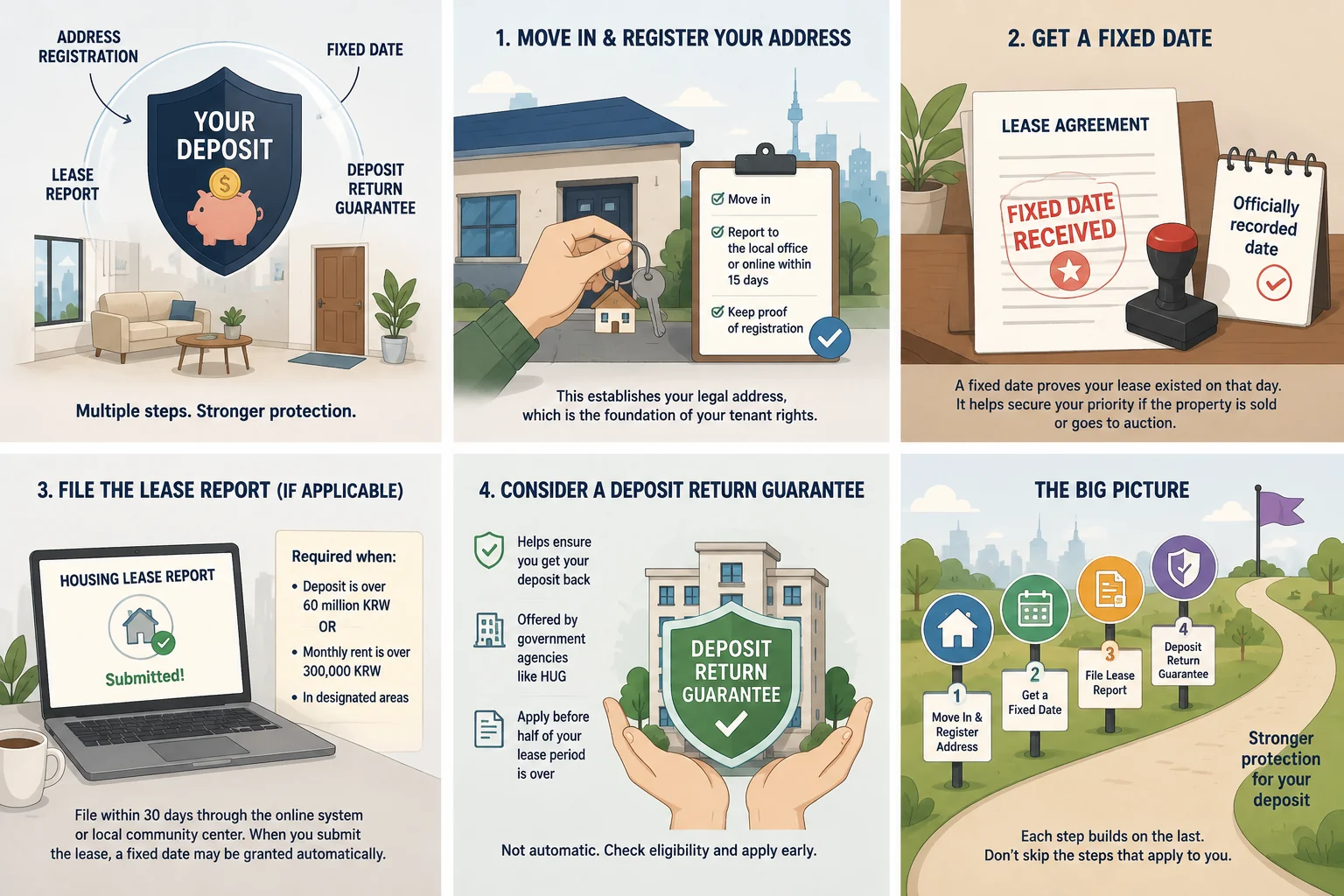
The Practical Order That Makes Sense
Before paying the final balance, repeat the registry checks in the pre-deposit apartment guide. Make sure the signed lease matches the contract details you verified.
On move-in day, receive the keys and take actual possession. Then complete the foreigner address report and obtain a fixed date as quickly as possible.
When the housing lease report applies, submit it within 30 days of contract signing, even if move-in is later. Confirm acceptance. Begin any guarantee application early and follow the provider’s application deadline; the lease midpoint is a product condition, not a general statutory deadline.
Keep digital copies of the signed contract, payment records, property registry, address-report confirmation, lease-report certificate, fixed-date proof, and guarantee certificate.
Give the files clear English names. “final_final_house_document2.jpg” is not a filing system, no matter how hopeful the name sounds.
The rhythm is easy to remember:
Keys, address, fixed date, lease report, guarantee.
Not every lease needs every procedure, and not every tenant will qualify for a guarantee. The point is to check each one deliberately rather than assuming that someone else took care of it.
What If You Are Still Waiting for Your Residence Card?
A newcomer may be able to sign a lease using a passport when the landlord agrees, but that does not mean the normal foreigner address-protection route is already complete.
Someone waiting for initial foreigner registration may face a period in which the contract exists but the usual change-of-place-of-stay procedure is not yet available.
For a small temporary rental, that may be a manageable practical issue. For a very large deposit, it deserves attention before the balance is paid.
Ask the Immigration Contact Center at 1345 how your registration timing affects the address report, and ask the intended guarantee provider what documents it will require. The 1345 service provides multilingual immigration counseling.
This guide also assumes that you signed the lease personally. When an employer or another company is the named tenant, the legal protection structure can be different and should be reviewed separately.
What These Steps Cannot Repair
A fixed date cannot repair a fake owner.
Address reporting cannot make an overpriced property worth more.
A lease report cannot erase a senior mortgage.
A guarantee cannot help when you never qualified, missed the deadline, or breached an important condition.
That is why this article comes after the property-checking guide. The checks before signing and the protections after signing are two halves of the same job.
The good news is that you do not need fluent Korean or a law degree to handle the basics. You need the correct address, reliable translation, official confirmations, and enough patience to finish the paperwork before life gets busy.
One quiet afternoon spent sorting it out can protect money that took years to save. That is a fair trade.
At key handover: Use the day-one apartment inspection guide to document the home’s condition while you complete the paperwork.
For the complete renting sequence and other everyday essentials, visit the Korea Knowledge Catalogue’s housing guide.
Sources and Further Reading
Content reviewed: September 10, 2026. Check the linked official guidance before signing, transferring money, or submitting an application.
Housing Lease Protection Act: Articles 3 and 3-2 cover opposability and priority repayment; Article 3-6 covers fixed dates (Korean).
Immigration Act: Articles 36 and 88-2 cover address reporting and its relationship with Korean resident registration (Korean).
HiKorea: change-of-place-of-stay reporting: Official reporting instructions and document guidance (Korean).
Real Estate Transaction Reporting Act: Articles 6-2 and 6-5 cover the reporting deadline and fixed-date treatment (Korean).
Real Estate Transaction Reporting Enforcement Decree: Article 4-3 specifies the financial thresholds and covered areas (Korean).
HUG: authorized guarantee application channels: Start with HUG or a participating bank to confirm current product rules and foreign-applicant documents (Korean).
HF: general Jeonse Keeper Guarantee: Current eligibility, required financing, application timing, and claim conditions (Korean).