
Renting in Korea, Part 7 · Sources checked: September 10, 2026
You open a rental app, find a promising place, and notice it is called an “officetel.” The next listing is a “villa,” although there is no swimming pool in sight. Then “one-room” appears alongside both.
Korean housing labels become much easier to use once you separate the building from the home inside it. That small distinction can save you a lot of unsuitable viewings.
Summary
An apartment usually means a home in an apartment building or complex. An officetel is a building type that accommodates office and residential uses. A villa usually means a smaller, low-rise residential building. A one-room describes a studio-style layout, so it can overlap with the other labels. Compare the actual floor plan, private floor area, total monthly costs and building condition before deciding which suits you.
First, separate the building, layout and payment method
Imagine a listing described as a “one-room officetel on wolse.” Those words answer three different questions: the building is an officetel, the unit has a studio layout, and the rental arrangement involves monthly rent.
Jeonse and wolse describe how you pay. They do not tell you whether the home is in a tower or a small brick building. Our jeonse-versus-wolse guide explains the deposit and rent arrangements. Here, we are choosing the kind of space you want to live in.
These descriptions are useful search filters. They are not a complete account of a property's registered use, ownership, condition or contract terms.
Apartments: a home within a larger building or complex
In everyday Korean conversation, an apartment, written 아파트 and pronounced roughly “ah-pah-teu,” often means a unit in one of the residential buildings you see across Korean city skylines. Larger developments group several buildings around shared paths, parking and facilities.
For a household that wants separate bedrooms and an established building-management contact, this can be a useful place to start. Some complexes have playgrounds, landscaped areas or community facilities. Check what actually exists, whether residents can use it, and whether any charges apply.
The building's reputation does not answer every question about the unit. A renovated kitchen tells you little about upstairs noise, winter drafts or the elevator queue when everyone leaves for work. Visit the exact home you would rent, including its entrance and the route from the street.
Also check the appliance inventory early. A fitted kitchen does not necessarily mean the refrigerator, washing machine, bed or air conditioner belongs to the landlord or stays with the apartment. If you are arriving with two suitcases, furnishing an otherwise suitable home can change your move-in budget substantially.
Apartments are worth comparing when your priorities include room separation, longer-term comfort and shared building management. The individual building still has to earn its place on your shortlist.
Officetels: convenient layouts, with details to check
An officetel, written 오피스텔, takes its name from “office” and “hotel.” In Korea, the term refers to a building type associated with both working and living. The name alone does not mean you are booking hotel accommodation, daily housekeeping or a short stay.
Many residential listings feature compact studios with built-in storage and appliances. Larger layouts and separate bedrooms also exist, so avoid treating “officetel” as another word for a tiny room.
This option can suit someone who wants a manageable home near their daily destinations. But convenience has several parts. Check the actual walk to the station, the elevator, parcel arrangements, and whether surrounding shops or restaurants create evening noise.
Pay particular attention to management charges and how heating, cooling and electricity are billed. Request recent bills with personal information removed. Ask which charges are fixed, which depend on usage, and whether parking or internet costs extra. A polished lobby can be attractive, but you should know what maintaining it costs you.
Finally, have the exact unit's intended residential use and address-reporting arrangements checked before signing. If the agent or landlord says you cannot report your address there, get qualified advice about that specific arrangement. A bed in a listing photograph cannot settle the paperwork.
Villas: smaller residential buildings with plenty of variation
A Korean villa, written 빌라, usually means a home in a low-rise residential building. Set aside the holiday-home picture the English word might suggest. In a Korean neighborhood, a villa may be an ordinary brick or stone-faced building with several households sharing an entrance.

The appeal may be the layout: a separate bedroom, a more useful kitchen, or space for a proper desk within your budget. Compare current listings in the same area before assuming a villa will always be cheaper or larger than an officetel.
Management arrangements deserve a direct conversation. Who handles a leaking common-area pipe? Who cleans the stairs? Where do deliveries and recycling go? Is there an elevator, and can you use the advertised parking space without coordinating with other drivers?
“Villa” is also a broad everyday label. Have the actual building register and ownership records explained, rather than expecting the marketing name to identify the legal category. The guide to checking a property before paying a deposit covers that next step.
A well-maintained villa can be a comfortable home. An appealing interior should still be considered alongside the shared entrance, exterior walls, windows and repair arrangements.
One-rooms: a layout, not a separate kind of building
A one-room, written 원룸, normally means a studio: the main living and sleeping functions share one room, usually with a kitchenette and a separate bathroom. It does not mean a one-bedroom home with a distinct living room.
You may find a one-room in an officetel or a small residential building. That is why asking “officetel or one-room?” can produce confusing answers. One describes the building category; the other describes how the unit is arranged.
For solo living, a studio can keep cleaning and furnishing straightforward. The tradeoff becomes clearer when you imagine an ordinary evening. Where will you eat, work, dry laundry and store an open suitcase? Can you cook while keeping bedding away from splashes and smells?
A listing may describe a partitioned studio, a “1.5-room,” or a loft layout. Treat those as invitations to inspect the floor plan. A sliding divider or raised sleeping platform may not provide the separation you expect from a bedroom. For a loft, check headroom, stairs and how warm the upper area feels.
The same applies to “full-option,” a phrase used for included equipment. Ask for an itemized list. A refrigerator, washing machine and air conditioner do not automatically add up to a furnished home with a mattress, desk, curtains and cooking equipment.
Compare private floor area before comparing size labels
You will hear pyeong, written 평, when people discuss housing size. One pyeong is approximately 3.3 square meters, or 35.6 square feet. The conversion is easy; understanding which area is being measured matters more.
Ask for the unit's exclusive-use area, written 전용면적, in square meters. This is the private area used to compare units, rather than a headline figure that may also account for shared parts of the building. Ask separately what balconies, storage areas or lofts are included in the stated measurements.
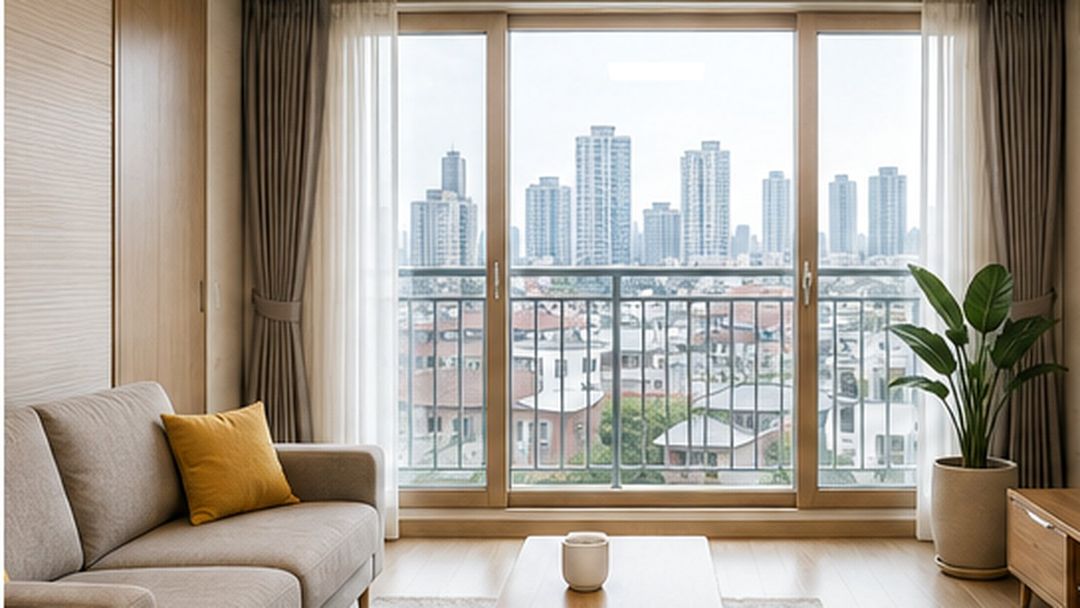
For example, a hypothetical listing showing 40 square meters overall and 24 square meters of exclusive-use area should not be compared with a 40-square-meter private interior. Put the private-area figures beside each other first.
Then measure the places that matter to you. A long entrance corridor uses space differently from a rectangular room. Check whether your bed fits without blocking the wardrobe and whether there is room to pull a chair away from the desk.
Work out the monthly cost beyond rent
Management fees, written 관리비, need their own line in your budget. Ask exactly what they cover and what comes separately. Korea's official Easy Law home-search guidance specifically recommends checking management costs before choosing a property.
Here is a hypothetical comparison: a home advertised at ₩700,000 rent plus ₩180,000 in management charges starts at ₩880,000 before any excluded bills. Another at ₩780,000 plus ₩60,000 starts at ₩840,000. The lower rent has not produced the lower subtotal. Neither example is a market-price estimate.
Request the fee breakdown in writing, then add utilities, internet, parking and any other recurring charges that apply. Check summer and winter bills where available, since one mild-weather month may give you an incomplete picture.
Keep the deposit and one-time moving or furnishing costs separate from this monthly comparison. Our Korean rental-contract guide explains how to record the agreed charges and included items.
Use the viewing to test your daily routine
A housing label cannot tell you how it feels to wake up there. Start with daylight and privacy: look out of the windows, check what faces them, and consider whether you would keep the curtains closed most of the day.
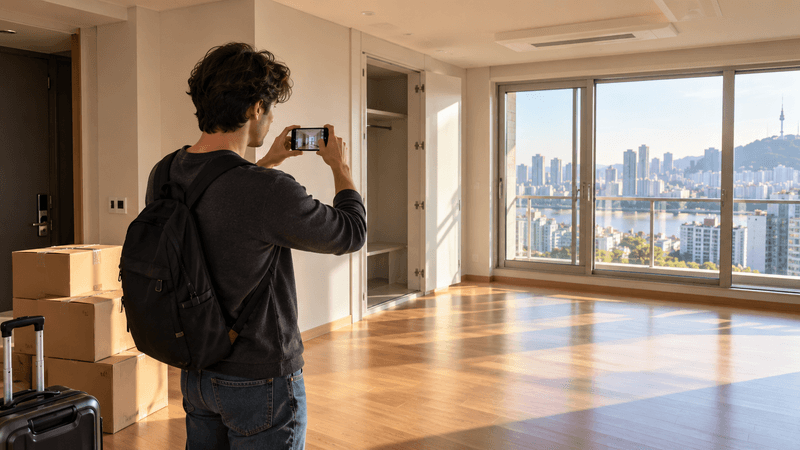
Pause to listen with the windows open and closed. Ask about nearby construction and evening activity. Check ventilation, signs of damp, water pressure and the condition of the heating and cooling equipment. These checks echo the official advice on assessing a home's comfort and repair needs.
Walk the entrance route, too. A few flights of stairs may be fine today, but think about groceries, visitors, luggage or a stroller. For a basement, semi-basement or rooftop unit, make a separate assessment of access, moisture, weather exposure and emergency escape.
Finish with one practical question: “If something stops working after I move in, who should I contact?” Ask for the answer and any promised repairs in writing.
Choose the home that fits how you live
If separate rooms and shared management are high on your list, start by comparing apartments. If a compact home with included appliances would simplify your move, add residential officetels. If you want a different room arrangement or a smaller building, include villas. If one main room suits your routine, search for one-room layouts across those building categories.
Choose your non-negotiables before booking viewings. A real work area, an elevator, pet permission or a sensible commute may matter more to you than the building's label. Give the agent those requirements along with both your deposit limit and monthly budget.
Once a home looks suitable, move to the property checks and deposit-protection guide. The Korea Knowledge Catalogue brings the wider practical guidance together.
The aim is to find a place where your furniture, bills and everyday habits make sense. Knowing the vocabulary helps you ask better questions before you pick up the keys.
Sources and useful resources
Study in Korea: Living and Housing Information, for the distinction between housing and rental arrangements and the recommendation to view a property in person. Easy Law: Finding a Home (Korean), for condition, management-fee and property-record checks.
Cover photo: apartment buildings in Pyeongtaek, South Korea, by Na Inho on Unsplash, used under the Unsplash License. Interior images are illustrative and do not show properties offered for rent.