
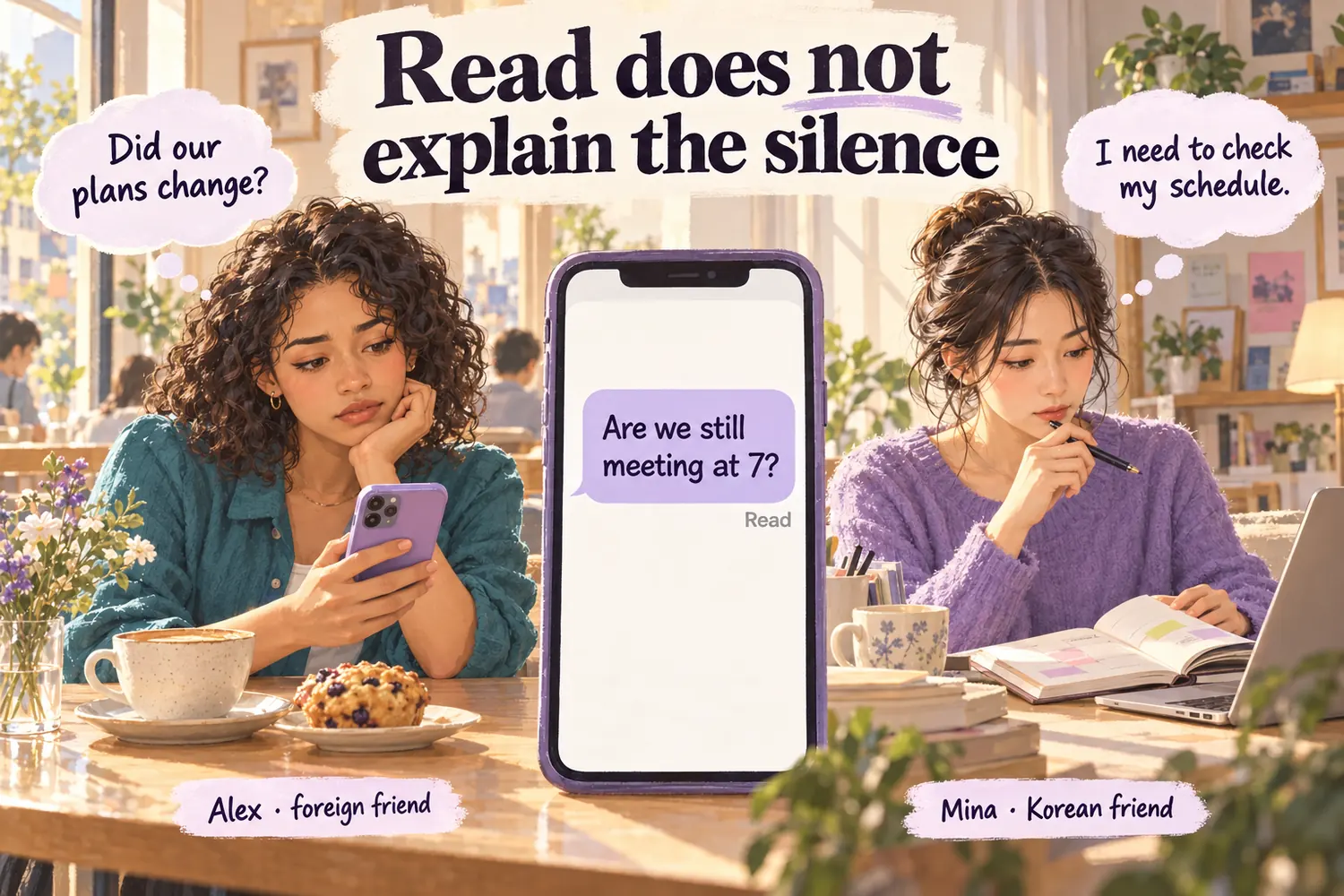
Imagine sending a Korean friend a simple question: “Are we still meeting for dinner?” The message is marked read, but no answer arrives. You start wondering whether the plan has changed, whether you said something awkward, or whether checking again would make you seem pushy.
Leaving someone on read can feel rude in Korea when it leaves an expected answer hanging. But the read receipt alone cannot tell you why the answer has not arrived. The useful questions are what the message needs, whether timing matters, and what these two people normally expect from each other.
Korean communication research helps explain why acknowledgment can matter and why silence can create pressure. It also shows the limits of looking for one national texting rule. Your friend, date, professor, and group chat are different relationships, even when they all use the same app.
What does being left on read actually tell you?
KakaoTalk’s familiar small number makes reading status visible. Yet a visible status gives you only part of the exchange. Someone may have seen a message while changing trains, opened it before a meeting, or wanted time to think before answering.
The reverse can also be misleading. In its September 2025 redesign announcement, Kakao advertised an unread-conversation preview that keeps the “1” in place. That announcement does not establish which features are available on your device today. It does show why an unread indicator cannot reliably prove that someone has seen nothing.
You may hear reading without replying described as 읽씹, roughly “read and ignore.” A National Institute of Korean Language publication defines the behavior as reading a text message without answering. The related term 안읽씹 refers to leaving it unread and unanswered, as explained in Korean reporting on the two expressions.
Those labels can carry the feeling of being ignored. Keep that interpretation separate from the observation: the message has no reply yet. Whether the person deliberately dismissed you is another question.
Why can a small reply matter in Korean chats?
A reply can do more than deliver information. A laugh, a sticker, or a brief acknowledgment can show that someone is participating in the relationship. If that is how you and a friend usually stay connected, its absence can feel like distance.
In a 2018 study of one KakaoTalk group involving five young Korean women, Hanwool Choe examined how short responses, laughter, and stickers displayed listenership. A 2021 experiment using simulated KakaoTalk group conversations associated socially connective messages with stronger perceived connection and solidarity.
These studies help explain the social work of small messages. They do not establish how quickly every Korean expects a reply. In a relationship where answering means “I’m here with you,” a silent screen can feel different from how it feels to someone who mainly texts to exchange practical information.
That is a useful starting point for understanding hurt feelings without describing Koreans as unusually needy or foreigners as unusually distant. People can have different expectations about attentiveness, including people from the same country.
Why reading a message can create pressure
From the sender’s side, a read receipt can make a delay seem like a choice: you saw my message, so why haven’t you answered? From the recipient’s side, answering may mean starting a conversation they cannot sustain right now. Reading takes a moment; a thoughtful reply may take longer.
A 2020 KAIST study involving 11 pairs of friends or couples tested a KakaoTalk-related prototype that shared availability information. The researchers reported reduced pressure around expectations of attention. The study was small, but it points to a practical problem: people can mistake visible phone activity for availability.
A separate 2022 interview study of 25 messaging users examined competing explanations for read messages without replies, including forgetting, being busy, and considering the conversation finished. It was cross-platform research, not a national Korean etiquette survey.
Someone might also be deciding how to decline an invitation or choosing words in a less familiar language. These are possibilities to clarify, not explanations you can confidently assign to a particular person. Sometimes silence really does reflect disengagement. The app cannot settle which explanation applies.
How long is too long to wait?
The research reviewed for this article does not support a Korean rule such as “reply within 30 minutes” or “a next-day answer means they aren’t interested.” A more useful comparison is with the person’s usual pattern and the consequences of waiting.
A 2025 study of 339 US participants used hypothetical messaging situations and found that urgency and previous responsiveness helped predict tolerance for delays. Its US sample and imagined scenarios cannot establish Korean norms. They do reinforce why the same delay can feel different in different circumstances.
A few hours may hardly matter when you have shared a funny video. They matter much more when you are waiting to book a restaurant for that evening. If someone usually replies after work, an afternoon silence tells you less than an unexplained change in an established daily conversation.
Which messages are actually left hanging?
Plans that need confirmation. “Are we meeting at seven?” leaves a practical question open. If a decision is needed, say so: “Can you confirm by six so I can book?” If no answer arrives, you can make another plan without first proving that the person intended to be rude.
A finished conversation. A final “Thanks, see you tomorrow!” may already close the exchange. A meme might be an invitation to laugh together, but it might also be something the sender simply wanted to share. You do not need an endless chain of replies to prove that a conversation ended warmly.
Dating and friendship. An unanswered personal question can feel more exposing than an unanswered joke. Still, one read receipt is a poor measure of affection. Look at the wider pattern: do they follow through on plans, return to conversations, and respond when you explain what matters to you? Repeated uncertainty deserves a direct conversation about communication.
Group chats. A message addressed to everyone may leave each person assuming someone else will answer. A read status does not confirm who has accepted a task. If you need one person’s decision, name them and ask the specific question rather than treating the whole group’s silence as rejection.
Work messages. Agree on the channel, deadline, and expected reply hours. A message read outside those hours should not automatically create a new expectation of immediate work. If something is urgent, state the urgency and use the contact method your team has agreed on.
What gets lost between Korean and English?
Two people can understand every word in a message and still disagree about what it is doing. Is it declining an invitation, acknowledging information, or asking someone to keep the conversation going? Those expectations can travel from a first language into a second one.
Korean honorific forms can signal a relationship in ways that do not translate word for word into English. A 2010 paper on Korean and English translation distinguishes grammatical honorifics from politeness in context. A formally worded sentence and a warmly received sentence are not always the same thing. When translating, consider the respect or warmth the message is trying to convey as well as its literal meaning.
A 2013 study of 69 Korean college students found mismatches between intended and expressed indirectness in English refusal tasks. It does not mean Koreans always refuse indirectly. It shows why a person’s attempt to sound considerate may land differently for another reader.
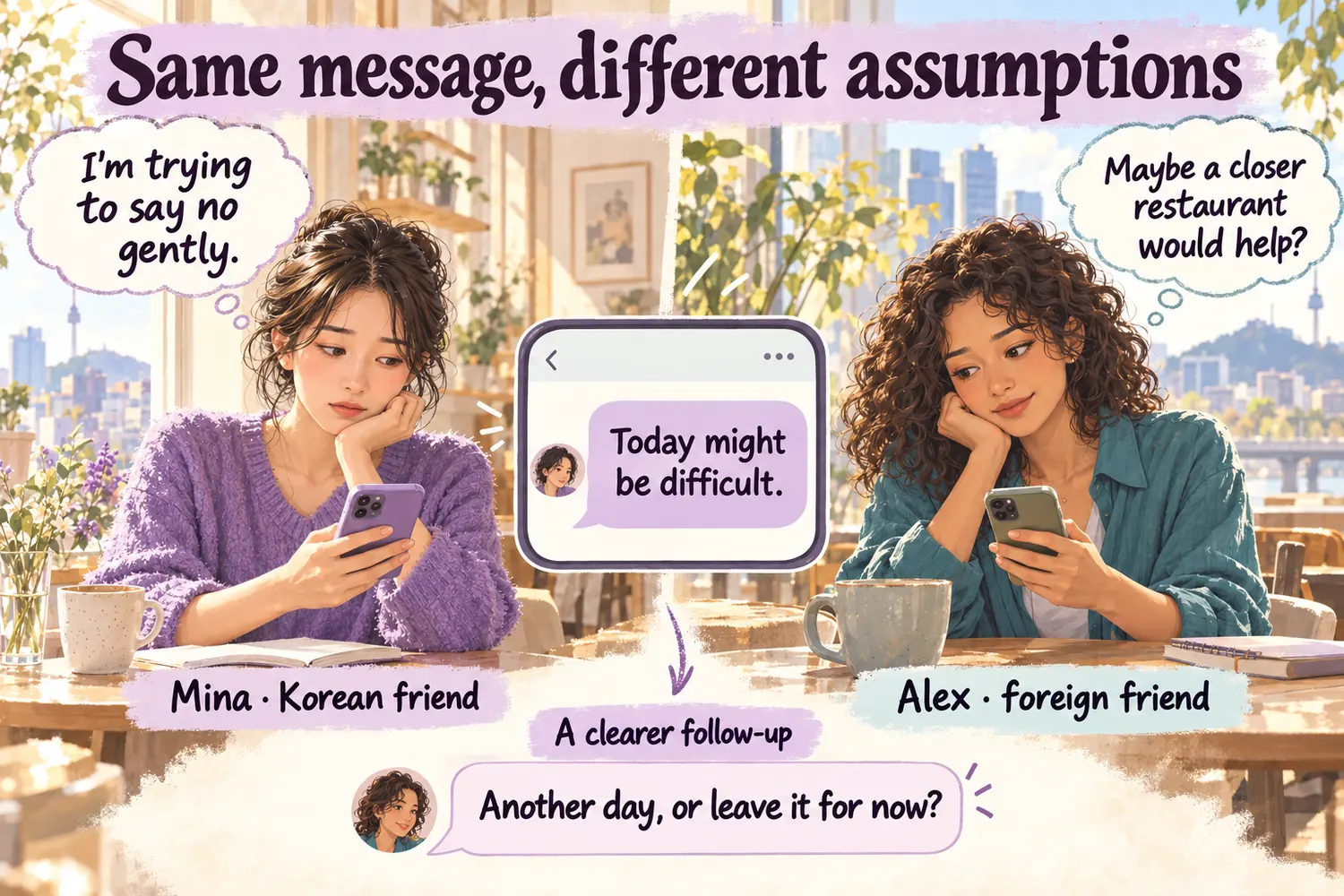
Consider these illustrative examples, not quotations from real chats. “Today might be difficult” could be a softened decline. Another person could hear a scheduling problem they should help solve and suggest a closer restaurant. If the first person thought they had already said no, the follow-up can feel like pressure; if the second thought they were helping, silence can feel confusing. “Would you prefer another day, or should we leave it for now?” makes the choice clearer.
A short “Okay” can also acknowledge that a message arrived without clearly confirming a plan. That ambiguity occurs in English too. When a commitment matters, ask for it directly: “Does that mean Friday works for you?” Neither a translated acknowledgment nor a read receipt should carry more certainty than the conversation provides.
Even expressive punctuation can change the tone. A 2023 study following four Korean students and four exchange students examined four weeks of English KakaoTalk exchanges. Punctuation and emoticons helped express emotion and familiarity. English was their shared language; the exchange students came from Mongolia, Lithuania, Mexico, and Vietnam.
Our invented “Really??!!” might convey excited surprise to one reader and doubt or irritation to another. If the feeling matters, spell it out: “Really? That’s great news!” Familiarity and the surrounding conversation affect interpretation, so there is no universal dictionary of what a punctuation mark means.
Misunderstandings also run in the other direction. A 2021 study of international students’ Korean texts to an instructor identified pragmatic difficulties involving honorifics and question or response forms. That formal setting differs from friendship, but the lesson is useful: correct vocabulary alone does not guarantee the intended social meaning.
What should you say when you cannot reply yet?
When you can manage a brief acknowledgment, it can remove uncertainty without opening a long conversation. Make it specific enough to help: “I saw this. I need to check my schedule and will reply tonight.” Choose a time you can realistically keep, then follow through.
For ordinary routines, a simple explanation can help both people adjust: “I’m often away from my phone during the day.” If longer messages take you more time, you can say that too. You should not have to perform constant availability to prove that you care.
If you are waiting, follow up on the unanswered question. “Can you confirm whether you’re coming?” gives someone a clear task. “Why are you ignoring me?” asks them to defend an intention you have not established. When timing matters, include the reason and a sensible cutoff.

These suggestions apply to relationships you want to maintain. Unwanted contact is different. You can disengage from someone who disregards your boundaries, and you do not owe a reply merely because a message is marked read.
If the same mismatch keeps happening, discuss what each of you needs from the conversation. You might want confirmation when plans depend on it; they might need space to answer after work. Cultural context can help you understand that difference. The relationship still needs an arrangement that works for both people.
When a read receipt leaves you wondering, start with what remains unresolved. A clear question gives the other person something useful to answer and gives you something firmer to act on than a disappearing number.
Reporting note: This article draws on published research and clearly labeled illustrative examples. We did not conduct original interviews or current device tests. Sources checked October 11, 2026.
Sources and further reading
Kakao’s September 2025 redesign announcement: advertised unread preview, rather than a current device test.
National Institute of Korean Language, 2019: definition of 읽씹, footnote 8. Health Chosun reporting, September 2023: reading and nonresponse terms.
Choe, 2018, Type your listenership: one five-person KakaoTalk group. Park, 2021, phatic communication: simulated group exchanges.
KAIST MyButler research, 2020: availability sharing with 11 pairs. Chou and colleagues, CHI 2022: 25 messaging-user interviews.
Büttner and Lutz, 2025: reply-delay judgments in hypothetical situations, 339 US participants.
Kang, 2013: intended indirectness in English refusals. Hwang, 2023: punctuation and emoticons in four English-messaging pairs.
Yun, 2021: international students’ Korean messages to an instructor.
Politeness in Korean and English translation, 2010: honorific grammar and politeness in context.
Korea Unboxed related reading
Are Koreans Rude? Understanding Korean Culture and Social Etiquette explores how intention and perceived politeness can differ.
What Is Nunchi? And Why Foreigners Struggle With It in Korea looks at the role of context in social exchanges.