What Nunchi Actually Is (and What It Isn’t)
People usually explain nunchi as “reading the room,” which sounds simple but ends up being a bit misleading. It makes it seem like you are just picking up on emotions, when in reality it is more about adjusting yourself based on what is happening around you without anyone needing to say anything out loud.
It shows up in small moments. You notice who is speaking and who is holding back, you pick up on a shift in mood even if the conversation has not changed, and you sense what is expected next without being told. The important part is not just noticing these things, but responding to them in a way that fits the situation.
"Good Nunchi" is reading the energy of a social interaction and calibrating to it. It shows mindfulness about others, and helps save time, energy, and face in the right situations.
Why You Don’t Really Notice It at First
Short visits may offer fewer chances to learn a group’s habits, but social cues can matter from the first interaction. You do not need to interpret every one perfectly.
It starts to matter more when you spend longer periods of time in Korean-speaking environments, especially in group settings where there are unspoken expectations. That is usually when people begin to realize that something is happening beneath the surface that they are not fully picking up on.
Scenarios:

The Quiet Dinner Table
Imagine you are out eating with a group. The food arrives, people start eating, and the conversation flows naturally for a while. Then at some point, things slow down. There is a short lull where nobody is really speaking.
If you are not thinking about nunchi, that moment might feel like something that needs to be fixed. You might jump in with a new topic or keep talking just to avoid the silence.
But someone who is more tuned into the situation might read it differently. They might notice that people are getting a bit tired, or that the meal is naturally winding down. Instead of trying to restart the energy, they simply match it. They slow down, let the silence exist for a moment, and allow things to move toward the next phase without forcing it.
Nothing was said out loud, but the adjustment still happens.
The Group Order Situation
Now picture a group ordering food to share. Everyone is looking at the menu, and there is a short window where decisions start getting made.
You can state a preference while noticing the group’s discussion. Important needs, such as allergies, should be explained clearly rather than left to inference.
Someone using nunchi is usually paying attention before speaking. They notice who tends to take the lead, how quickly others are speaking up, and what kind of balance the group is forming. Instead of jumping in immediately, they might wait just a moment longer, then suggest something that fits into what has already been said rather than redirecting it.
It is a small difference, but it changes how smoothly the group decision comes together.
The Workplace Pause
In a work setting, this becomes even more noticeable. Imagine a question is asked during a meeting, and nobody answers right away. There is a brief silence.
Depending on your background, that silence might feel uncomfortable, like something is wrong or missing. The instinct might be to jump in quickly and fill the gap.
But someone more familiar with the environment might interpret that pause differently. It could mean people are thinking, or that there is some hesitation about who should speak first. In some cases, there may be an unspoken expectation that a specific person will answer.
Waiting briefly can give someone time to think. If the pause leaves a work decision unclear, ask who will respond and when.
The Elevator Moment
You step into an elevator with a few other people. Nobody says anything. Everyone is facing forward.
If you are not thinking about it, you just ride the elevator like you would anywhere else.
But there are small things happening. Someone with nunchi might subtly position themselves closer to the buttons if they entered first, or press and hold the door for someone a step behind without making a big deal out of it. If the elevator is crowded, people adjust their stance to create just enough space for others without drawing attention to it.
It is not about being polite in an obvious way. It is about quietly doing what the situation seems to call for.
Crosswalk Timing
You are waiting at a crosswalk late at night. There are no cars coming.
Follow pedestrian signals and use the crossing safely. This is not merely a question of matching the crowd.
I once treated an empty-looking road as permission to cross. That was not a reliable way to judge either safety or the rules.
Waiting for the signal is the useful practical lesson, even when other people choose differently.
Social observation should never replace traffic rules.
The Café Laptop Situation
You go into a café and sit down with your laptop.
After a while, the space starts filling up. Tables are getting harder to find.
Someone without much awareness might stay exactly as they are for hours, not really caring about the changes around them.
Someone with nunchi starts to pick up on it. They notice people walking around looking for seats, the subtle tension of a full space, the way others are adjusting. Maybe they start wrapping up, or at least make themselves a bit more compact.
Check the café’s posted time limits or minimum order. If you are unsure whether a long stay is welcome, ask staff instead of assuming a silent room means one answer.
Getting on the Subway
The doors open, and people start getting on.
If you are focused on your own movement, you just step in and find a spot.
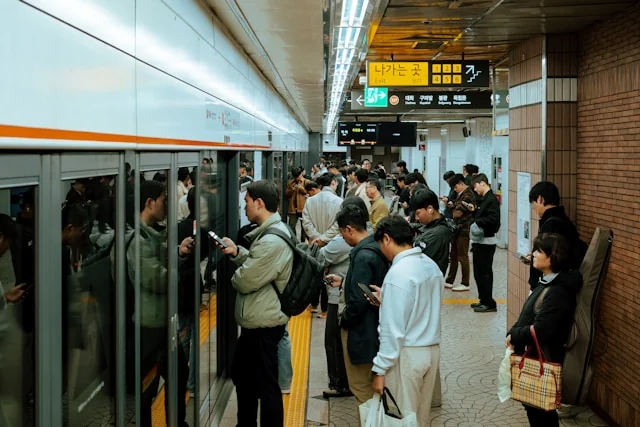
But if you watch closely, there is a flow. People outside step aside first to let others exit. They form lines without being told. Once inside, they shift slightly to make space for the next person, even if it means being a bit uncomfortable.
And trust me, during rush hour, it's very uncomfortable.
Someone with nunchi is constantly adjusting to that flow, even in small ways like where they stand or how they turn their body.
It is not something you think about consciously, but you feel it when someone is out of sync with it.
The “Who Pays” Moment
You are out with someone, and the meal ends. The bill comes.
Groups differ in how they handle the bill. A clear question can avoid a misunderstanding.
Someone with nunchi is already thinking ahead. They might notice who invited whom, the context of the meeting, or previous patterns. Sometimes one person reaches for the bill quickly, almost preemptively. Other times, there is a brief moment of hesitation where both people are reading the situation.
If you are not tuned into that, it can feel confusing or slightly awkward, even though nothing is explicitly said.
The Conversation Entry
A group of people is talking, and you want to join in.
If you approach it directly, you might just start speaking when there is a small gap.
Someone using nunchi is usually watching first. They are looking at how the conversation is flowing, who is leading it, and whether the group is open to someone new joining at that moment.
Instead of jumping in immediately, they wait for a more natural opening, sometimes just a few seconds longer. That timing makes the entry feel smooth instead of interruptive.
The Phone Volume Check
You are on public transport, watching something or listening to audio.
Someone with nunchi is aware of how their behavior might affect others. They put in headphones, avoid speaking loudly if they have to take a call, and adjust based on how quiet the environment is.
A lot of times, Koreans will just refuse to take calls on public transport so as not to be percieved as inconsiderate of others.
It is all about matching the atmosphere.
How people learn a group’s habits
Nunchi is not usually something people sit down and learn directly. It develops over time through constant exposure to group environments where paying attention to others matters.
As people grow up in those settings, they get used to noticing small cues and adjusting without thinking too much about it. Over time, it becomes second nature, something that happens automatically rather than something they consciously try to do.
Why an unfamiliar setting can be harder to read
For foreigners, the difficulty is not a lack of awareness, but a different set of instincts.
In many places, speaking quickly is seen as confidence, silence can feel uncomfortable, and expressing your own preference is expected. So the natural reaction is to act directly, respond quickly, and make your position clear.
Those habits do not suddenly disappear just because you are in a different country. The result is that your timing or approach might feel slightly off in situations where the group is operating on a different rhythm.
What Happens When You Don’t Have It

People differ in how they interpret an unfamiliar response. Explaining that you are still learning can help, but there is no universal exemption for visitors.
At the same time, there can still be a quiet sense that something is not fully aligned. You might not be seen negatively in a direct way, but your responses can feel slightly out of sync with the group. People may adjust around you instead of naturally flowing with you.
It is not something that is usually pointed out, which makes it harder to notice on your own.
In my experience, warmth and curiosity have often helped more than trying to perform every convention perfectly.
That is personal experience, not a rule about how every Korean person will react.
Do not confuse social awareness with accepting mistreatment. A group’s expectations can still be questioned.
On public transport, keep belongings and feet off seats needed by other passengers. Courtesy is useful regardless of how others respond.
You can learn conventions without pretending to be someone else.
I have enjoyed being an outgoing person in social settings, while learning to adjust my volume and timing in quieter places.
The goal is mutual comfort, not making other people more like you.
Treat an uncertain cue as a reason to observe or ask a respectful question.
Bring your personality, stay curious and give other people room to do the same.
A Realistic Way to Think About It
You do not need perfect nunchi to live or travel in Korea. But if you are spending a longer period of time there, especially in Korean social environments, developing some awareness of it can make interactions feel more natural.
A simple way to approach it is to slow down slightly. Give yourself an extra moment before reacting, pay attention to how others respond in the same situation, and focus on timing as much as content.
You are not trying to change your personality. You are just learning how to move within a different rhythm, and over time, that rhythm becomes easier to recognize.
Where to go next
For concrete examples, read everyday etiquette differences, ordering a shared meal and clear communication with Korean brands. The Korea Knowledge Catalogue brings the practical essentials together.