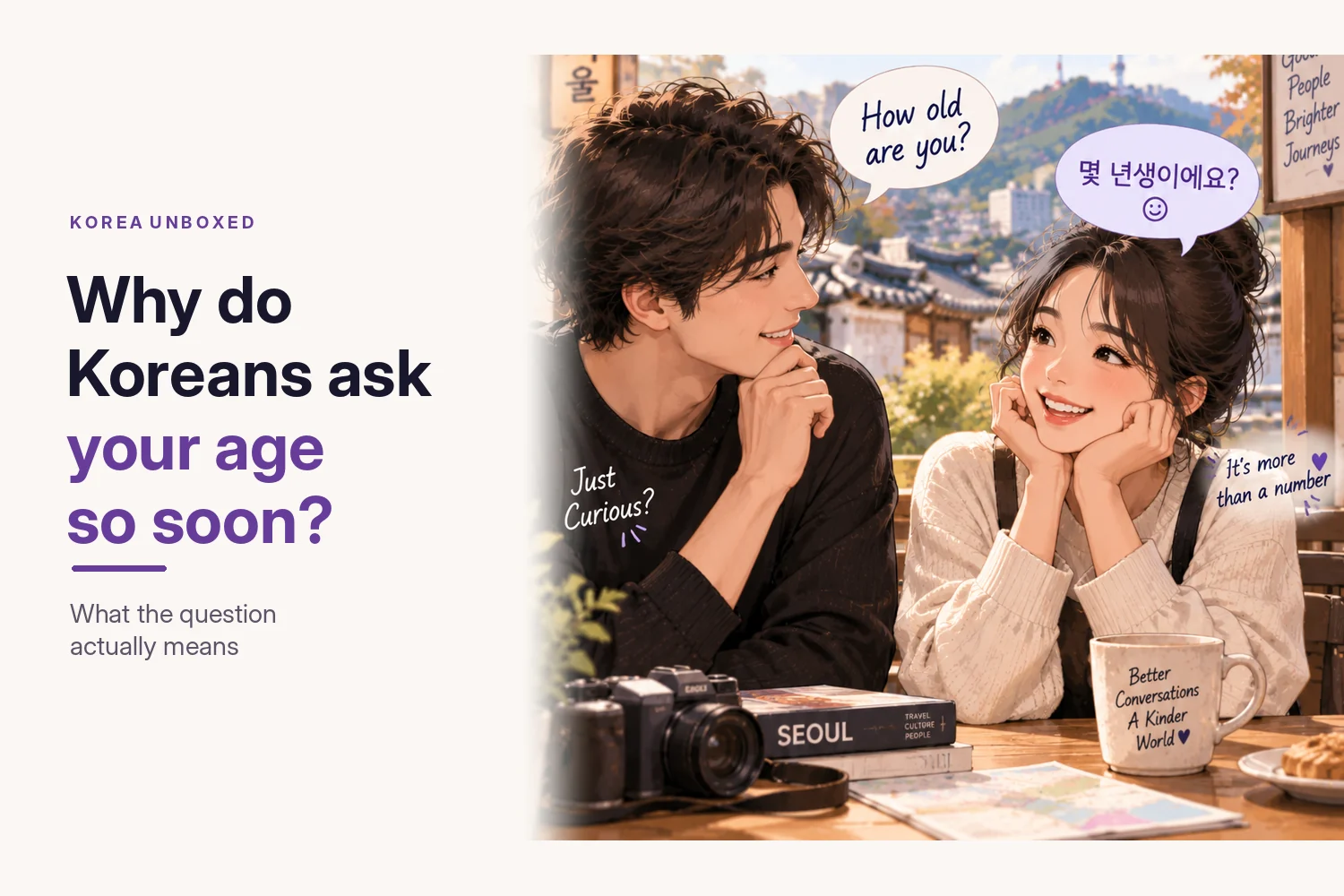
Imagine a friend introduces you to someone over coffee in Seoul. You exchange names, explain what brought you to Korea, and are still deciding what to order when the other person asks, “What year were you born?” Nothing in their expression suggests a delicate question. You, meanwhile, may be wondering how your birthday became relevant before your coffee arrived.
Koreans may ask your age early because it helps them work out how to address you and what kind of relationship you might share. The question can establish relative seniority, reveal that you belong to the same age group, or open a conversation about speaking more casually. That does not make it compulsory, universally welcome, or a reliable guide to the questioner’s intentions. It makes age useful social information in situations where another culture might leave it unspoken.
The interesting question is not simply why age matters, but why a detail that feels private to one person can feel like an introduction to another. To understand that, we need to separate three things that often get bundled together: the history of respecting seniority, the way Korean expresses relationships, and the modern habit of sorting people into age and school cohorts.
Sources checked: September 25, 2026. Historical customs and dated research below explain context; they are not rules followed by every Korean today.
The question can be about “us,” not just about you
An age question asks for a number, but the useful information may be the comparison: are we peers, or is one of us older? In their 2007 study, Tae-Seop Lim and Howard Giles described age questions and explicit negotiations over speech style as part of establishing relationships.
That is a possible explanation, not permission to read somebody’s mind. Imagine two versions of the coffee conversation. In one, the answer produces a delighted discovery of a shared school cohort. In the other, the person immediately starts insisting that being older gives them the last word. The opening question is identical; what follows tells you much more about the relationship being offered. Cultural context should make an interaction easier to interpret, not decide in advance that it must be friendly or intrusive.
Korean speech makes relationships audible
English speakers also adjust their language for a manager, a grandparent, or a close friend. Korean makes some of those adjustments more explicit through sentence endings, honorific vocabulary, and forms of address. Two useful everyday terms are jondaetmal (존댓말), broadly respectful speech, and banmal (반말), familiar or non-polite speech. Neither is a complete description of the language’s register system, and “formal versus informal” is only an approximation: respectful conversation can still be relaxed and warm.
Linguist Lucien Brown’s research on the meanings of Korean honorifics challenges the idea that a respectful form carries one fixed meaning. Depending on context, honorifics can convey emotional stance, social identity, or even sarcasm. That is an important qualification to the familiar explanation that Koreans ask age “because of the language.” Age is one factor in choosing language, not a password without which Korean conversation is impossible.
For a visitor, the practical implication is reassuring. You do not need somebody’s birth certificate before you can greet them politely, nor must two people stop being respectful because they discover that they are the same age. Think of the age question as information that may help a relationship develop, rather than a calculation that automatically determines every sentence thereafter.
When did asking age become a custom?
There is no single starting date that the sources reviewed for this article establish. The history of respect for seniority is well documented; the precise moment when asking a new acquaintance’s birth year became routine is not. Those are different historical questions. An old teaching about respecting elders does not, by itself, prove that people at every period of Korean history introduced themselves by checking a one-year age gap.
A significant part of the background lies in Confucian relationship ethics. The Academy of Korean Studies’ account of the Five Relationships explains an ethical framework that assigned different responsibilities to different relationships, including parents and children, older and younger people, and friends. One of its principles is jangyu yuseo (장유유서), the ordering of relationships between older and younger people. Friendship, meanwhile, is associated with trust. This was not just a recommendation to be pleasant to the elderly; it gave relative position a place in moral conduct.
The distinction is useful. Respecting an older person because they might need assistance is not the same idea as recognizing an older-younger relationship as meaningful in itself. The latter provides a historical vocabulary for seniority even when both people are young. It helps explain the background to age-conscious interaction, without establishing a direct, unchanged line from a classical text to a present-day café conversation.
How an ethical idea became an everyday habit
Abstract philosophy becomes socially powerful when it is taught through ordinary behavior. The Academy’s history of Sohak, or Elementary Learning, offers a concrete example. Compiled in 1187 by Liu Zicheng under Zhu Xi’s supervision in China, the text entered Korea in the late Goryeo period and became an important educational work during Joseon. Its teaching emphasized habits and relationships, including caring for parents, respecting elders and teachers, and maintaining friendships.
The significance is not that every Korean household read the same book or lived perfectly by its prescriptions. It is that these ideas were repeatedly promoted through education, publication, translation, and moral instruction. The Academy describes both institutional encouragement and circulation beyond scholarly circles. Seniority could therefore become something practiced through manners, rather than a philosophical position a person consciously chose each morning.
This gives us a better-supported account than a neat story about who “invented” asking age. We can document older relationship ideals and their transmission, then examine later institutions and language practices separately. We cannot responsibly supply an exact origin for the introductory question where the evidence does not provide one.
Being older could mean responsibility, not only precedence
The family background also complicates the idea that an older person simply receives privileges. In its entry on hyeong, the older brother, the Academy describes a traditional patrilineal family model in which an eldest son’s position involved household succession and ancestral rites. An older brother could also assume responsibility for family affairs when the father was absent. These were unequal roles, but they involved obligations as well as precedence.
That historical model should not be mistaken for a description of every contemporary family. It does, however, suggest a useful question when interpreting an older-younger relationship: what is expected in return? Imagine an older friend who offers guidance, takes responsibility when plans go wrong, and makes room for someone less experienced. Compare that with a person who invokes age only when challenged. Both claim seniority, but the relationships are not equivalent. The historical context helps explain why care and deference can be discussed together without proving that either will appear in a particular encounter.
Why can a single year make a difference?
A general respect for elders does not fully explain a twenty-three-year-old carefully addressing a twenty-four-year-old. Here, research on young adults is more useful than repeating a broad statement about tradition. Lim and Giles’ 2007 study compared 100 Korean and 121 American students drawn from one university in Seoul and one in California. The Korean respondents attached more significance to a one-year difference and to careful language choices across student levels. They also expressed expectations of respect toward younger students, not only toward older ones.
This university sample was not nationally representative and does not measure attitudes in 2026. Age and university seniority were intertwined, so the findings should not be read as isolating age from every other influence.
School cohorts provide another part of the context. The government cultural publication K-Style: Living the Korean Way of Life describes schoolmates entering in the same year as being treated as the same age. It also describes the traditional counting system in which a child begins at one and gains another year at the turn of the year. This is an older cultural account, not current legal guidance, but it shows why a birth year or school cohort could carry information that an exact birthday does not.
Consider the arithmetic as an illustration. Two people born in January and December of the same year are nearly a year apart, yet belong to one birth-year category. Two people born on opposite sides of New Year can be only days apart but fall into different categories. Neither example establishes how a particular pair must behave. It shows that grouping people socially and measuring elapsed lifetime are different activities. That distinction also explains why changing an age-counting formula need not redraw an established friendship.
Oppa, hyung, unnie, and noona describe relationships
Age becomes especially noticeable in words used to address people. In conventional sibling usage, a female speaker calls an older brother oppa (오빠), while a male speaker uses hyung, also written hyeong (형). An older sister is unnie, or eonni (언니), to a female speaker and noona, or nuna (누나), to a male speaker. The speaker’s position is part of the meaning, not just the identity of the person being addressed.
The Academy’s discussion of kinship terminology also notes its extension beyond actual relatives. That helps explain why hearing an older-brother or older-sister term between friends does not establish a family relationship. It should not be treated as a simple substitute for “you,” either. Our practical recommendation is to follow how people introduce themselves and the terms they invite you to use, rather than applying sibling vocabulary to every older person you meet.
For interpreting a scene, this produces a useful caution: a familiar term is evidence about how someone is addressing another person, not a complete biography of their relationship. Hearing oppa alone is not enough to establish romance, just as hearing a first name in English does not tell you whether two people are friends, colleagues, relatives, or partners. Look at the interaction around the word before giving it a larger meaning.
Age and workplace seniority do not always agree
Age is not the only way to be senior. Sunbae (선배) refers to someone senior in a school, organization, or field of experience; it does not simply translate as “an older person.” An older newcomer and a younger established colleague can therefore occupy different positions depending on whether the conversation is about age, organizational experience, or responsibility for the work. There is no useful universal formula in which whichever person was born first wins every comparison.
The National Institute of Korean Language’s dictionaries illustrate precisely this tension. Its entry for nai daejeop, treating someone with respect for their age, includes an example of using respectful speech to a colleague who is professionally junior but older. Its entry for jondae, respectful treatment or speech, includes an example of someone unhappy about having to address a younger superior respectfully. These are language examples, not statistics about how often workplace conflict occurs, but they make the distinction clear.
Imagine a meeting led by a younger manager. Recognizing that person’s professional role need not involve pretending the older colleague’s age is unknown; acknowledging the colleague’s age need not transfer responsibility for the meeting to them. The challenge is accommodating more than one relationship at once. For someone entering a Korean workplace, learning people’s actual titles and the team’s habits is therefore more informative than arranging everyone by birth year.
When deference makes a warning harder to hear: Korean Air and Outliers
The difference between recognizing authority and hesitating to challenge it becomes especially important when people are working under pressure. Malcolm Gladwell explores this in chapter seven of Outliers (2008), using Korean Air’s historical safety problems to discuss mitigated speech: softening a concern into a suggestion or hint. He interprets remarks about worsening rain and weather radar during Flight 801 as indirect warnings whose urgency the captain was expected to infer. Gladwell connects that pattern to deference and Korean speech levels; it is his interpretation, not an accident investigator’s finding that Korean grammar caused the crash.
A hint leaves the listener with an additional task: recognizing that an observation is really an objection. In a hypothetical office conversation, “Perhaps we should check that figure” might be intended to mean “The calculation is wrong; we should not send this.” The speaker may feel that they have raised the problem tactfully, while the manager hears an optional suggestion. The difference matters when everyone needs the same understanding before acting.
The U.S. National Transportation Safety Board’s report on Flight 801, which crashed in Guam in August 1997, identifies failures in the captain’s approach and the other crewmembers’ monitoring, alongside fatigue, inadequate training, and a disabled ground-based warning system. Crucially, investigators could not determine whether the lack of earlier challenges reflected poor preparation, failure to recognize errors, reluctance to confront the captain, or a combination. The first officer did directly call for a missed approach about six seconds before impact. The record supports a serious crew-coordination failure, not certainty about each person’s unspoken motives.
A separate British investigation into Korean Air’s 1999 cargo crash near Stansted found that the captain’s criticism of the first officer before takeoff helped create a tone that discouraged further input. It also identified instrument and maintenance problems, and could not settle whether the first officer’s later silence reflected distraction, misunderstanding, or inhibition. The report describes subsequent changes to crew selection, training, and performance monitoring, emphasizing crew resource management. That is a more specific organizational story than saying that an entire nationality is unable to speak directly.
Age and authority were not interchangeable here, either. On Flight 801, the captain was 42 and the flight engineer was 57. The engineer was older, but the captain held command. This makes the case relevant to how different kinds of seniority interact, rather than simply illustrating younger people deferring to older people.
Gladwell’s account also describes stronger aviation-English requirements and English-language training under flight-operations executive David Greenberg, who joined in 2000. He argues that using English helped crews step outside established patterns of deference. That language-based explanation should remain attributed to the book, rather than presented as proof that an English-only rule solved the safety problems. Flight 801’s earlier cockpit recording already contains both Korean and English. The documented reforms extended beyond language, and their effects cannot be reduced to a vocabulary change.
The broader principle is expressed in the U.S. Federal Aviation Administration’s crew resource management guidance: effective teamwork requires appropriate questioning to be encouraged, without punishment for challenging another pilot’s decision. This is not a Korea-only issue. The connection to our everyday age question is therefore not that respectful language prevents honesty, but that recognizing someone’s seniority and communicating a problem clearly are different responsibilities. A relationship can preserve courtesy while making room for disagreement; in a safety-critical workplace, that room has to be deliberately protected. These historical cases are not an assessment of the airline’s present-day safety.
Did the 2023 age reform change these relationships?
On June 28, 2023, amendments to the Civil Act and the Framework Act on Administrative Affairs took effect, making the international-age calculation explicit as the general standard unless a specific rule provides otherwise. The official implementation explanation describes a system beginning at zero at birth and increasing on birthdays. It also makes clear that international age was already used in many legal contexts. This was not a day on which every Korean institution discovered birthdays for the first time.
The government’s FAQ on the reform addressed an especially revealing question: if classmates have different international ages because their birthdays fall at different times, should they change how they address one another? Its answer was no. School-entry arrangements were unchanged, and friends did not need to adopt different forms of address simply because one birthday had already occurred and another had not.
That example helps separate legal calculation from social classification. A childhood classmate does not become a newly discovered senior each year between your birthdays. The reform clarified the calculation used in law and administration; it did not require every private relationship to be renegotiated. The FAQ expressed an expectation that strict attention to one- or two-year gaps might weaken over time, but an expectation in a policy explanation is not evidence that the change has already happened throughout society.
Closeness and hierarchy can exist in the same conversation
A useful way to understand the emotional ambiguity is to imagine a friendship in which one person speaks familiarly while the other retains respectful forms. A newcomer might read the difference as distance or inequality. The friends themselves might experience the relationship as affectionate and comfortable. Alternatively, one of them might genuinely dislike the arrangement. The language pattern alone cannot settle which interpretation is right; the people’s responses and their freedom to discuss it matter.
The same is true of advice. Imagine being new to a city and appreciating an older friend’s help with an unfamiliar situation. Now imagine receiving instructions about a personal decision you had not asked them to make. The point at which guidance becomes interference cannot be determined by the age gap alone. Recognizing the cultural possibility of an older-younger bond should sharpen our attention to the relationship, not substitute for it.
This is why an age question can feel like an invitation in one encounter and a restriction in another. It may introduce a familiar way of relating, but it may also introduce expectations that one person does not share. Neither reaction requires us to portray Korea as a single hierarchy or to insist that every expression of hierarchy is secretly affectionate.
People negotiate the conventions; they do not only inherit them
Research also gives us reason not to treat speakers as passive followers of rules. In a 2008 study of Korean as a second language, Brown analyzed fourteen hours of recorded interactions, examining both expected honorific use and strategic departures from it. The published abstract describes speakers’ efforts to establish more equal relationships and their adjustments of honorific levels according to interactional goals. This concerns particular language-learning interactions, not all foreigners or all Korean friendships, but it demonstrates that the conventions can be actively managed.
We should be equally careful with claims about generational change. A young person is not automatically indifferent to seniority, and an older person is not automatically committed to it. The research reviewed here does not establish a representative 2026 measure of how often younger Koreans ask age or prefer to abandon age-based address. A confident claim that “young Koreans no longer care” would go further than this evidence allows.
For everyday purposes, it is more useful to notice what the people involved propose and accept. Are they comfortable staying polite? Do they want to use first names? Have they invited a more familiar way of speaking? Treat those answers as information about this relationship, not proof that you have encountered the one authentic version of modern Korean culture.
How to answer without overthinking it
When you are comfortable answering, giving your birth year is straightforward and avoids confusion about which age-counting system someone has in mind. When you would rather not, you can keep it light and redirect toward the practical issue: “I tend to keep my age private, but what would you like me to call you?” That is a suggested response, not a traditional Korean formula, and nobody can guarantee how an individual will receive it.
If you are learning Korean, our recommendation is to begin respectfully and let familiarity develop through mutual understanding. Being older is not a good reason to decide unilaterally that a stranger should accept familiar speech. Equally, discovering that you are younger does not require you to interpret the whole encounter as a contest you have lost. You are meeting a person, and the age information is only one part of what the two of you will learn about each other.
What the question actually means
Return to the imagined café introduction. “What year were you born?” may have sounded like a request to disclose something private before you were ready. Seen against this background, it can also be an attempt to find a familiar starting point: not only who you are, but how the two of you might speak and relate. The surprise comes from encountering a social question disguised as a numerical one.
There is no need to turn that recognition into a verdict about whose manners are better. A person can value privacy without rejecting friendship; another can ask age without intending to diminish anyone. The useful shift is to hear the possible relationship question beneath the birthday question, while still listening to what the person does with the answer. Knowing the convention gives you context. Getting to know each other gives that context meaning.
For another look at the gap between intention and interpretation, read Do Koreans Think You’re Rude? Korean Etiquette Explained.
Sources and further reading
Historical and institutional background
Academy of Korean Studies: Three Bonds and Five Relationships (삼강오륜). Korean-language scholarly encyclopedia entry on relationship ethics, including older-younger order.
Academy of Korean Studies: Sohak (소학). Korean-language history of the moral-education text and its circulation during Goryeo and Joseon.
Academy of Korean Studies: Older Brother (형). Korean-language entry on family roles and kinship terminology. Its traditional family model is not treated here as a description of every modern household.
Korean government cultural publication: K-Style, Living the Korean Way of Life. See printed pages 48–49 for an older account of customary age counting and school cohorts, not current legal advice.
Language and communication research
Lim and Giles (2007): Differences in American and Korean Evaluations of One-year Age Differences. Original study, with full text available. A study of university students.
Brown (2015): Expressive, Social and Gendered Meanings of Korean Honorifics. University research record and abstract; the article explains meanings beyond straightforward deference.
Brown (2008): “Normative” and “Strategic” Honorifics Use in Interactions Involving Speakers of Korean as a Second Language. University record and abstract describing research on recorded interactions.
National Institute of Korean Language: 언니. Definitions covering both an older sister and an older woman addressed affectionately.
National Institute of Korean Language: 나이대접. Korean-English dictionary definition and Korean usage examples for respect associated with age.
National Institute of Korean Language: 존대. Korean-English dictionary definition and examples of respectful treatment and speech.
Korean Air, cockpit communication, and Outliers
Malcolm Gladwell: Outliers (2008). Chapter 7, “The Ethnic Theory of Plane Crashes,” especially printed pages 213–219 in the edition consulted. Publisher’s book page; the cultural and language-based explanations are Gladwell’s interpretation, not official accident findings.
U.S. National Transportation Safety Board: Korean Air Flight 801, report AAR-00/01. See printed pages 9 and 12 for crewmember ages, 146–148 for monitoring and challenges, 175 for probable cause, and Appendix B for the bilingual cockpit transcript.
UK Air Accidents Investigation Branch: Korean Air Boeing 747 HL-7451, report 3/2003. See printed pages 72 and 77–78 for cockpit interaction and training, and 84–85 for causal factors and recommendations.
U.S. Federal Aviation Administration: Crew Resource Management Training, AC 120-51E (2004). Historical guidance on teamwork and a training culture that encourages appropriate questioning, particularly paragraph 10(b).
Official explanation of the 2023 age reform
Korea Policy Briefing: Age-standardization implementation, June 26, 2023. Official explanation of the amendments taking effect on June 28.
Korea Policy Briefing: Ministry of Government Legislation age-reform FAQ, June 23, 2023. Includes the explanation that classmates do not need to change their forms of address.
More from Korea Unboxed
Do Koreans Think You’re Rude? Korean Etiquette Explained. Related editorial reading about cultural interpretation, not an independent research source.