Something has gone wrong in Korea.
Maybe your bag disappeared while you were out. Someone will not leave you alone. You witnessed an assault. A night out stopped feeling safe. Or perhaps nothing dramatic is happening anymore, but you need to report something and have no idea what a Korean police interaction is supposed to look like.
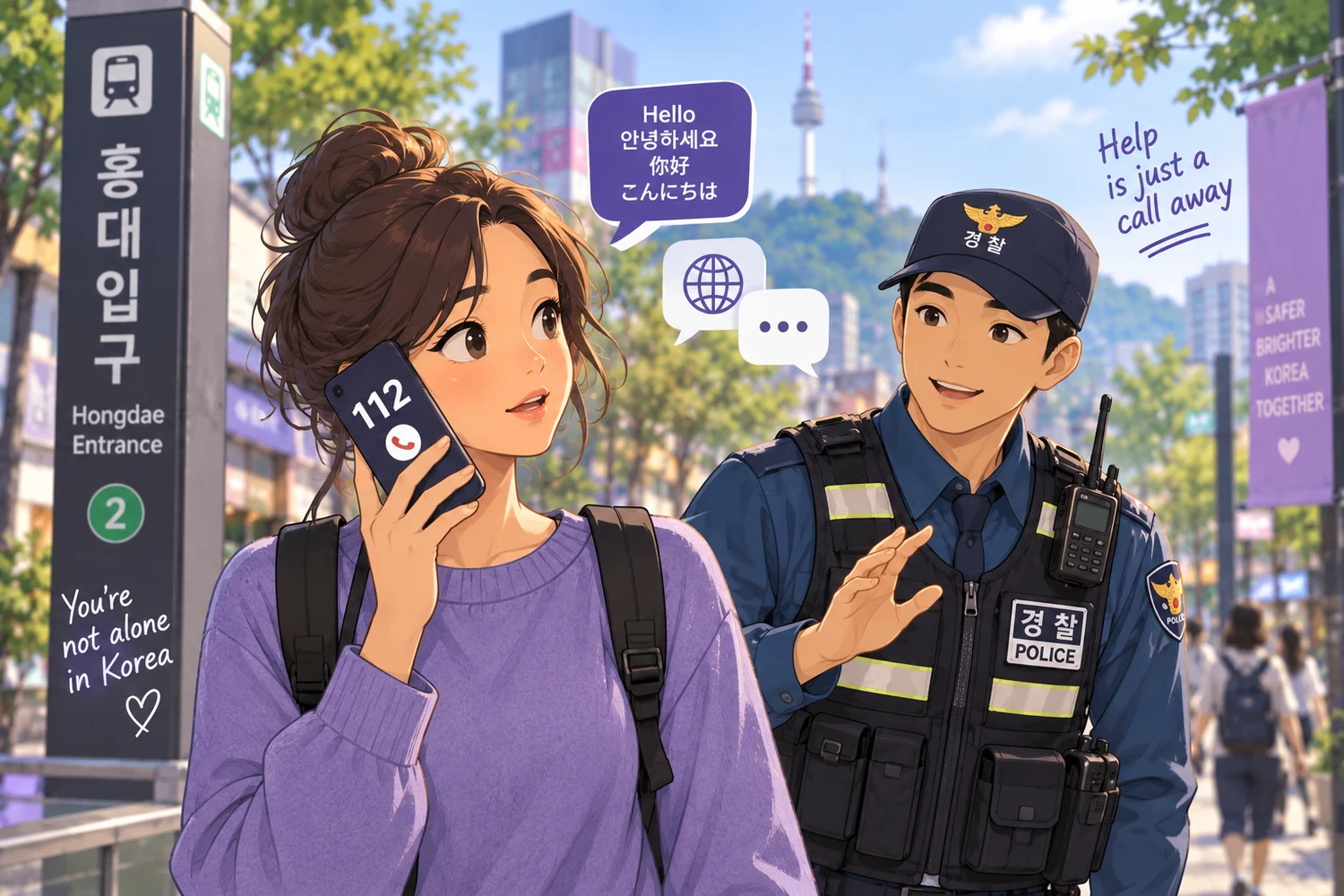
If a crime is happening now, someone is in danger, or you need urgent police assistance in Korea, call 112.
You do not need to speak fluent Korean before asking for help. The Korea National Police Agency operates a foreign-language interpretation center for 112 calls, expanded to 24-hour operation in 2024. Korea National Police Agency: 24-hour foreign-language interpretation for 112.
The harder questions usually come after that: What should you tell the operator? What if you cannot explain yourself in Korean? Do you need to go to a police station? What if the police start asking questions about your own involvement?
Those situations are different, and understanding the difference matters.
Sources checked: September 29, 2026. This guide provides general information, not legal advice. PIN Agency is not a law firm. Criminal procedures depend on the facts of the case, so contact a qualified Korean lawyer or an official legal-support service when you need advice about a specific situation.
112, 119, or 182? Start with the right number
Korea has separate numbers for different kinds of help.
For an immediate crime or danger requiring police, call 112. Seoul's current foreign-resident safety guidance lists 112 for accidents or crime. Seoul Foreign Portal: emergency contacts and safety services.
For a fire, rescue situation, or medical emergency requiring an ambulance, call 119. The same Seoul guidance and the National Fire Agency identify 119 for fire, rescue, and emergency medical response. National Fire Agency: emergency medical services.
182 is different. Police Civil Service Portal lists 182 as the general police civil-service number, currently operating on weekdays from 9:00 a.m. to 6:00 p.m. It is useful for administrative inquiries and case-related questions, but it is not a substitute for 112 when something dangerous is happening. Police Civil Service Portal 24.
If you are staring at your phone trying to decide whether a situation is serious enough for 112, focus on what is happening rather than whether you know the perfect Korean procedure. If somebody is being threatened, attacked, followed, restrained, or otherwise appears to be in immediate danger, asking the police to assess the situation is more useful than trying to perform your own legal analysis first.
You can ask for language help
Calling an emergency number in another country can be intimidating even when nothing unusual is happening. Doing it while frightened and trying to explain a location in a language you do not speak is much harder.
Korean police created a dedicated foreign-language interpretation center for 112 and expanded it to 24-hour operation. The National Police Agency's announcement describes the center and its round-the-clock expansion.
That does not mean the first officer who answers the phone, or every officer at every station, necessarily speaks English.
If communication is difficult, make it clear that you need an interpreter. Keep the first explanation simple. Your location and the immediate problem matter more than telling the entire story in perfect chronological order.
For example, the useful information might be: you are at Hongdae Station, Exit 9; a man is hitting another person; someone appears injured; or you saw a weapon. Once police understand the location and level of danger, the longer explanation can follow.
What if you cannot safely talk?
Korean police also have a system for situations where speaking out loud may be unsafe.
With the silent 112 / Visible 112 system, a person can call 112 and respond to the operator by pressing phone buttons when they cannot speak. Police can then send a link that, with the caller's consent, can share location information and allow video or discreet chat communication. Korea Policy Briefing: silent 112 and Visible 112.
Treat that as an emergency option, not something you need to practice casually. Emergency systems and interfaces can change, so follow the instructions you actually receive from the 112 operator.
Seoul's 2026 foreign-resident safety guidance also points to the BARO Emergency Reporting App for situations where speaking is difficult. Seoul Foreign Portal: Essential Emergency Contacts & Disaster Safety Services.
If the immediate danger has passed, you can still report what happened
Not every police matter begins with an emergency call.
You may realize later that something was stolen. You may want to report harassment after reaching a safe place. You may have photographs or messages relevant to something you witnessed. Or an incident may simply not require an emergency response.
You can go to a police station to make a report. The Ministry of Justice's current crime-victim guidance tells victims to report crime through 112 and explains the support system that follows a criminal case. Ministry of Justice: criminal procedure and crime-victim rights.
For certain matters, especially cybercrime, lost property, administrative inquiries, and follow-up, the national Police Civil Service Portal 24 provides online police services.
The important distinction is urgency. An online form is not a replacement for 112 when somebody needs immediate protection.
Preserve what you know before the details disappear
When the situation allows it, write down what happened while it is still fresh.
The useful information is often ordinary: the time, exact place, nearby station exit, business name, description of a person or vehicle, screenshots, photographs, messages, receipts, booking details, or the names of people who saw the same thing.
If you have original photographs, videos, or messages, preserve them rather than editing the only copy.
This is a practical recommendation, not a rule that you should remain at a dangerous scene to collect evidence. Your safety comes first. Police can investigate an incident; you do not need to turn yourself into an investigator.
Being a victim or witness is different from being a suspect
This is one of the most important distinctions in the entire article.
You might enter a police station believing you are simply explaining what happened, only for the conversation to reveal that officers are also investigating something you did. A fight, traffic incident, property dispute, argument, or confusing nightlife situation can involve competing accounts.
If the direction of the interview is unclear, it is reasonable to ask what role you are being questioned in.
Are you reporting the incident as a victim? Are you giving information as a witness? Or are police questioning you as a suspect?
Once you are being questioned as a suspect, do not treat the conversation as though you are simply helping to fill in some paperwork.
If police are questioning you as a suspect, you have important procedural rights
Korea's Criminal Procedure Act requires police to inform a suspect before questioning that they may refuse to make any statement or refuse individual questions; that they will not be disadvantaged merely for exercising that right; that statements they do make may be used as evidence; and that they can receive assistance from counsel. Criminal Procedure Act, Article 244-3: notice of the right to remain silent and counsel.
The Act also provides for a lawyer to meet with the suspect and, absent a legally recognized reason for restriction, participate in questioning when properly requested. Criminal Procedure Act, Article 243-2: participation of defense counsel.
There is an additional language protection for foreign participants in police investigations. The National Police Agency's Crime Investigation Rules state that when a foreign suspect or other related person is not proficient in Korean, police must have an interpreter participate so the suspect-examination record or statement record can be prepared in Korean. The rule also addresses oral complaints, accusations, or voluntary surrenders by foreigners who are not proficient in Korean. National Police Agency Crime Investigation Rules, Article 217.
The practical lesson is not to pretend you understood a question, legal term, or written statement because you are embarrassed to ask again.
Say that you do not understand. Ask for interpretation. If the situation is serious, ask for a lawyer.
A Criminal Procedure Act amendment takes effect on October 2, 2026, just days after this article's fact-check date. We reviewed the incoming provisions as well as the rules currently in force. The suspect-questioning protections described above remain in the amended provisions, although the broader structure of investigative authority changes. Criminal Procedure Act effective October 2, 2026.
Read a police statement before you agree that it is accurate
A formal police statement is not something to treat like the terms-and-conditions box on an app.
Article 244 of the Criminal Procedure Act says a suspect's statement is recorded, that the record must be shown or read to the suspect, and that objections, requested additions, or corrections must be recorded when the person says the written statement is inaccurate or incomplete. Criminal Procedure Act, Article 244: suspect examination record.
Our practical recommendation is simple: do not confirm that a statement is accurate when you do not understand what it says.
If you cannot read the Korean document accurately, ask for interpretation. If you disagree with what has been recorded, say so. If you are being investigated for an offense, this is an appropriate point to get legal advice rather than relying on a friend, translation app, or hurried explanation of a document with legal consequences.
Crime victims may have support beyond the police report
Reporting a crime and recovering from it are not the same problem.
The Ministry of Justice describes Crime Victim Support Centers that can provide services including consultation, certain medical or psychological support, emergency assistance, accompaniment to investigative agencies or court, and other help depending on the crime and eligibility. The nationwide crime-victim assistance number is 1577-1295. Ministry of Justice: Crime Victim Support Centers.
The Ministry also lists 1577-2584 for prosecution victim-support offices and describes protection and assistance programs available through the criminal process. Ministry of Justice: victim-support service contacts.
These programs have eligibility rules. Do not assume every service applies automatically to every incident, nationality, or type of loss. Call the relevant service and explain the actual circumstances.
For general legal consultation, the Korea Legal Aid Corporation provides telephone, online, and in-person consultation services and lists 132 as its legal consultation number. Korea Legal Aid Corporation: legal consultations.
For a serious criminal investigation, especially one in which you may be a suspect, a qualified Korean criminal lawyer is different from a general helpline.
1330 can help with the surrounding travel problem, but it is not the police
Visitors may already know 1330, the Korea Tourism Organization's multilingual travel helpline.
It operates 24/7 for its major supported languages and can help with tourism information, interpretation, complaints, and connections to related services. Korea Tourism Organization: 1330 Travel Helpline.
That can be useful when your problem is figuring out whom to contact or dealing with a non-emergency travel issue.
But when a crime is happening or somebody is in immediate danger, call 112 directly. Do not add another intermediary because you are worried that your Korean is not good enough.
You do not need to know Korean law before asking for help
Foreign visitors sometimes hesitate because they are unsure whether what happened is "serious enough," whether Korean police will understand them, or whether a situation would be handled differently in their home country.
Those are reasonable concerns, but they are separate from the first decision.
If there is immediate danger, call 112.
If somebody needs an ambulance, rescue, or fire response, call 119.
If the situation is no longer urgent, preserve the information you have and report it through the appropriate police channel.
And if the conversation changes from explaining what happened to being investigated yourself, stop treating language uncertainty as a minor inconvenience. Ask what your status is, request interpretation if you need it, and get legal help when the consequences matter.
Knowing those distinctions will not make every encounter simple. It does give you a much better starting point than trying to remember a half-read social-media comment while something has already gone wrong.
For practical phone preparation before your trip, read 10 Apps to Download Before Visiting Korea, which includes Korea's Emergency Ready app and other useful tools. If your concern is specifically about going out at night, Nightlife 101 in Korea covers transportation home, personal boundaries, and what to do when a night stops feeling safe.
Sources and further reading
Police and emergency services
Korea National Police Agency: 24-hour foreign-language interpretation for 112. Official announcement on expansion of the 112 foreign-language interpretation center.
Seoul Foreign Portal: Essential Emergency Contacts & Disaster Safety Services. Current foreign-resident guidance listing 112, 119, BARO Emergency Reporting, and other emergency resources.
National Fire Agency: emergency medical services. Official 119 emergency-medical-service information.
Police Civil Service Portal 24. Police civil services, cybercrime reporting and consultation, lost-property services, and 182 contact information.
Korea Policy Briefing: silent 112 and Visible 112. Police guidance on keypad signaling, location sharing, video, and discreet chat when speaking is unsafe.
Criminal procedure and legal help
Criminal Procedure Act, Article 244-3. Notice of a suspect's right to remain silent and receive assistance from counsel.
Criminal Procedure Act, Article 243-2. Participation of defense counsel in suspect questioning.
Criminal Procedure Act, Article 244. Preparation, review, objections, and corrections to the suspect examination record.
National Police Agency Crime Investigation Rules, Article 217. Interpretation for foreign suspects and other related persons who are not proficient in Korean.
Criminal Procedure Act effective October 2, 2026. Incoming text checked because the amendment takes effect shortly after this article's fact-check date.
Korea Legal Aid Corporation. English information on legal consultations; the corporation lists 132 as its legal-consultation number.
Victim and visitor support
Ministry of Justice: criminal procedure and crime-victim rights. Official overview of victim rights and support during criminal proceedings.
Ministry of Justice: Crime Victim Support Centers. Support scope and the 1577-1295 emergency-assistance number.
Ministry of Justice: victim-support service contacts. Lists prosecution victim-support offices, Crime Victim Support Centers, and related programs.
Korea Tourism Organization: 1330 Travel Helpline. Multilingual 24/7 travel assistance for major supported languages and connections to related services.
More from Korea Unboxed
10 Apps to Download Before Visiting Korea. Practical phone preparation including emergency and travel tools.
Nightlife 101 in Korea: What It Actually Looks Like (And What to Watch Out For). Related practical guidance for going out, personal safety, and planning the journey home.