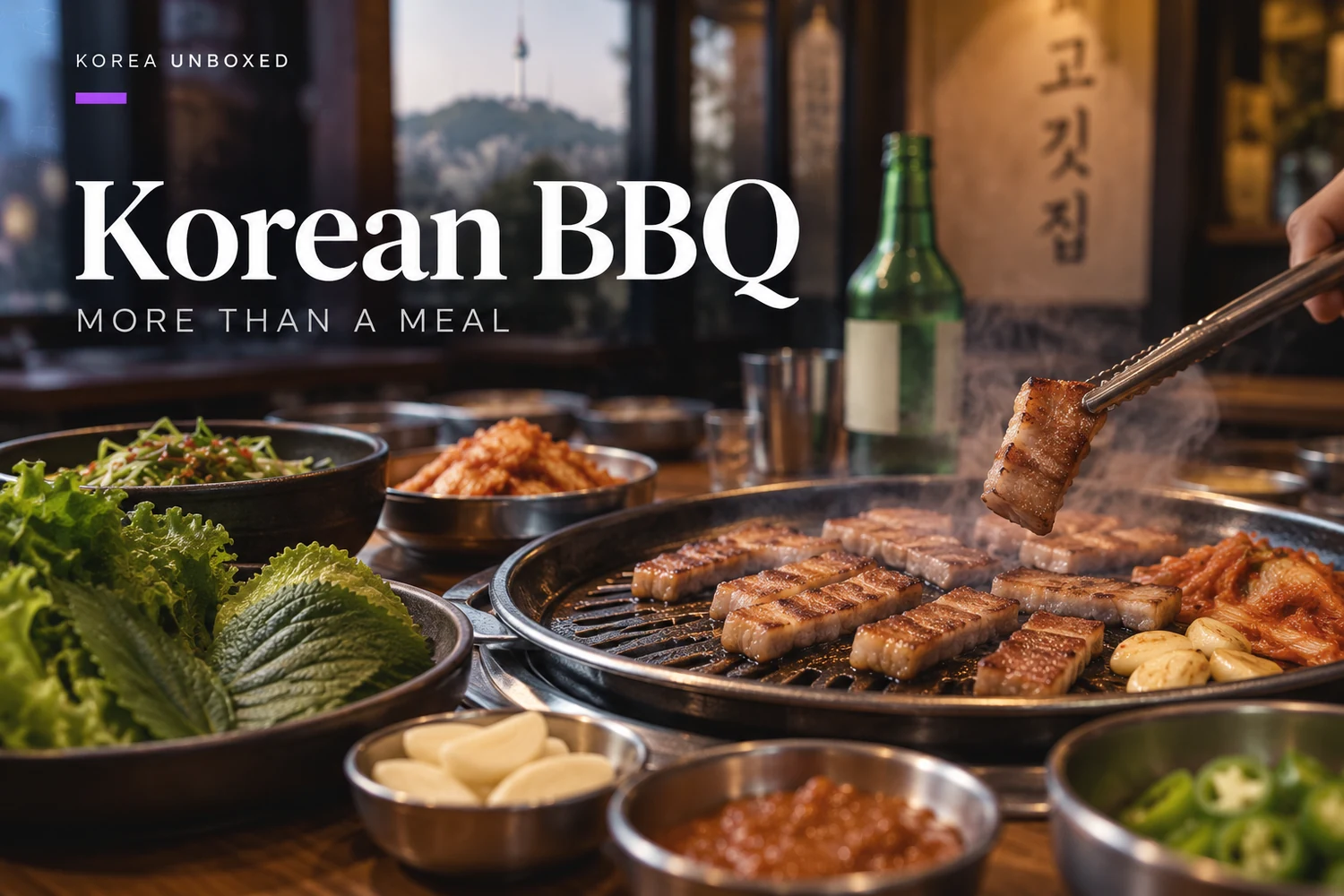
How to Tell If Korean BBQ Is Authentic: What the Experience Is Like in Korea
You do not need to live in Seoul to eat Korean barbecue anymore. In many cities, you can sit down at a table grill, order pork belly, wrap it in lettuce, dip something into a red-brown sauce, and feel like you are getting at least a small piece of the Korean dining experience.
But how close is it to what you would actually find in Korea?
That is a better question than asking whether a restaurant is "real" or "fake."
Korean barbecue in Korea is not one standardized meal. A neighborhood pork restaurant, a charcoal beef restaurant, a trendy aged-meat place in Seoul, and a Jeju black-pork restaurant can all feel noticeably different. Some places let you grill the meat yourself. Others have staff do almost everything for you. Some tables arrive covered in side dishes, while newer restaurants may keep the setup much more restrained.
What connects them is not a checklist of decorations or the nationality of the person cooking. It is the logic of the meal: the cuts of meat, the grill, the sauces and vegetables around it, the way you build bites, and the dishes that often appear before, during, and after the grilling.
If you want to know whether the Korean BBQ restaurant in your hometown gives you an experience that feels close to Korea, these are the details worth noticing.
First, Korean BBQ in Korea usually starts with the meat, not the spectacle
Outside Korea, "Korean BBQ" often functions as a cuisine category. In Korea, you are more likely to think of the restaurant as a 고깃집 (gogijip), literally a meat restaurant, and then care about what kind of meat it specializes in.
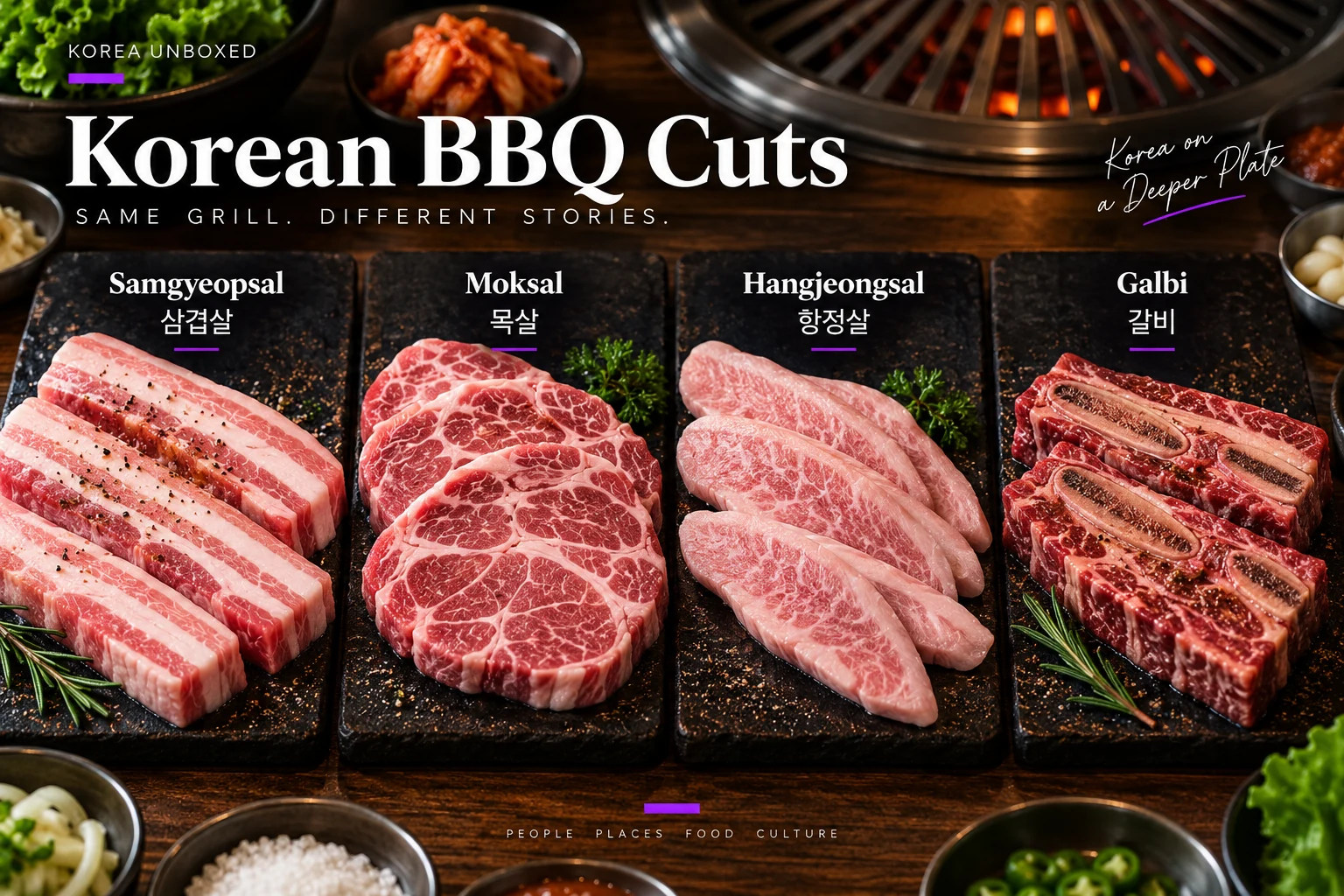
A pork place might offer samgyeopsal (삼겹살), pork belly; moksal (목살), a meatier cut from around the neck and shoulder; hangjeongsal (항정살), a richly marbled specialty cut; and gabeurisal (가브리살), another smaller pork cut valued for its texture.
Current Korea Tourism Organization restaurant listings routinely show several cuts together instead of treating "Korean BBQ" as one generic meat dish. One Seoul restaurant, for example, serves samgyeopsal, moksal, hangjeongsal, and gabeurisal as a mixed set.
That does not mean your local restaurant needs five obscure cuts to feel Korean. A simple menu built around good samgyeopsal can be completely convincing.
What matters more is whether the restaurant seems to understand the meat it is serving.
What should samgyeopsal look like?
The name samgyeopsal refers to the layered appearance of pork belly. Korea's Encyclopedia of Korean Culture describes the cut as the belly section below the loin, with layers of lean meat and fat that inspired the name. It also notes that while the belly cut was historically used in preparations such as boiled pork, restaurants specializing in grilled samgyeopsal appear to have emerged in the late 1970s. Read the Encyclopedia of Korean Culture entry on samgyeopsal-gui.
For a diner, that layered structure is useful to recognize. A slice of samgyeopsal should look like pork belly, with visible lean and fat running through the cut.
But there is no magic fat percentage that proves quality.
Korea's Livestock Products Quality Evaluation Institute grades pork using several characteristics, including the condition of the belly, fat deposition, meat color, fat color, texture, and fat quality. Its official pork grading criteria use multiple quality measures.
The same agency has found that Korean consumers themselves prefer different amounts of fat depending on the section of the belly. A 2024 consumer project found particularly strong preference for a relatively leaner part of the belly.
So "more fat equals better" is not a Korean rule.
What you can reasonably look for is meat that appears fresh and cleanly cut, with a structure that makes sense for the cut being advertised.
Thickness is not an authenticity test either.
Very thick fresh samgyeopsal is common at modern Korean meat restaurants, but thin slices and naengsam, frozen pork belly, are also established styles. Korea Tourism Organization listings include restaurants known specifically for frozen samgyeopsal. Jamsugyo-jip in Seoul is one current example.
The useful question is not "Is this thick enough to be authentic?"
It is "Does this restaurant seem to know what style of meat it is serving?"
And what about moksal?
If samgyeopsal is the cut most international diners recognize, moksal is one of the easiest ways to understand how much variety exists at a Korean pork restaurant.
Compared with pork belly, moksal generally looks meatier. You do not get the same obvious alternating bands of fat and lean that make samgyeopsal instantly recognizable.
That also changes the eating experience.
Samgyeopsal tends to feel richer because of the belly fat. Moksal can feel firmer and more substantial, while still containing enough fat to stay juicy when it is cooked well.
Neither is "more Korean."
Plenty of groups order both.
That contrast is part of the appeal of a Korean meat restaurant. You can move between cuts with different textures rather than eating one identical piece of meat all evening.
The table around the grill matters almost as much as the grill
When a Korean BBQ table arrives in Korea, the meat is rarely sitting alone.
Depending on the restaurant, you might see lettuce, perilla leaves, raw garlic, green chili peppers, kimchi, sliced onions, seasoned scallions, pickled radish, fermented seafood sauces, individual dipping sauces, or a bowl of ssamjang.
There is no universal required set.
A current Korea Tourism Organization listing for a Korean meat restaurant describes lettuce, radish salad, cabbage kimchi, mustard-leaf kimchi, soybean paste, peppers, onions, and garlic among its basic accompaniments. See the current listing for Deokjang Hanwoo.
Another popular Seoul pork restaurant serves white kimchi, pickled radish wraps, seasoned scallions, and meljeot with the meat. See the current listing for 401 Restaurant.
What you are looking for is not a huge number of little plates.
You are looking for accompaniments that make sense with grilled meat.
Fatty pork becomes more interesting when you can alternate it with something sharp, fermented, fresh, salty, herbal, or crunchy. That is why a few well-chosen side dishes can create a more recognizably Korean meal than an enormous spread assembled mostly for visual impact.
Learn to make one ssam and the whole meal makes more sense
One of the easiest ways to understand Korean BBQ is to make a ssam (쌈).
Ssam simply means wrapping food in a leaf or another wrapper.
At a barbecue restaurant, the basic version might be:
lettuce or perilla leaf + grilled meat + a little ssamjang + garlic + chili
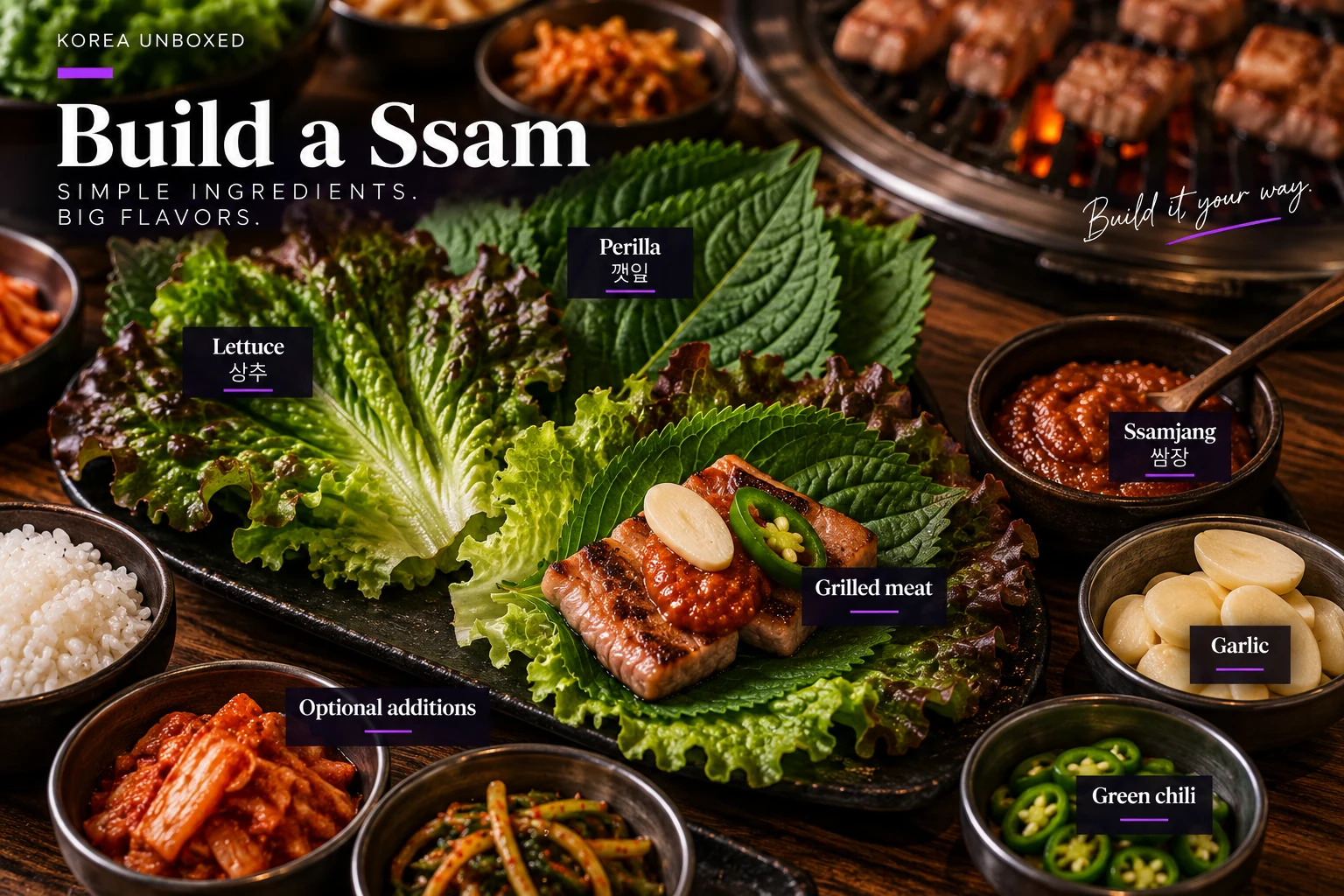
From there, you can add kimchi, seasoned scallions, rice, or another side dish if you want.
There is no official assembly order and no prize for building the largest possible wrap.
You also do not need to put everything into every bite.
A lettuce leaf gives you a mild, fresh wrapper. Kkaennip (깻잎), usually translated as perilla leaf, has a much stronger herbal aroma and flavor. Some people love it; others prefer lettuce. Some restaurants give you both.
That choice is part of the experience rather than a rule.
The idea of wrapping food in leaves also predates modern Korean BBQ by centuries. The Encyclopedia of Korean Culture defines sangchu-ssam, lettuce wraps, as lettuce filled with rice and seasoning, and records a historical account of Koreans in the Yuan court growing lettuce and wrapping rice in it. The source presents this as a transmitted historical story rather than a precise origin point for all Korean ssam. Read the entry on sangchu-ssam.
That long history is useful because it shows that the leaf wrap is not simply a restaurant gimmick invented for barbecue.
At the same time, you do not need to wrap every piece of meat. Koreans do not all build the same bite. Many people alternate between eating the meat alone, dipping it into sauce, eating it with kimchi, or making a ssam.
If your local Korean BBQ restaurant gives you leafy vegetables and ssamjang and lets you build your own combinations, you are participating in a very recognizable part of the Korean meal.
Ssamjang is not just "the red sauce"
This is one of the easiest small details to learn.
Gochujang (고추장) is Korean fermented red chili paste. It is an important Korean seasoning with a history that developed after chili peppers reached Korea. The Encyclopedia of Korean Culture notes that gochujang developed later than doenjang and soy sauce because chili peppers themselves arrived later. Read the Korean encyclopedia entry on gochujang.
Ssamjang (쌈장) is the sauce specifically associated with wraps and grilled meat.
It is commonly built around doenjang, fermented soybean paste, and gochujang, with additional seasoning. Korea's K-Food Trade platform describes ssamjang as a wrap sauce made from fermented soybean paste, gochujang, garlic, sesame oil, and other seasonings. See the K-Food Trade description of ssamjang.
So if you have been calling the brown-red paste beside your lettuce "gochujang," there is a good chance you were actually eating ssamjang.
That distinction is exactly the kind of small detail that makes the table easier to understand without turning dinner into a test.
Garlic and chili are ingredients, not decorations
The raw garlic cloves and green peppers beside the grill are there to use.
Garlic can go directly into your ssam, or it may be grilled until it softens and becomes sweeter.
A fresh green chili can be bitten between pieces of meat or dipped into ssamjang.
Neither is mandatory.
Kimchi can stay on the side, but at some pork restaurants it is also placed onto the grill so that it cooks in the rendered pork fat.
Seasonal or regional vegetables can become part of the grill too. Korea Tourism Organization's feature on Cheongdo minari describes diners grilling samgyeopsal and adding fresh minari to the grill or wrapping the two together in lettuce. Read the Visit Korea feature on minari and samgyeopsal.
This is another reason not to judge a restaurant by one rigid table arrangement.
The details change. The basic relationship between rich grilled meat and fresh, fermented, salty, aromatic, or crunchy accompaniments is much more consistent.
Korean table rice is cohesive, but "sticky rice" can mean something different
If you are used to long-grain rice that separates easily, ordinary Korean rice can feel noticeably stickier.
Korean bap (밥) is the everyday cooked grain that anchors the traditional meal. The Encyclopedia of Korean Culture describes rice as the basic staple of Korean food culture and notes the long-standing distinction between the staple rice and the dishes eaten with it. Read the entry on bap.
Modern Korean rice varieties also differ in gloss, stickiness, and texture. Korea's Rural Development Administration specifically evaluates those characteristics when discussing eating quality. Its 2026 guidance notes that variety affects gloss, stickiness, and texture after cooking.
The practical point is simple: the white rice you receive at a Korean restaurant will often be moist and cohesive enough to pick up comfortably with chopsticks.
That does not mean it is chapssal (찹쌀), the glutinous rice that English speakers often call sticky rice.
And white rice is not the only legitimate possibility.
Korean meals can also include mixed-grain rice, with combinations of rice, barley, beans, millet, or other grains depending on the restaurant and household.
If a restaurant abroad uses a different local rice variety, that alone does not make the meal illegitimate. But a bowl of glossy, cohesive Korean-style rice will feel immediately familiar to anyone used to eating in Korea.
Sometimes you cook. Sometimes the restaurant cooks for you.
One common misconception is that "real" Korean BBQ means the customer must do all the grilling.
Plenty of restaurants work that way.
Plenty of other Korean restaurants have staff grill the meat for you, especially when the restaurant cares about a particular cooking temperature or wants thick cuts handled consistently.
Current Korea Tourism Organization listings describe restaurants where trained employees grill the meat at the table, including aged-pork specialists in Seoul. Gogitjip Yeol is one example, and 401 Restaurant is another.
At a self-grill restaurant, tongs and kitchen scissors are common tools. Thick pieces can cook as larger slabs and then be cut into bite-size pieces at the table.
Charcoal is also common and can add a distinctive aroma, but it is not the only legitimate heat source.
Korea has charcoal restaurants, gas grills, electric systems, different metal plates, and restaurants built around cooking pork on a traditional-style pot lid.
So if your hometown restaurant uses a tabletop gas grill instead of charcoal, you have not automatically been cheated out of the Korean experience.
A Korean BBQ meal often keeps going after the meat
This is one of the details that can make a meal abroad suddenly feel very Korean.
After the grill has done most of its work, you may order a bowl of doenjang-jjigae, a fermented soybean paste stew, with rice.
Or you might order naengmyeon, cold noodles, especially after beef or pork.
At some restaurants, fried rice becomes the final stage of the meal.
These are not universal courses, but they are normal enough that Korean meat restaurants frequently list them alongside the grill menu.
Visit Korea's restaurant database repeatedly pairs grilled meat with dishes such as doenjang-jjigae, naengmyeon, rice, or fried rice. One current charcoal-meat listing includes both doenjang-jjigae and naengmyeon, while another pork restaurant lists naengmyeon and several stews alongside samgyeopsal.
It is easy to arrive hungry, eat a large amount of meat, and assume dinner is finished.
Then someone asks whether you want naengmyeon.
That is a very Korean BBQ problem to have.
There are regional versions too
A restaurant does not need to match one generic Seoul samgyeopsal table to be recognizably Korean.
Jeju black pork is a good example.
In Jeju, grilled black pork is commonly associated with meljeot, a fermented anchovy sauce. Korea Tourism Organization's description of Jeju's black-pork street specifically notes eating the pork with anchovy jeotgal. Read the Visit Korea listing for Jeju Black Pork Street.
Elsewhere, a restaurant might be known for aged pork, specialty salts, wasabi, particular kimchi, minari, or a house dipping sauce.
That variation is important when looking at Korean restaurants outside Korea.
A detail that looks unfamiliar may represent a regional style, a modern restaurant trend, or simply the restaurant's own specialty.
"Different from the Korean BBQ place I already know" is not the same as "not Korean."
A little history: samgyeopsal is deeply Korean, but the restaurant culture is newer than you might think
Grilled pork belly feels inseparable from modern Korean food culture, but the restaurant format is relatively recent.
The Encyclopedia of Korean Culture notes earlier records of the belly cut being used for boiled or pressed preparations and places the appearance of samgyeopsal grilling specialists around the late 1970s. It became deeply embedded in popular dining culture by the late twentieth century. See the encyclopedia's history of samgyeopsal-gui.
Regional traditions evolved alongside it.
A Korea Tourism Organization history of Cheongju's samgyeopsal culture describes people there grilling pork with salt in the 1960s and 1970s, later adding a soy-based sauce seasoned with ginger and green onion. Read the history of Cheongju's samgyeopsal street.
There is even a modern food-calendar tradition: March 3 is promoted as Samgyeopsal Day because the Korean word begins with sam, meaning three.
Korea's Rural Development Administration traces the campaign to a 2003 Nonghyup promotion encouraging pork consumption. Read the Rural Development Administration's explanation.
None of that means you need a history lesson before dinner.
It is simply a reminder that the Korean BBQ experience people now consider familiar has always been evolving.
What does not tell you much on its own
There are a few shortcuts people use when deciding whether a Korean restaurant is authentic that do not actually tell you very much.
A Korean owner or chef can certainly bring cultural and culinary knowledge to a restaurant, but someone's nationality by itself does not tell you how well a particular meal is executed.
The same is true of seeing Korean customers.
Hangul on the menu, K-pop on the speakers, stainless-steel chopsticks, Korean posters, soju bottles, and a tabletop grill can all help create the atmosphere. None of those details alone tells you how closely the food resembles the experience you would have in Korea.
Even the size of the banchan spread can be misleading.
A restaurant with five thoughtful accompaniments that work beautifully with its meat may feel much closer to a Korean gogijip than one with fifteen unrelated dishes.
The more useful clues are on the table itself: does the restaurant understand the cuts, sauces, vegetables, rice, side dishes, and rhythm of the meal?
So how close is your local Korean BBQ restaurant to Korea?
You do not need to score the restaurant against a checklist. It is more useful to look at how the meal comes together as a whole. Does the restaurant seem to understand the cuts of meat it serves, rather than treating everything as generic “Korean BBQ”? Do the side dishes, vegetables, garlic, sauces, and fermented flavors make sense with the meat? Can you make a ssam if you want one, and is the sauce on the table actually something like ssamjang rather than just another generic spicy condiment? Even small details, such as the texture of the rice or whether the menu includes doenjang-jjigae, naengmyeon, or fried rice after the meat, can make the experience feel more familiar to someone who has eaten at meat restaurants in Korea.
At the same time, none of these things needs to appear in exactly the same way everywhere. Restaurants in Korea vary by region, specialty, price point, and style, and restaurants abroad naturally adapt to local ingredients, customer expectations, and what is available in that city. The point is not to decide whether a restaurant passes an authenticity test. It is simply to understand the patterns well enough to notice when a meal feels close to the kind of Korean BBQ experience you might have in Korea, even if some of the details are different.
Sources and further reading
Korean food history and culture
Encyclopedia of Korean Culture: Samgyeopsal-gui — definition, historical use of pork belly, and the development of grilled samgyeopsal restaurants.
Encyclopedia of Korean Culture: Sangchu-ssam — lettuce wraps and historical references to Korean ssam culture.
Encyclopedia of Korean Culture: Gochujang — development and historical context of Korean fermented chili paste.
Encyclopedia of Korean Culture: Bap — the role of cooked rice in Korean meals.
Rural Development Administration: Rice washing and eating quality — rice variety, gloss, stickiness, texture, and cooking quality.
K-Food Trade: Ssamjang — description of ssamjang as a seasoned wrap sauce built around doenjang and gochujang.
Korean meat and restaurant examples
Livestock Products Quality Evaluation Institute: pork grading criteria — official pork-quality factors including belly condition, fat deposition, meat color, fat color, texture, and fat quality.
Livestock Products Quality Evaluation Institute: samgyeopsal fat preferences — consumer research showing that preferred fat characteristics differ across belly sections.
Visit Korea: 401 Restaurant — multiple pork cuts, meat-friendly side dishes, meljeot, staff grilling, doenjang-jjigae, and naengmyeon.
Visit Korea: Jamsugyo-jip Seongsu — an example of Korean frozen-samgyeopsal culture.
Visit Korea: Gogitjip Yeol — aged pork and staff-grilled service.
Visit Korea: Deokjang Hanwoo — charcoal meat, lettuce, kimchi, garlic, peppers, doenjang-jjigae, and naengmyeon.
Visit Korea: Sotgojip — pot-lid grilling, kimchi, samgyeopsal, noodles, and stews.
Visit Korea: Cheongdo minari and samgyeopsal — seasonal vegetable variation with grilled pork and ssam.
Visit Korea: Jeju Black Pork Street — Jeju black pork and fermented anchovy sauce.
Visit Korea: Cheongju Samgyeopsal Street — regional history of salt-grilled pork and soy-sauce traditions.
Rural Development Administration: Samgyeopsal Day — explanation of the March 3 promotional tradition.
More from Korea Unboxed
Why Korean Menus Don't Explain Everything
Ordering Food in Korea When You Can't Read Anything