May 1, 2026

Walking into a restaurant in Korea without being able to read the menu can feel like a gamble. You are surrounded by unfamiliar words, there may not be pictures, and the staff might not speak much English. Despite that, most people figure it out quickly because Korean menus follow patterns. Once you understand those patterns, the situation becomes much more predictable.

You can often avoid confusion by taking a moment to understand a restaurant before you even enter.
Many places display their menu outside, either on a board, a window, or with photos. Even if you cannot read everything, you can look for patterns. If you see the same word repeated across multiple items, that usually indicates the restaurant’s specialty.
Photos are especially useful. If most of the images show large shared dishes or table grills, it is likely a group-focused restaurant. If you see individual bowls or plates, it is more suitable for solo dining.
Taking a few seconds to scan the outside can save you from sitting down somewhere that does not match what you are looking for.
Not every restaurant in Korea is set up for solo diners, and this is something that surprises a lot of visitors.
Some places are built around shared meals. Korean BBQ restaurants and large stew-based places often expect at least two people ordering multiple portions. You may see something like 2인분 on the menu, which means a minimum of two servings. Even if you are allowed to order alone, the portion size may be much larger than expected.
If you are dining by yourself, it is easier to focus on restaurants that naturally serve individual meals. Rice bowls like 덮밥, soup-and-rice combinations like 국밥, and casual spots that serve simple dishes are usually more flexible and comfortable for one person.
If a place looks heavily focused on large shared dishes, it may be easier to choose a different restaurant rather than trying to make it work.
Once you sit down in a Korean restaurant, the next step is not always obvious. In many places, a staff member will come to your table fairly quickly to take your order, but this is not guaranteed. If no one approaches you, it is completely normal to get their attention yourself.
The most common way to do this is by making eye contact and saying “저기요” (jeogiyo), which is a polite way of saying “excuse me.” It is not considered rude, even in quieter restaurants. In fact, waiting silently can sometimes slow things down more than expected.
In more modern or casual places, especially in cities, you may find a tablet at the table or a kiosk near the entrance. In those cases, you are expected to place your order through the device rather than speaking to staff. Some smaller restaurants also require you to order and pay at the counter before sitting down.
If you are unsure, take a quick look around. Watching what other tables are doing usually gives you the answer within a few seconds.

One of the more confusing parts of eating in Korea is not knowing what is included and what costs extra.
Side dishes, known as 반찬 (banchan), are almost always included with your meal. These are small plates like kimchi, vegetables, or pickled items that arrive automatically. In many restaurants, you can ask for refills at no additional cost.
Water is also free in most places, but it is often self-service. You may need to get it yourself from a station in the restaurant rather than waiting for it to be brought to the table.
At the same time, not everything on the table is free. Bottled drinks, alcohol, and certain extras are charged separately. If something looks packaged or sealed, it is usually not included.
If you are unsure, it is completely reasonable to watch what others do or ask before assuming.
Most Korean menus are organized by food type rather than by individual dishes. Instead of listing completely different items one after another, they group similar styles of food together.
A typical menu might list several items that all end in the same word. That ending tells you how the food is prepared rather than what specific ingredients are inside. Once you recognize a few of these patterns, you can make reasonable guesses about what kind of dish you are ordering.
Prices are usually listed clearly next to each item, often in thousands of won. For example, 8,000 or 12,000. Even if everything else looks unfamiliar, the numbers are easy to spot and give you a sense of portion size or type of restaurant.
Beyond basic structure, Korean menus usually follow a few predictable systems. If you understand how to move through these sections, you do not need to read everything at once.
Many restaurants divide their menu into clear sections, even if you cannot read the headings. You might see a block of items grouped together, followed by a visible break, then another group. Each section usually represents a category such as stews, grilled meat, or rice dishes.
In some places, especially casual restaurants, the menu is simplified into a single focus. For example, a restaurant might specialize in one type of stew or one type of meat. In those cases, the menu is less about choosing a completely different dish and more about selecting variations, portion sizes, or add-ons. If everything looks similar, that is often the reason.
Another common format is the “main dish plus add-ons” system. The main items are listed first, usually larger and more expensive. Below or beside them, you may see smaller items with lower prices. These are often extras such as additional meat, noodles, rice, or toppings that are meant to complement the main dish rather than replace it.
Set menus, labeled 세트 (set in Konglish) or 정식 (jeongsik), follow a different structure. Instead of choosing multiple items, you are selecting a complete meal that already includes rice, soup, and side dishes. These are often the easiest option if you are unsure what to order, because the decision is already made for you.
You may also notice that some menus are designed for groups. Large dishes are placed at the top or center of the menu, often with higher prices. These are meant to be shared. Individual meals, like rice bowls or soups, are usually listed separately and are easier to identify once you know what to look for.
The key is not to translate everything. Instead, scan the menu in sections. First, identify which group looks like individual meals versus shared dishes. Then narrow down your choice within that section. This approach is much more manageable than trying to understand the entire menu at once.

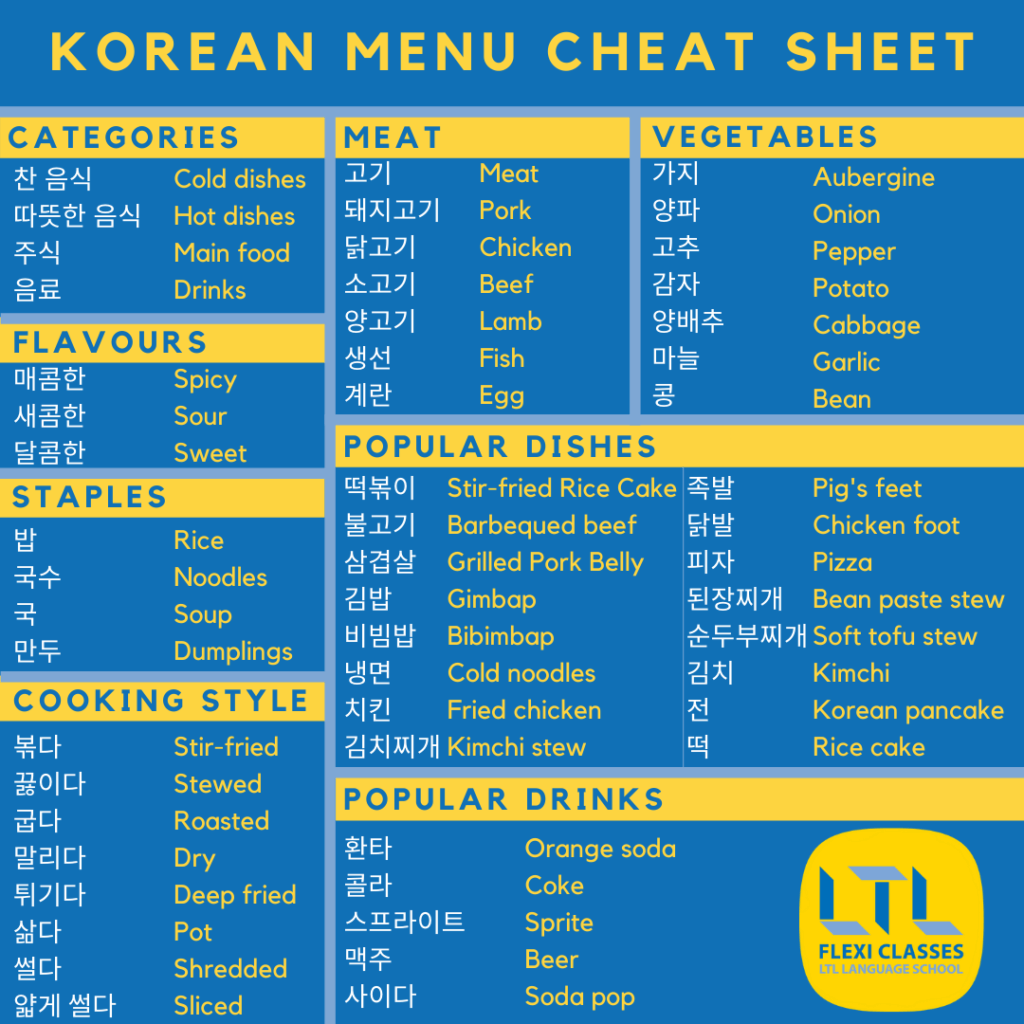
These categories appear everywhere, and recognizing them will help you quickly narrow down what kind of food you are looking at.
With these, you can navigate ordering in a korean restaurant. For western food, you'll need to spend a few hours learning the alphabet so you can start experiencing the world of Konglish.
Even without translation, menus often give you clues.
Pictures are the most obvious. Many restaurants include photos either on the menu or on the wall. If you see something that looks familiar or appealing, pointing to it is completely normal.
Repetition is another clue. If you see the same word appearing across multiple items with slight variations, it usually means a base dish with different ingredients. For example, you might see several items ending in 찌개 (jigae). That tells you they are all stews, just with different main components.
Numbers can also hint at portion size. Larger prices often indicate shared dishes or meat portions, while lower prices usually mean individual meals like rice bowls or soups.
Sometimes you will also see words like 김치 (kimchi), 불고기 (bulgogi), or 비빔밥 (bibimbap) mixed into longer phrases. These are common dishes and can act as anchors when scanning a menu.
If you have food allergies, ordering in Korea requires a bit more caution because menus rarely highlight allergens clearly. Unlike some Western countries, there is usually no standardized allergen labeling, and staff may not always be familiar with how to handle detailed dietary restrictions.
The first thing to understand is that many Korean dishes include ingredients that are not obvious from the name. For example, soups and stews often contain anchovy or kelp-based broth, even if the main ingredient is something else. Sauces frequently include soy sauce, sesame oil, garlic, or fermented pastes. This means that even if a dish looks simple, it may still contain allergens.
It helps to learn and recognize a few key ingredient words related to your allergy. For example, if you are allergic to peanuts, knowing the word 땅콩 (ttangkong) can help you scan menus or confirm with staff. If your concern is shellfish, words like 새우 (saeu, shrimp) or 조개 (jogae, shellfish) are useful to recognize. Even partial recognition can make a difference when you are double-checking a dish.
When communicating with staff, simple and direct phrases work best. Saying something like “[ingredient] 안 돼요” (an dwaeyo), meaning “I can’t have [ingredient],” is often more effective than asking complex questions. For example, “땅콩 안 돼요” clearly signals that peanuts are not acceptable. Pairing this with pointing at a menu item helps reduce confusion.
Translation apps can be useful here, but they need to be used carefully. Instead of translating the entire menu, it is more effective to translate a short sentence explaining your allergy and show it to the staff. This gives them a clearer understanding of your situation than trying to interpret individual dish names.
There are also situations where it is safer to avoid certain types of restaurants altogether. Shared dishes, hot pots, and stews can be difficult to modify because they are prepared in a single pot. Grilled meat places may be easier if you are only avoiding specific ingredients, since you can see what is being cooked.
Even with preparation, there will be moments where the answer is unclear. In those cases, it is better to choose a simpler dish or move on to another restaurant rather than take a risk. Korean dining is generally accommodating, but it is not built around strict dietary customization, so being cautious is the safer approach.
In many situations, you do not need to read the menu perfectly. You just need a simple way to communicate your choice.
Pointing works almost everywhere. If you can identify an item visually or even just want to try something random, pointing and saying a short phrase is enough.
Here are a few useful phrases that go a long way:
이거 주세요 (igeo juseyo) means “this one please.” Igeo means "this" and juseyo is a polite way to ask for something to be given to you.
뭐가 맛있어요? (mwoga masisseoyo?) is how you ask for recommendations; it translates to "What has deliciousness?"
매워요? (maewoyo?) means “is it spicy?” If they say "maewa," that means it's spicy.
몇 인분이에요? (myeot inbun-ieyo?) means “how many servings is this?”
Even if your pronunciation is not perfect, most staff will understand what you are trying to say, especially when combined with pointing.
Translation apps can help, but they work best when used selectively. Taking a photo of the menu and scanning specific items is more effective than trying to translate everything at once. Focus on confirming one or two choices rather than decoding the entire menu.

One of the most common issues is minimum order quantities. Some dishes, especially grilled meat, require you to order at least two portions. This is often written as 2인분, which means “two servings.” If you are dining alone, this can limit your options.
Another common misunderstanding is that many dishes are meant to be shared. A large stew or grilled dish placed in the center of the table is usually for everyone, not just one person. If you are alone, it is safer to look for rice bowls, soups, or set meals.
Side dishes, known as 반찬 (banchan), are typically included automatically. You do not need to order them, and they often come with free refills at many places.
Self-service is also common. Water, utensils, and sometimes even side dishes may be available at a separate station. If nothing is brought to your table, it is worth looking around before assuming you need to ask.
Imagine walking into a small local restaurant with no English menu. The wall is covered in Korean text. You notice several items ending in 찌개 and a few with 덮밥. You recognize that rice bowls are usually individual portions, so you focus on those. One of them has a small picture. You point to it and say “이거 주세요.” That is enough to place your order.
In a busier restaurant, you might feel pressure to decide quickly. Instead of trying to read everything, you can ask “뭐가 맛있어요?” while pointing at the menu. The staff will often suggest something popular, and you can simply agree.
Sometimes people accidentally order too much food. This usually happens when ordering a shared dish without realizing the portion size. If a dish seems expensive or is listed with a serving count, it is worth double-checking by asking “몇 인분이에요?” before ordering.
When you finish your meal, the process of paying is usually simple but slightly different from what some visitors expect.
In many Korean restaurants, you do not pay at the table. Instead, you take your receipt or let the staff know you are ready, then walk to the counter near the entrance to pay.
Splitting the bill is less common, especially in smaller or more traditional places. It is often easier for one person to pay and sort it out separately.
Card payments are widely accepted, so you usually do not need to worry about carrying large amounts of cash.
Once you understand this flow, the entire experience from sitting down to leaving becomes much more predictable.
Ordering food in Korea without knowing the language is less about understanding every word and more about recognizing patterns and using simple strategies. Once you know how menus are structured and what to look for, the experience becomes much less stressful.
You do not need to get everything right. Most restaurants are used to helping people through the process, and small mistakes are part of the experience. What matters is that you can walk in, make a choice, and enjoy the meal without feeling stuck or overwhelmed.

.svg)




Your Instagram preview will appear here once the widget is published.
👉 Publish your site to see the live Instagram feed.