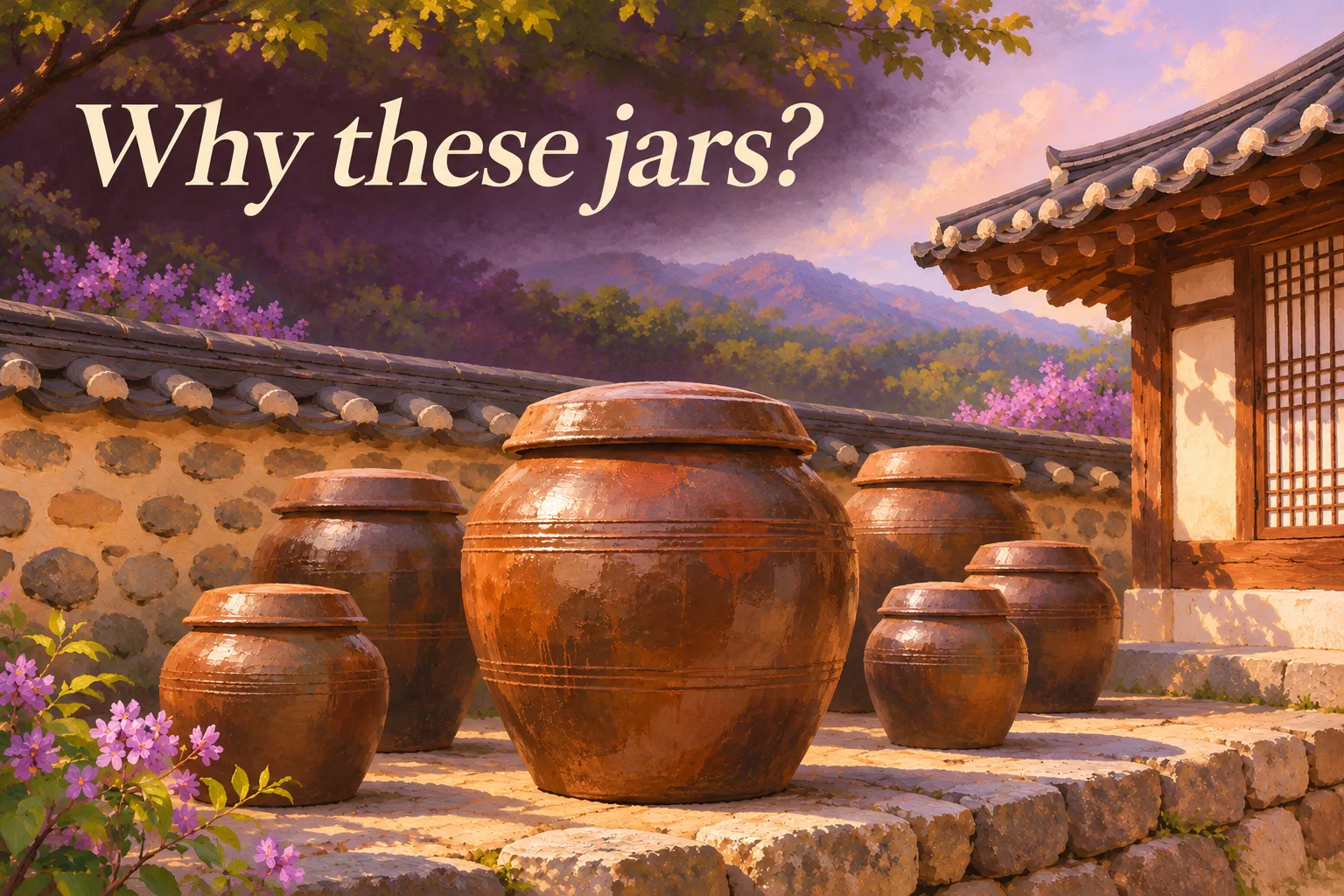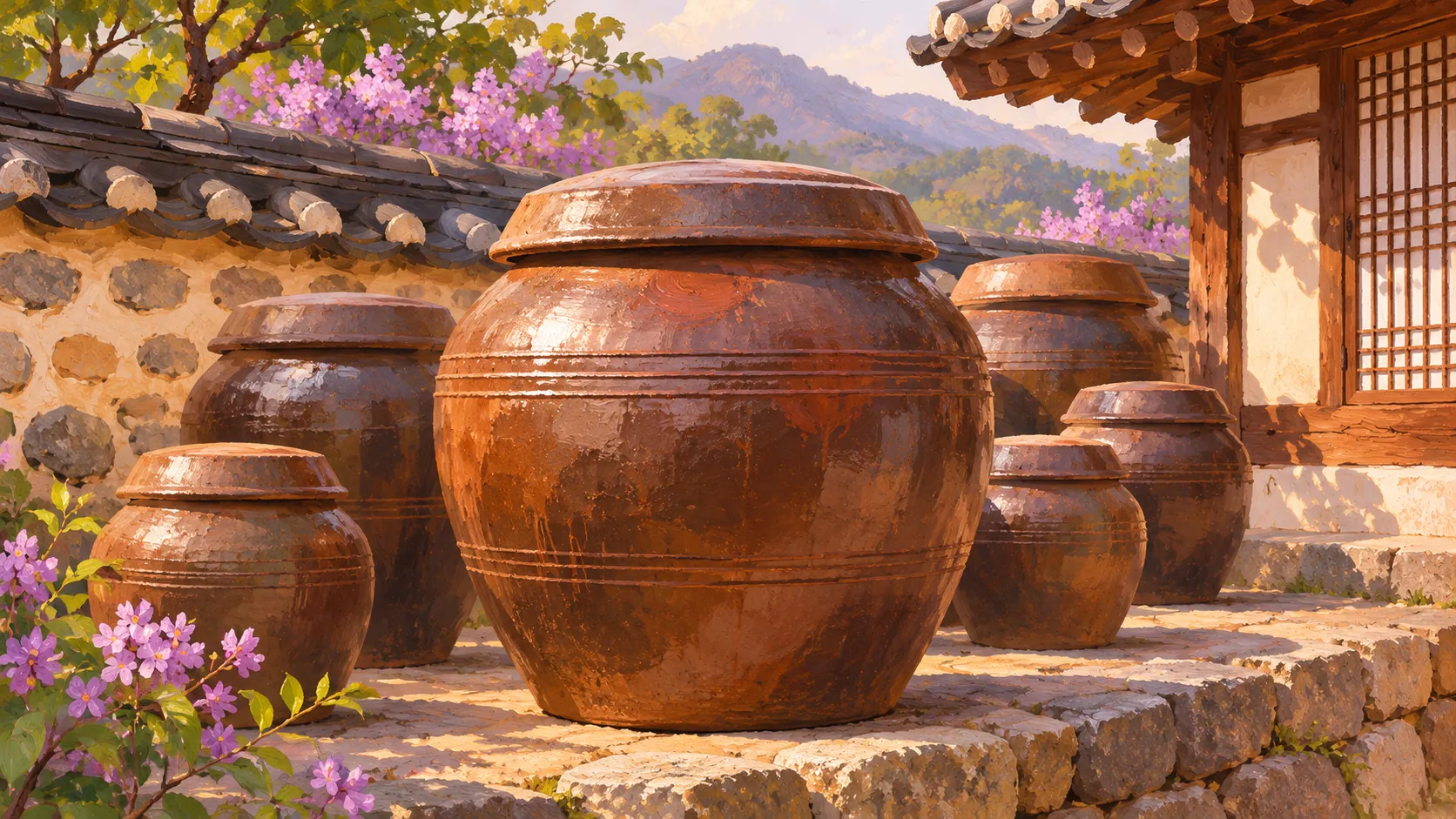
The brown jars arranged outside a Korean house are often onggi: earthenware vessels made for the practical business of keeping food, water and other household supplies. Their rounded bodies and broad lids have become a familiar image of Korean tradition. What makes them interesting is how much work sits behind that apparently simple shape.
A jar begins with someone preparing clay and building walls that must hold their own weight. Once fired, it becomes part of another person's work: preparing ingredients, watching the weather and looking after what is stored inside. Following those two kinds of expertise helps explain both why onggi mattered and why their place in Korean life has changed.
Useful pottery, with a history beyond the display case
Onggi belongs to Korea's long history of earthenware, but there is no single, securely established invention date to put on every brown jar. The Korea Foundation's introduction describes vessels used for rice, fermented foods and everyday objects, as well as earthenware lamps. The category extends beyond the large fermentation jars most visitors recognize.
For the familiar working jars, the National Research Institute of Cultural Heritage's account of onggi craftspeople traces continuity in forms and production practices from the Joseon period. It also points out an uncomfortable contrast: households depended on pottery, while the people making it occupied a low social position.
A later snapshot makes that working world more concrete. Writing for the Smithsonian in 1982, anthropologist Robert Sayers traced the workshops he described to private pottery enterprises of late Joseon. His account connects some of those communities with Catholics who found refuge in pottery-making during nineteenth-century persecution. This is a history of livelihoods and marginal communities, not simply a succession of attractive ceramic styles.
By the early 1980s, the industry Sayers documented still divided work among owners, skilled potters and assistants who prepared clay and glazed vessels. Potters also loaded and fired the kiln. Families often lived near the workshop, while completed jars awaited collection by vendors. The jar on a household platform was therefore connected to a network of specialized labor and distribution.
The Smithsonian account also records change: chamber kilns had increasingly replaced older single-chamber kilns, and urban residents used rooftops and balconies where courtyards were unavailable. These are observations from that period, not a description of every workshop or home today. They show a craft adapting in production and use, even before its later role as heritage became so visible.

What was kept in those jars?
Think of three ingredients: ganjang, soy sauce; doenjang, fermented soybean paste; and gochujang, fermented red pepper paste. These belong to the broad category of jang. They give onggi a connection to food you may already have eaten, even if you have never opened a fermentation jar.
UNESCO's account of jang making includes ingredient preparation, fermentation, aging and storage. It describes knowledge passed through families and also taught by community groups and educational institutions. Some families keep aged soy sauce for decades, making continuity of flavor part of the household's history.
The practice was inscribed on UNESCO's intangible heritage list in 2024. That recognition concerns the knowledge and customs of making jang, rather than a certification of individual jars. Kimchi is another important part of onggi's story, but making kimchi and making jang are different processes. Our guide to kimjang explores the shared work of preparing kimchi for winter.
How a large jar takes shape
A finished vessel hides most of its construction. The heritage institute's illustrated documentation makes the sequence easier to see. It records particular traditional methods, rather than a recipe followed identically by every workshop.
1. Prepare the clay
The maker needs workable material before a recognizable jar can emerge. In the documented process, clay is wetted, unwanted material is removed and its moisture is adjusted before kneading. Where washing and straining are needed, stones and plant matter are separated out. The point is not simply to make the clay look clean: it must be ready to be shaped consistently. The clay-preparation photographs show the labor before the wheel.

2. Build the body and finish the mouth
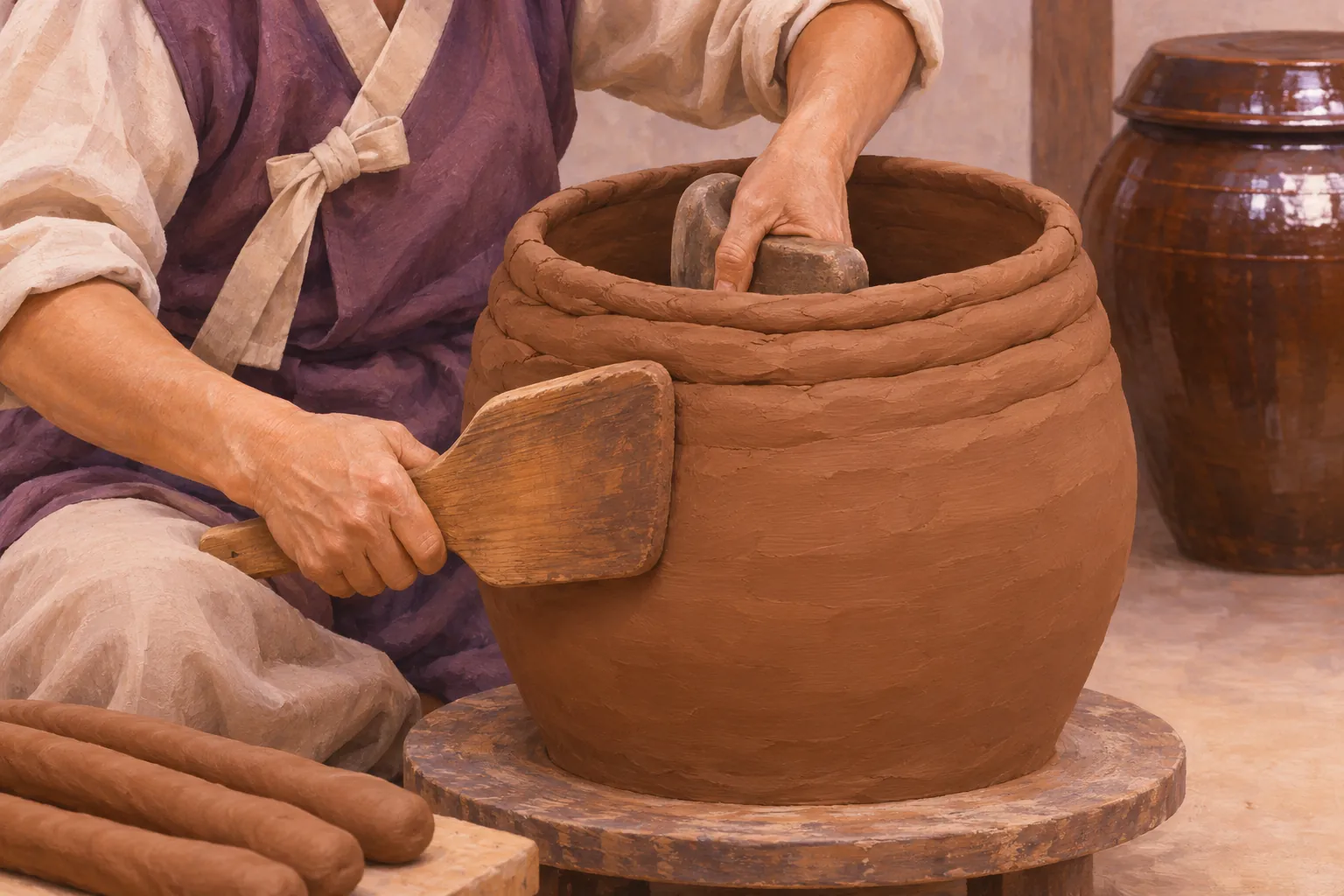
The bottom is made first. Long pieces of clay are added to build the sides, with techniques varying according to the vessel and its size. A large jar is not necessarily pulled from one lump in the way many people picture a small wheel-thrown bowl. The shaping sequence shows coils and slab-like strips being joined and worked into a continuous body.
Watch the relationship between the wide belly and the smaller opening. The maker has to control the growing walls while bringing the vessel toward its intended outline. The rim is a finishing task with a practical role: it forms the opening through which the contents will be handled and over which the lid will sit.
3. Dry, glaze where appropriate, and move carefully
Unfired clay is vulnerable even when it looks like a finished pot. The drying and glazing documentation shows large vessels carried with a cloth sling and explains why drying in strong direct sunlight can cause distortion or cracking. In this glazed method, the shaped vessel dries, receives glaze and dries again before firing.
It is worth pausing over that stage. A large jar has to survive being lifted and moved before it has the strength of fired pottery. The apparent solidity of the shape can conceal how easily earlier work could be damaged.

4. Manage the fire, then the cooling
In the documented wood-fired kiln process, heating begins gradually to drive off moisture before the temperature rises. The potter feeds the fire and observes the kiln through openings, making adjustments as firing continues. Cooling is controlled too; unloading cannot simply begin when the flames stop.
The account describes firing and cooling extending over days. Those times belong to that kiln and method, not a universal schedule for all onggi. The useful lesson is the sequence: preparing a jar includes managing its changes through heat and cooling, not only giving wet clay a handsome outline.

What does it mean for a jar to “breathe”?
The phrase points to a material property, not a living action. In a 2023 study by Soohwan Kim and David Hu, researchers investigated gas movement through an unglazed Jeju onggi. They compared salted cabbage in that vessel with a glass container, measured carbon dioxide and used a mathematical model to interpret its production and escape.
The work helps explain how porous walls can allow fermentation gas to leave a vessel. It does not mean that every onggi behaves identically or that air moves through it like an open window. The experiment involved three trials per condition at 25°C, using salted cabbage rather than a fully seasoned household kimchi recipe.
Those limits matter. The study was not a taste competition, a test of every kind of jar or a guarantee of safe home fermentation. “Breathing” is a useful starting point for understanding the material; it is not a substitute for knowing the food, vessel and storage conditions.
What replaced onggi, and who still uses it?
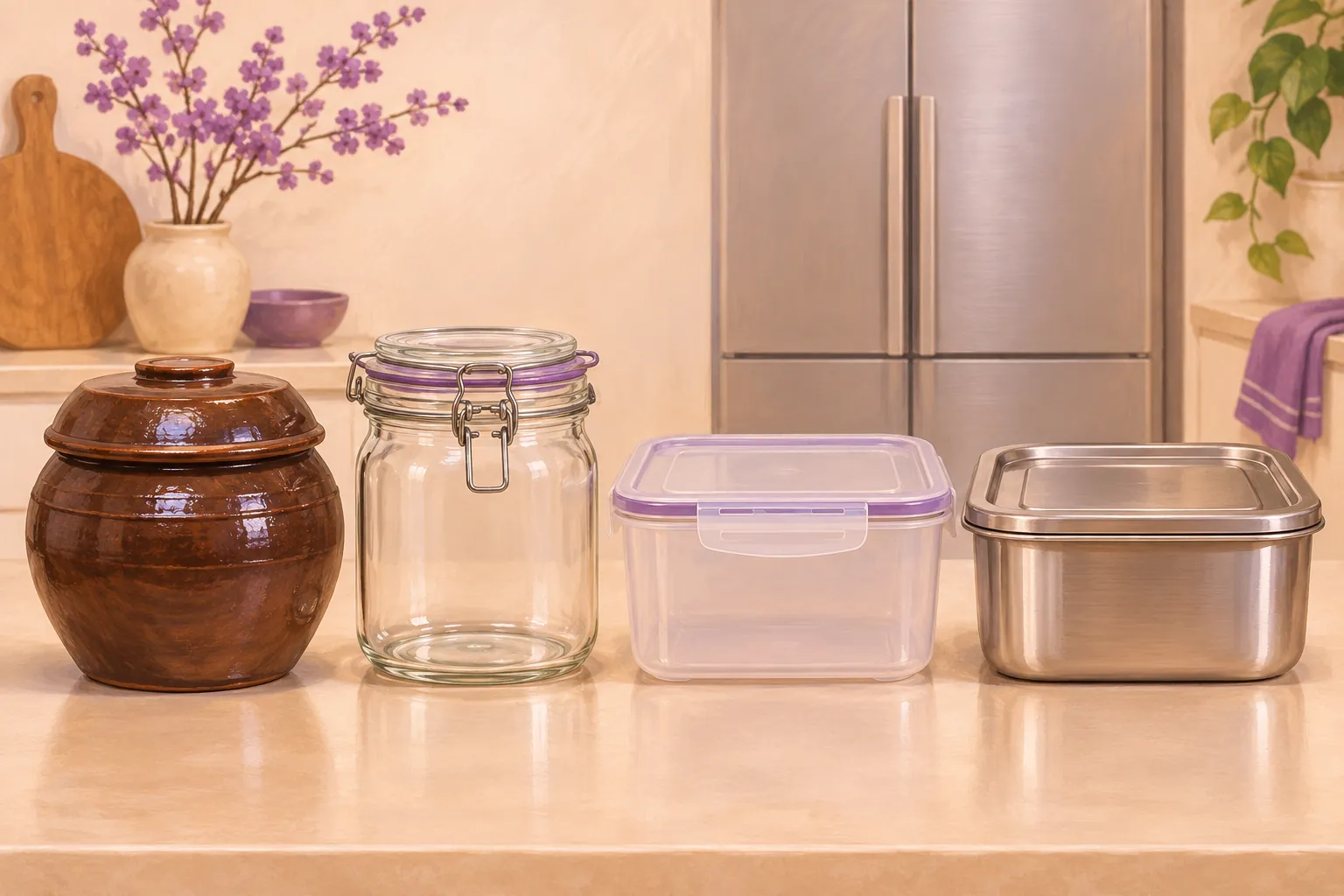
Modern Korean kitchens do not all depend on a courtyard full of jars. In a 2026 essay, National Folk Museum senior curator Lee Kyunghyo describes how piped water, refrigeration and containers made from plastic, glass and stainless steel reduced the everyday need for onggi. The same account follows continuing uses in fermentation, storage, tableware and contemporary design.
Lee also explains that local clay and firing methods create differences among vessels, including Jeju onggi made without an ash glaze. A brown surface alone cannot tell you exactly how a jar was made or what it was intended to hold.
So there are several present-day relationships with onggi: a person using a jar for food, a ceramic artist adapting its form, a household choosing other storage, or a visitor encountering it as heritage. None requires imagining that all Koreans live the same way. The tradition can remain meaningful to someone who does not keep a working jar at home.
Look again at the next jar you see
Start with the opening, the shoulder and the breadth of the body. Look at how the lid meets the rim and whether the surface is glossy, uneven or marked by the making process. If there is a label, check the place, maker, date and intended use before drawing conclusions from appearance.
At a demonstration, watch the joins as well as the wheel. Ask what the vessel is being made to hold and which stages you are not seeing. A few minutes of shaping may be the most visible part of a process whose preparation, drying and firing happen elsewhere.
Then return to the whole object. The jar brings together decisions about clay, shape, heat and use. Knowing a little of that work makes an ordinary-looking row of vessels much harder to overlook.
Sources checked November 18, 2026. This is a cultural and craft introduction, not a home-fermentation method or a report of firsthand workshop visits.
Sources and illustration notes
The following sources informed the history, making process and contemporary context. The process describes documented traditional methods, not a uniform procedure for every workshop.
- Korea Foundation: introduction to onggi — everyday vessels and uses.
- Korea.net / National Research Institute of Cultural Heritage: onggi craftspeople — historical context.
- Robert Sayers, Smithsonian festival program (1982) — workshops, labor and historical adaptation.
- UNESCO: knowledge, beliefs and practices related to jang making — food practices and heritage recognition.
- Korea.net / National Research Institute of Cultural Heritage process documentation: clay preparation; shaping; drying and glazing; firing and cooling.
- Soohwan Kim and David Hu (2023): experimental onggi research — the specific vessel and fermentation experiment discussed above.
- Lee Kyunghyo, Morning Calm (2026) — contemporary uses and alternatives.
Images are AI-generated illustrations of imagined scenes. They do not document a named maker, workshop or historic household. Process illustrations support the written explanation; they are not photographs or instructions for making or firing pottery.