For much of the year, kimchi arrives at the table in a small dish. In late autumn, the scale changes. Cabbages fill basins, radishes become heaps of thin strips, and enough seasoning is mixed to turn a kitchen or courtyard into a winter food workshop.
This is kimjang: the seasonal work of making and sharing a household’s supply of kimchi. It is a practical response to winter, but also a way of passing on family taste, dividing labor and looking after people beyond your own dinner table. Understanding it changes how that familiar red side dish looks.
Kimchi is the food. Kimjang is the relationship around it.
Kimchi is a family of salted, seasoned and fermented vegetables, not a single recipe. Kimjang is the collective tradition of preparing it in quantity for winter. The distinction matters: UNESCO inscribed the making and sharing of kimchi on its Representative List of the Intangible Cultural Heritage of Humanity in 2013, recognizing the shared practice as well as the food.
Late autumn brings the most visible work, but preparation traditionally starts earlier: securing salt and fermented seafood, drying peppers, and following the weather to choose a suitable time. There is no single nationwide kimjang date. Climate, harvests and household schedules shape when people gather.
Sharing is as important as production. A batch can travel to adult children living elsewhere, older relatives or neighbors. Making too much for one kitchen can be the point. For a visitor used to buying fermented food as a specialty product, this is a different frame: kimchi as a household staple and a social obligation, not just an adventurous taste.
Why kimchi was not always red cabbage
The bright red napa-cabbage kimchi most recognizable overseas is one branch of a much older vegetable-preserving tradition. The vegetables and seasonings used to make it changed over centuries.
Chili peppers came to Korea after their arrival in the Old World from the Americas. Their adoption in kimchi was gradual, not an overnight national switch. By the nineteenth century, records describe winter kimchi containing cabbage, radish, garlic, red pepper and salt. The familiar practice of spreading rich seasoning between cabbage leaves developed within that longer history. ICHCAP’s history of kimjang knowledge connects these ingredients to nineteenth-century seasonal records.
The National Institute of Korean History’s account also explains how cabbage cultivation and new combinations of seasonings helped shape modern kimchi. Red pepper is important, but so are the vegetables people could grow and the techniques they used to preserve them. The result is a food that feels timeless while carrying a history of adaptation.
White kimchi and watery radish kimchi make that history visible on the table. They are not watered-down versions for people who cannot handle spice. They belong to the same broad tradition, with their own textures, aromas and uses.
What happens on kimjang day?
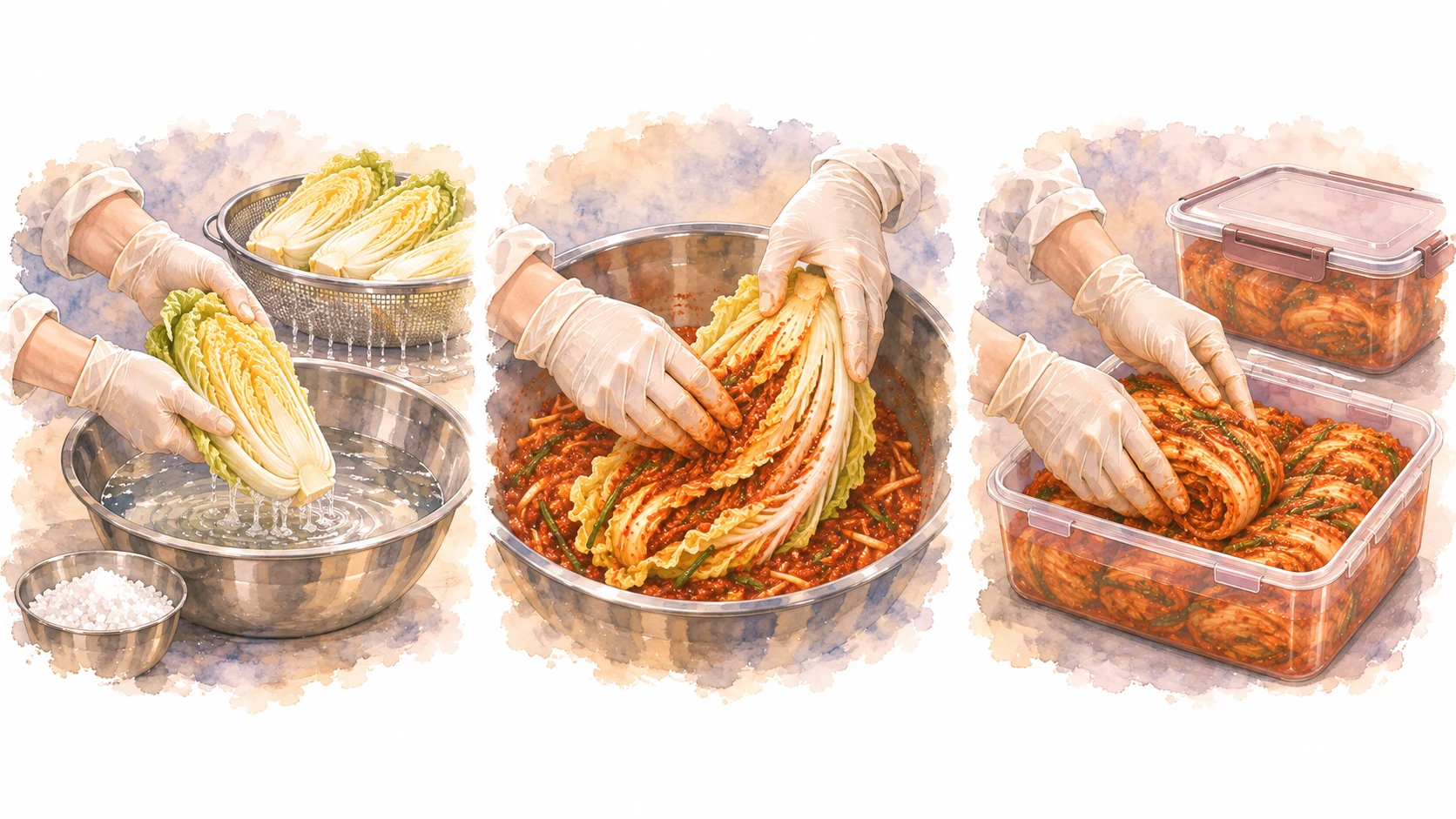
Recipes vary by family and region, but a cabbage-kimchi session usually moves through four recognizable stages. Much of the skill lies in judging texture and taste rather than copying a fixed number of spoonfuls.
1. Salt the cabbage
Napa cabbages are cut or split, then salted so the leaves soften and release water. After salting, they are rinsed and drained. The aim is supple leaves with some bite left, ready to accept seasoning without turning into a watery pile.
2. Prepare the filling
Radish strips, red-pepper flakes, garlic, ginger and scallions are common ingredients. Some recipes use a rice-flour paste, fermented shrimp or fish sauce. Other versions omit seafood. The exact balance is a family signature, which is why two bowls of equally recognizable kimchi can taste surprisingly different.
3. Season between the leaves
The filling is worked between the cabbage leaves rather than merely poured over the top. This is the image most associated with kimjang: people sitting together, handling cabbage after cabbage while conversation moves around the bowls. The repetitive work makes room for younger participants to learn by watching and helping.
4. Pack, store and share
The seasoned cabbage is packed into containers for fermentation and storage. Earthenware onggi jars are part of kimjang’s visual history; modern homes often use sealed containers and dedicated kimchi refrigerators. The equipment changes, but the challenge remains the same: manage temperature and time so the batch develops the flavor the household likes.
Freshly made kimchi offers crisp leaves and vivid seasoning. As fermentation progresses, acidity becomes more pronounced. That changing flavor gives the same batch different roles: a fresh accompaniment early on, then a good candidate for kimchi jjigae or fried rice as it grows sourer.
A kimchi tasting guide: twelve varieties to know

Ordering or shopping becomes more interesting once “kimchi” stops meaning just one thing. The Korea Tourism Organization’s food guide introduces several familiar styles; these twelve show how widely the ingredients, cuts and textures can vary:
- 배추김치 · Baechu kimchi: napa cabbage, often with red-pepper seasoning tucked between the leaves. The leafy and thick-stemmed parts offer different textures.
- 백김치 · Baek kimchi: white cabbage kimchi without the usual red-pepper coating. Its appeal is a cleaner, gentler flavor, not the absence of fermentation.
- 깍두기 · Kkakdugi: cubed radish kimchi with a firm crunch, frequently served beside soups.
- 총각김치 · Chonggak kimchi: small radishes fermented with their leafy tops, giving you both root and greens in one mouthful.
- 동치미 · Dongchimi: radish kimchi in a clear, refreshing brine. The liquid is part of the pleasure, not something to drain away.
- 나박김치 · Nabak kimchi: thin squares of radish and cabbage in a lightly seasoned, often pinkish brine. It is a water kimchi, with a different cut and character from dongchimi.
- 오이소박이 · Oi sobagi: cucumbers slit and stuffed with seasoning, valued for their crispness and often associated with warmer-weather eating.
- 파김치 · Pa kimchi: slender green onions coated in red seasoning, with a pungent bite that softens as they ferment.
- 갓김치 · Gat kimchi: mustard-leaf kimchi, known for its peppery greens and especially associated with the Yeosu area.
- 열무김치 · Yeolmu kimchi: young summer-radish greens with tender stems and small roots. Their refreshing crunch makes them a favorite with cold noodles.
- 부추김치 · Buchu kimchi: flat, narrow garlic-chive leaves seasoned as kimchi. They look different from the round, hollow stalks of green-onion kimchi.
- 깻잎김치 · Kkaennip kimchi: perilla leaves layered with seasoning. Their broad, serrated leaves bring a distinctive herbal aroma.
If you avoid seafood, ask about the seasoning even when the dish looks entirely vegetable-based. Fish sauce and fermented shrimp can disappear into a red paste. Vegan kimchi exists, but “cabbage” alone does not tell you how it was made.
How kimjang fits into modern Korean life
Kimjang does not mean every Korean household spends an autumn weekend making hundreds of cabbages. Supermarket kimchi, smaller households and prepared ingredients all change how people participate. Some families make less; some receive kimchi from relatives; some buy most of what they eat.
That flexibility is part of the tradition’s continued life. Buying pre-salted cabbage reduces one demanding stage without removing the shared seasoning and packing. A community session can introduce people who did not grow up making kimchi to the rhythm of the work.
It is also worth noticing who does that work. The warm image of family togetherness rests on shopping, lifting, washing, cutting and cleaning as well as the photogenic moment of seasoning cabbage. Appreciating kimjang means appreciating the labor, not only the finished jars.
Visit Museum Kimchikan in Insadong

For travelers, Museum Kimchikan is an accessible way to connect the food with its history. It occupies floors 4–6 of Insadong Maru at 35-4 Insadong-gil, Jongno-gu, Seoul, in an area that already fits naturally into a walk through galleries, craft shops and tea houses.
Exhibits explore kimchi culture and fermentation. The museum also runs hands-on programs, so choose between a museum visit and a booked activity rather than assuming admission includes a cooking class. Its official visitor information lists individual adult admission at ₩5,000. General opening hours are Tuesday–Sunday, 10 a.m.–6 p.m., with last admission at 5:30 p.m. It closes on Mondays, January 1, Christmas Day and the three-day Seollal and Chuseok holiday periods.
Anguk Station on Line 3 and Jonggak Station on Line 1 are both walkable. Use the museum’s official directions and map to find the Insadong Maru entrance. An audio guide is available through a QR code in Korean, English, Japanese and Chinese; bring your phone and earphones. Reserve a hands-on program separately through the museum’s current schedule.
What kimchi can add to your diet
Kimchi contributes vegetables, fiber and a strongly flavored accompaniment that can make a meal more satisfying. Fermentation produces organic acids and a changing community of microorganisms. A fresh, unpasteurized product is different from kimchi that has been heat-treated or cooked into a stew.
Human studies suggest possible metabolic benefits, although the clinical evidence remains limited. A 2025 systematic review pooled five intervention studies with 205 participants and found a modest reduction in fasting blood glucose. That is encouraging research on a food, not a reason to treat kimchi as medicine.
Its nutritional value also sits alongside its salt content. Kimchi is usually eaten as one part of a meal, not as a food to consume in unlimited quantities. The most useful everyday approach is variety: enjoy it with other vegetables, protein and staple foods rather than treating a single fermented dish as a shortcut to health.
The best way to understand kimjang is to notice the sharing
You can learn something from a museum, a cooking class or a careful tasting of different kimchi. But the deeper idea is simple: making food for the coming season can also be a way of maintaining relationships.
Once you recognize that, the small plate beside your rice carries more than heat and sourness. It connects preservation, agricultural change, household labor and the people who make sure someone else has enough to eat.
For more seasonal context, explore our guide to Korean holidays and seasonal traditions.
Sources and further reading
Visitor information checked November 10, 2026. Cultural background draws on UNESCO’s kimjang entry, the National Institute of Korean History and ICHCAP’s account of traditional knowledge. Plan a visit using Museum Kimchikan’s official information.