You have found a K-pop fanmeeting during your trip to Korea. There is a stage, a ticket price and, somewhere in the announcement, the word “VIP.” It sounds exciting. But will you actually get to say hello?
A K-pop fanmeeting can be a show you attend as part of an audience. The name alone does not promise a personal conversation, photo or autograph. Those experiences depend on the benefits listed for that particular event, ticket tier or drawing.
That still leaves plenty to enjoy: hearing an artist talk, laughing at a game and sharing a room with people who understand why one particular song matters so much. The useful question is what your booking includes, especially if a brief personal interaction is the reason you are going.
Sources checked October 22, 2026. The examples are dated official notices, rather than current booking offers. The AI-generated illustrations depict fictional people and formats.
What happens at a K-pop fanmeeting?
A fanmeeting, also written “fan meeting,” is an event centered on an artist spending time with fans. It can combine performances with conversation, games and audience participation, as illustrated by UOB LIVE’s venue overview. The balance varies, so do not use the name to predict the set list or running time.
You may also see fancon, combining “fan” and “concert.” Treat that as a clue about the format, then read the actual program. There is no dependable song count or venue size that separates every fancon, fanmeeting and concert.
For a visitor, the atmosphere and language can matter as much as the seat. A talk-heavy program may feel different if you cannot follow the conversation. Check whether the organizer advertises interpretation or subtitles; an international audience does not automatically establish either.
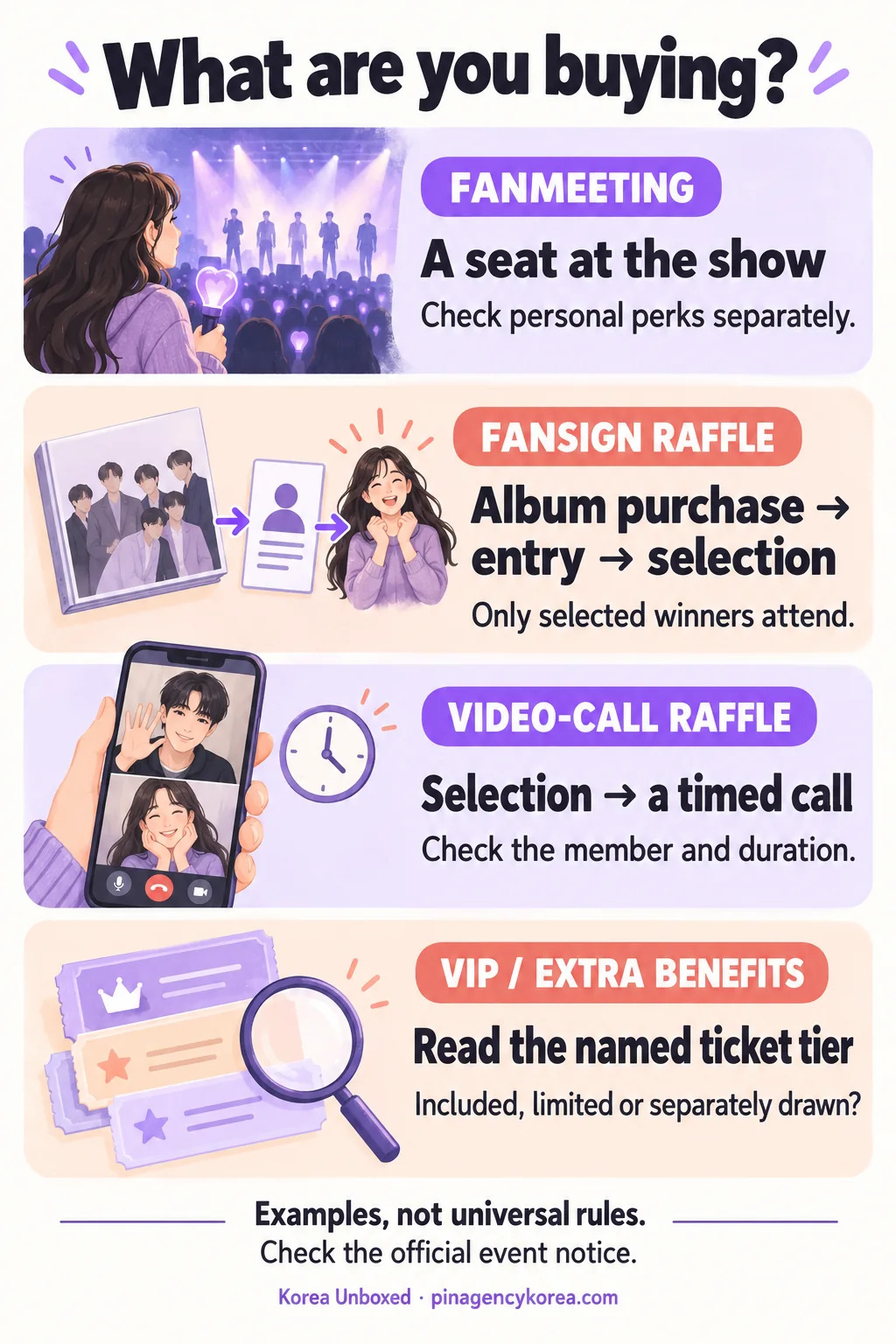
Fanmeeting vs. fansign vs. video call: what are you buying?
Start with the format, then identify the route into it. A ticket purchase and an album purchase linked to a drawing can lead to very different outcomes.
Fanmeeting: access to the advertised show. Read the program and ticket benefits. A seat may be the main inclusion, with any additional greeting, photo or signing described separately. Some benefits may be included for a named tier; others may go only to selected attendees.
Fansign: an advertised signing event. Check how participants are chosen and what can be signed. In the TXT/WITHMUU notice for April 22, 2026, participation was limited to selected raffle winners who bought specified album versions. Buying an eligible album did not itself secure admission.
Video call or fancall: an advertised remote interaction. Look for the artist or member, selection method, platform and stated time. A purchase may require a separate application before it counts as an entry. Selection and identity checks can still come before participation.
Concert: access to the advertised performance. Additional packages need the same careful reading. For TREASURE’s June 2026 Seoul concerts, VIP included soundcheck. That notice did not advertise a personal conversation, individual photo or autograph.
Across all four, keep three labels in mind: included with your valid booking, available only if selected, and not stated. Something attractive in a promotional image is not necessarily a benefit attached to your purchase.

Three official notices, decoded
These dated examples show how the wording works. They are comparisons, rather than a list of events currently accepting bookings.
A fanmeeting ticket: KANGTA in Seoul
The official ticket notice for KANGTA’s November 15, 2026 fanmeeting, published October 19, lists all seats at ₩121,000, including VAT. It sets out membership verification, a member presale and a general sale for remaining seats.
Those are separate steps. Having the relevant membership or completing verification does not reserve a seat. The notice also requires matching names for the membership, purchaser and attendee on the fanclub route.
This ticket-opening announcement does not advertise an individual autograph, photo or conversation. A reader seeking one should look for an explicit additional benefit, including any later official announcement, before counting it in the experience.
A fansign drawing: TXT and WITHMUU
For the historical April 22, 2026 signing, the TXT notice specified 50 raffle winners from purchasers of designated album versions. Other versions did not qualify, and only the winner could attend.
It also limited autographs to assigned pages in the event album. “Fansign” therefore did not mean bringing any object for a signature. No individual interaction time was stated.
The important distinction is between owning an eligible album and being selected for the event. The winner count does not reveal the chance of winning without knowing the total eligible entries.
A selected video call: DxS
The official DxS video-call notice for January 24, 2026 was more specific about personal time: one minute with the selected member, DK or SEUNGKWAN, for successful participants. It listed 60 winners, 30 per member.
Applicants needed the specified event product and a separate raffle application through the purchasing Weverse account. An applicant photocard benefit was distinct from winning a call. Receiving the former did not establish selection for the latter.
The notice also required identity verification and prohibited transferring the opportunity. This was a defined, selected interaction, with conditions attached, rather than an open call available to every purchaser.
Read the benefit, then read who receives it
A benefit list becomes much clearer when you find the words that explain eligibility.
All eligible ticket holders. Check whether everyone receives the benefit or everyone may enter a drawing for it. Those are different promises. In a September 2026 THE BOYZ Japan notice for YOUNGHOON and HYUNJAE’s NINE TO FIVE fanmeeting, all ticket holders were eligible for the special-benefit drawing. The notice listed 600 hi-touch winners and 30 winners for a 2:1 Polaroid session per show. The benefit itself was not included for every attendee.
A named ticket tier. In a historical DOH KYUNG SOO Japan fanmeeting notice, VIP ticket holders received access to a send-off after the August 16, 2026 main event. The notice did not promise a conversation, photo or autograph during that send-off.
Selected winners. Look for a winner count, the selection method and whether you need another application. “Eligible,” “entered” and “selected” describe different stages.
A separate purchase. If an add-on costs extra, establish exactly what it buys and whether it also requires an event ticket. Do not assume the main ticket includes everything shown on the event page.
The Japan examples demonstrate how benefits vary; they do not establish rules for events in Korea. Equally, “VIP” has no single benefit list across artists or countries.
For photos, check the stated arrangement. A group photo and an individual photo are different experiences. For hi-touch or send-off, use the organizer’s description rather than assuming time for a conversation or permission for a selfie. Soundcheck access similarly establishes the advertised soundcheck benefit, with any further interaction requiring its own wording.
What international fans should check before paying
Foreign fans can be eligible for these events. For example, the TXT notice explicitly described accepted identification for non-Korean participants. Eligibility still belongs to the individual event, including its ticket route and age rules.
Before booking, check these five things:
- Follow the official booking chain. Start with the artist, agency or official fanclub announcement and follow its link to the named seller. A familiar artist name on a resale listing does not establish that the listing meets the organizer’s rules.
- Match the event and purchase route. Confirm the city, country, date, member and ticket tier. If Korean and global ticket routes are separate, use the applicable instructions consistently.
- Keep names and accounts consistent. Read the exact requirements before purchasing or applying. The TXT event required a valid physical passport or residence card for non-Korean participants; copies and screenshots were not accepted. Other notices may specify different documents.
- Separate the deadlines. Membership verification, purchase, application, winner announcement and venue check-in may have different windows. Buying within a sale period does not establish that you completed a separate application.
- Read the experience conditions. Check language support, age restrictions, recording rules, transfer and refund terms, and any benefit check-in. For a video call, include the platform, connection instructions and technical-failure policy.
These checks are most useful before arranging travel around an interaction. Save the official notice and confirmation so you can consult the actual conditions, rather than reconstructing them from a social post later.
How much does a K-pop fanmeeting cost, and is it worth it?
There is no single price that answers this across artists, countries and packages. KANGTA’s named November 2026 Seoul fanmeeting lists ₩121,000 seats. For a different format, TREASURE’s June 2026 Seoul concerts listed ₩132,000 general tickets and ₩154,000 VIP tickets including soundcheck. These are dated examples, not a typical-price calculation.
Build your budget around the full route: ticket, any required membership, eligible album purchases and shipping, then transport and accommodation. Check the cancellation terms before assuming an unsuccessful raffle lets you undo a purchase. The DxS notice, for example, restricted cancellation or refund of event-exclusive products after the results.
For a drawing, ask whether you would still be comfortable with the purchase if you were not selected. A winner count alone cannot tell you how many albums will secure a place.
As for value, think about the evening you want. A performance, shared jokes and a room full of enthusiastic fans can be a great reason to go. If your priority is a particular interaction, choose an event whose notice explicitly offers it and understand how participants receive access.
Quick questions
Do you need fanclub membership?
Read the sale rules. Membership may give access to a presale, as in the KANGTA example, while a general sale covers remaining seats. Membership eligibility and a completed ticket booking are separate.
Will you get an autograph or photo?
Only count on the benefit actually listed for your ticket or selection. Check what can be signed, the photo arrangement and any restrictions. The word “fanmeeting” does not answer those questions.
How long do you get with the idol?
Use a stated duration, if there is one. The DxS example specified one minute; a KO1KEYZ notice for October 16, 2026 specified two-minute video calls for selected winners. Neither establishes a standard for other events. A show’s running time is also different from individual interaction time.
Is watching a livestream the same as joining a fancall?
Check whether the product offers audience access to a broadcast or an individual two-way call slot. Those are different experiences, even when both happen on your phone.
If you secure an interaction and are wondering what to say, our guide to talking to a K-pop idol can help you prepare. For another kind of artist-fan communication, see whether K-pop idols can read Bubble messages.
Sources and further reading
Official notices checked October 22, 2026. Past events are used as historical examples. Benefits and booking conditions should be checked again for your own event.
- UOB LIVE: What Is a Fan Meet?. General format overview from a Bangkok venue, accessed October 22, 2026; individual event notices control their own benefits.
- YES24: 2026 KANGTA FANMEETING ticket notice. Published October 19, 2026; Seoul event November 15, 2026.
- BIGHIT MUSIC/TXT: WITHMUU fan-signing notice. Event April 22, 2026.
- PLEDIS/SEVENTEEN: DxS video-call fansign notice. Event January 24, 2026.
- THE BOYZ Japan: NINE TO FIVE special-benefit notice. Published September 14, 2026; Japan event.
- DOH KYUNG SOO Japan: fanmeeting send-off notice. Published August 12, 2026; Japan event August 16, 2026.
- YG Entertainment: TREASURE THE STAGE 2026 ticket notice. Published April 13, 2026; Seoul concerts June 19–21, 2026.
- LAPONE/KO1KEYZ: MAKESTAR signing and video-call notice. Published September 21, 2026; events October 16, 2026.
Original comparison graphic: full-size AI illustration. The format distinctions are also explained in the article text.