Imagine opening your phone to a message from your favorite K-pop artist: Good night, Alex! Your name is there, the screen looks like a familiar chat, and there is a space to answer. It is easy to understand why a new subscriber might wonder how personal the conversation really is.
Yes, Bubble gives artists a way to receive fans' replies. It does not promise an exclusive conversation or prove that an artist paid attention to your particular message. The useful distinction is between receiving artist content, sending a reply, having that reply marked read, and getting a response that addresses it. Those events can mean different things.
Sources checked October 16, 2026, America/New_York. This guide uses public operator guidance and dated research, rather than a hands-on review of a paid account. Features and purchasing terms can differ between Bubble apps and versions.
What is Bubble, and what are you paying for?
Bubble is DearU's artist-to-fan messaging service. It is offered through several branded apps, including Lysn, bubble for JYPnation and bubble with STARS. DearU describes it as a way to exchange messages with real artists and receive artist-specific content. Start with the company's official Bubble overview and your artist's official channels to find the appropriate app.
The experience is organized around the artists you choose. The official Lysn listing, for example, explains that the number of artists you can select depends on the tickets purchased. Do not assume that downloading an app, buying one ticket or joining an unrelated fan club subscribes you to an entire group.
For someone following an artist, the attraction may be a casual update, a voice message or a photo that would feel different from a polished public post. A subscription creates access to that kind of content under the service's terms. How much personal interaction follows is a separate question.
Can K-pop idols see the replies you send?
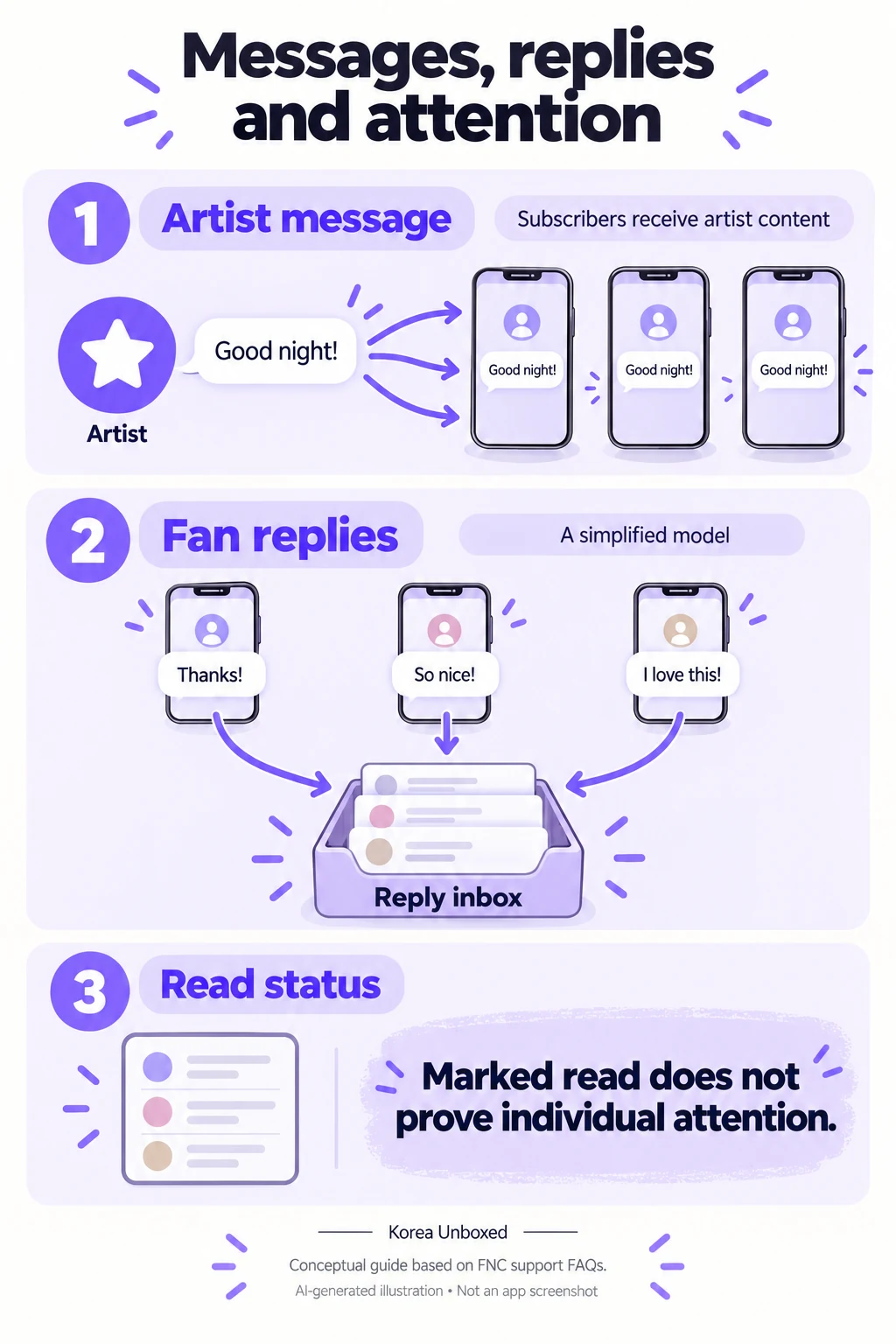
According to Bubble for FNC's official reply FAQ, fans' replies are stored in a reply inbox without a separate notification to the artist. The artist can enter the screen displaying those replies. That is a route for a reply to be available to them, rather than a promise that every new message interrupts their day.
A separate FNC delivery FAQ also notes that prohibited content may be filtered. Sending a message, having it reach the inbox and having someone choose to engage with it should not be treated as one automatic sequence.
This helps explain why a fan's question and the next artist message may not line up. If you ask about dinner and the next update is about rehearsal, that alone does not reveal whether your question was seen, overlooked or simply unrelated to what the artist wanted to share. The interface cannot answer all of those questions for you.
Why does the chat look like a personal conversation?
Each subscriber sees a personal-looking room. However, the FNC one-to-one messaging FAQ expressly says the artist cannot send a message exclusively to only one subscriber. A room that feels private to its reader is different from a message composed and delivered only to that person.
Personalization adds another layer. The STARS web-store guide tells subscribers to set their nickname so an artist can address them by it. Seeing your name is therefore not, by itself, evidence that the whole message was individually written for you.
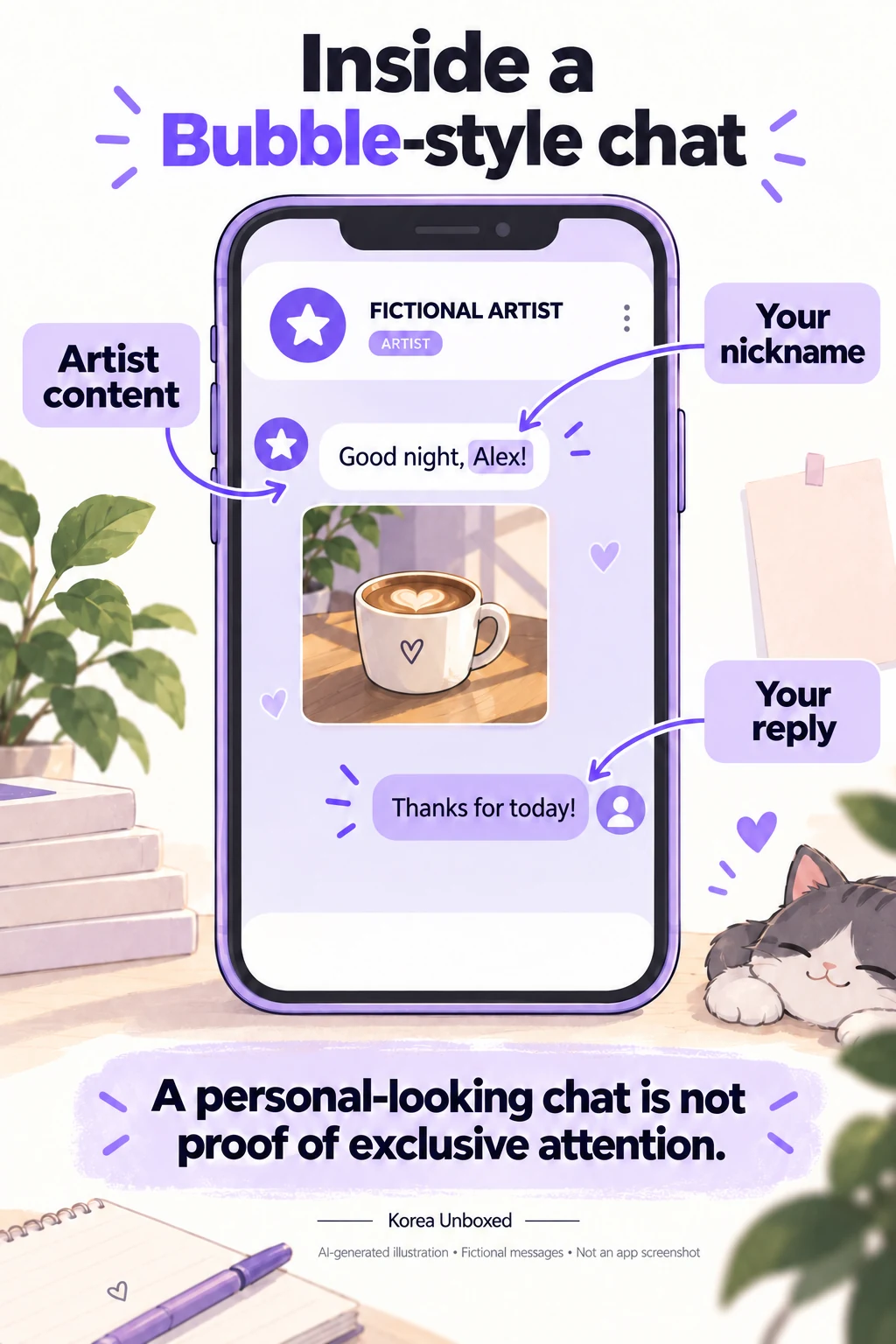
For the fictional example above, imagine several subscribers receiving an address using their own preferred nickname. The useful question is what the service's personalization tells you, rather than whether the greeting sounds warm. A message can be welcoming and meaningful without being exclusive.
Does a read status mean an idol read your message?
The FNC reply FAQ gives a more specific explanation than a simple read/unread label suggests: replies are sequentially marked read when the artist enters the inbox screen displaying the list. It also says network conditions can affect the timing. That describes a processing event, not a record of how carefully the artist considered each reply.
So a change in status is not enough to establish that your exact wording was noticed, understood or remembered. It also does not establish the opposite. The evidence is narrower: the system recorded the read-status event described in its guidance.
You may have seen fans discuss a small number 1. Nielsen Norman Group's October 2022 usability research documented that indicator and how its disappearance could create a feeling of being noticed. That is dated interface evidence. We have not verified the same icon behavior in every current Bubble app, so the guide below focuses on the supported distinction between read status and individual attention.
Can an artist reply to one specific fan on Bubble?
This is where the word reply can become confusing. An artist can respond to something a fan said without opening an exclusive private exchange with that subscriber.
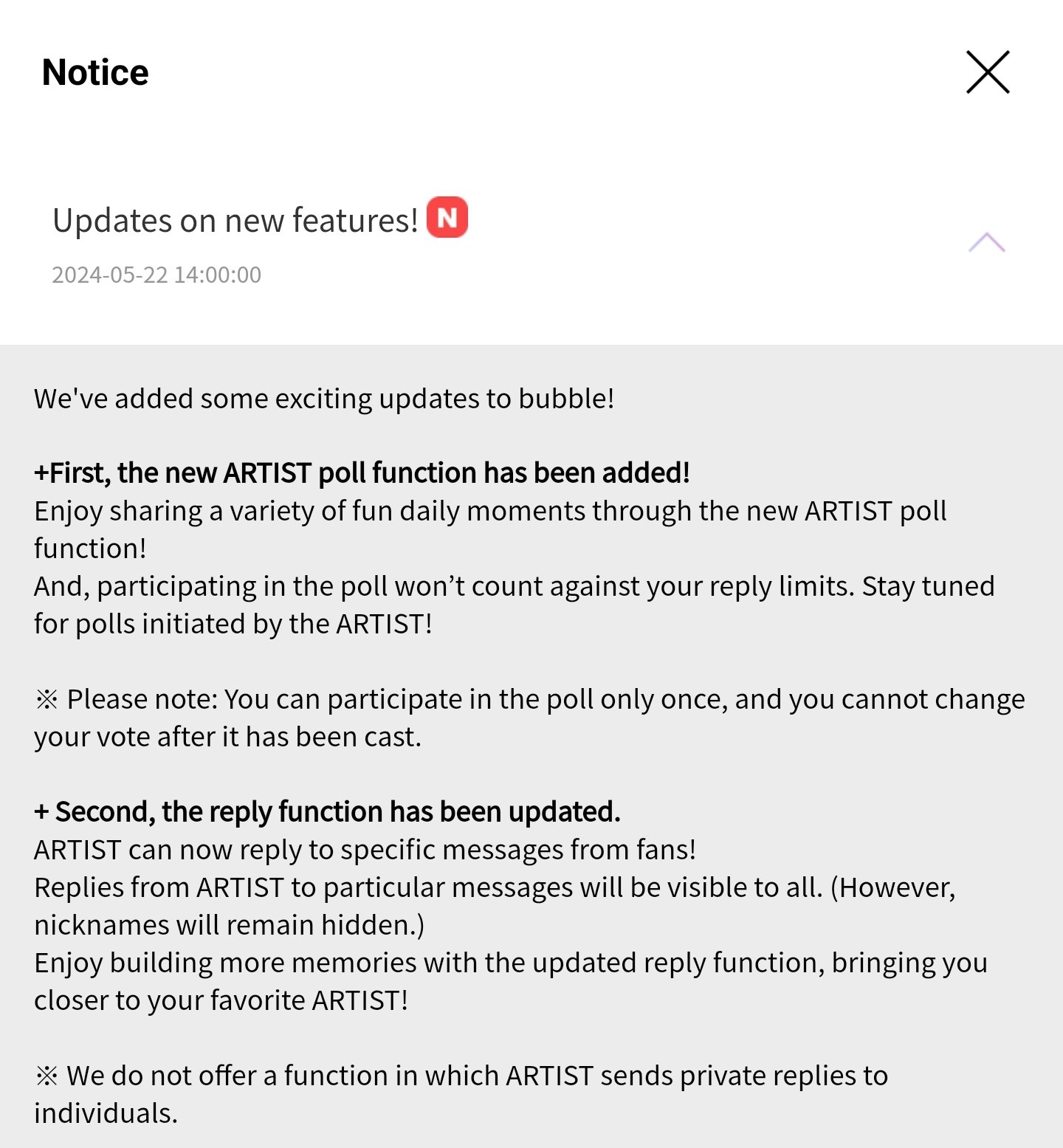
A Bubble feature notice dated May 22, 2024, reproduced in this contemporary report, explains an optional selected-message reply feature. The notice itself says artist replies to particular fan messages are visible to all, while the fan's nickname remains hidden. It explicitly distinguishes that feature from private replies sent to individuals.
Think of a performer choosing one audience question and answering it for the room. There is a particular question behind the answer, but everyone can hear the response. That analogy explains the distinction; it is not a claim about the artist's exact screen or selection process.
The notice establishes what was announced in 2024. It does not confirm the feature's present availability in every branded app. This is why broad claims that artists can never answer a particular fan, or that a selected reply creates a private conversation, can both mislead.
Why fans can understand the system and still enjoy it
Understanding shared delivery does not make a good-morning update or a funny voice note meaningless. Someone may enjoy receiving an artist's casual thoughts in a familiar place on their phone, even while knowing that other subscribers receive the content too.
The 2022 Nielsen Norman Group research, based on interviews and usability testing with adult fans in Seoul, described participants who understood the messaging model and still valued the experience. It helps explain why treating all subscribers as people who have been fooled misses something about the product's appeal.
A peer-reviewed study published in May 2026 also examined subscription routines and the feeling of being noticed. Its fieldwork included a 275-day subscription during 2024–2025 and interviews with six female fans aged 19–25 in the context of Chinese K-pop fandom. It is a small, specific study, not a survey of every Bubble user or a test of today's features.
For a reader deciding whether to subscribe, a more useful question is whether the content and experience are worth the cost to you. If the value depends on an idol recognizing you personally, the service's visible signals cannot give you that certainty. If you enjoy the updates themselves, you can assess that experience without needing to turn each one into evidence of a private relationship.
What to check before you subscribe
First, confirm the artist, the correct app and what the ticket includes. Then read the current price and renewal terms on your purchase screen. Prices and purchase channels can differ, so an old screenshot or another fan's payment amount is not a reliable quote for your own subscription.
The STARS web-store terms say tickets renew monthly and do not guarantee the frequency or availability of artist messages or live broadcasts. They also explicitly warn that web-store refund policies can differ from in-app policies. That means you should check the terms for the place you actually pay, including how to stop renewal.
It is also worth deciding what would make the subscription enjoyable before the first notification arrives. Occasional content, convenient translations and the possibility of a shared interaction are different expectations from a regular personal conversation. Having that distinction clear makes the purchasing decision easier to judge on its own terms.
Common questions about Bubble messages
Are Bubble messages fake?
The FNC operator FAQ says artists write and send their messages directly. That is the operator's description, not our independent audit of every message. Shared distribution alone does not mean the content is fabricated or computer-written.
Do you need to speak Korean to use Bubble?
Translation tools are available. The FNC translation guide describes selecting a language and tapping the translation button. Features vary, and a translation may not preserve every joke, nickname or tone. Check the options in the app you use.
Does paying guarantee a personal reply?
No exclusive personal exchange is promised by the messaging guidance discussed here. A subscription, an available reply route and a response to a selected fan message are different things. Check the named service's terms rather than assuming payment guarantees attention.
Can I post screenshots of artist messages?
Read the content rules first. The STARS terms identify subscriber content as exclusive and warn against leaking it. Our graphics use fictional messages and original illustrations; they are not screenshots of paid artist content.
Bubble can bring an artist's updates into an intimate-looking space. The part you can verify is how the service delivers content and handles replies. The part a status indicator cannot settle is what your particular message meant to the person on the other side.
Sources and further reading
Official service and app guidance
DearU: Bubble service overview; official Lysn App Store listing; official STARS listing and promotional interface references. Accessed October 16, 2026; listing and service details can change.
FNC one-to-one messaging FAQ; reply inbox and read-status FAQ; reply delivery/filtering FAQ; artist-authorship FAQ; translation FAQ. Korean, undated, app-specific guidance retrieved October 16; some pages were intermittently unavailable.
STARS Nerd Connection web-store terms and instructions. English, accessed October 16; this product's terms do not establish every app or purchase channel's policy.
Dated feature notice and research
Koreaboo: report on the selected-message reply update, May 22, 2024; reproduced Bubble-authored notice, timestamped May 22, 2024. The notice image was inspected; current rollout across all apps was not verified.
Lillian Yang, Nielsen Norman Group: How K-Pop Apps Create the Illusion of Private Messaging with Celebrities, October 2, 2022. Dated user research, not a current universal interface specification.
Qi Zheng: Proceduralized Intimacy: A Procedural Rhetoric Approach to Idol Subscription in Chinese K-pop Fandom, first published May 19, 2026. Includes 2024–2025 fieldwork and six interviews; findings have that scope.
Related Korea Unboxed reading
Are K-pop Idols Allowed to Date? Privacy, Public Image, and One Personal Account. A companion cultural feature about relationships and public expectations, rather than independent evidence of Bubble's features.