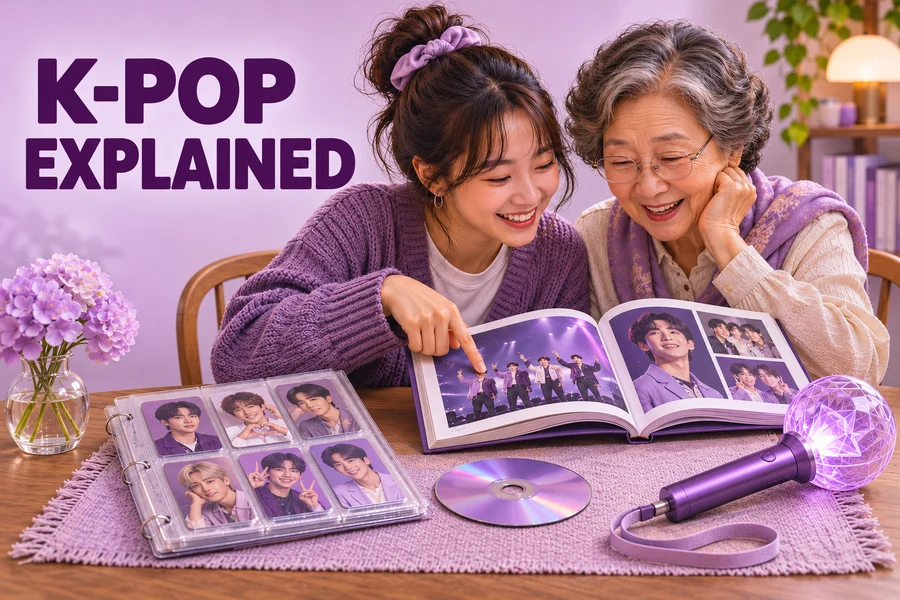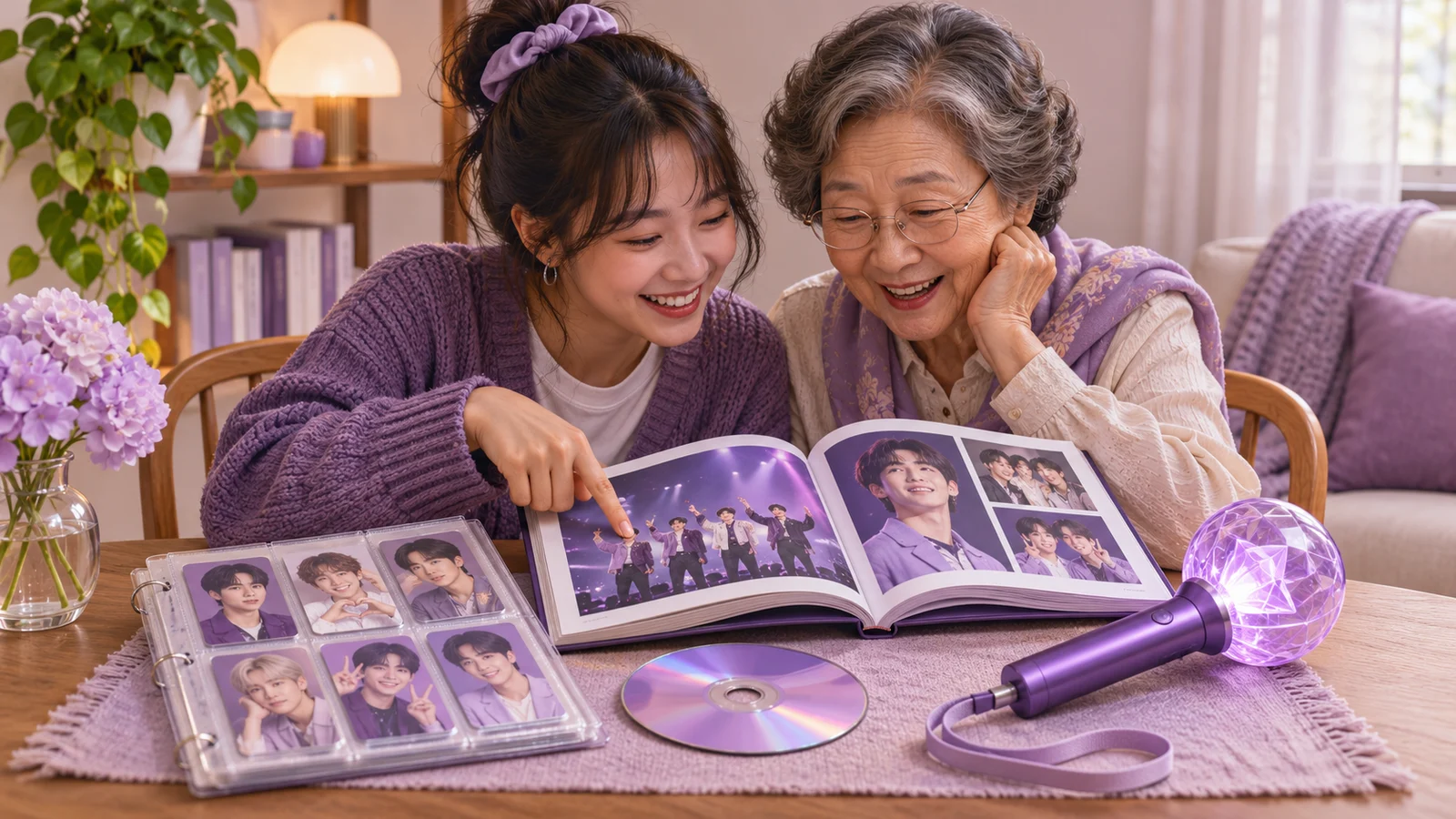
Someone you love has a new favorite group. They mention a comeback, show you a tiny photo in a plastic sleeve and explain that the person in it is their bias. You would like to follow the conversation. You might also like to buy a birthday present without accidentally choosing the wrong thing.
K-pop is short for Korean pop music. This guide focuses on the idol groups, releases and fan culture you are likely to encounter around it. The conversation gets much easier to follow once the words have something familiar attached to them. A comeback is a new release. A bias is a favorite member. A photocard is a small collectible photograph. The interesting part is how the music, people and objects fit together.
This is a starting point for new listeners, curious friends and families. We will follow the words you encounter while discovering a group, watching its videos, opening an album and joining the audience.
Start with the people: group, member, bias and fandom
In K-pop, an idol is a performer promoted through an entertainment company, often as part of a group built around singing, dancing and appearances on screen. Some perform solo. A member is one person in a group. Knowing a fan's favorite group is a good start, but their favorite member can matter just as much when choosing a gift.
A bias is that favorite member. Someone may love the whole group and have a particular fondness for one person's voice, dancing, humor or personality. An ult, short for ultimate bias, is their overall favorite across the artists they follow. The Korean word choeae (최애) also expresses a most-loved favorite. Korea.net's account of a fan-made dictionary commissioned by the Korean Cultural Center in Germany explains this overlap between Korean and international fan vocabulary.[1]

“Who is your bias?” is an easy question to ask a fan. A follow-up such as “Which performance made you like them?” can lead to a much better introduction than trying to memorize everybody's name from a group photo.
The fandom is the community of fans. Groups often have a name for that community, which fans use to recognize one another. You may hear someone introduce themselves using a fandom name long before they mention buying anything. A paid fan-club membership is a specific product with its own benefits and terms. Enjoying the music and calling yourself a fan is open to you from the start.

Two more words help with interviews. The leader has a coordinating or representative role in the group. The maknae (막내) is the youngest member, a Korean word that also applies to families and other groups.[2] When a caption calls an adult performer the maknae, it is describing their place in that lineup.
What happens when a group has a comeback?
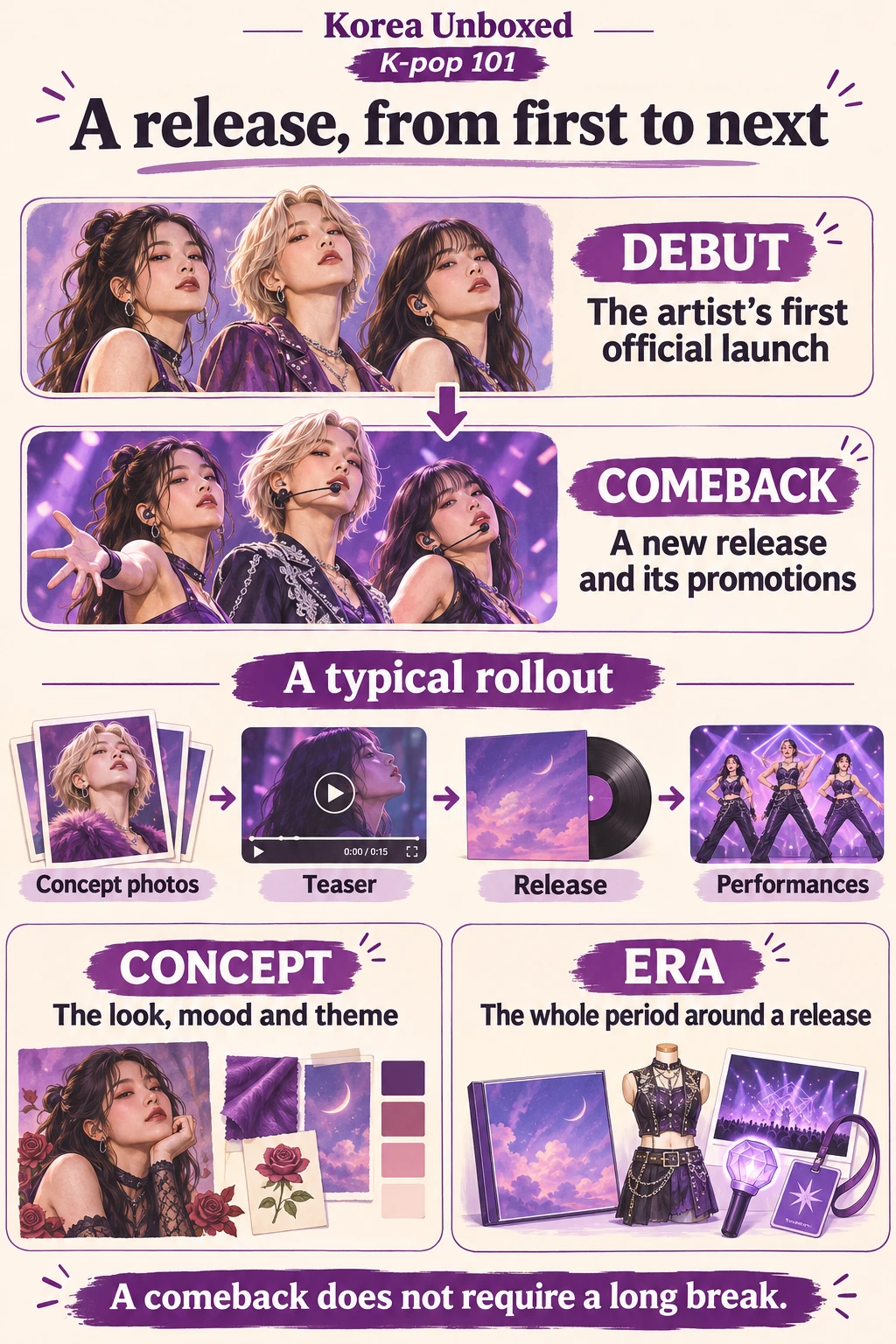
A debut is an artist's first official launch. A comeback is a new music release and the activity surrounding it. A busy group can have several, with new photographs, videos and performances giving each release its own mood.
That look and mood is often called the concept. Fans may refer to the whole period as an era: the songs, styling, choreography and memories associated with it. Someone who loves one era might particularly like that release's album photographs, even if a newer album is available.
The rollout can be part of the fun. Concept photos reveal the styling. A teaser gives a short preview. The track list names the songs. A highlight medley previews parts of several tracks. On release day, fans listen to the album and watch the MV, meaning music video.
You can see several of these pieces together on BIGHIT MUSIC's official page for TOMORROW X TOGETHER's 2024 release minisode 3: TOMORROW. It presents a concept trailer, a preview, two teasers and the full “Deja Vu” music video. Opening that page makes the sequence much easier to picture.[3]
Title tracks, B-sides and mini albums
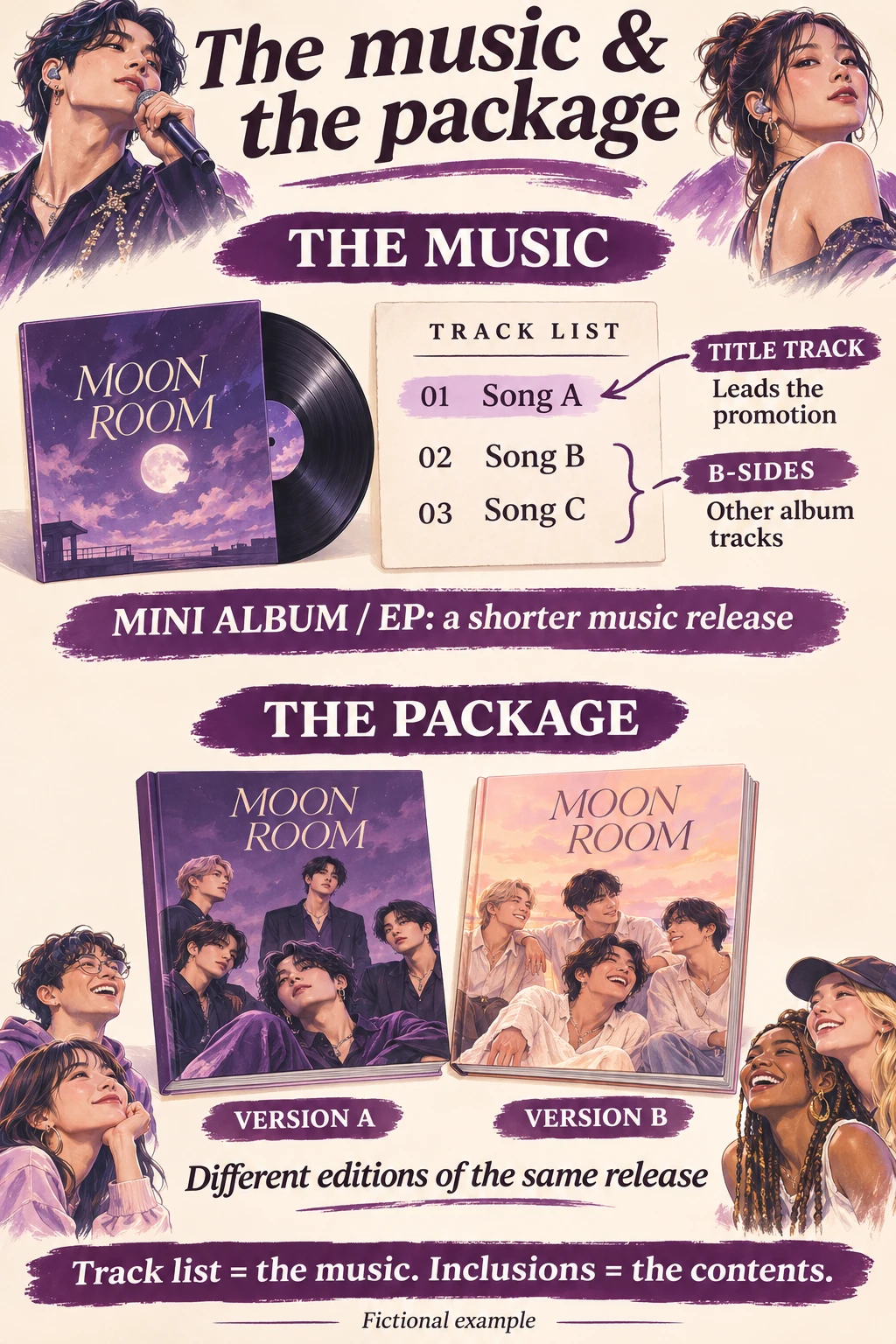
The title track is a song selected to lead the release's promotion. Its title can differ from the album's name. B-sides are the other album tracks in common fan usage, and a fan's favorite song may be among them.
A mini album, often called an EP (extended play), is a shorter release than a full-length album. “Mini” describes the music release, so the physical package can still be a substantial book or box. A single album is another release format with a small number of tracks. To know what you will hear, look at the track list; to know what will arrive in the mail, look at the product's contents.
Which video should you watch first?
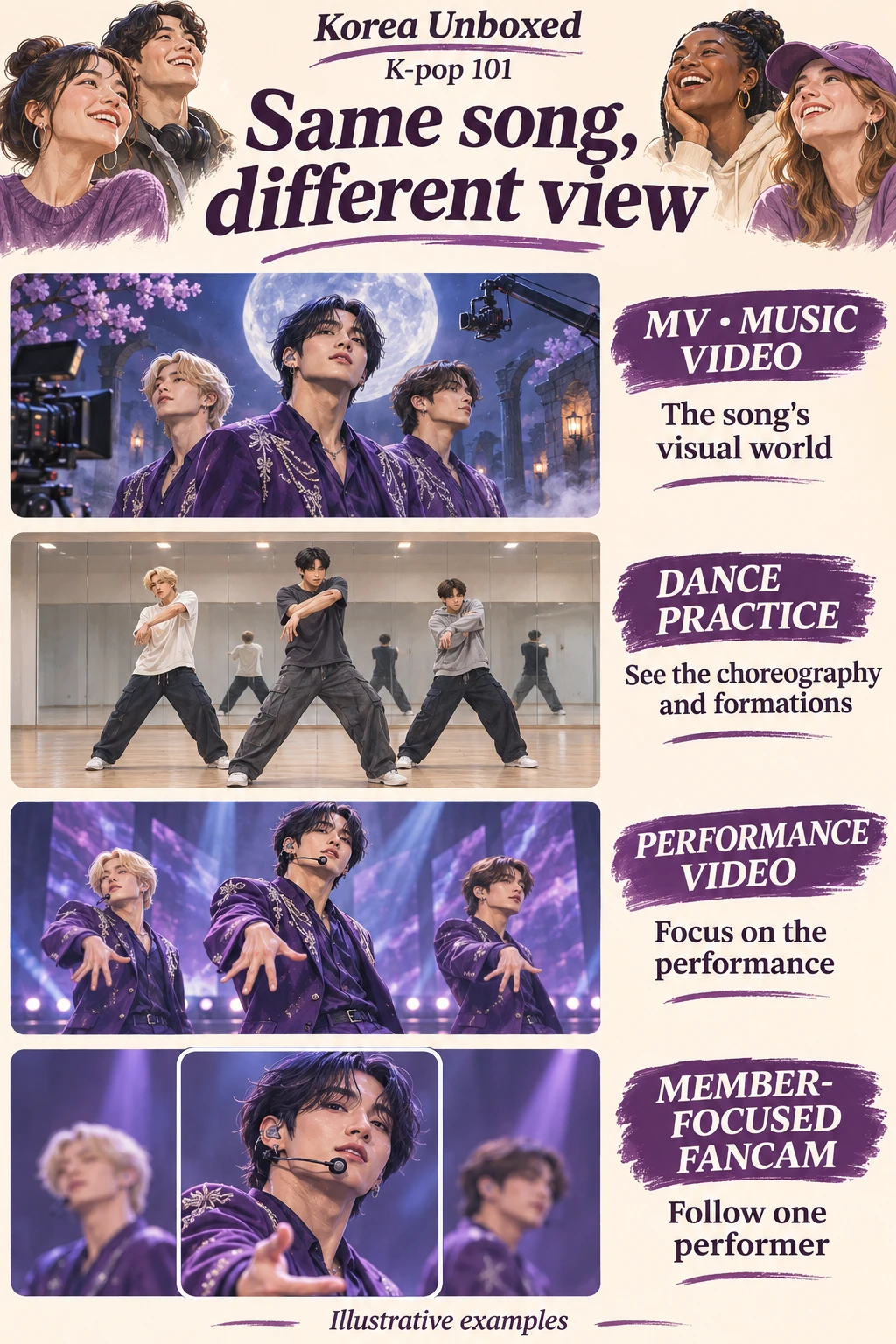
Start with a music video if you want the song's visual world: sets, costumes, editing and sometimes a storyline. Then watch a dance practice to see the choreography more continuously, including how the members move around one another. A performance video emphasizes the performance, often with its own lighting and camera work.
A fancam follows a particular performer or performance. Broadcasters also produce member-focused videos under this label. If you keep losing track of the person your friend is pointing out, a member-focused fancam makes it easier to follow their expressions and dancing.
Try M2's official Yeonjun fancam of “Deja Vu” alongside the music video linked above. You are hearing the same song while the camera gives you a different way to enjoy it.
Watch the fancam on YouTube if the player does not load.
A music show is a television program featuring artist performances. The first promotional appearance for a new song is often called a comeback stage. Fans also celebrate music-show wins, which are awards made under the individual program's scoring rules. Soompi's established culture glossary explains the comeback-stage terminology.[4] Our music-show attendance guide covers the separate question of getting into a recording in Korea.
Open the album: photocards, versions and inclusions
For many fans, a physical album is also a collection of photographs and design. A package might contain a CD, a photo book, postcards, stickers and small photo cards. The list of those objects is usually called the inclusions.
A photocard, often shortened to PC, is a small collectible card featuring a performer. Think of a trading card, often with a portrait or selfie on one side and a designed back. Fans may put them in protective sleeves, display a favorite in a holder, or arrange them in binder pages.

The appeal can be wonderfully specific: a favorite member, an outfit from a favorite performance, or an expression that makes the fan smile. Two cards showing the same person can therefore be very different gifts.
A pull is the card or other random item someone finds when opening a package. “I pulled my bias” means the random card featured their favorite member. A product listing that says “random 1 of 6” supplies one card from six possibilities. Buying a sealed album can preserve the surprise, while buying a clearly identified individual card can suit someone seeking one particular picture.
An album version is an edition of that release. Versions can have different covers, photographs, packaging or inclusions. A member version may feature one performer on the package. The product description determines whether the cards inside also match that member.
A POB is a preorder benefit: an extra item offered with qualifying advance purchases, often by a particular shop. An album photocard and a shop bonus photocard can therefore be two separate things in the same order. The official TWS TO US preorder notice gives a concrete example, with different bonus-card quantities and designs attached to different editions and order types.[5]

Our album-buying guide compares those offers side by side. Use it when you are choosing a specific purchase; here, the key is recognizing which part of the package the fan cares about.
Buying a gift? Match it to what the fan enjoys
“What group do you like?” gets you to the right shelf. “Which member, album or card are you collecting?” gets you much closer to a present they will love. Asking for a link or a picture keeps the excitement while removing the guesswork.
On a phone, swipe across the table to see all three columns.
On secondhand listings, album only may mean that a seller has kept the cards and is offering the remaining package. Sealed generally describes an unopened product. Ask for the exact included items and condition if the listing is unclear. For a collector, a missing card or an unwanted duplicate can matter more than the size of the box.
Lightsticks and fanchants: joining the audience
A lightstick is a handheld light fans bring to performances. Official designs give a group's audience a recognizable object to hold, and compatible models can participate in coordinated concert lighting. They are also display pieces and keepsakes.
For a recognizable real example, BLACKPINK's official lightstick product photos show its black handle and pink, heart-shaped ends. The linked listing is a product reference and currently displays sold out.[6]
Models and concert setup matter. &TEAM's official app guidance, for example, explains how to connect a lightstick to a phone using Bluetooth and check whether a concert requires pairing. If a lightstick is a gift for an upcoming show, the event's instructions are worth reading before choosing the model.[7]
A fanchant is a coordinated audience response timed to a song. It may include names, repeated words or lines sung with the performers. Artists publish guides so fans can join in. SEVENTEEN's official cheering guide for “사랑 노래” shows the audience's parts within the song.[8] Hearing a crowd land the same response together is part of what makes a familiar song feel different in a venue.

Fanmeeting, fansign and video call: what happens at each?
A fanmeeting is generally a staged event for an audience, with a mix of talking, games and performances. The name can sound intimate to a newcomer, but the usual experience is watching from your seat. Any individual interaction needs to be included in the named event's offer.
A fansign involves selected fans meeting performers for brief signing interactions. A video-call event offers an online interaction, usually for a stated time. Entry often involves qualifying purchases and an application or draw, so these take more planning than buying a concert ticket.
For example, the official JxJ DREAMSCAPE notice for November 5, 2026 offered selected winners a one-minute call with a member, following an eligible purchase and completed application. That event has ended, but it makes the format concrete.[9] Our fanmeeting and fansign guide explains the experiences in more depth.

A good first conversation starts with one song
You can let a fan introduce the rest. Ask them to play the song that got them interested, show you their favorite performance or point out the card they would save first. Their answer will tell you more about their taste than the size of their collection.
And if you are the new fan, start with whatever caught your attention. Listen to the other tracks, watch a performance and learn the names at your own pace. The vocabulary becomes familiar as you find things you enjoy.
K-pop jargon dictionary
A quick alphabetical reference to the terms in this guide. Fan vocabulary is informal, so usage can vary.
Album version: An edition with its own cover, photographs, packaging or inclusions.
Bias: A fan’s favorite member in a group.
B-side: An album track other than the main promoted title track, in common fan usage.
Choeae (최애): A Korean word for a most-loved favorite.
Comeback: A new music release and its surrounding promotions, even without a long break.
Comeback stage: A first promotional performance of a new song on a music show.
Concept: The look, mood or theme of a release.
Concept photos: Promotional photographs showing a release’s styling and visual theme.
Dance practice: A video showing the choreography, usually with a clearer view of the full formation.
Debut: An artist’s first official launch.
Era: The period around a release, including its music, styling and performances.
Fan-club membership: An optional paid program with artist-specific benefits, eligibility rules and terms.
Fancam: A video focused on a performer or performance. Broadcasters make them too.
Fanchant: A coordinated audience response timed to a song.
Fandom: The community of fans around an artist or group.
Fanmeeting: An audience event featuring conversation, games or performances; individual interaction depends on the event.
Fansign: An event offering selected fans brief signing interactions with performers.
Group: Performers who work together under a shared name.
Highlight medley: A preview of parts of several tracks on a release.
Idol: A performer in K-pop’s entertainment-company system, working in a group or solo.
Inclusions: The items listed as part of an album package.
Leader: A member with a coordinating or representative role in a group.
Lightstick: A handheld light fans use at performances or keep as merchandise.
Maknae (막내): The youngest person in a group.
Member: One person in a group.
Mini album / EP: A music release shorter than a full-length album; the physical package can still be large.
MV: Music video.
Photocard / PC: A small collectible card featuring a performer, often with a portrait or selfie.
POB: Preorder benefit: an extra item supplied with a qualifying advance purchase.
Pull: The random card or item found when opening a package.
Teaser: A short preview released ahead of the full content.
Title track: A song selected to lead a release’s promotion; its name may differ from the album title.
Track list: The list of songs on a release.
Ult / ultimate bias: A fan’s overall favorite across the artists they follow. “Ult group” means their favorite group.
Video-call event: An online fan interaction with stated entry conditions and a set duration.
Sources and further reading
Sources checked November 16, 2026. Fan vocabulary is informal and usage can vary between communities. Product and event references below illustrate the named formats; their individual sales and entry conditions apply to those offers.
- Korea.net: Korean Cultural Center in Germany releases “K-pop dictionary”, February 22, 2022. Fan vocabulary and the relationship between ultimate bias and choeae. ↩
- Korea.net: Seven Korean words added to Oxford English Dictionary, January 2025. Definition of maknae. ↩
- BIGHIT MUSIC: minisode 3: TOMORROW, 2024 release page. Album, trailer, preview, teasers and music video. ↩
- Soompi: K-Pop Culture Glossary, January 21, 2012. Used for established terminology, particularly comeback stage. The glossary's dated industry rankings, age conventions and chart details are outside this guide's scope. Video example: M2, TXT Yeonjun “Deja Vu” fancam, April 4, 2024. ↩
- Weverse Global: TWS TO US preorder notice, 2026. Named edition and shop-bonus examples. ↩
- Weverse Shop: BLACKPINK Official Light Stick Ver.2 Limited Edition. Product photographs and specifications; sold out when checked. ↩
- &TEAM: Official Light Stick Ver.2 mobile app release information, 2026. Connection, version and concert-mode guidance. ↩
- SEVENTEEN: “사랑 노래” fanchant guide. Example of a published audience cheering guide. ↩
- PLEDIS Entertainment: JxJ DREAMSCAPE 1:1 video-call fansign. November 5, 2026 event with an October application period. ↩
More Korea Unboxed: Your first K-pop birthday café in Seoul · Choosing albums, photocards and membership benefits · How Weverse comments work.
Original artwork is AI-generated and depicts fictional people and illustrative objects.