Your first cold evening in a Korean apartment can begin with a small mystery: the wall controller is lit, the shower works, and the floor is still cold. Turning every number up is tempting. A better first step is finding out what those numbers control.
This guide helps you identify your heating system, read common Korean labels, and prepare for freezing weather. Keep a photo of your controller and its model number on your phone. A guide for a similar-looking unit can be wrong for yours.
First, find out where your heat comes from
An individual boiler has its own model label and operating manual. Its controller may manage both floor heating and domestic hot water. District or building-supplied heating uses shared infrastructure; your apartment’s controls and building management matter more than another household’s gas-boiler instructions.
Seoul Energy Corporation’s district-heating overview identifies components such as the thermostat, distribution manifold, and heating meter. If you cannot identify your system, ask the management office or landlord before adjusting equipment or valves.
At move-in, ask someone to show you heating, hot water, and the setting to use during a winter absence. Our guide to Korean apartments covers the broader handover and everyday features.
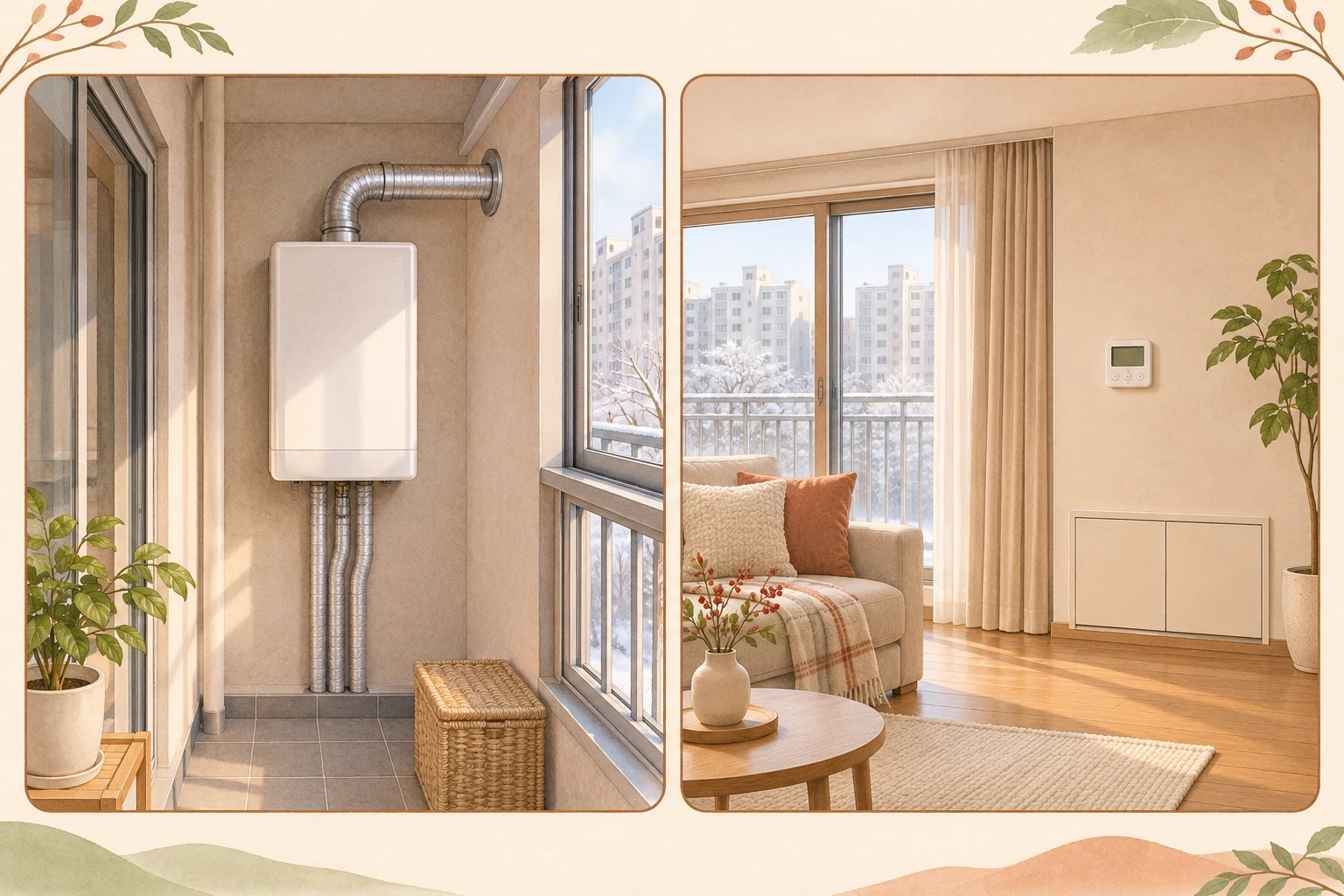
Left: an individual wall-mounted boiler. Right: a home with building-supplied heating and an apartment controller. AI-generated examples; equipment and locations vary. Confirm your system with management.
The Korean words worth recognizing
These translations help you find the right part of a manual. The same label can behave differently on different models.
| Label | Meaning | What to check |
|---|---|---|
| 난방 | Heating | Which heating mode is selected? |
| 실내 / 실온 | Room temperature | Is the display showing the current temperature or your target? |
| 온돌 | Ondol mode | On the examples below, the setting controls heating-water temperature. Actual floor-surface temperature will differ. |
| 온수 | Hot water | Find the instructions for taps and showers, separately from room heating. |
| 외출 | Away | Read the model’s actual behavior before leaving. |
| 예약 | Scheduled operation | It may mean repeating intervals rather than a clock-time schedule. |
| 전원 | Power | Controller off and physically disconnected power are not the same action. |
| 연소 | Burner operation | Shows whether the burner is operating. |
| 점검 / 에러 | Check / error | Photograph the code and find its model-specific meaning. |
Why copying someone else’s settings can go wrong
Two official manuals show the problem clearly. The Rinnai RC610 manual lists a room-temperature setting range of 5–40°C and an ondol range of 35–85°C. The Navien NCB311 manual gives 10–40°C for room mode and 30–65°C for ondol mode. These ranges show what each controller allows. Choose a setting using your model’s instructions and the conditions in your home.
On these models, the ondol number refers to heating-water temperature. Room and floor-surface temperatures will be different. The NCB311 manual also warns about prolonged high-temperature heating for people vulnerable to burns.
Room mode uses a room-temperature sensor. The official Rinnai RC600 instructions explain that nearby heat can affect its reading. If your controller sits beside another heat source, a comfortable reading there may not reflect how the rest of the room feels.
Look up the exact model, identify the selected mode, and distinguish the current reading from the target before making an adjustment. Change one setting at a time so you can tell what helped. These instructions apply to the specific models described in each manual. Check the manual for your own Rinnai or Navien installation.
Hot water, away mode, and “off” are different
A warm shower does not prove that room heating is running. Look for the hot-water instructions in your manual if you want hot water without heating the rooms. Do not assume that selecting away mode or switching the controller off achieves the same thing.
The RC610 manual describes away operation as minimal heating at four-hour intervals. Its reservation controls also use operating intervals and durations. That is different from telling a clock to start heating at 7 p.m. The NCB311 manual describes its own minimum-operation away setting; do not borrow the RC610 cycle for it.
Away does not automatically mean cheapest. These functions alone do not establish which choice will cost least in your home. Before a long absence, ask for the winter setting appropriate to your system and building rather than relying on a neighbor’s bill-saving shortcut.
Before you leave during freezing weather
Freeze protection depends on the boiler’s operating conditions, and some pipes may need separate protection. The RC600 and NCB311 instructions require connected power for their protective functions and specify model-dependent operating conditions. Do not unplug a boiler to save electricity without checking its winter instructions.
Seoul’s cold-wave guidance recommends protecting exposed pipes and water-meter areas against freezing. Ask management which parts are your responsibility and whether existing insulation needs attention. Keep required ventilation and exhaust routes clear; do not seal a boiler space as a makeshift insulation project.
Seoul Arisu’s January 2026 meter-protection notice explains preventive steps. Check the current forecast separately. For a damaged water meter in Seoul, it directs residents to the water authority or Seoul 120. Outside Seoul, use your local water service or building contact.
Simple checks before you call
Try another tap, then compare its hot and cold sides. Check that heating or hot-water mode is enabled on your controller and photograph any error code. For shared heating, check management notices or ask whether another apartment has the same problem. These observations help you choose the right next step.
Can you thaw an exposed water pipe yourself?
Seoul’s winter-safety guidance supports gentle thawing with warm wet towels for frozen water pipes and meters. Only try this on an accessible water pipe you can positively identify, away from the boiler casing and electrical equipment. Ask management to identify it first if you are unsure.
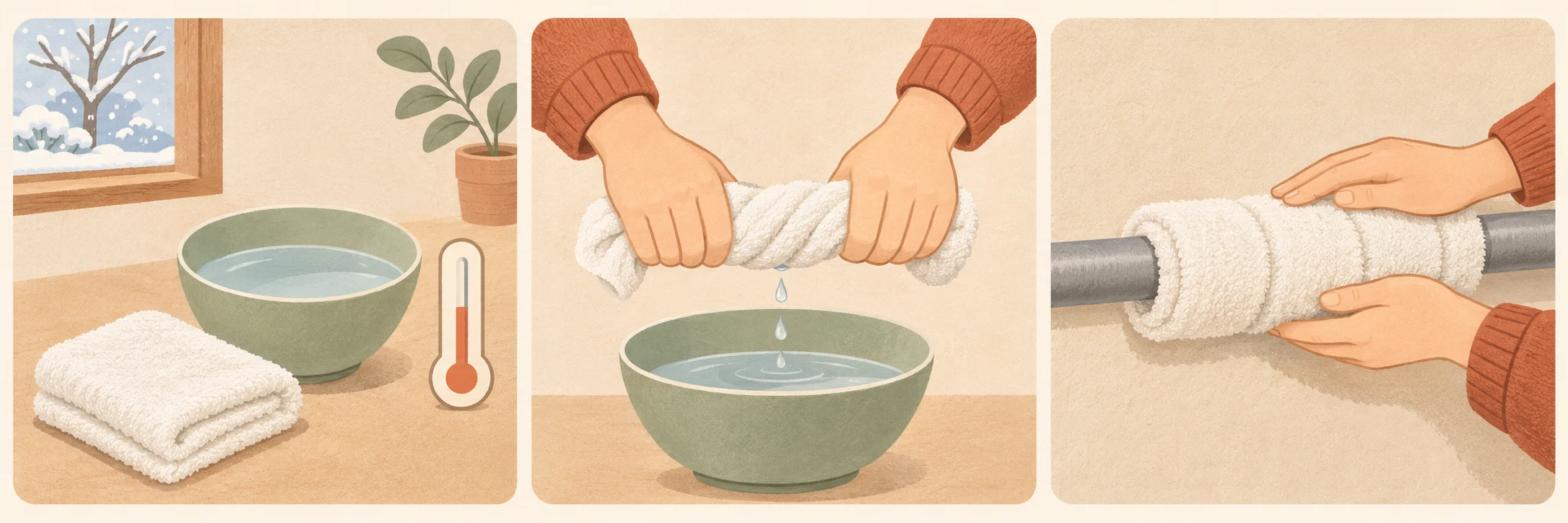
- Start lukewarm. Prepare water below 50°C. Seoul warns that water at 50°C or above can damage frozen pipes or meters.
- Use a warm damp towel. Wring it out and gently wrap the identified pipe. Rewarm the towel gradually as it cools, keeping water away from electrical equipment.
- Watch for leaks. Stop if you see cracking or leaking, or cannot reach the pipe safely. Ask management or a qualified service provider for help if flow does not return. Afterward, remove the wet towel and arrange proper dry pipe insulation.
AI-generated illustration of the towel method. It applies to an identified accessible water pipe. Keep water off the boiler, sockets, wiring, and controls.
What about a hair dryer?
Water meters: keep hair dryers and other direct heat sources away. Seoul’s water-meter guidance warns of fire risk from dryers and torches and recommends warm wet towels. Contact the water service if the meter is cracked, swollen, or leaking.
The Rinnai RC600 instructions mention a dryer specifically for the boiler’s frozen water-inlet and hot-water pipes. Follow this only when your own model’s instructions support it and the pipe, floor, hands, plug, and surrounding area are completely dry. Skip electrical thawing around wet towels, leaks, or standing water. If you cannot meet those conditions, use the service contact.
Leave gas pipes, exhaust parts, and the inside of the boiler to a qualified technician. Avoid flames, boiling water, and improvised heaters. Keep boiler ventilation clear. If you smell gas, leave the area without operating electrical switches or appliances and call for help from outside. A damaged or leaking water meter in Seoul can be reported through Seoul 120.
When something is not working
Use the observations below to describe the problem when you request help. Diagnosis belongs with the appropriate service provider. Photograph the display before changing settings.
| What you notice | Useful detail to collect | Where to start |
|---|---|---|
| No water from any tap | Whether nearby homes are affected and whether management announced a supply interruption | Building management or landlord |
| Cold water flows, but the hot side has no flow | Which taps are affected and when it began | Management or boiler service; mention possible freezing |
| Water flows but stays cold | Selected hot-water mode, model, and any displayed code | Boiler service, or management for shared hot water |
| Hot water works, but rooms stay cold | Heating mode, target, current display, and whether all rooms are affected | Management for shared heating; the model’s service provider for an individual boiler |
| An error appears | A clear photo of the complete code and model label | The official manual and appropriate service contact |
Do not repeatedly reset an unresolved fault, adjust unidentified valves, or remove a boiler cover. A service request is more useful when it includes the exact symptoms than when every control has already been changed.
A five-minute winter handover
- Photograph the controller and the model label without opening equipment.
- Save the official manual and the management or service number.
- Ask for a demonstration of heating and hot-water controls.
- Confirm the setting and checks needed before a winter trip.
- Ask who handles exposed pipes, water-meter insulation, and emergency access while you are away.
You can send this message to your landlord or management office:
안녕하세요. 이 집은 개별난방인가요, 지역난방인가요, 중앙난방인가요? 난방 조절기 사용법과 겨울에 며칠 집을 비울 때 설정을 알려주실 수 있을까요? 동파 예방을 위해 확인할 부분과 문제가 생겼을 때 연락할 곳도 부탁드립니다.
“Hello. Does this home use individual, district, or central heating? Could you show me how to use the heating controller and what setting to use when I’m away for a few days in winter? Please also tell me what to check to prevent frozen pipes and whom to contact if something goes wrong.”
Once you know your system and have the right contact saved, the controller becomes less mysterious. You do not need to become a boiler technician. You need to know what your controls do and when to ask for help.
Sources and further reading
- Rinnai: RC610 user manual. Room and ondol modes, printed p. 11; hot water, p. 13; away and reservation modes, pp. 16–18.
- Rinnai: RC600 accessible user instructions. Sensor placement, freeze protection, and ventilation.
- Kyungdong Navien: NCB311 user manual. Room and ondol modes, printed pp. 13–14; away mode and winter protection, pp. 18–19.
- Seoul Energy Corporation: district-heating equipment overview.
- Seoul Metropolitan Government: cold-wave guidance.
- Seoul Arisu: winter water-meter protection notice, January 1, 2026.
- Seoul Metropolitan Government: winter-safety guidance. Cold-wave section: warm-towel thawing, temperature limit, and damaged-meter reporting.
- Seoul Metropolitan Government: water-meter freeze prevention and thawing guidance. Explicit warning about hair dryers and torches around water meters.
Sources checked November 13, 2026. Hero, thumbnail, and in-article illustrations: AI-generated.