Cover image: AI-generated editorial illustration inspired by Korean ginseng culture.
A ginseng root can look surprisingly unglamorous for something sold in such elegant boxes. Pale, knotted and trailing fine roots, it belongs as comfortably in a market basket as in a carefully wrapped gift. Understanding why it matters in Korea means looking beyond the promise of a quick energy boost.
Korean ginseng is a cultural ingredient, an agricultural tradition and a modern consumer product. Fresh, white and red ginseng describe different ways of processing the root, not a simple ladder from ordinary to best. Its associations with vitality and care are real parts of Korean culture, but those associations are not guarantees of medical benefit.
For a visitor, the most useful starting point is simple: decide whether you want to understand the tradition, try a food or choose a gift. Those are different decisions from starting a supplement routine. This guide explains the history, the names on the packaging and the questions worth asking before buying.
Why this root has such a long story
Ginseng was valuable long before it appeared in convenient sachets. The National Institute of Korean History describes wild ginseng among the gifts carried by Silla envoys to the Tang court. Its history connects diplomacy with the movement of valuable goods across East Asia. National Institute of Korean History
During Goryeo, ginseng continued to feature in trade, diplomatic gifts and medical writing. Research published in the Journal of Ginseng Culture examines these records, including the role of the trading port Byeokran. The historical picture is richer than a claim that ginseng was simply a secret reserved for kings. Records on Ginseng and Medical Book during the Goryeo Dynasty
Joseon records connect ginseng with medical texts, tribute and an expanding cultivation economy. The National Institute of Korean History explains how scarcity of wild roots and commercial demand helped encourage cultivation, particularly in the later Joseon period. Processing roots into red ginseng also helped with storage and transport. That makes the distinction between fresh and processed ginseng part of an economic story, not only a wellness story. National Institute of Korean History
These records explain why the root carries cultural weight. They do not establish that an ancient remedy works for every modern health claim. A long history can tell us what people valued without telling us what a clinical trial would find.
Fresh white and red ginseng explained
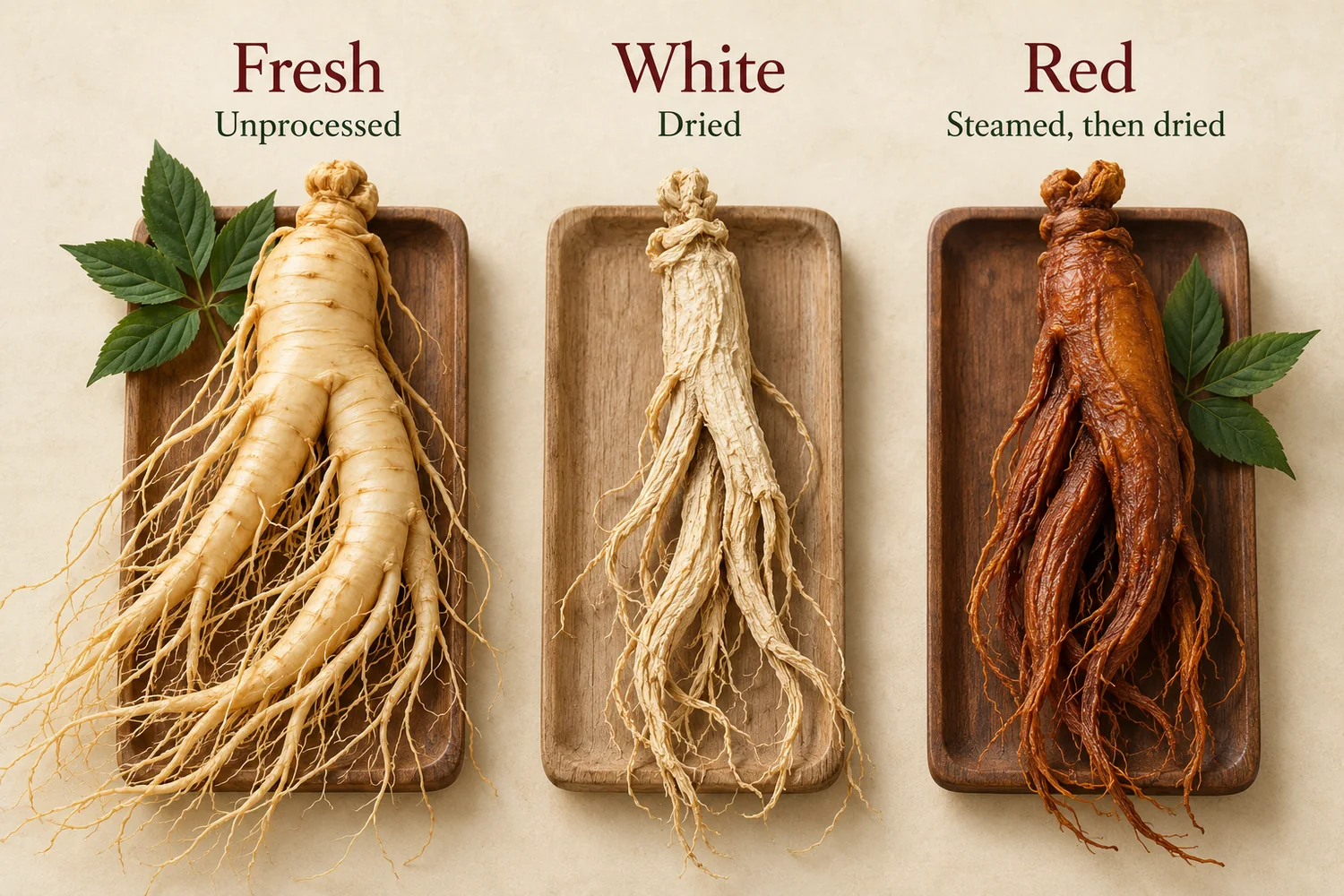
The three names you are most likely to encounter are susam, baeksam and hongsam. The Korea Tourism Organization distinguishes them by processing: fresh ginseng is unprocessed, white ginseng is dried, and red ginseng is steamed before drying. KTO guide to Korean ginseng
Fresh ginseng
Susam (수삼) is the fresh root. Think of this as an ingredient decision: what will you cook, how will you store it and how soon will you use it? If you are staying in a hotel without a kitchen, a tray of roots may be more interesting to look at than practical to take home.
White ginseng
Baeksam (백삼) is dried ginseng. Its appearance and texture differ from the fresh root, but “white” is not a separate species. When comparing products, look beyond the category name to the actual form, preparation instructions and ingredients.
Red ginseng
Hongsam (홍삼) is steamed and dried ginseng. A box labelled red ginseng might contain roots or a processed product, so the name alone does not tell you exactly what you are buying. Turn the package over before letting the presentation make the decision.
One more naming distinction matters. Korean or Asian ginseng refers to Panax ginseng. American ginseng is a different species, Panax quinquefolius, while products called Siberian ginseng come from a different plant altogether. Research on one is not automatically evidence for another. NIH Office of Dietary Supplements
A food tradition you can actually experience
Samgyetang is an approachable way to encounter ginseng in Korean food. The dish brings together a young chicken, glutinous rice, ginseng, garlic and jujube, simmered into a substantial soup. It is associated with summer eating in Korea, even if a hot bowl seems an unexpected choice in hot weather. KTO food guide to samgyetang
The useful approach is to treat it as a meal and a cultural experience, not as proof that ginseng will fix tiredness. Ask what is in the restaurant’s version if you have dietary restrictions. A familiar dish name is not a complete ingredient list.
Ginseng also appears in tea, sweets and other prepared products. Geumsan’s official local-product guide includes ginseng foods and souvenirs, illustrating how far the root travels beyond the supplement shelf. Geumsan County ginseng products
For a first taste, choose a format you actually want to eat or drink rather than buying a large box because it looks authoritative. A sweet snack and a concentrated extract serve different purposes. Enjoying the first does not require making a health claim about the second.
For more context on seasonal eating, read our guide to Korean food rituals.
Why Geumsan matters
Geumsan offers another way to understand ginseng: through the work required to grow it. In 2018, the Food and Agriculture Organization recognized the Geumsan Traditional Ginseng Agricultural System as a Globally Important Agricultural Heritage System. Its significance includes cultivation knowledge, local culture and the relationship between farming and the landscape. FAO Geumsan agricultural heritage
The FAO describes a system involving shade management, crop rotation and careful attention to soil, alongside knowledge passed between generations. This is a more grounded explanation of ginseng’s value than treating every expensive package as evidence of superior health effects. Agricultural heritage recognition concerns a farming system; it does not certify the medical claims on an individual product.
Geumsan’s markets make that connection visible, with roots and processed goods sold alongside local ginseng dishes. The Korea Tourism Organization identifies the International Ginseng Market and Ginseng Center as places to explore that trade. KTO guide to Korean ginseng
If your curiosity is mainly cultural, the market itself may be the rewarding part. You can learn from the different forms, packaging and uses without making a purchase or committing to a wellness regimen.
A gift can express care without promising a cure
Ginseng’s place in gifting helps explain the polished boxes. The Korea Tourism Organization lists it among popular Seollal gifts for parents. In that context, the gift communicates care and good wishes, not merely the contents of the package. KTO guide to Seollal traditions
That does not make it the right gift for everyone. Start with the recipient rather than the display: do they enjoy ginseng, already use a particular product or prefer something that is not marketed around health? Asking is more thoughtful than assuming an older relative needs a supplement.
If you do choose ginseng, keep the message modest. “I thought you would enjoy trying this Korean specialty” is very different from “This will strengthen your immune system.” The first shares something cultural. The second makes a promise you may not be able to support.
What the health evidence can and cannot tell us
Research does not justify a blanket promise of more energy, stronger immunity or better focus. The US National Center for Complementary and Integrative Health notes that many Asian ginseng studies have been small and short. Some evidence suggests a small effect on general fatigue, but findings on blood sugar are inconsistent and most research does not show improved athletic performance. NCCIH Asian Ginseng
The NIH Office of Dietary Supplements also describes uncertainty around effects on immune function. Different species, preparations and study conditions matter. A result involving a particular extract is not a guarantee for a tea, candy or another supplement. NIH immune function evidence review
There are safety questions too. NCCIH identifies insomnia as the most common side effect and notes possible effects on blood clotting and blood sugar, medication interactions and concerns for people with autoimmune disorders. If you take medicines or have a medical condition, ask a clinician or pharmacist before using ginseng as a supplement. Ginseng supplements may be unsafe during pregnancy; breastfeeding and use in children also require particular caution. NCCIH Asian Ginseng
The distinction is not between respecting tradition and rejecting it. You can appreciate the cultural meaning while expecting health claims to meet a different standard of evidence.
Before you buy
Make the choice easier by checking a few concrete things rather than trying to identify the most impressive box.
- Purpose: Are you buying an ingredient, a snack, a gift or a supplement? Choose the category first.
- Contents: Read the ingredient list, product form and serving instructions. A large package does not necessarily contain more of the ingredient you want.
- Comparison: Compare like with like. The price of whole roots is not directly comparable to a box of sweetened drinks, and neither price proves a health benefit.
- Practicality: Check storage directions, the expiry date and whether the recipient will realistically use it.
- Suitability: Do not guess about medication compatibility or give a health-oriented product as if it were suitable for everybody.
If you are taking it abroad, check the destination’s official customs and plant or food import guidance for the exact product before buying. Fresh roots and processed foods may be treated differently. Do not rely on a shop’s general reassurance that a product is a popular souvenir.
You do not need to leave Korea with a supplement routine to have understood ginseng. A bowl of soup, a closer look at a market stall or a conversation about a holiday gift can reveal more than a list of promised benefits. Its most interesting story is the one connecting cultivation, food, trade and care.
Sources and further reading
Sources checked on October 21, 2026.
- National Institute of Korean History on ginseng
- Records on Ginseng and Medical Book during the Goryeo Dynasty
- Korea Tourism Organization guide to Korean ginseng
- Korea Tourism Organization food guide to samgyetang
- Geumsan County ginseng products
- FAO Geumsan Traditional Ginseng Agricultural System
- Korea Tourism Organization Seollal traditions
- NCCIH Asian Ginseng
- NIH Office of Dietary Supplements immune function evidence review