If you are visiting Korea for fall colors in 2026, start with late October and early November, then choose your destination. Northern mountains can color earlier than Seoul, while some southern destinations stay on the foliage calendar into November. A mountain forecast is a useful starting point, but it cannot promise the same view on every trail.
There is also more than one forecast. VISITKOREA publishes a travel forecast from Weatheri, while the Korea Forest Service forecasts individual tree groups. Their dates differ enough to matter when booking a trip. Below, you will find both, along with Seoul walks, Nami Island photo spots, mountain outings, and something good to eat afterward.
Sources checked: October 9, 2026, Korea Standard Time. Dates shown as forecasts are estimates. Check recent foliage photos, weather, and access notices again before leaving.
When will the leaves change in Korea in 2026?
The VISITKOREA forecast, published September 8, gives these peak dates: Seoraksan on October 25, Bukhansan on November 4, Jirisan on November 5, Naejangsan on November 11, and Hallasan on November 13. The illustrated map below brings both forecasts together for South Korea. These are predicted peaks, not reports that the leaves have already reached them.
The newer Korea Forest Service release, dated September 22, predicts maple-group peaks on October 20 at Seoraksan, October 27 at Jirisan, November 4 at Naejangsan, and November 6 at Hallasan's 1100 Road. Its benchmark is at least 50% of that tree group's leaves changing color. It is not measuring the same thing as a general mountain travel forecast.
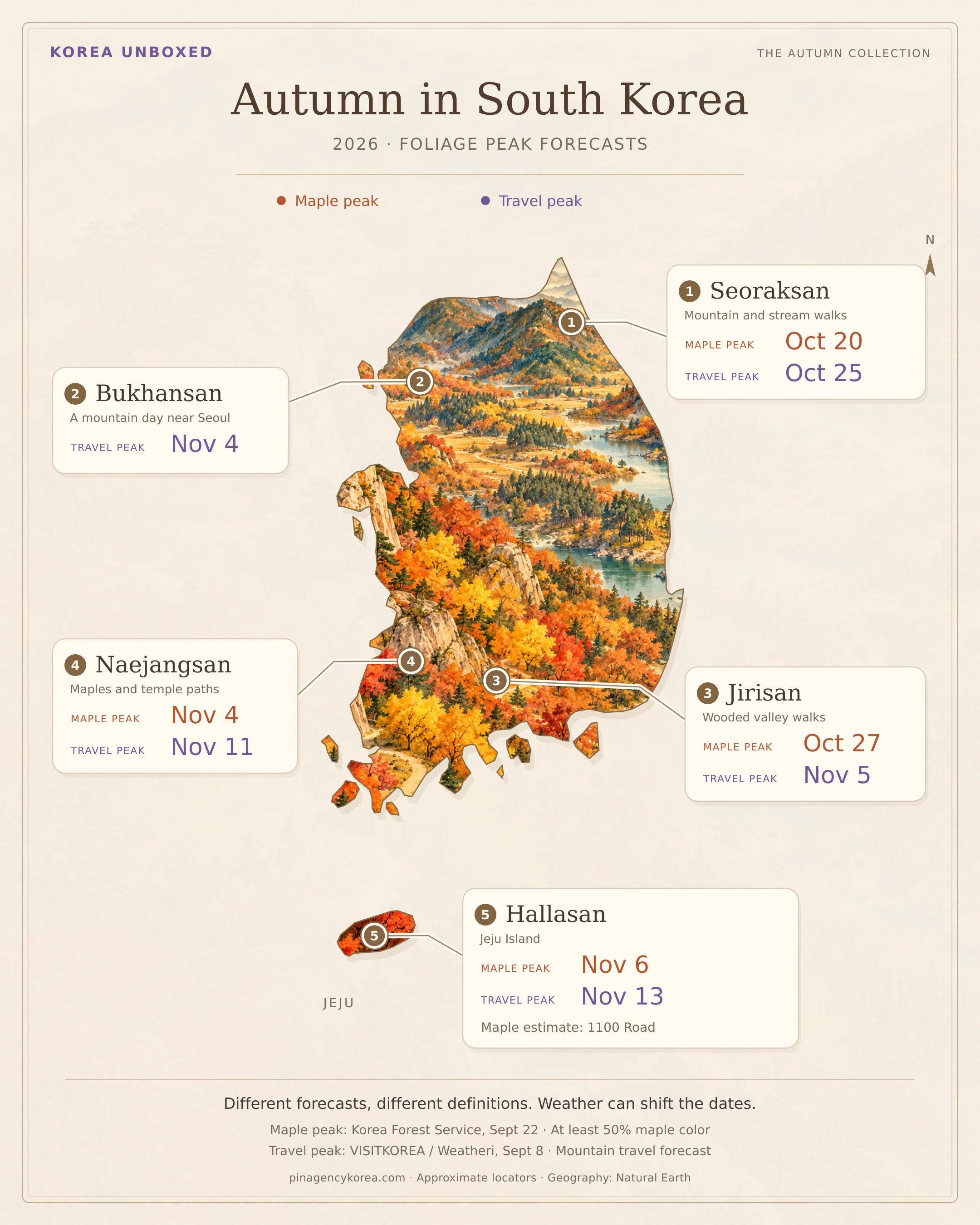
Save the full-size South Korea foliage map (PNG) for your trip planning.
Use that difference to keep your plans flexible. If you can move a mountain outing by a few days after checking fresh photos, you have more options than someone booking everything around a single dot on a calendar. Temperature, rain, wind, elevation, and the trees along your chosen path can all affect the view.
First foliage is different from peak foliage
The Korea Meteorological Administration describes a mountain's first foliage as roughly 20% changing from the summit downward, and peak as roughly 80% of the mountain showing color. Those observation thresholds differ from the Forest Service's tree-specific benchmark.
Seoraksan's first foliage was actually observed on September 28, 2026. That replaces the earlier forecast of October 3 as the answer to when its colors began. It does not mean the whole mountain, or an entrance-level walking path, was already at peak. Early October visitors should expect mixed green and changing leaves rather than a guaranteed sea of red.
Seoul foliage without a full hiking day
For a Seoul-based trip, late October into early November is a sensible period to keep park and palace outings flexible. This is planning guidance, not an official citywide peak date. Bukhansan's November 4 estimate applies to the mountain; it does not tell you when every ginkgo tree in central Seoul will turn yellow.
Seoul Forest for a walk and outdoor photos
Seoul Forest is an easy choice when you want an outdoor afternoon rather than a summit. General park admission is free, and Seoul Forest Station makes it convenient to reach. Look for changing tree-lined paths, take a relaxed walk, and leave time for a café in nearby Seongsu. Individual facilities keep their own hours.
For photos, try soft morning light or the hour before sunset. A low angle along a path can catch the leaves overhead without filling the frame with the entire crowd. Stay on the path and take turns at popular spots. A smaller patch of yellow can make a lovely picture even before a whole park reaches its strongest color.
Gyeongbokgung and other city outings
Gyeongbokgung Palace pairs autumn trees with courtyards and traditional architecture. It is normally closed on Tuesdays, with holiday exceptions. Its regular closing time is 6 p.m. in October and 5 p.m. in November, with last entry one hour earlier. Check the day's notice before arriving.
Olympic Park and Namsan are other foliage choices named by Korea's tourism organization. Choose one area and enjoy it properly rather than crossing Seoul to collect several quick photos. A park walk, lunch, and a neighborhood stop make a manageable autumn day.
Nami Island for tree lanes and a river outing
Nami Island suits travelers who want a scenic walk and photos without committing to a mountain climb. Its own foliage FAQ says katsura and maple trees begin changing from mid-October, while ginkgo trees often turn yellow in late October. Treat this as general seasonal guidance, not a confirmed 2026 peak day.
For golden ginkgo photos, late October is a useful starting point, followed by a check of the island's recent updates. Explore Ginkgo Tree Lane, Metasequoia Lane, and the maple gardens instead of expecting every lane to look identical. The operator also says it brings fallen ginkgo leaves from Songpa-gu onto the lane by mid-November, so a leaf-covered path is not necessarily evidence that the local canopy is still at peak.
Public transport involves reaching the Gapyeong area, getting to the wharf, and crossing to the island. Leave room for each connection and the return journey. Check the current ferry timetable, especially if you plan to stay late. A weekday visit and an early arrival are practical ways to reduce the pressure of a busy foliage trip.
For a seasonal extra, the operator's 2026 foliage cruise is scheduled for October 22, 23, 29, and 30, and November 5 and 6. The 50-minute cruises require advance reservations and depend on weather. Check availability before building your day around one.
Mountain foliage and temple walks beyond Seoul
Seoraksan for an earlier mountain trip
Seoraksan, near Sokcho, belongs earlier on your calendar than the southern destinations in these forecasts. You do not have to climb its highest summit to enjoy the season. The tourism organization's national parks guide suggests the stream-side Biseondae route as an easier alternative to a summit hike. It is still an outdoor trail, so assess the terrain and current conditions.
If traveling from Seoul, an overnight stay in Sokcho gives you more room for an early start and a slower return. This is a pacing suggestion, not a promise that a particular bus will avoid traffic. Book transport and accommodation early if your dates fall on a popular autumn weekend.
Bukhansan for hiking near Seoul
Bukhansan is the mountain option when you want to stay near the city. Choose a route based on distance, slope, and your group's experience. The Baegundae summit route includes steep terrain; an attractive photograph does not turn it into a casual park walk. A shorter forest route may suit your day better.
Jirisan for a trip built around one valley
At Jirisan, choose your entrance and walking route before booking a hotel or bus. The National Park Service's trail guide lists options including Piagol and Baemsagol. Look up the exact route, its difficulty, access notices, and transport rather than treating a large mountain park as one interchangeable destination.
Naejangsan for maples and temple scenery
Naejangsan, near Jeongeup, is a strong choice for combining autumn color with Naejangsa Temple. The two forecasts point to different dates within November, so recent photos are especially useful. Reserve your intercity journey first, then allow time for the local connection and a slower arrival at the park.
Hallasan for travelers already visiting Jeju
Hallasan adds a different kind of mountain outing to a Jeju trip. The Forest Service's November 6 maple estimate refers to 1100 Road, while the tourism forecast gives November 13 for Hallasan more broadly. Neither promises summit conditions.
Visit Jeju explains that designated summit sections of the Seongpanak and Gwaneumsa routes require reservations. Other routes, such as Eorimok and Yeongsil, do not reach the summit. Use the official reservation and trail-status system to check your chosen route. Plan for mountain weather rather than the temperature at your hotel.
Autumn foods and snacks to look for
A foliage outing is a good excuse to try Korea's harvest flavors. The tourism organization's autumn food guide highlights persimmons and chestnuts. Crisp sweet persimmons are easy fruit-market purchases; soft ripe persimmons, called hongsi, have a spoonable texture. Dried persimmons, or gotgam, offer a chewier, concentrated sweetness and also appear in desserts.

Roasted chestnuts, called gunbam, make a simple warming snack. Chestnut breads, cakes, and other desserts are another way to try them, especially in regions associated with the crop such as Gongju. If your trip includes a coastal meal, grilled gizzard shad and salt-grilled prawns are also autumn specialties worth looking for.
As the weather cools, watch for roasted sweet potatoes, hotteok pancakes with sweet syrup fillings, and fish-shaped bungeoppang buns, often filled with red bean paste. These are cold-weather favorites, rather than foods available only in fall. Vendors and fillings vary, so check what is being sold and ask about ingredients. They make a nice finish to an outdoor afternoon, especially when the light has faded and you are ready to warm up.
Save the illustrated Korean autumn foods guide (PNG).
How to plan a foliage day that works
Choose one main outing, then keep a city walk as a flexible alternative. A Seoul-only day might mean Seoul Forest, a Seongsu lunch, and outdoor photos. A Nami Island day works better with time to explore its lanes than with several distant attractions added afterward. For a mountain trip, prioritize the route and return transport.
Check the KMA's recent foliage observations, the local weather forecast, and the destination's access notices shortly before your visit. On hiking days, start early enough to finish before dark, wear shoes with grip, bring water and a warmer layer, and follow posted trail rules. Choose a park walk if the mountain conditions do not suit your group.
For finding entrances and transfers, see our guide to maps in Korea. For getting around Seoul, our T-money and travel-card comparison explains the different options. Check each attraction's final approach separately; reaching the nearest town is not always the last step.
Fall foliage questions
Is early October too early?
It can be early for widespread color in Seoul. Seoraksan has already recorded first foliage, but early color and peak color are different. Keep expectations local and check recent photographs rather than assuming all of Korea changes at once.
Can I enjoy the leaves without hiking?
Yes. Seoul Forest, palace grounds, and Nami Island offer walking and photography options. Check the specific paths and facilities if your group needs a particular level of accessibility.
Which exact day should I book?
Use the forecasts to choose a period, then refine your outing with current observations. They are estimates with different definitions, not guarantees. A flexible weekday and a realistic route are often more useful than chasing one supposedly perfect date.
Sources and further reading
VISITKOREA 2026 forecast and Korea Forest Service forecast and maple map: dates and forecast coverage.
KMA Seoraksan observation and current mountain foliage observations: observed first color and checking actual conditions.
Nami Island: foliage FAQ, ferry timetable, and 2026 foliage cruise notice.
Seoul: Seoul Forest and Gyeongbokgung Palace.
Mountain outings: VISITKOREA hiking guide, Jirisan trail guide, Naejangsan, Visit Jeju Hallasan guide, and Hallasan reservations and notices.
Food: Korean autumn seasonal foods and cold-weather street snacks.
Map geography: Natural Earth public-domain map data. Original Korea Unboxed illustrated foliage map; source dates are credited above.
Korea Unboxed related reading: Maps in Korea and T-money, Climate Card, and WOWPASS.