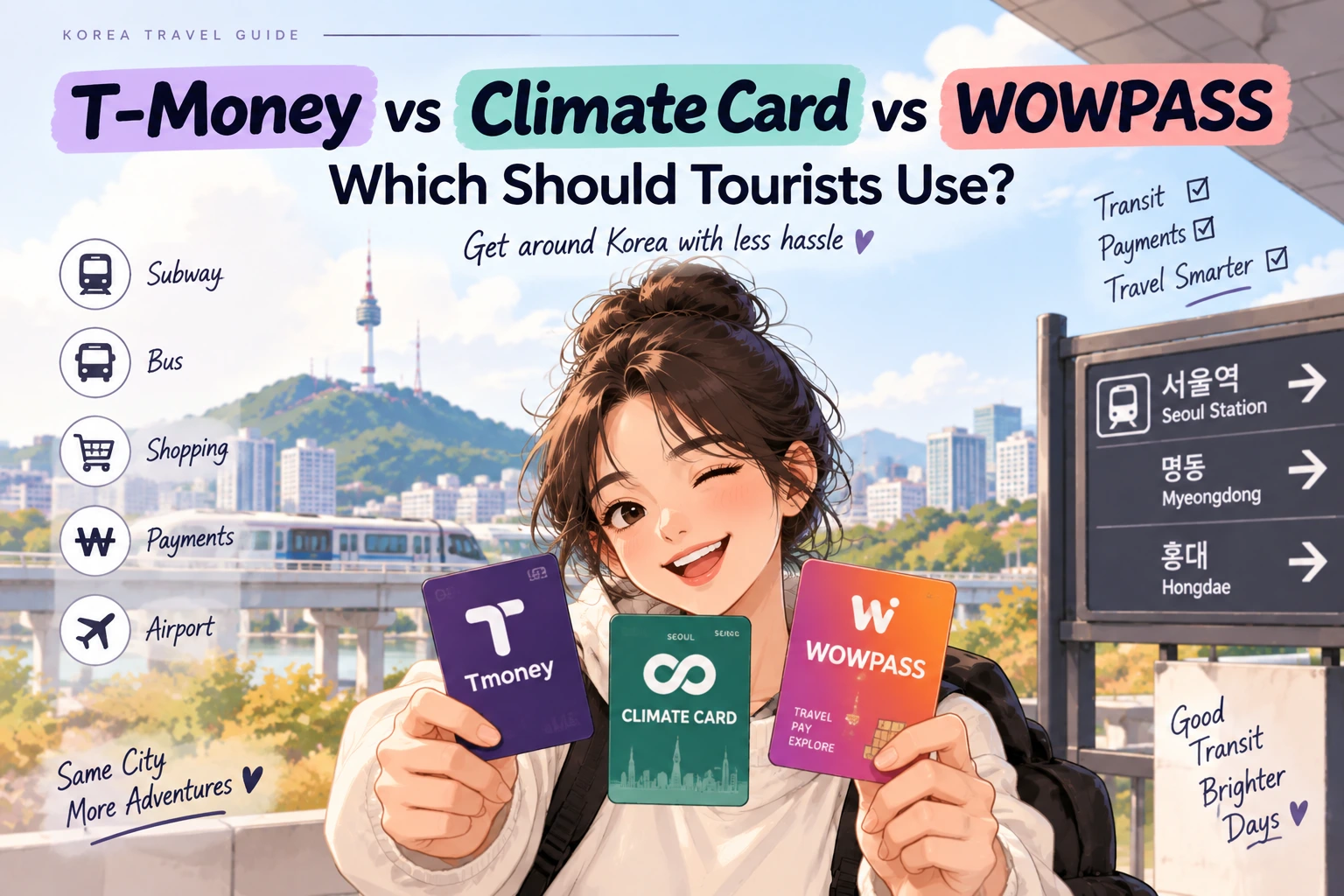
Choosing a transport card can feel like another booking decision to get right before Korea. One offers unlimited rides, another promises easier shopping, and T-money seems to appear everywhere. The useful starting point is that these are not three versions of the same product. A card that helps you pay for lunch is solving a different problem from a pass that covers a week of subway journeys.
Our recommendation: choose T-money for flexible pay-as-you-go travel, consider a short-term Climate Card for frequent journeys within its covered area, and choose WOWPASS when you also want its shopping and currency-loading features. WOWPASS already contains a T-money function, so buying both is usually unnecessary for the same traveler. The explanation below separates the transport decision from the payment decision, using the official city and provider guidance linked throughout.
Sources checked: September 25, 2026. This guide includes Seoul’s announced October 1, 2026 coverage change. Prices and examples use standard adult fares unless stated otherwise.
T-money: the straightforward pay-as-you-go option
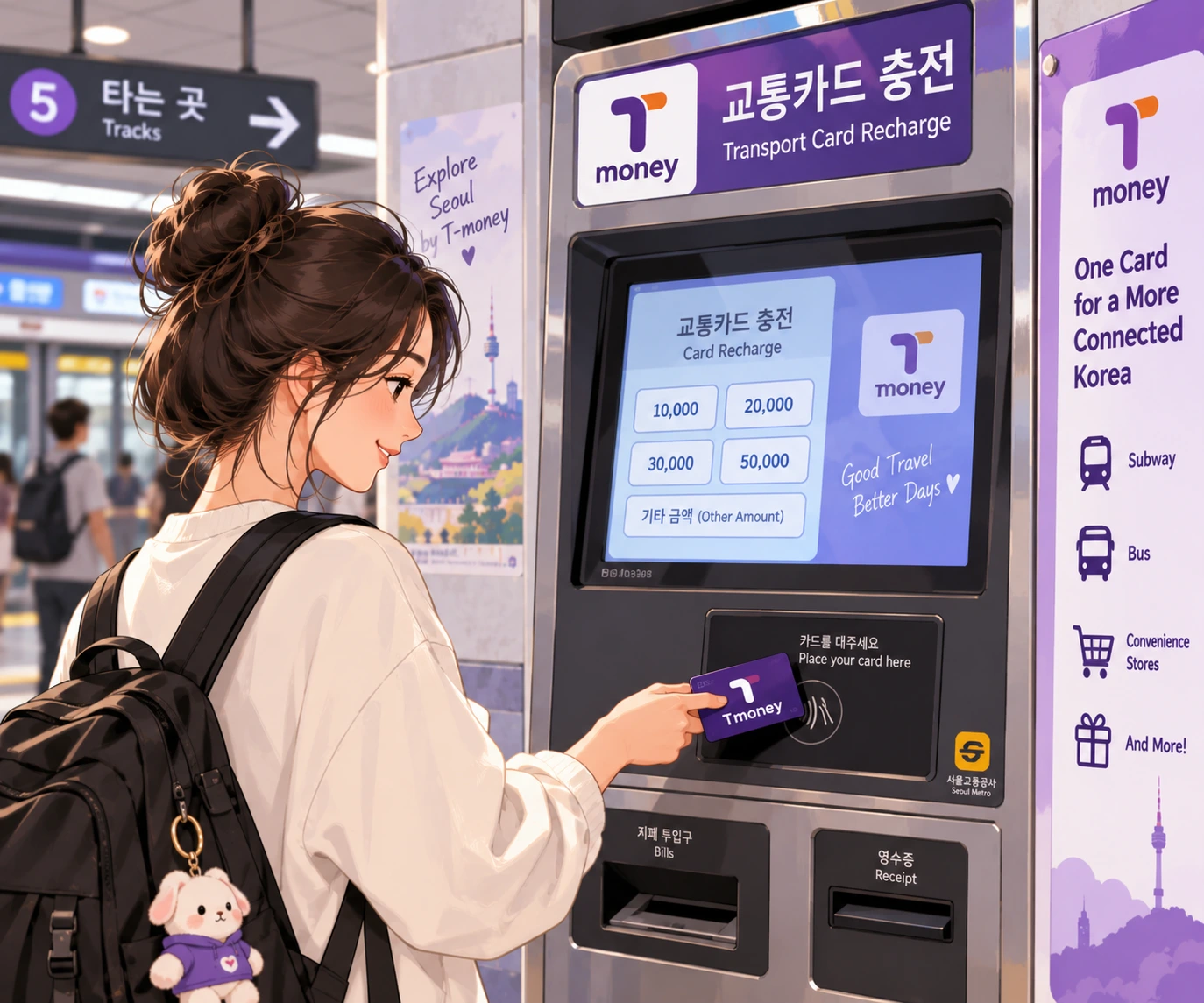
An ordinary T-money card holds prepaid value. You load money, then fares are deducted as you travel; it is not an unlimited pass. Visit Seoul’s transport guide describes its use on subways, buses, and participating taxis and shops. For this comparison, we are focusing on physical cards rather than every mobile-wallet version.
The Korea Tourism Organization’s card guide lists general T-money cards at ₩3,000–₩5,000, depending on the product, with the travel balance loaded separately. It identifies convenience stores such as CU, GS25, and 7-ELEVEN as purchasing locations, alongside relevant subway-station outlets. You can recharge at participating stores or subway machines. Carrying some Korean cash for top-ups is a sensible backup, rather than assuming every machine accepts your foreign bank card.
T-money is our default recommendation for a loosely planned holiday because you do not have to make a pass pay for itself. A walking-heavy day costs less in fares than a day spent crossing the city, and an unexpected change of plan does not waste a prepaid day. Its broader local-transport acceptance also makes it more useful for a multi-city itinerary than a Seoul-limited pass. Check unusual services individually, and budget separately for intercity rail tickets rather than treating a transport-card balance as a rail pass.
Climate Card: pay for covered days, not individual rides

The short-term Climate Card buys unlimited journeys on eligible services during its validity period. Seoul’s official usage guide lists five standard options: one day for ₩5,000; two days for ₩8,000; three days for ₩10,000; five days for ₩15,000; and seven days for ₩20,000. The physical card costs another ₩3,000. These short-term products do not include Ttareungi bike hire or Hangang Bus river services.
The days are consecutive calendar days starting on the date you load the pass, not rolling 24-hour periods beginning with your first ride. A three-day pass loaded on Friday is therefore for Friday, Saturday, and Sunday, even if you only start traveling on Friday evening. Buy the plastic card beforehand if convenient, but do not load a short-term pass early for a later sightseeing day.
For a packed city itinerary, the appeal is not only potential savings. Once you have checked that your journeys are covered, you can change neighborhoods or return to your accommodation without recalculating each additional fare. That convenience is worth considering, but it does not make a pass automatically cheaper for someone who mostly walks.
The 2026 change: tourist passes remain, but coverage narrows
Do not confuse the short-term Climate Card with the monthly product being phased out. Seoul’s 2026 transition announcement says prepaid 30-day recharges ended on August 31, while the one- to seven-day passes continue. The separate Climate Pass is a residence-based refund program with Seoul-specific benefits, not a replacement tourist ticket that you simply buy for a holiday.
From October 1, 2026, Seoul says the short-term passes cover travel within Seoul and journeys ending at Incheon International Airport. Previously included areas in Gimpo, Goyang, Guri, Gwacheon, Seongnam, Hanam, and Namyangju are being removed. Gimpo Airport Station remains included because it is in Seoul; do not confuse the airport with Gimpo city.
This matters when choosing accommodation as much as when planning a day trip. A hotel described as convenient for Seoul is not necessarily inside the pass area. Match both ends of your journey to the official service-range finder and the dated October notice, rather than relying on an older map showing a larger network. Trips crossing the September–October change need particular care.
Airport trips and exclusions: check the service, not just the city
The official Climate Card guide excludes services including the Sinbundang Line, airport buses, and non-covered bus routes; the Korean usage guide also explicitly excludes GTX. A station being inside Seoul does not mean every train serving it accepts the pass. If you take a subway journey beyond the eligible area, Seoul warns that staff can collect the fare for the whole journey, not merely the portion outside the boundary.
Incheon Airport has a directional exception. You may board within the covered area and finish at Terminal 1 or Terminal 2, but you cannot board at those terminals using the Climate Card. Treat this as an airport-bound rail exception, not a round-trip airport ticket, and do not mistake it for an AREX Express ticket. Budget for your airport-to-city journey separately.
Can you buy and recharge a Climate Card with a foreign card?
Yes, at the supported machines. Seoul’s overseas-card payment announcement confirms that its new ticket machines on Lines 1–8 support overseas-issued cards for short-term Climate Card purchases and recharges. That is different from saying every older machine, station, or convenience-store counter supports the same payment methods. Follow the options displayed where you are buying, and keep a backup payment method.
The same announcement also says overseas-card payments carry a separate service fee, which the payment screen should show. Include that in your comparison rather than assuming the advertised pass price is the final amount charged to a foreign card. This change applies to specified products and machines; it is not proof that every ordinary T-money top-up can be paid for the same way.
When is a Climate Card actually cheaper than T-money?
Start with the journeys you expect to make, not the number of days on your airline ticket. Seoul’s published adult subway card fare starts at ₩1,550. As an illustration, thirteen separately charged base-fare journeys cost ₩20,150, just above a seven-day pass’s ₩20,000 fare component. That comparison excludes card purchases, payment fees, distance supplements, and discounts.
Card ownership changes the calculation. Someone who already has T-money would pay ₩23,000 for a new Climate Card plus its seven-day pass. Fourteen base-fare journeys on their existing card cost ₩21,700, while fifteen cost ₩23,250. In that narrow example, the pass only edges ahead at fifteen journeys before any extra payment fee. Someone buying a new T-money card must also include its purchase price on the other side of the comparison.
Do not count every train or bus boarded as a separate full fare. Eligible transfers are combined, and distances and route types affect the total. Use expected journey fares when comparing an actual itinerary. A longer covered journey can make the pass worthwhile sooner; a walking day, an uncovered outing, or a discounted fare can push the calculation the other way. For children and teenagers, check the applicable fare and registration requirements rather than multiplying an adult estimate by the family size.
WOWPASS: a payment card with T-money built in
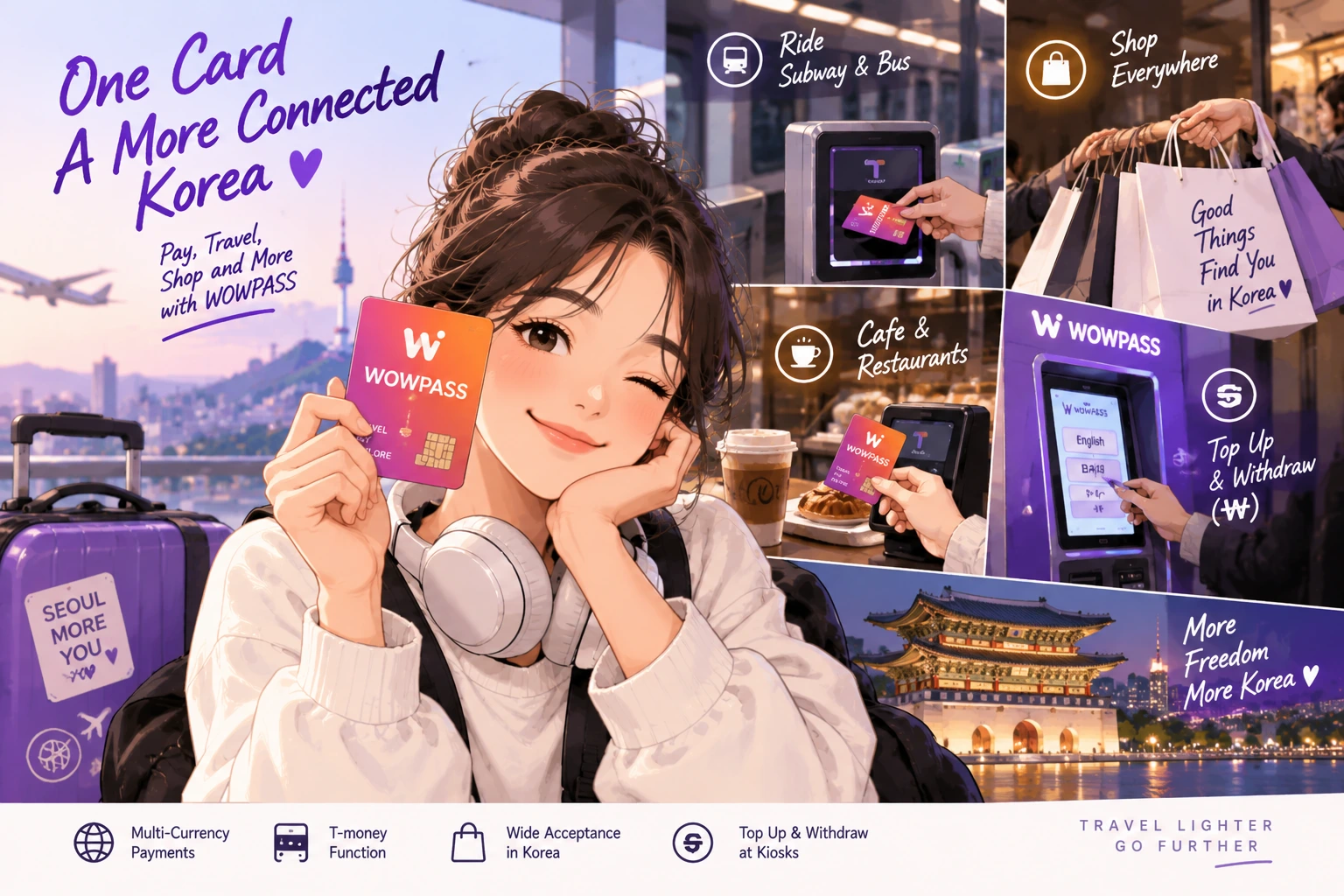
WOWPASS is more interesting as a payment tool than as a competing transport fare. Its official usage guide explains that the shopping balance pays at offline merchants accepting local card payments, while the embedded T-money balance pays eligible transport fares. You insert the card’s chip for ordinary merchant payments and tap it for buses and subways.
The two balances are separate. For example, ₩100,000 loaded into the shopping balance does not automatically give you ₩100,000 available at a subway gate. Check and fund the transportation balance before traveling. Nor does purchasing WOWPASS buy unlimited rides: its transport function is still T-money, with fares deducted as you use it.
Older instructions describing a cash withdrawal followed by a separate cash top-up are no longer the only route. WOWPASS’s current website advertises in-app transport-balance top-ups, and an official developer reply dated September 17, 2026 confirms that its app supports balance transfers without withdrawing cash. Follow the current app instructions and review any displayed conditions or fees; do not assume all funding methods cost the same.
For the shopping balance, the provider advertises supported foreign-currency cash loading and mobile funding through supported international cards or wallets. Bring your passport for issuance, as VisitKorea’s guide instructs. This can suit travelers who want a separate won-denominated spending budget, but it is an additional service to assess, not something you must buy just to use public transport.
WOWPASS costs: compare the actual offer and funding method
At the time of checking, WOWPASS’s own booking page displayed a ₩5,500 pre-booked machine offer against a ₩6,000 regular price. VisitKorea’s comparison still listed ₩5,000. Those figures should not be presented as interchangeable: check the current provider checkout for the product and collection method you choose, especially when comparing a card-only offer with a SIM or transport-credit package.
The provider’s service terms allow different issuance, withdrawal, exchange, and other service fees, with details disclosed through the app or kiosk. Compare the amount of usable won you receive after charges, and how you will handle any leftover balance. We could not verify one public fee schedule covering every funding method, so we are not assigning a universal top-up percentage or claiming WOWPASS is always cheaper than using your own bank card.
Which setup would we choose for a tourist?
For a relaxed visit or a changing, multi-city itinerary, we would start with T-money. It keeps the transport decision small: load a manageable amount and pay for the journeys you actually make. Choosing the simpler option is reasonable when the possible pass saving is marginal or depends on changing the way you wanted to spend your holiday.
For several busy days concentrated in the Climate Card’s covered area, we would compare the shortest suitable pass against the planned fares. Check the accommodation, airport direction, and every out-of-city excursion first. Keep another payment method for excluded journeys, and tap only the card you intend to use rather than presenting several cards together.
We would choose WOWPASS when its payment features solve a separate shopping or funding problem. There is usually no need to buy an additional ordinary T-money card for the same traveler. Combining WOWPASS for purchases with a Climate Card for covered transport can make sense, but buying all three is not a prerequisite for a well-prepared trip.
For a physical Climate Card, read the refund instructions before buying on the assumption that unused days will be returned. Seoul calculates refunds from the loaded amount minus actual transport use and a ₩500 fee, subject to its registration and validity rules, rather than refunding a simple number of unused days. Load pay-as-you-go balances modestly for the same practical reason: there is little benefit in ending the trip with more money tied up than you need.
Once you have chosen a card, our guide to T-money, subways, buses, and trains explains the next part: using it while navigating Korea. The aim is not to assemble the most impressive collection of travel cards. It is to have the right payment ready for the journeys you actually want to take.
Sources and further reading
VisitKorea: Transportation Cards. T-money purchasing, standard card prices, and WOWPASS passport requirements.
Visit Seoul: Transportation. T-money payment mechanics and transport-card guidance.
Seoul Metropolitan Government: Climate Card. Short-term passes, excluded services, and the Incheon Airport alighting exception. Read its current notices alongside older sections.
Seoul: Climate Pass transition and short-term pass Q&A. August 20, 2026 notice; see questions 2, 12, and 13 for monthly-card changes and October 1 coverage.
Seoul: Climate Card usage guide (Korean). Short-pass prices, activation dates, excluded bike/ferry benefits, and refund procedures.
Seoul: Climate Card service-range finder (Korean). Check individual stations and eligible bus services against the rules for your travel date.
Seoul: Overseas-card payments at new ticket machines (Korean). March 16, 2026 announcement covering short-term Climate Cards and single-journey tickets.
Seoul: Subway fares and transfers. Published adult card fare and integrated-transfer rules used in our calculations.
WOWPASS: How to Use. Separate shopping and T-money balances, merchant payments, and transport tapping.
WOWPASS: Official website. Current funding options and transportation-balance top-up features.
WOWPASS: Official app listing and developer guidance. Orange Square’s September 17, 2026 reply confirms in-app balance transfers without cash withdrawal.
WOWPASS: Card and package booking. Current offers and collection options; the displayed offer may change.
Orange Square: WOWPASS service terms. Article 4 explains fee categories and disclosure through the app or kiosk.
More from Korea Unboxed
Transportation in Korea: T-money, Subways, Buses and Trains. Our companion guide to using Korea’s transport network, rather than choosing a card.