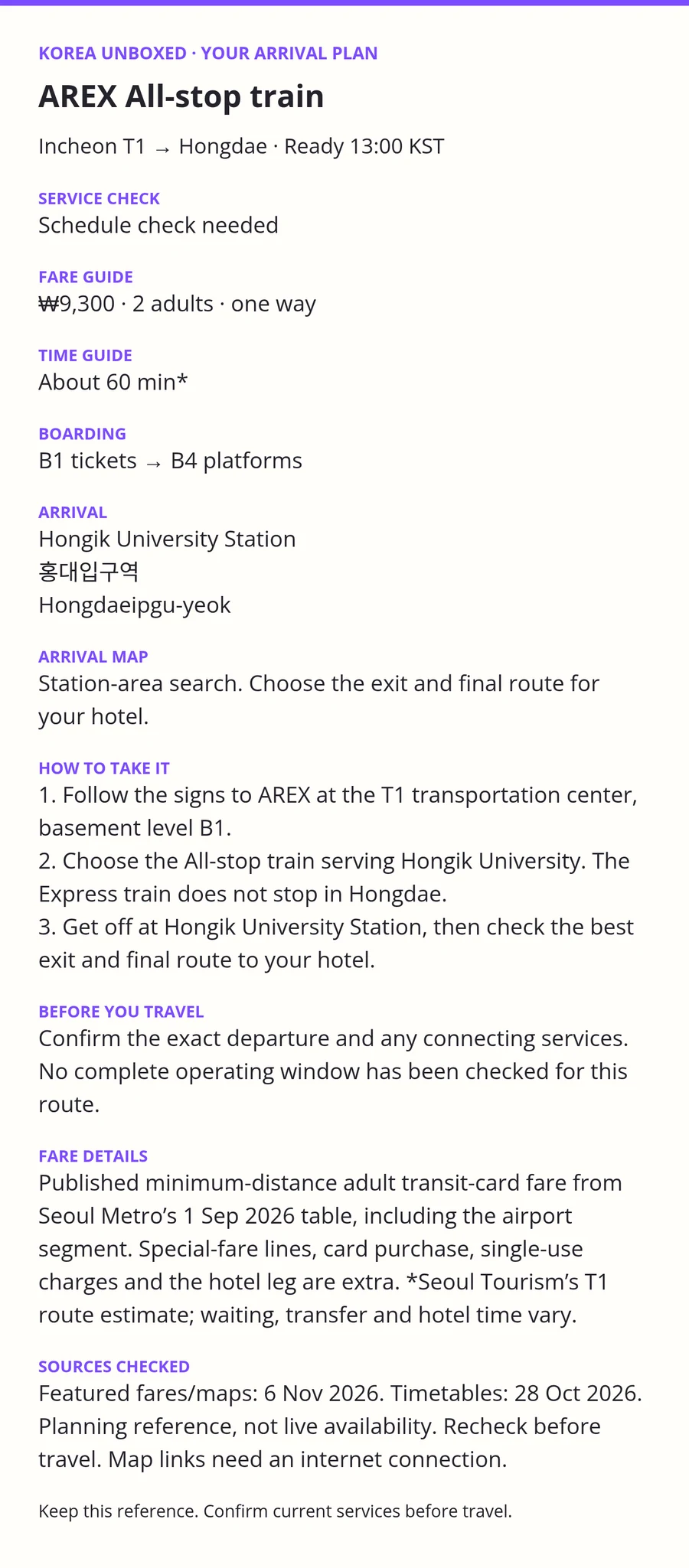
Planner steps checked November 7, 2026. Official-source guidance checked November 6, 2026.
Your flight is booked and you know where you are staying. The next question is more practical: which route will get you from Incheon Airport to the right part of Seoul with the bags and energy you actually have?
The Korea Unboxed airport-to-Seoul planner brings that decision into one place. Choose an area or a listed airport-bus stop, add your arrival details, then open a route for boarding instructions, an arrival point, map links, and a journey card you can save.
Use it to prepare a journey and a backup. You still need to confirm current departures and the final route to your accommodation. The planner does not book tickets, check live seats or delays, or guarantee that a service will be running when you reach it.
If you want the broader explanation of airport trains, buses, and the main hotel districts first, start with our Incheon Airport transport guide. This page explains how to use the planner itself.
1 Choose the area that matches your actual address
Start with one of the nine featured areas: Hongdae, Myeongdong, Seoul Station, Gangnam, Itaewon, Jongno / Insadong, Dongdaemun, Jamsil, or Yeouido. Read the smaller location label beneath the area name. These choices point to particular station or hotel areas, not every address in a district.
Keep your accommodation address beside you. Before settling on a route, compare its arrival point with the entrance you need. A familiar neighborhood name can still leave you with a substantial walk.
If none of the featured areas fits, open More Seoul areas. Search for a station, a listed hotel stop, or a bus number, select the matching result, and continue to Next: arrival details.
The expanded search is a directory of direct airport buses. It currently covers 33 daytime routes from the airport's Seoul catalog, with Seoul stop options. It does not compare rail alternatives for those extra choices, and it excludes night buses, Gimpo-only routes, and stops outside Seoul. Use Incheon Airport's official bus search to check the current route information.
2 Enter the time you expect to leave the airport
Select Terminal 1 or Terminal 2, then enter Ready to leave at in Korea time. This means after immigration, baggage collection, and customs, rather than your flight's landing time. Allow for your own circumstances rather than assuming a fixed processing time.
Check your terminal against your booking or flight details. Incheon Airport warns that the actual terminal can differ because of codeshares and airline circumstances; its arrival guidance explains what to verify.
Add the number of adults aged 19 or over, select your large-suitcase category, and choose Least hassle or Lower cost. Use the additional checkboxes when someone is under 19 or when you need step-free travel or boarding assistance.
Those checkboxes matter. Younger travelers require an age-specific fare check, and the displayed total covers only the adults entered. The assistance option brings attention to checks you need to make with the operator; it does not verify an accessible journey or reserve assistance.

3 Compare the arrival points as well as the numbers
Select Compare my options. For a featured area, read the route name, service-check message, fare guide, and time guide together. Open the arrival map to see whether the named station or bus stop is useful for your accommodation.
The fare guide is for the adults entered, one way to the named arrival point. Read the route's fare notes for exclusions. It is not automatically a full-family price or a door-to-door total.
Time labels also need context. An onboard time leaves out waiting and walking. Other estimates have their own qualifications, and buses are affected by traffic. Add the final journey from the stop or station to your accommodation before deciding what is easiest.
Treat Schedule check needed as an instruction to check the service, even if the route otherwise looks ideal. A route appearing in the comparison does not establish a usable departure at your chosen time.

4 Open the route and check how to board
Choose Choose this route to reveal the fuller instructions. The selected route includes an arrival-point name, Korean text you can copy, Google Maps and Naver Map links, and a How to take it section. Read any warnings before using the card as your plan.
Below the route, the terminal guide helps you understand the sequence from the arrival hall toward trains, buses, or taxis. Use the Train / subway, Bus, and Taxi controls to view the relevant guidance. The illustrations and schematics explain the general layout and sequence, not exact walking turns from every arrival hall.
Follow airport signs and use the linked official diagrams for the current arrangement. For rail access, the airport publishes terminal-specific Transportation Center diagrams. If you need lifts or boarding help, confirm a suitable path with airport staff and the operator, including the exit at your destination.
Check the backup shown with your route, too. It needs the same departure, arrival-stop, and final-walk checks as your first choice. The taxi section can help you consider another option, but it is not a booking or a fixed-price quote.
5 Save the useful details before you travel
Open Save your journey, then choose Download journey card. The planner downloads an image with the selected route, boarding guidance, arrival name, fare and time notes, and service warnings.
Save that image somewhere easy to find on your phone. It remains readable offline. The map links stay on the webpage and require an internet connection; the downloaded image is not an offline navigation app.
Keep your accommodation address and any important entrance or check-in instructions alongside the card. Recheck the service before traveling, especially if your flight time, terminal, or accommodation changes.
View an example downloaded Hongdae journey card. This is the planner’s actual export from November 7, 2026; create your own card for your selected route.
Three useful ways to use the planner
Compare two arrivals in the same neighborhood
For a daytime Hongdae arrival, select Hongdae and enter your terminal and group details. The featured comparison includes the AREX All-stop train and airport bus 6002. Open each arrival map and compare the stop with your accommodation, then read the selected route's instructions.
This is useful when a cheaper journey and a more convenient drop-off are competing priorities. Compare the final approach rather than assuming that all routes labeled Hongdae end in the same place.
Find a named stop beyond the featured areas
Try COEX in More Seoul areas. The current search returns separate bus-stop options, including Coex City Airport Terminal on 6103, a COEX Mall / Samseong Station stop on 6006, and The Westin Seoul Parnas / COEX on 6703.
Choose the stop that matches your address and check its direction and drop-off with the operator. These are bus-directory matches, not a claim that a bus is better than rail for every COEX-area stay.

Prepare a late arrival backup
If you expect to leave the airport late, enter that later ready-to-leave time rather than the scheduled landing time. In a Hongdae example set to 23:30, the selected route adds a confirmation warning and links to night-bus and taxi guidance.
Use that warning to check the exact departure and any onward connection. Do not interpret the displayed train or daytime-bus card as proof that it will still be running. Keep a workable backup and your accommodation's late-check-in instructions ready.
Before you rely on the result
- Confirm your terminal and current departure with the relevant operator.
- Check every connection, not just the airport leg.
- Compare the named arrival point with your actual accommodation entrance.
- Check younger travelers' fares, luggage arrangements, and any assistance you need.
- Save the journey image, but keep internet access for maps and current service information.
Ready to compare your arrival? Open the airport-to-Seoul planner, choose your area, and work through one route before saving it.
Common questions
Can I book a ticket through the planner?
No. It provides planning information and links to relevant sources. Confirm ticketing and booking arrangements with the operator.
Does the expanded bus search include train comparisons?
No. The extra stop choices are direct-bus options. Rail alternatives have not been compared for those selections.
Can I use the journey card without mobile data?
Yes, once the image has downloaded to your phone. Online maps and current service checks still need an internet connection.
Does the assistance checkbox mean the route is step free?
No. Confirm terminal access, boarding, lifts, and the destination exit with the relevant staff or operator before choosing.
Sources and further checks
This guide was checked against the planner and Incheon Airport’s official arrival process, rail-access diagrams, and airport-bus search. Use the operator links in your selected route to confirm departures, ticketing and assistance before you travel.