You have collected your suitcase, found a connection on your phone, and opened the address of your hotel. Now you have to turn “somewhere in Seoul” into an actual journey. The airport train, a limousine bus, and a taxi can all be sensible choices, but they solve slightly different problems. A fast train is less useful when it leaves you with an awkward transfer and a long walk with your bags.
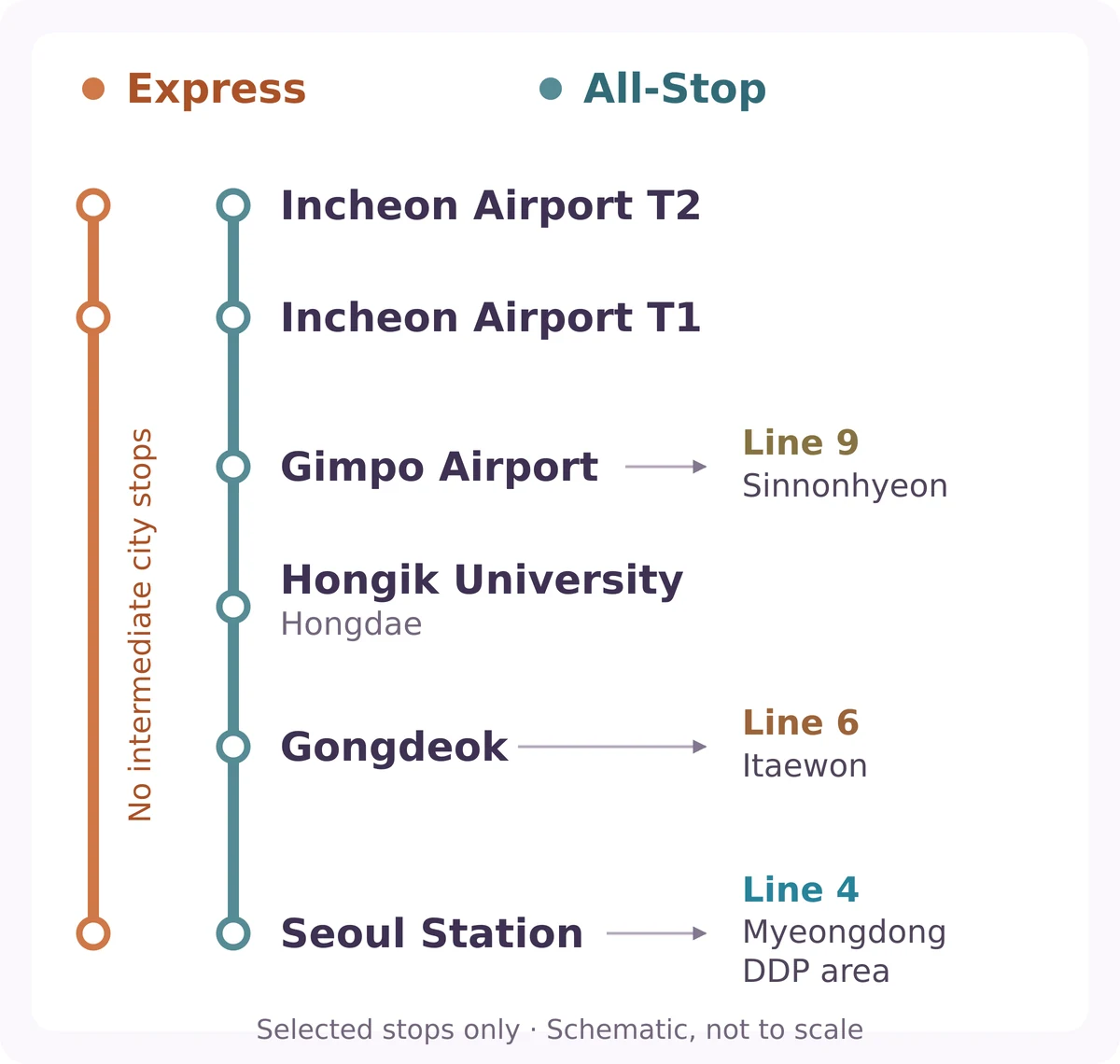
The simplest approach is to work backward from your accommodation. Hongdae has a direct All-Stop train connection. Myeongdong and the Dongdaemun Design Plaza area connect through Seoul Station and Line 4. For Itaewon, changing at Gongdeok avoids an unnecessary second transfer. Gangnam needs a little more care because the name covers much more than the area around Gangnam Station.
Fares checked: October 4, 2026. Prices below are one-way adult fares unless stated otherwise. Train running times do not include immigration, baggage collection, waiting, transfers, or the walk to your hotel.
The fresh AI-generated hero depicts a fictional airport arrival. It does not document either Incheon terminal’s layout or a real traveler.
First, check your terminal and your actual hotel address
Both Terminal 1 and Terminal 2 have an AREX station in their basement-level Transportation Center. You do not need to change airport terminals to catch a train into Seoul. Terminal 2 is farther along the railway, so its journey takes longer and the All-Stop fare is higher.
For the Seoul airport buses discussed here, Terminal 1 boarding is outside on the first floor, while Terminal 2 uses the basement Transportation Center. Other bus types can use different areas. Follow your route’s terminal-specific ticket and boarding instructions.
Save your hotel’s Korean address and check its nearest useful station or bus stop. A place marketed as “Myeongdong” might be easier from Euljiro 1-ga or Chungmuro; a “Gangnam” hotel might be near Sinnonhyeon rather than Gangnam Station. The final few hundred meters deserve as much attention as the airport leg, especially with children, heavy luggage, or limited mobility.
AREX Express or All-Stop: which train do you need?
The Express: a reserved seat to Seoul Station
The AREX Express runs between the airport terminals and Seoul Station without stopping at the intermediate city stations. The operator lists 43 minutes between Terminal 1 and Seoul Station, and 51 minutes between Terminal 2 and Seoul Station.
The current advertised adult fare is ₩13,000. Use the price shown for your selected ticket when booking.
The reserved seat can be appealing when Seoul Station suits your journey. The Express does not stop at Hongik University, Gongdeok or Gimpo Airport, so choose the service that reaches your destination.
The All-Stop: cheaper, with useful transfer stations
The All-Stop train is the commuter-style service with unreserved seating. It stops at the stations needed for the routes below. AREX lists 59 minutes between Terminal 1 and Seoul Station and 66 minutes between Terminal 2 and Seoul Station, with some trains taking a few minutes longer.
For an adult using an eligible transport card, the airport-to-Seoul Station fare is ₩4,750 from Terminal 1 or ₩5,350 from Terminal 2. To Hongik University or Gongdeok, it is ₩4,650 from Terminal 1 or ₩5,250 from Terminal 2.
Those are fares to the named AREX station, not a promise that every onward subway journey costs the same. The complete fare depends on your destination and route. A single-journey card adds ₩100 to the adult fare and requires a refundable ₩500 card deposit. The cost of buying a reusable transport card is separate from its travel balance.
At the airport, choose the correct service before entering the gates. The Express needs its own ticket; topping up a T-money card is not an Express reservation. Our Korea public transport guide explains everyday card use and transfers in more detail.
How to get to Hongdae
For accommodation near Hongik University Station, take the AREX All-Stop directly to Hongik University. No train change is needed. The station’s Korean name is 홍대입구, often written as Hongdae-ipgu.
Choose a Seoul-bound All-Stop service, stay on until Hongik University, and then follow the exit appropriate for your accommodation. Do not buy an Express ticket for this journey: it bypasses your stop.
The direct fare is ₩4,650 from Terminal 1 or ₩5,250 from Terminal 2 with a transport card. For planning, allow roughly an hour for the train portion, then add your wait and final walk. That is a rounded allowance, not a guarantee for a particular departure.
Airport bus 6002, currently ₩17,000 for adults, also serves Hongik University and the Seogyo-dong/RYSE Hotel area. Compare its stop with your accommodation entrance. A bus that leaves you closer to the door can be worth the extra fare; a bus that duplicates your direct rail journey may not be.
How to get to Myeongdong
For Myeongdong Station, take AREX to Seoul Station, then transfer to Line 4 toward Hoehyeon and Myeongdong. Myeongdong is the second stop.
Either AREX service reaches Seoul Station. Follow the Line 4 transfer signs instead of leaving the station and looking for another entrance.
Do not mistake the short Line 4 ride for a quick transfer. Budget time for the walk between railway and subway platforms, finding lifts where needed, and waiting for the next train. A hotel beside the station and one uphill toward Namsan can produce very different arrivals.
With a large suitcase, compare buses 6001 and 6015. Both currently list a ₩17,000 adult fare and serve the Myeongdong area. Route 6015 also serves stops around Euljiro, so it can be a better match for accommodation north of the main shopping streets. Choose by the named stop nearest your hotel, not simply the word “Myeongdong” on the route.
How to get to Itaewon
Take the AREX All-Stop to Gongdeok, then change to Line 6 toward Itaewon. This requires one transfer.
There is no need to continue to Seoul Station and then change again at Samgakji. From Gongdeok, the Line 6 journey passes Hyochang Park, Samgakji, and Noksapyeong before reaching Itaewon. Follow signs toward that sequence, rather than toward Daeheung.
The airport-to-Gongdeok portion costs ₩4,650 from Terminal 1 or ₩5,250 from Terminal 2 with a transport card. Your final fare includes the onward journey; do not treat the Gongdeok price as an exact quote to Itaewon.
Check the accommodation entrance before choosing your final stop. A booking described as Itaewon may be closer to Noksapyeong or involve a climb from the main road. Compare the full rail journey with a taxi or rail-and-taxi combination when the final approach is awkward.
How to get to Dongdaemun
For Dongdaemun Design Plaza, take AREX to Seoul Station and transfer to Line 4 toward Myeongdong. Continue to Dongdaemun History & Culture Park Station.
The important distinction is between Dongdaemun History & Culture Park and Dongdaemun Station, the next Line 4 stop. They are different stations serving different parts of the district. The former is useful for DDP; the latter may suit accommodation near the gate and northern shopping area better.
Bus 6001 currently lists a ₩17,000 adult fare and named hotel stops including Baiton Hotel. Compare the current airport-to-city stop list with your accommodation and check the final walk. Do not assume it delivers you directly to DDP or Dongdaemun History & Culture Park Station; ask the operator about the stop you intend to use.
How to get to Gangnam
Gangnam is the destination where a generic instruction is most likely to send you somewhere inconvenient. First distinguish Gangnam Station from Sinnonhyeon, Sinsa, and the COEX area.
For accommodation near Gangnam Station, airport bus 6009 is a useful direct option. Its stop list includes Sinsa, Nonhyeon, the Gangnam/Sinnonhyeon area, and Gangnam’s Sinbundang Line station area. The operator currently lists an adult fare of ₩17,000. Check the airport-to-city stop sequence against your hotel before buying.
For accommodation near Sinnonhyeon, a useful rail route is AREX All-Stop to Gimpo Airport, then Line 9 Express toward Sinnonhyeon. Stay within the railway interchange at Gimpo; this is a train change, not a trip through the airport terminal. Check the display for an Express service because Line 9 also runs trains that stop at every station.
Sinnonhyeon is not Gangnam Station. Do not assume that arriving there ends your journey: compare the remaining walk or local connection with the direct airport bus. For a COEX-area hotel, check whether Bongeunsa on Line 9 is the more useful destination instead.
When an airport bus or taxi is worth the extra cost
I have taken the airport limousine bus several times, and the appeal is easy to understand when you are traveling with bags: you settle into a seat instead of navigating another station transfer. I would choose it over the train when its stop is genuinely convenient for the hotel, not because every airport bus is faster.
At the airport, show the ticket counter your hotel address and confirm the route, destination stop, departure, and boarding bay. Boarding and payment instructions can differ by route and direction, so do not assume that advice for boarding in Seoul applies at the airport. Terminal 1 and Terminal 2 also have separate departure times.
A taxi becomes more attractive for several travelers, an awkward final address, or a late arrival. Compare the vehicle’s passenger and luggage capacity as well as the fare. Four people buying ₩17,000 bus tickets would spend ₩68,000 before any onward journey; that is a useful comparison figure, not a claim that a taxi will cost the same.
Use the airport’s designated taxi stands or an identifiable pre-booked service. For a regular metered taxi, the total depends on the journey, traffic, tolls, and applicable surcharges. Seoul standard taxis have late-night surcharges between 10 p.m. and 4 a.m.; reserved and international services can have different pricing. Our Seoul taxi guide explains what to check before boarding.
Arriving late: check the whole journey, not just the airport train
A flight’s landing time is not the time you will be ready to board ground transport. Immigration, baggage, and finding the station all come first. Avoid building your plan around the last possible departure with no room for delay.
More importantly, a train that gets you into Seoul may arrive after your connecting subway has finished. Check the last workable journey to your destination, including every transfer. A late train that terminates short of central Seoul is not a substitute for the service you actually need.
The airport lists overnight options including N6002 via Hongdae and Heunginjimun, the Dongdaemun gate; N6701 via Seoul Station and Euljiro to DDP; and N6000 to Gangnam Express Bus Terminal. The gate and DDP are different destinations, and the bus terminal is not Gangnam Station. Terminal 1 and Terminal 2 have different departures, with gaps between services.
Use the airport’s terminal-specific night-bus timetable and verify the destination and departure with the operator before relying on it. Keep a taxi alternative and your accommodation’s late-check-in instructions ready. A workable backup matters more than squeezing the last possible saving out of an exhausted arrival.
Plan the last part before you leave the airport
Before boarding, take a screenshot of the complete route, the correct station exit or bus stop, and your accommodation’s entrance. For a route involving stairs, check the lift route instead of assuming the nearest numbered exit will work with your luggage.
Choose the simplest journey you can comfortably manage that day. Sometimes that is a direct All-Stop train; sometimes paying more to avoid a transfer is the better fit.
Frequently asked questions
Does the AREX Express stop at Hongdae?
No. Use the All-Stop service for Hongik University. The Express goes between the airport terminals and Seoul Station without intermediate city stops.
Does a transport-card top-up buy an Express ticket?
No. The Express requires a separate ticket and reserved seat. Choose the correct service before entering its gates.
Can I rely on bus 6001 to drop me directly at DDP?
Check the current named stop with the operator. The airport-to-city list read for this guide names Baiton Hotel; it does not establish a direct DDP stop.
What matters most for a late arrival?
Check the last workable journey through every transfer, allowing for immigration and baggage first. Use your terminal’s night-bus information and keep a taxi and late-check-in backup.
Does this guide give a fixed airport taxi fare?
No. Vehicle type, distance, traffic, tolls and surcharges affect the total. A regular metered trip and a reserved service can use different pricing.
Sources and further reading
Sources reopened October 4, 2026: AREX Express, All-Stop and fares; Incheon Airport rail access, T1 bus boarding and T2 bus boarding; operators for 6002, 6001, 6015 and 6009.
For transfers and backups: Line 9 train guide; Seoul subway map; airport night buses for T1 and T2; airport taxi guidance. Fares, schedules and stops can change. Confirm the selected direction, terminal and trip date with the operator.
More Korea Unboxed transport guides
For everyday cards and transfers, read transportation in Korea. For meters and service types, see taking taxis in Seoul.