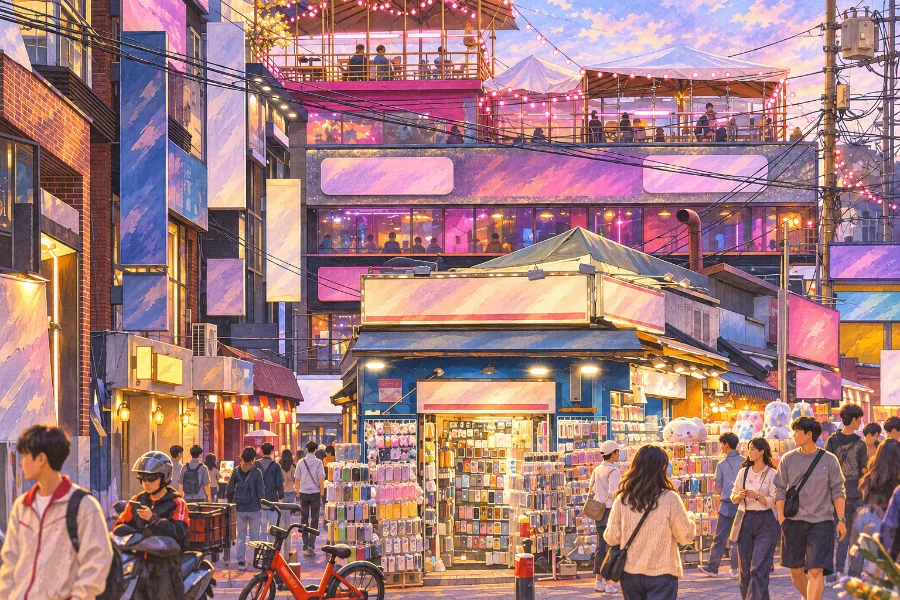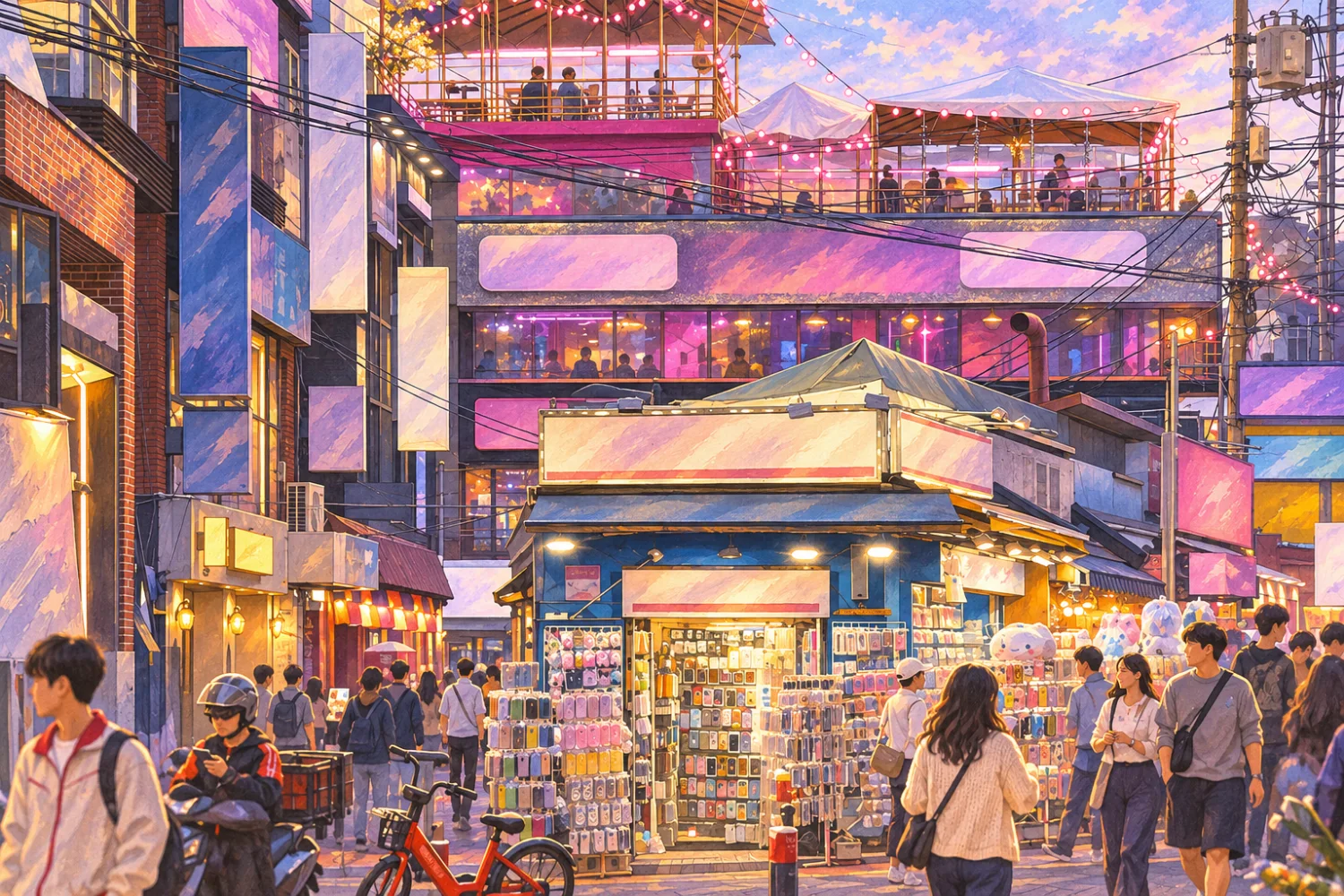
Hongdae is easy to recognize and harder to get a handle on. The shopping streets, performance crowds, and late-night reputation offer an immediate introduction. They also leave a question unanswered: why did this particular part of Seoul become a place where so much of the city’s creative life gathered?
The answer begins with Hongik University, then moves through art studios, small music venues, changing streets, and the people who have repeatedly found new uses for them. Following that story gives a visit some shape. A design exhibition, a meal near campus, and a live show that catches your interest can reveal more about the neighborhood than another afternoon spent moving between whatever happens to be busiest.
Practical information checked November 6, 2026. Hero illustration adapted with AI from a Hongdae street photograph by lumoplank (CC0).14
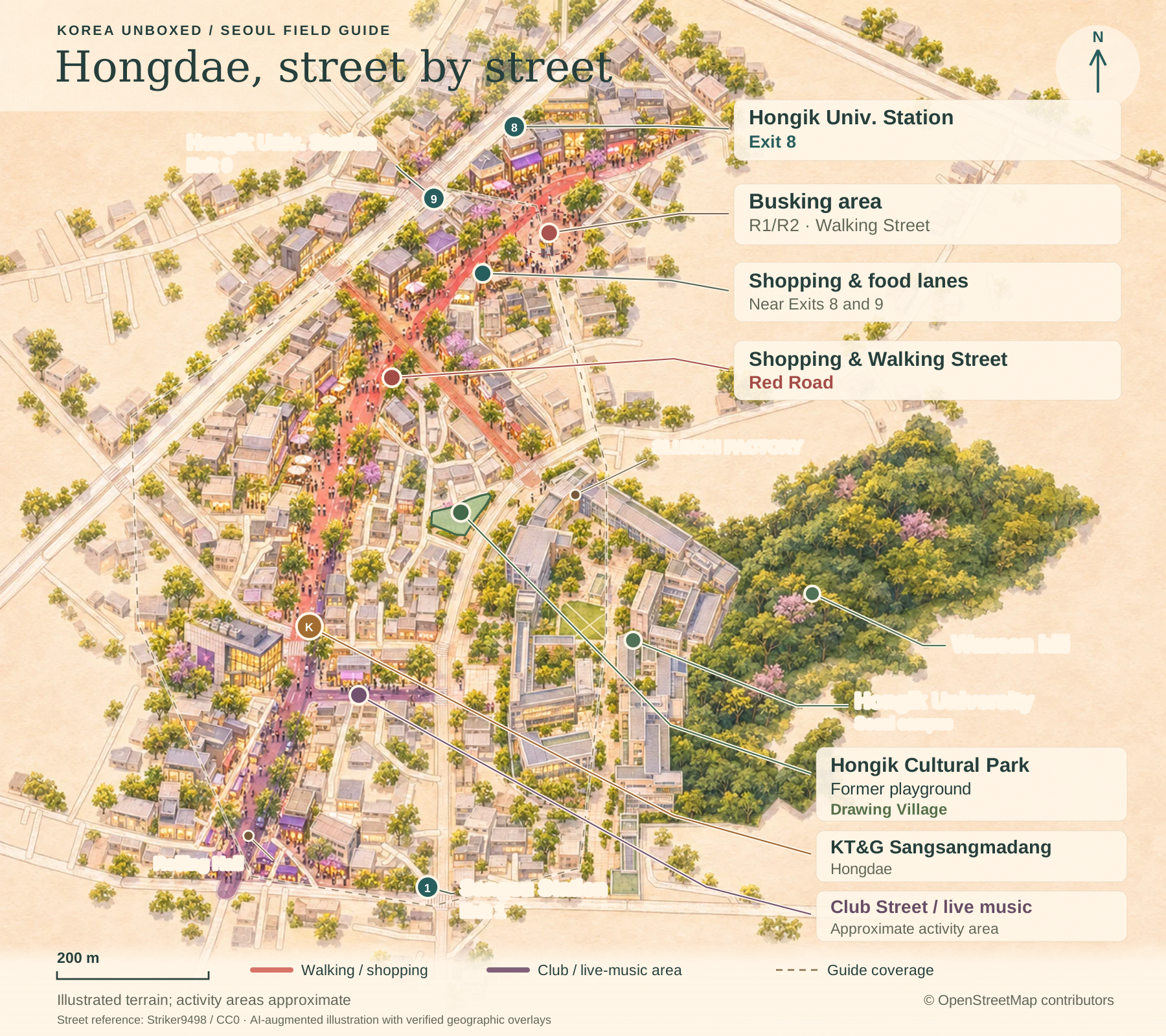
Map key: Red follows the Eoulmadang-ro shopping and walking spine; apricot marks Hongik-ro toward Hongik University. Purple highlights the club and live-music area. Busking and food labels mark general areas to explore. Visit Seoul identifies R2 as a busking street approached from Exit 8.16 Performances vary with the day and program.
Where this Hongdae guide begins
For this guide, Hongdae means the area south of Hongik University Station: the central Seogyo shopping and music streets, the university frontage, and the stretch toward Sangsu Station. Yeonnam, Hapjeong, Mangwon, and the quieter streets deeper into Sangsu have their own character. They make good neighboring explorations, but this is a closer look at the streets between the station and the school whose name the neighborhood borrowed.
The name has never described one perfectly bounded district. The Korea Foundation’s account of Hongdae’s changing cultural geography explains how Hongdae-ap, the area in front of Hongik University, became associated with a much wider cultural landscape.1 The shaded area on our map is an editorial choice, rather than an administrative border. It keeps a visit manageable while leaving the surrounding neighborhoods visible.
Within that small area, it helps to think in terms of encounters rather than attractions. An exhibition asks you to look closely. A concert asks for a particular part of the evening. A shared meal makes room for conversation; a dance floor changes the purpose of going out again. Hongdae becomes easier to enjoy when those choices have room to be different. You can give the afternoon to art, stay for music, or return another day for the part you missed.
The university came before the nightlife
Hongik University moved to Sangsu-dong in 1955, according to its official history.2 The school did not arrive on an empty site waiting to become a nightlife district. Seoul Museum of History research, summarized by the city, describes an earlier area shaped by the railway serving the Dangin-ri power station and subsequent residential development.3 The university joined an existing piece of Seoul, then helped change what people came here to do.
That change depended on more than a famous school name. Art education brings needs into the surrounding streets: materials, practice space, places to show work, and people willing to discuss it. The Koreana cultural history follows the ateliers, academies, workshops, bookstores, and galleries that gathered around the university.1 They made art part of an everyday local economy, with connections between learning, making, and earning a living.
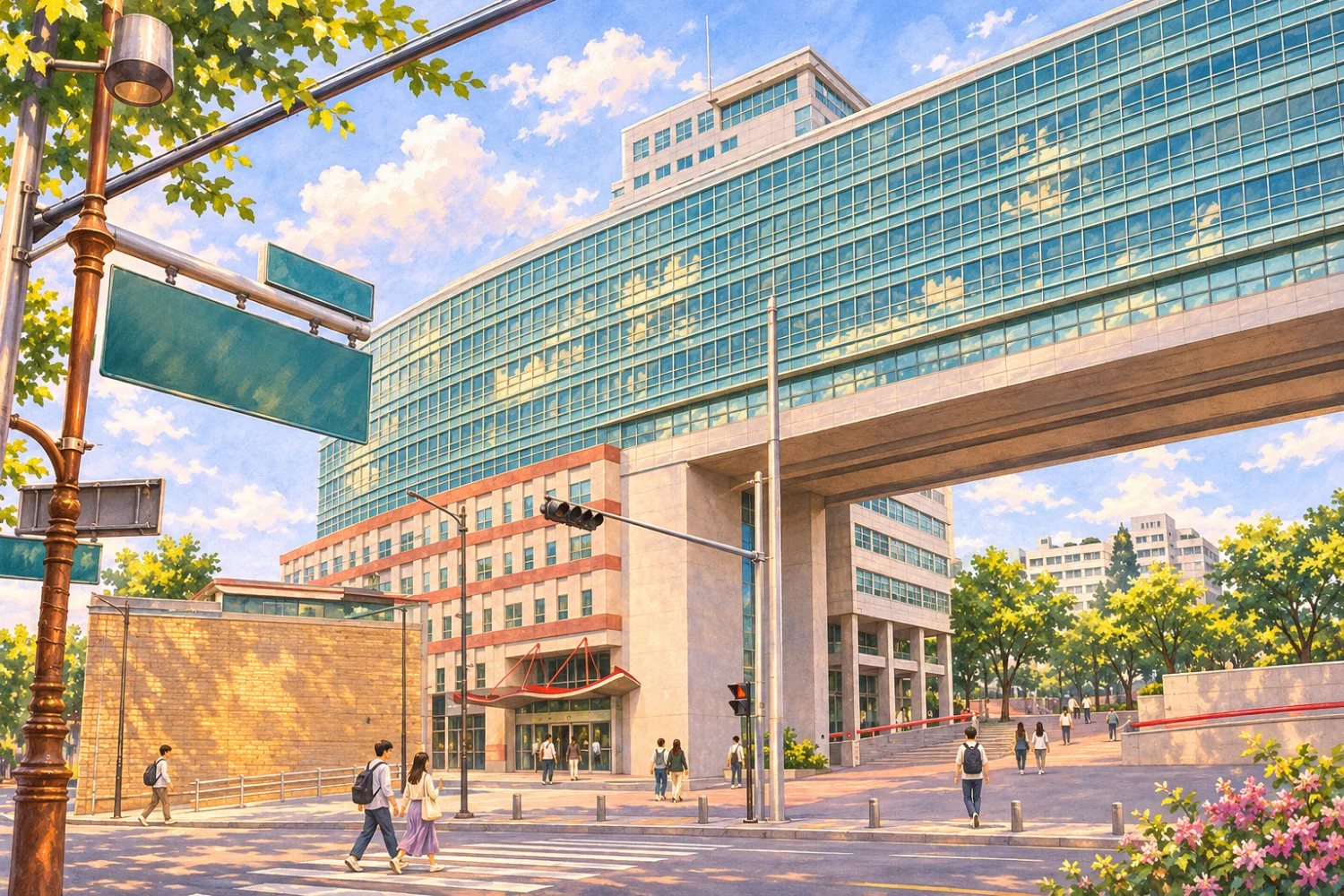
Start with the frontage rather than treating the campus as a shortcut. The large Hongmun-gwan gateway is a working university building. Hongik’s Korean institutional chronology records its completion in 2006 and the completion of Art & Design Valley in 2023.18 Those dates put the school in the present as well as the past. The campus edge has continued to develop while the surrounding streets have become places to shop, eat, and go out.
Even one department gives a more useful picture of the art school than its reputation alone. The College of Fine Arts’ printmaking curriculum places intaglio, lithography, screen printing, and artists’ books alongside interactive media and 3D printing.43 Traditional processes and newer tools are part of the same education. For a visitor looking at a print or a small edition, that is a reason to notice how an image was made and how it can move between people, rather than asking only what it depicts.
A college report from October 2025 gives one concrete example. Its printmaking group DECKLE took part in a charity exhibition and donated money raised through work sales and printmaking activities.44 The account connects students’ making with participation and exchange outside a classroom. A print was something to exhibit or buy, while a printmaking activity let other people take part. It is a small episode in the university’s much larger history, but a useful reminder that an art school’s influence can be found in what its students do together as well as in the objects it produces.
Seeing the art school at work
The Hongik Museum of Art, or HoMA, gives that educational story a public-facing form. Its official introduction distinguishes two locations: Hall 1, on Moonheongwan’s fourth floor, principally presents student graduation, project, and degree exhibitions; Hall 2, on Hongmun-gwan’s second floor, presents contemporary art exhibitions.19 The difference is useful. A student project exhibition and a professional contemporary show offer different ways to understand what an art school makes possible.
At a student exhibition, follow an idea across a group of pieces, read the project explanation, and notice choices of material or presentation. A university gallery makes part of the educational process public without requiring a visitor to enter a classroom or studio.
Use HoMA’s exhibition calendar to choose a particular show before entering the campus.20 Its visitor guide asks groups of 20 or more to arrange a visit ahead and requires permission for photographing artworks.21 Follow the exhibition’s own admission instructions. A gallery visit is a clearer invitation than assuming every university building is open for sightseeing.
The official campus map is useful for finding the two buildings and understanding the frontage.15 It also gives a sense of how much of Hongdae’s identity begins with a place of study. From the public street, the university may seem like one more landmark. Inside an announced exhibition, it becomes an institution whose students are still making things for other people to encounter.
From the old playground to the walking street
The connection between school and street has often been expressed outdoors. The city’s neighborhood history identifies the 1993 Street Art Exhibition as an important moment in Hongdae’s public art culture.3 That history helps explain why murals and informal creative activity belong in the story. It does not make every painted wall part of one permanent exhibition, or every current shop an artist’s project.
Hongik Cultural Park is the clearest place to see an older identity meeting a newer one. Many people know it as Hongdae Playground. Visit Seoul’s current park account describes its December 2025 renewal as Drawing Village, or Geurimdongne, with a Creative Center and shared studios supporting creative work, exhibitions, and participation.4 The address is 19-3 Wausan-ro 21-gil. The familiar playground name remains useful for orientation, while the current program gives a visit its purpose.
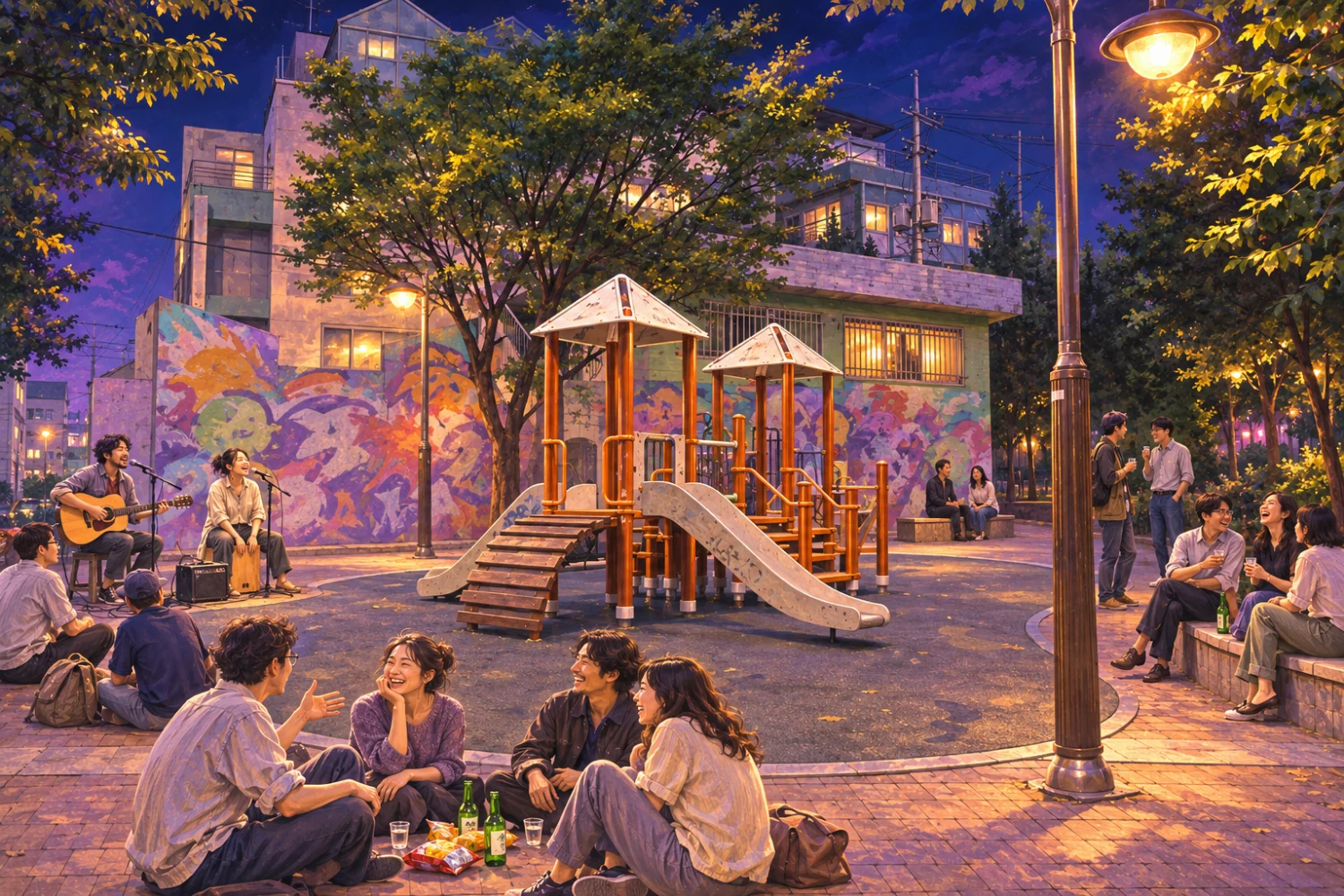
Look for the relationship between making and showing here. An exhibition, a shared workspace, and a public activity represent different stages of creative work. A visitor might encounter one of those stages through the announced program, rather than finding an artist automatically available to demonstrate something. Give the place time on its own terms. For the Saturday Free Market familiar from older guides, use a current organizer announcement before treating it as a weekly appointment.
The surrounding mural lanes also reward a flexible approach. Visit Seoul describes dispersed walls and alleys without a fixed viewing course.23 Hongik’s 2024 account of its New Hongik development describes changes to the former wall and mural-street edge near the main gate as Art & Design Valley took shape.22 An old photograph may show a real part of Hongdae’s history without showing a wall you can still find.
That does not make looking for street art a disappointing exercise. It changes the kind of attention it invites. Take a lane because it interests you, notice how art meets doors, signs, and ordinary buildings, and leave enough room for people using the street. A mural can matter as part of a changing neighborhood rather than as a photograph that every visitor has to reproduce.
Near the station, busking has a more clearly organized setting. Visit Seoul identifies R2 Busking Street with the Walking Street area and an approach from Exit 8; its listing describes registered performances across different genres.16 The nearby R1 cultural area includes programs such as markets, busking, caricatures, and games.10 The red walking spine is a useful way to connect these spaces, while the map’s activity labels describe broad areas rather than reserved seats for a continuous show.
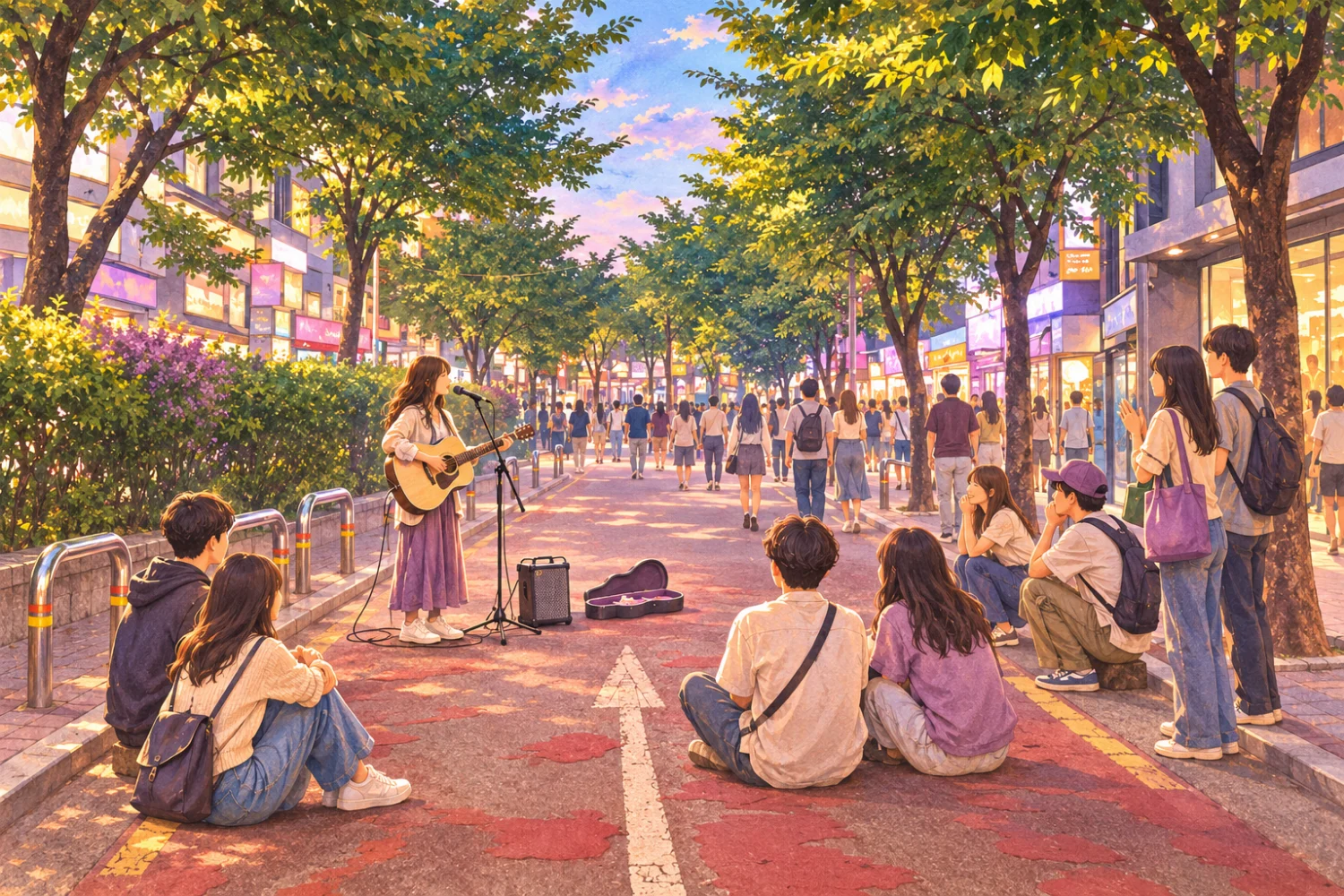
If a performance is underway, let it become a pause rather than a quick background for your own video. Give the performer a little attention, keep entrances and routes through the crowd clear, and follow any guidance about filming. You can stay for a song without understanding every word. The useful distinction is between happening upon a public performance and making a plan around a ticketed show: both belong in Hongdae, but they ask different things of your time.
If you enjoy a set, look for a performer’s announced name or a way they have chosen to share their music. That can turn a passing encounter into something you follow beyond the street. You might later recognize a name on a small-venue bill or listen to a recording at home. The street and the concert room do not have to be separate discoveries; the connection can begin with giving one performance enough attention to remember who made it.
A cultural center to build an afternoon around
KT&G Sangsangmadang Hongdae, opened in September 2007, brings design retail, exhibitions, cinema, live performance, and education into one building at 65 Eoulmadang-ro.5 It makes a useful next step after the university frontage and Drawing Village. You can move from seeing how creative work is taught or supported to choosing something that is being presented to an audience.
Choose one part of its program as an anchor. An exhibition can introduce an artist or an idea; a film has a defined running time; a design object offers another relationship between creative work and everyday use. These are different experiences even when they share an address. There is pleasure in leaving a little time between them, instead of treating the building as a set of floors to complete.
Visit Seoul lists general building hours, while individual exhibitions, films, classes, and performances have their own arrangements.6 Follow the particular program for admission and booking. If you are meeting friends here, agreeing on the exhibition or event is more useful than agreeing only on the building’s name.
If you’re coming by taxi, say 홍대 상상마당으로 가 주세요. (Hongdae Sangsangmadangeuro ga juseyo.), meaning “Please take me to Sangsangmadang in Hongdae.” You can also show the driver the venue name and address: KT&G 상상마당 홍대, 서울시 마포구 어울마당로 65.5
The center is also a practical place to start an access check. Korea Tourism Organization’s building-specific accessibility record lists a step-free approach and main entrance, an accessible elevator, and an accessible restroom.13 Confirm the room used by your particular event, especially when a visit includes another venue afterward. A useful building record can support a plan without standing in for the whole neighborhood.
Small rooms made a music neighborhood
Hongdae’s music history is easier to understand at the scale of a room. Music critic Kim Hak-seon’s history for Koreana traces Drug from a music bar opened in July 1994 to regular live performances after a 1995 Kurt Cobain memorial concert. Crying Nut became central to the venue’s story; the May 1996 Street Punk Show was another landmark. The essay also describes house-band relationships and club compilations, including those associated with Spangle, Jammers, and Rolling Stones.7 These are historical rooms and relationships, rather than a list of doors to find tonight.
Seoul Museum of History’s research into the area’s club cultures places those rooms within communities formed around musical interests.40 A venue could provide repeated contact between musicians, organizers, and listeners, not simply a stage rented for a single performance. Thinking about that role makes the smaller names important. A scene needs places where people can begin, meet again, and develop an audience as well as somewhere to play a large show.
FF, between a live bill and a DJ party
Club FF offers a specific way into that story. In a 20th-anniversary message republished by Indistreet, representative Eddie Hwang dates its opening to 2004 and its developing rock-club direction to summer 2005. He describes influences including Manchester’s Haçienda and Sonic Youth’s “Dirty Boots” video, and credits the bands, DJs, staff, and people supporting the room over the years.24 It is an account of a place being made through people’s ideas and work, rather than a claim that its present identity appeared fully formed.
That history also explains a practical distinction. FF combines live-band and DJ-party uses. Its November 2026 gig calendar lists “Walking With You@FF” on November 6 and “Emo Night” on November 7.25 One is a band bill; the other is a party program. Rock can be the common interest without the two evenings offering the same kind of listening. Look at the artist lineup and event description as well as the venue name.
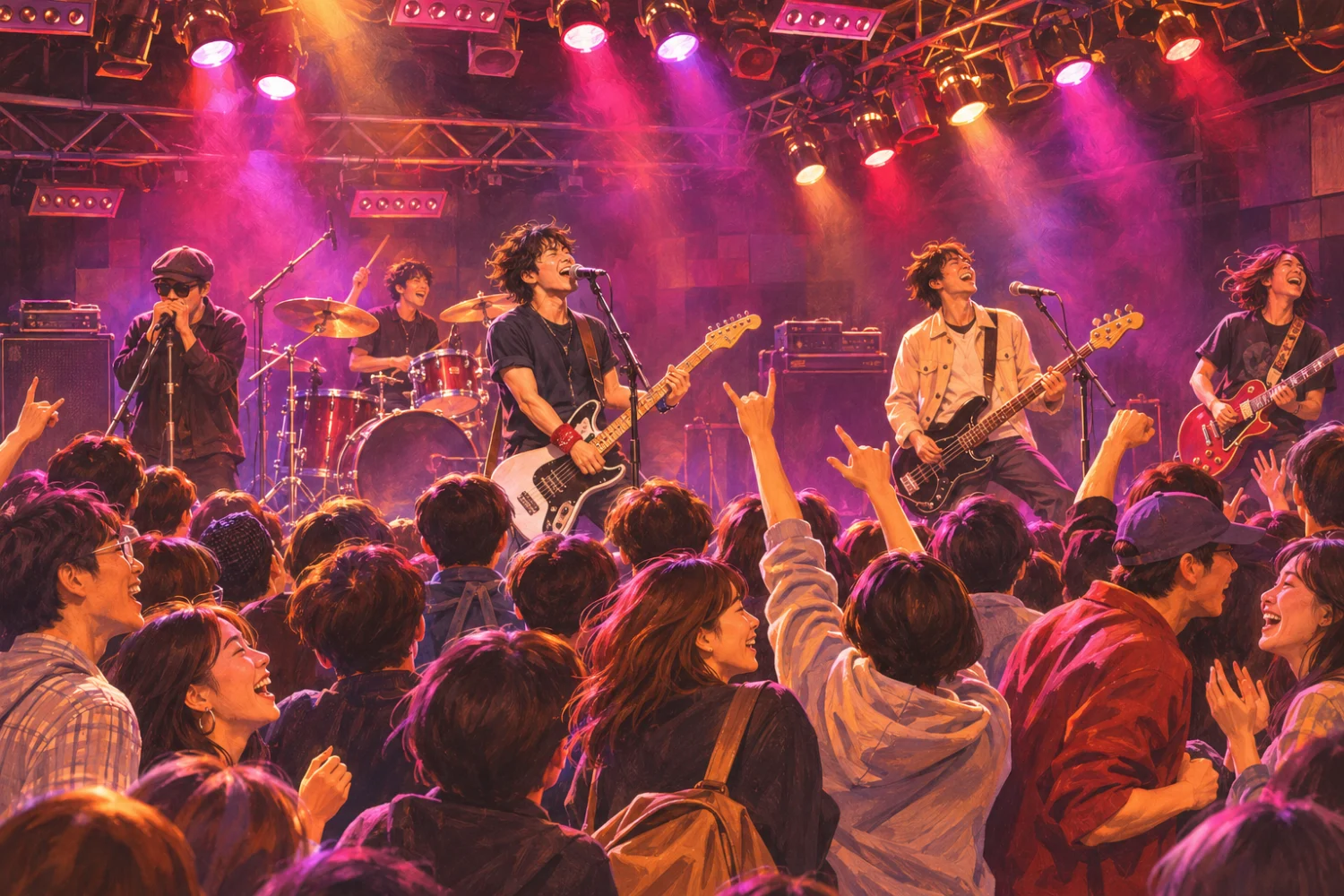
For a band bill, listen to a track or two from the listed artists and let the concert set the evening’s timing. Dinner and the afternoon can fit around it. A small show offers a chance to hear an unfamiliar musician on their own terms; a DJ party offers another way to enjoy a shared musical interest. The difference is worth making before arriving at the door.
Other ways into the live circuit
Toward Sangsu, Rolling Hall provides another named performance destination at 35 Eoulmadang-ro.8 Seoul’s September 2026 cultural account of Hongdae connects its 1995 beginnings with 31st-anniversary programming, while also discussing the larger concert and showcase role of MUSINSA Garage.39 Those different scales are part of the neighborhood’s story. A reader can choose a particular artist or room rather than assuming the busiest stretch of the shopping street will supply the right show.
Unplugged, at 26 Wausan-ro 33-gil, opens another route into music. The operator’s site combines a café and pub identity with drinks created by musicians associated with the venue. Its musician-cocktail section names collaborators including Park So-eun, Jeongwoo, Wisue, and Kim Sawol.26 The musicians are part of the bar’s presentation as well as its performance story. A name on the drinks page can become a route into someone’s recordings.
The performance calendar includes open microphones, open stages, Club Wednesday, and singer-songwriter programs, with different rooms identified in the listings.27 The names describe different points in a musical practice: a chance to present songs, a curated gathering, or a program centered on a songwriter. A café drink and an announced concert remain separate experiences, even when they belong to the same venue.
A particularly revealing example is Unplugged’s 2026 Jumok (“Spotlight”) program announcement. It introduces musicians the venue encountered through open microphones and open stages, bringing them together for a curated bill.28 The interesting connection is between trying out songs, being noticed, and reaching listeners who came for the program. An open mic is part of a working musical community, not simply an informal version of a finished concert.
Club BBang adds another thread. Koreana’s account dates its opening to 1994 and describes its folk and modern-rock identity.7 Its Indistreet venue page emphasizes performers playing their own songs, from solo musicians to bands, and provides a calendar for the room at 12 Wausan-ro 29-gil.45 A songwriting-centered program gives you another basis for choosing a show: the songs themselves, and the person or group presenting them. Listen to the listed artists before choosing the evening. The musical history can explain why a room matters, while the particular bill gives you a reason to go now.
That is a rewarding way to approach Hongdae’s live venues in general. Pick a room or a program because it gives you something to listen to closely. A café drink, a seated singer-songwriter event, a band bill, and a DJ party all offer different company and demands on attention. Once you make that distinction, the neighborhood’s music becomes much more specific than the promise of a lively night out.
The underground circuit, beyond one address
Gig archives, recordings, and interviews add another kind of map to Hongdae: one made of relationships between rooms. A promoter works at more than one venue, a basement becomes a recording project, or an old bar returns with a different program. Following those connections explains how a place can remain part of the neighborhood’s culture after its original doors have closed. This is a history of a wider circuit, extending beyond the highlighted visitor core.
MWG and Temple: a community before and after closure
MWG, or 명월관 (Myeongwolgwan), had a history that reached back to the 1990s. In a 2019 DJ Mag Asia interview, owner Kim Eun-hee traced its beginnings to a club opened in 1994 as Hwanggeum Tugu, later renamed Myeongwolgwan after a move. She had taken over its leadership in 2010.54 That account describes an institution maintained by successive people, rather than a single unchanged room or founding personality.
One episode makes the work of keeping it alive unusually concrete. Kim described a March 2016 benefit party at which DJs and clubgoers contributed toward safety, electrical, and fire-related work needed for the venue to continue.54 Behind the music were the practical demands of maintaining a room. The benefit made the relationship reciprocal: the club provided a place to gather, and people who used it helped sustain the place.
The musical communities were specific too. An organizer-posted March 2017 Innertrip psytrance bill at MWG included Psytonic and Jamjari.56, 87 Psytrance was one strand of the room’s musical world. AFP’s later reporting describes band performances, DJ events, and LGBT parties, with several communities attaching themselves to the same venue.55
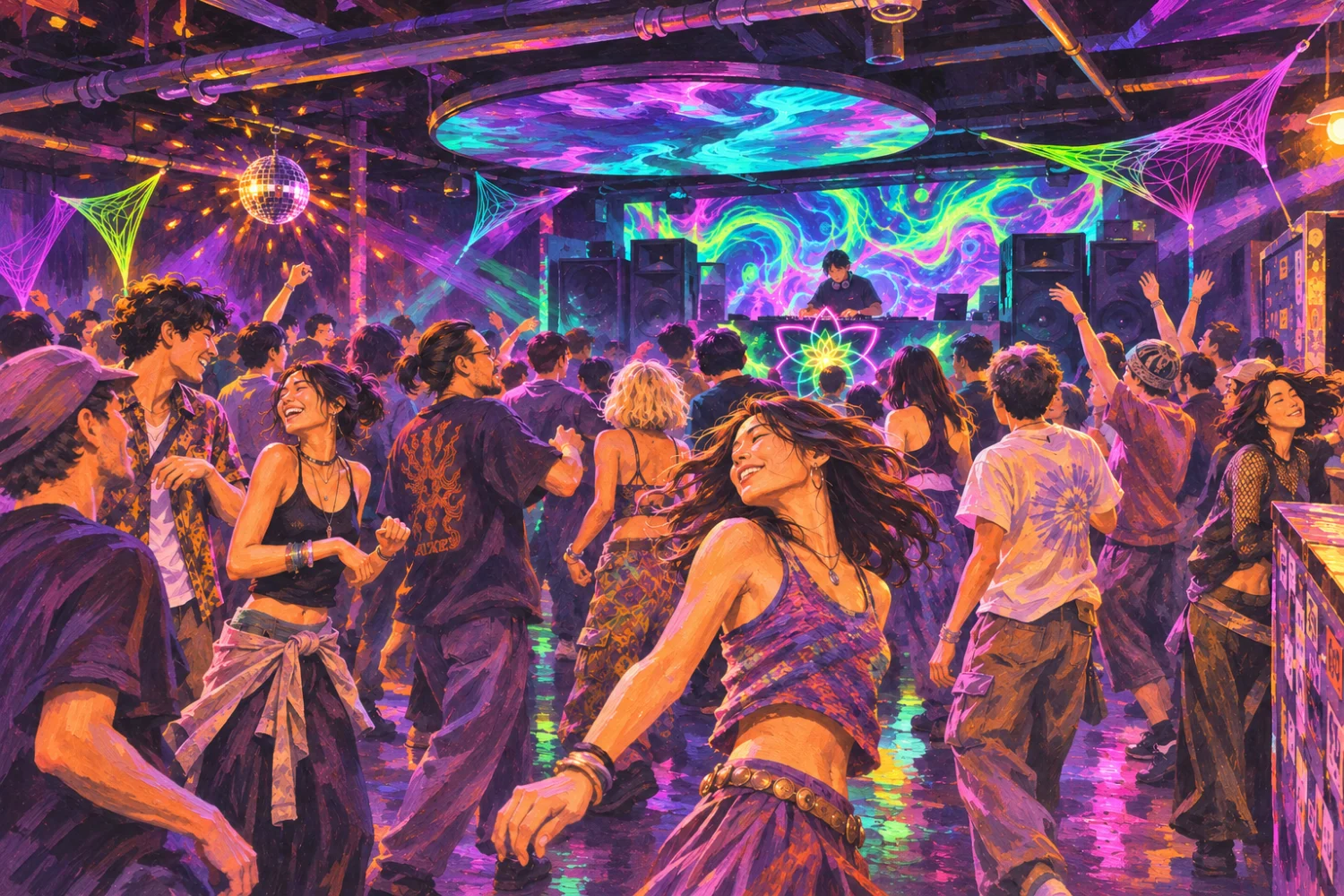
Temple advertised its grand opening for August 9, 2019. Its “Trance Stay” program listed Psytonic among the DJs.57 MWG was still operating when Temple began. Jamjari’s public artist biography supplies a precise connection between the rooms: MWG from July 2017 to March 2019, followed by Club Temple from July 2019 to March 2024.58 A DJ’s working life links the two rooms, carrying a musical practice across their doors.
MWG’s farewell came in September 2020. AFP’s reporting, with a photograph identifying the September 26 farewell, describes repeated pandemic shutdowns and rent the venue could no longer meet.55 People could help a room through some crises without being able to protect it from every one. The closure belongs in Hongdae’s history alongside the gigs and anniversary parties, because losing a room also changes where a community can meet.
Temple developed a program of its own. A November 2024 Hard Maker anniversary announcement documents hard-dance programming, from hardstyle through hardcore, at 147-1 Wausan-ro, B1.59 Then an announcement for a July 10, 2026 memorial at UNDERCITY identified Psytonic as Temple’s founder and presented a final chapter for Temple and 999PROJEKT.60 UNDERCITY in Seongdong-gu was the venue named for the memorial, carrying the connection beyond Temple’s old Hongdae room.
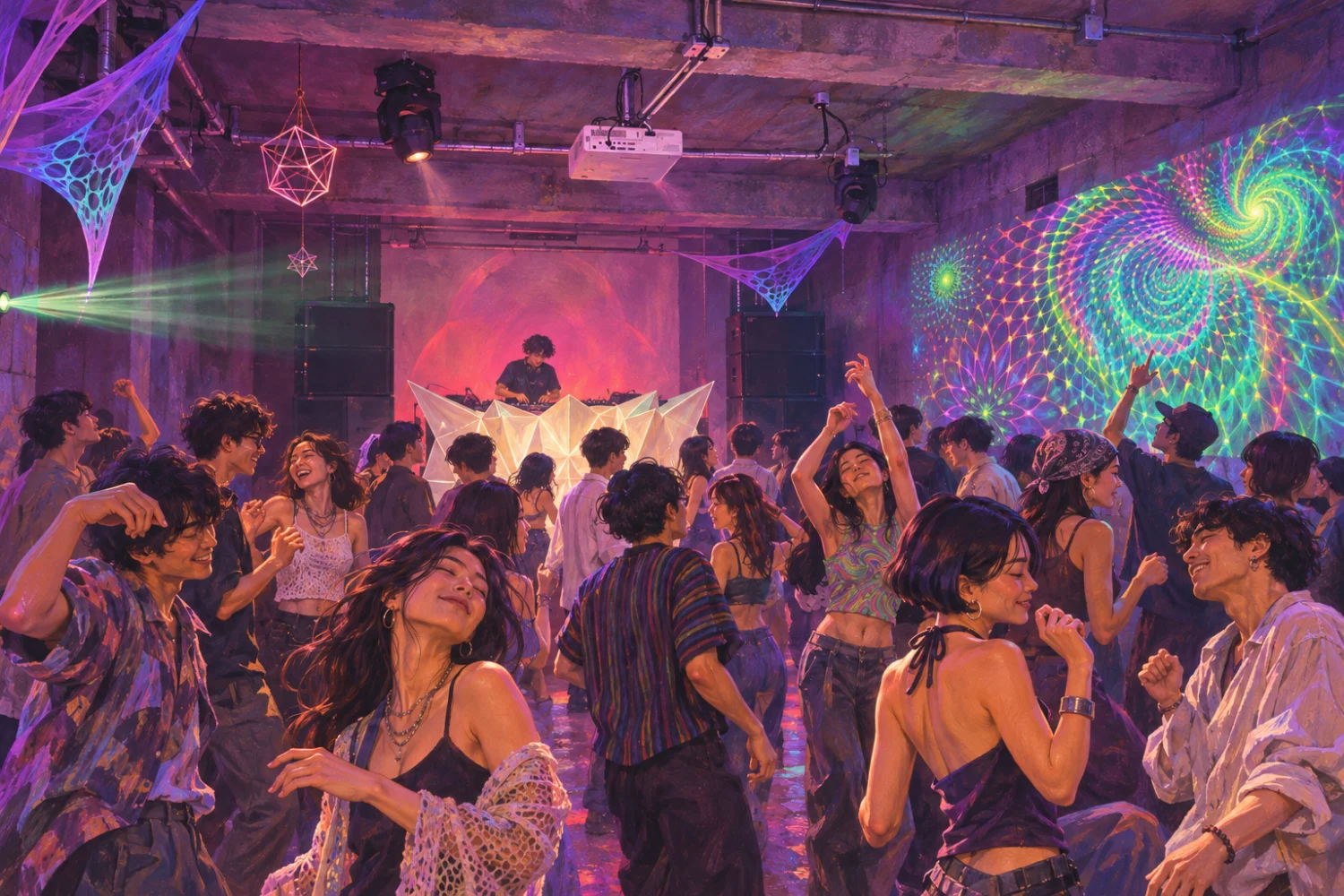
Hippy Tokki: the room and the recordings
Hippy Tokki, also written Hippytokki, was a separate live bar in Hongdae’s indie-music circuit. An artist-managed Jungle Julie archive preserves an October 2018 underground live-music bill under the Hippytokki name, with an afterparty.61
The Goinmool archive records the Hippytokki/Goinmool venue.65 The operator’s Hippytokki Compilation Project, released in December 2021, credits recording sessions at Studio Goinmool on April 18 and May 23. Six acts contributed original songs: The Onebutton, Sick Jeff, GoryMurgy, Youthlim, 2 Day Old Sneakers, and HERD.62 The project describes cooperation between musicians and the venue as part of sustaining the scene.
The room also became a recording site for THE POST-ROCK, digitally released in February 2022. Its distributor-supplied liner notes describe one-take live recordings at Hippy Tokki involving ten acts. Wings of the ISANG’s “Crimson Sky” and cotoba’s “Love&Art” appear in versions identified with the venue. The formal credits name Zeed as producer and 재선 as co-producer, with Hippy Tokki among the planning collaborators.102 The project widens the picture of the bar’s musical life: different bands could use the same room to make something that traveled beyond the night itself.
Punk Time Capsule followed in May 2023, collecting recordings by punk acts that had played at Goinmool.63 The recordings give the former room an accessible afterlife. You can hear people who made music there through the venue’s own archive, rather than relying only on someone else’s account of what the basement meant.
James, publicly interviewed as Hippy Tokki’s former operator, later founded Delay Relay. His work connects the venue’s recording archive with a wider circuit of Korean indie musicians and rooms.
Delay Relay: from one room to a wider circuit
Youthlim supplies a direct connection between the old basement and what followed. The band appears on the 2021 compilation with “장산범.”62 In his January 2025 interview with The Korea Times, James recalled knowing Youthlim from the Hippy Tokki days and singled them out among the performers announced for the first Delay Relay. He described conversations with Club Bbang’s owner about a multi-venue event, with shoegaze becoming its focus. That inaugural programme advertised 32 artists.94 A familiar name on an old recording becomes a way to follow the relationships into another room and another year.
The programme announced for January 10 through February 7, 2026 expanded to 65 artists across 13 shows over five weekends. In a second interview, James identified support for underground venues as one of the festival’s purposes. A five-person committee helped shape the edition, with individual shows organized around different themes and colors. Its rooms included Club Bbang, Channel1969, Strange Fruit and Gongsangondo.64 The scale came from connecting existing places and the people who programmed them.
Delay Relay also left its musical borders open. James described a programme that welcomed post-rock, dream pop and other neighboring approaches alongside shoegaze; he pointed readers toward both zzzaam and the newer Post Inner Circle. The festival’s official Instagram is the place to follow later announcements.64 The January 2025 and 2026 programmes belong to those editions. Their history gives a visitor a useful way into Hongdae’s live-music circuit, while a future visit should follow a newly announced bill.
Korean shoegaze: a listening route through the scene
For a first encounter, think about what the guitars and voices are doing together. Shoegaze often makes texture central: distortion, sustained tones and reverberation can let a voice become part of a larger sound. Electric Muse’s account of Vidulgi OoyoO emphasizes exactly that relationship, describing the band’s attention to tone, space and the voice as an instrument within the arrangement.96 A small club gives those layers a shared physical setting. The distance from the stage, the room’s size and the audience around you become part of the experience.
There is a longer Korean history to follow here. The distributor POCLANOS dates zzzaam’s formation to around 1997–98, then lists the original albums 낮잠 in 2000, requiem #1 in 2002 and 거울놀이 in 2004. Its current catalogue page makes that older chronology visible alongside a 2023 digital-release date.95 Start with requiem #1 and carry those earlier years into the newer festival story. The scene has records, names and working relationships that reach well beyond a recent revival.
Vidulgi OoyoO offers another route through that history. On Electric Muse’s release page for Aero, the label traces the band to 2003, describes its activity at Salon Badabie and credits an April 3, 2008 album release. Its account places “Elephant” within Hongdae’s live scene and discusses shoegaze, slowcore and psychedelia as parts of the band’s approach.96 “Siren” and “Elephant” are manageable starting points; the nine-minute “Murmur’s Room” lets you spend longer with one piece.
For a more recent path, Parannoul’s own To See the Next Part of the Dream dates to February 23, 2021. Its track list includes “Beautiful World,” “Analog Sentimentalism” and “White Ceiling,” with Korean titles and English translations supplied by the artist.97 Pair it with After the Night, released in March 2023 from a January 14 recording at KT&G Sangsangmadang Live Hall. The live credits bring together Parannoul, Yo, BrokenTeeth, Asian Glow, 9SuK and guest trumpeter Fin Fior. “Into the Endless Night” runs for 46 minutes.98 That recording returns the listening route to a building on this guide’s map, and shows several musicians sharing a stage under one project’s name.
Ghost Bookstore’s self-titled first EP, released October 7, 2024, gives you a shorter entry into a newer band. “Sue” is one place to start. The artist’s page lists shoegaze alongside math rock, midwest emo, garage and indie, while the credits identify Ymir Kim and Sue Kim as producers and POCLANOS as publisher.99 Those overlapping descriptions help explain the breadth of a festival such as Delay Relay. A shared bill can bring together musicians whose work approaches the same territory from different directions.
Post Inner Circle makes that breadth explicit in its own description, combining post-rock, dream pop and shoegaze with four musicians and a visual artist. Its first EP, Artificial Sun, was released on October 13, 2025; “Dream Tomorrow (내일꿈)” and “Flashback” offer two entry points. The band describes the record through small sources of hope in a dystopian present.100 Its attention to sound and image is another connection a reader can carry between Hongdae’s art-school history and its performance spaces.
The wider Korean indie landscape extends to other cities, too. Say Sue Me is a Busan band: Damnably’s account of The Last Thing Left, released in May 2022, describes the group recording and producing the album in its own Busan studio.101 Keeping that geography visible gives Hongdae its proper place in a larger musical network. Follow a record to its credits, a musician to a collaboration, or an announced bill to a small room, and a night in this neighborhood can become the start of a much longer interest.
Gopchang Jeongol: Korean records and requests
At Gopchang Jeongol (곱창전골), the musical encounter centers on records and requests. Seoul’s 2020 music-spots guide describes an LP bar at 8 Wausan-ro 29-gil, with Korean records by artists including Shin Jung-hyun, Sanullim, Boohwal, Jo Dong-jin, Kim Hyun-sik, and Yoo Jae-ha. It describes bringing a chosen song to the DJ booth.66 The point is a listening culture that reaches across several generations of Korean popular music.
The bar’s history also involves earlier names and moves. A publisher-supplied excerpt from music critic Go Jong-seok’s 2020 book traces a small predecessor, 그 집에 술이 있다, to 1998, before the later Gopchang Jeongol identity.67 Late-1990s origins are a better shorthand than treating one remembered address as the whole story. The book’s account of requests also treats songs as part of people’s musical lives, not simply a catalogue of famous tracks.
A request changes the relationship between listener and room. A song someone brings forward becomes something other people hear too, with different memories and levels of familiarity. That can make an older Korean recording newly interesting without requiring everyone to recognize it. The same record can carry different meanings for people of different generations.
The institution is still developing new connections. In an October 2026 announcement reported by OSEN, Ruby Records described a planned CosmosRUBY collaboration linking the Cosmos space inside Gopchang Jeongol with Incheon’s Ruby Salon, scheduled for November 21.68 The planned collaboration adds a live-performance and emerging-musician connection to the longer record-bar story.
After the show: dancing or a social bar
Hongdae’s dance-floor history runs alongside its live-band story. The museum’s neighborhood research describes SKA, opened in 1992, as a rock-café-style dance club, and traces the development of communities around shared musical preferences.40 This is a historical example, rather than a current destination. It helps explain why “club” has never meant only one thing here. Listening to records, hearing a band, and dancing were different ways for people to gather around music, sometimes within a closely connected set of streets.
Dance clubs have their own place in this history. The Korean Visit Seoul account of NB dates the brand’s Hongdae arrival to late 1999 and describes its later expansion, including a second Hongdae branch. The current listing is headed Club NB2 and identifies a hip-hop dance-club setting.29 That chronology helps locate NB within Hongdae’s nightlife without turning it into an unsupported claim about the neighborhood’s first club.
Here, the purpose of the night is dancing to a DJ, rather than watching a band’s scheduled set. The distinction matters even when the same friends would enjoy both. An evening built around a particular musician has a performance to arrive for; an evening built around a dance floor is organized around the kind of music and club experience you want. NB and NB2 are names to match carefully to the specific venue notice, rather than interchangeable labels on an old nightlife map.
Popular culture is part of that self-presentation too. NB2’s own account identifies the venue as a Squid Game filming location.42 That is the venue’s claim, and a different kind of connection from its documented place in the hip-hop club story. Neither requires you to know a television scene before deciding whether a dance-club evening is something you would enjoy.
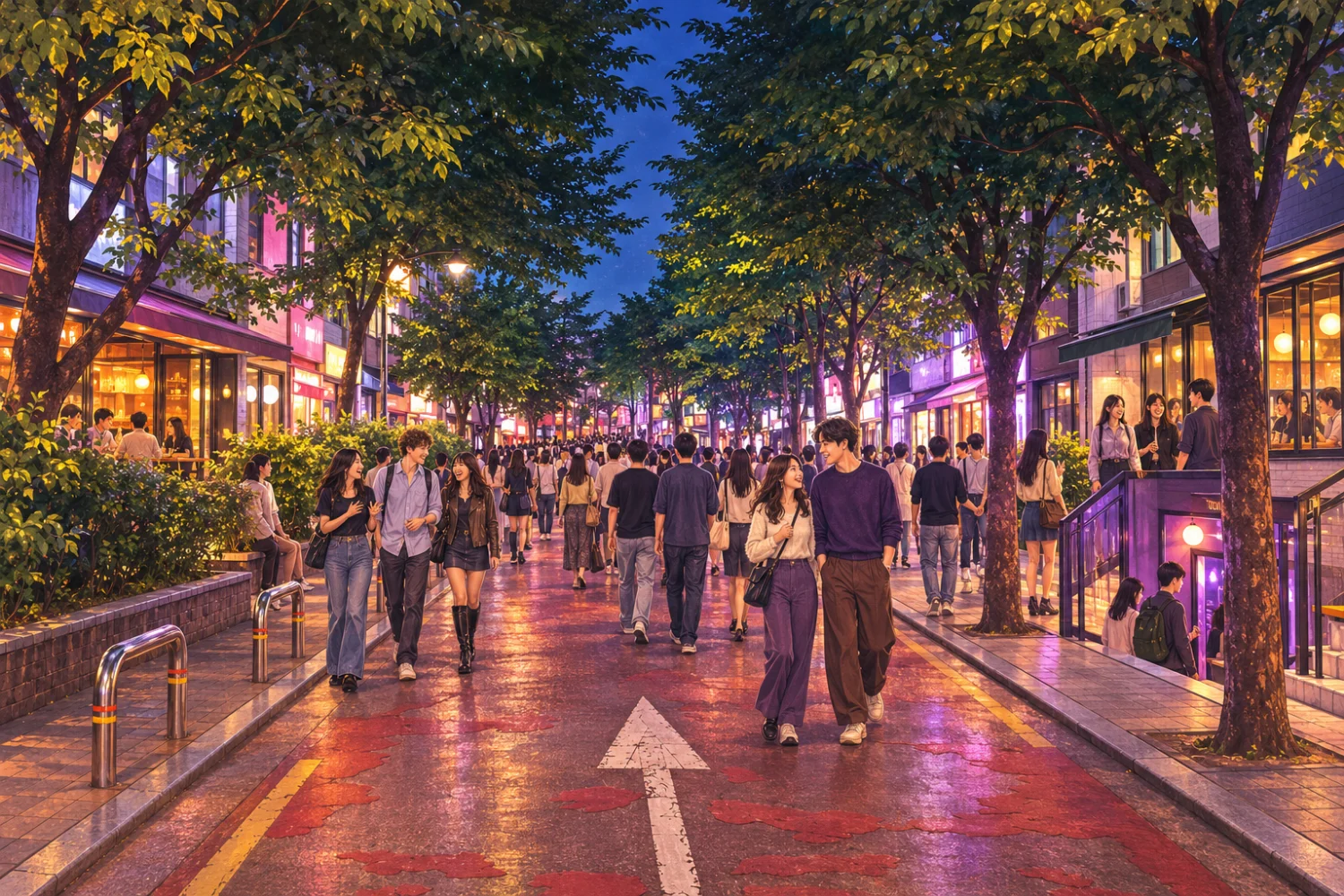
A social pub offers a third kind of evening. Corner Pub’s operator account identifies it as a bar at 16 Wausan-ro 19-gil, with darts among its promotional material.30 Thursday Party belongs to this pub conversation too: the brand’s operator archive includes a Hongdae first branch in 2019 material.31 Use the particular venue’s current notice when choosing a branch or making plans with friends.
A pub can simply be somewhere your own group spends time together over drinks. If conversation is the main purpose, it makes more sense than using the back of a concert room for the same thing. Agree on the part of the evening you want to share, whether that means dinner, a live bill, or dancing afterward. The neighborhood’s range allows the evening to end differently for different people.
Nabi: the same place, a new chapter
Nabi’s full name is 나비도 꽃이었다 꽃을 떠나기 전에는, which can be translated as “The butterfly was a flower, too, before it left the flower.” A firsthand account published in 2017 describes a blue butterfly at the basement approach, cushions, candles, a shallow pond, and instruments including a guitar and djembe.69 Those physical details give the older room a very particular identity.

An October 2014 visitor account describes guests playing djembe while a DJ performed, with reggaeton and dub in the set that night.83 The detail gives the older room a participatory musical history: some of the people gathered there helped make the sound. The account places percussion alongside the DJ set, with listeners taking part in the music.

The later story is a reopening at the same address. Kim Sora’s April 2026 Marie Claire Korea feature reports Nabi’s return after a closure, with its pond retained and floor seating still part of the space. It describes ambient DJ, handpan, and ritual programs alongside drinks, tea, and food.70 Its return kept a familiar gathering place in the same basement while giving it another phase of programming.
A LifeShare/InnerCity event page for February 21, 2026 identifies Nabi at B1, 19-9 Wausan-ro 17-gil and links the current venue account.71 The program links the room’s new chapter to the organizer’s particular event.
For recognition, the historic Trazy photo gallery offers a look at the older room.73 The current operator gallery is the place to follow venue-supplied images and announcements.72 The old photographs are part of the room’s history; the operator’s images accompany its current public identity.
Give dinner its own place in the story
Food is more than the interval before an evening event. It can change the pace of a visit and give people who have been looking at different things a chance to sit down together. Hongdae’s restaurants also show how many different lives meet in the area. There is no need to invent one signature neighborhood dish to make those meals belong here.
Curries, kimchi, and a bowl of thukpa
Yeti supplies a particularly human connection. In a March 2020 TENANT News interview, owner Gambhir described helping his family run a Korean restaurant in Nepal, including making kimchi, and connected that experience with adapting Indian curry for Korean diners. The report also discussed naan, samosa, and lassi.33 It is a two-way food story: someone learning Korean cooking abroad, then bringing another set of dishes into a Korean neighborhood.
The detail about kimchi makes the story personal. Gambhir’s experience of Korean food began in Nepal, before the exchange continued through his restaurant in Seoul. His account lets a meal connect two places through a cook’s working life, rather than making one restaurant stand for an entire country.
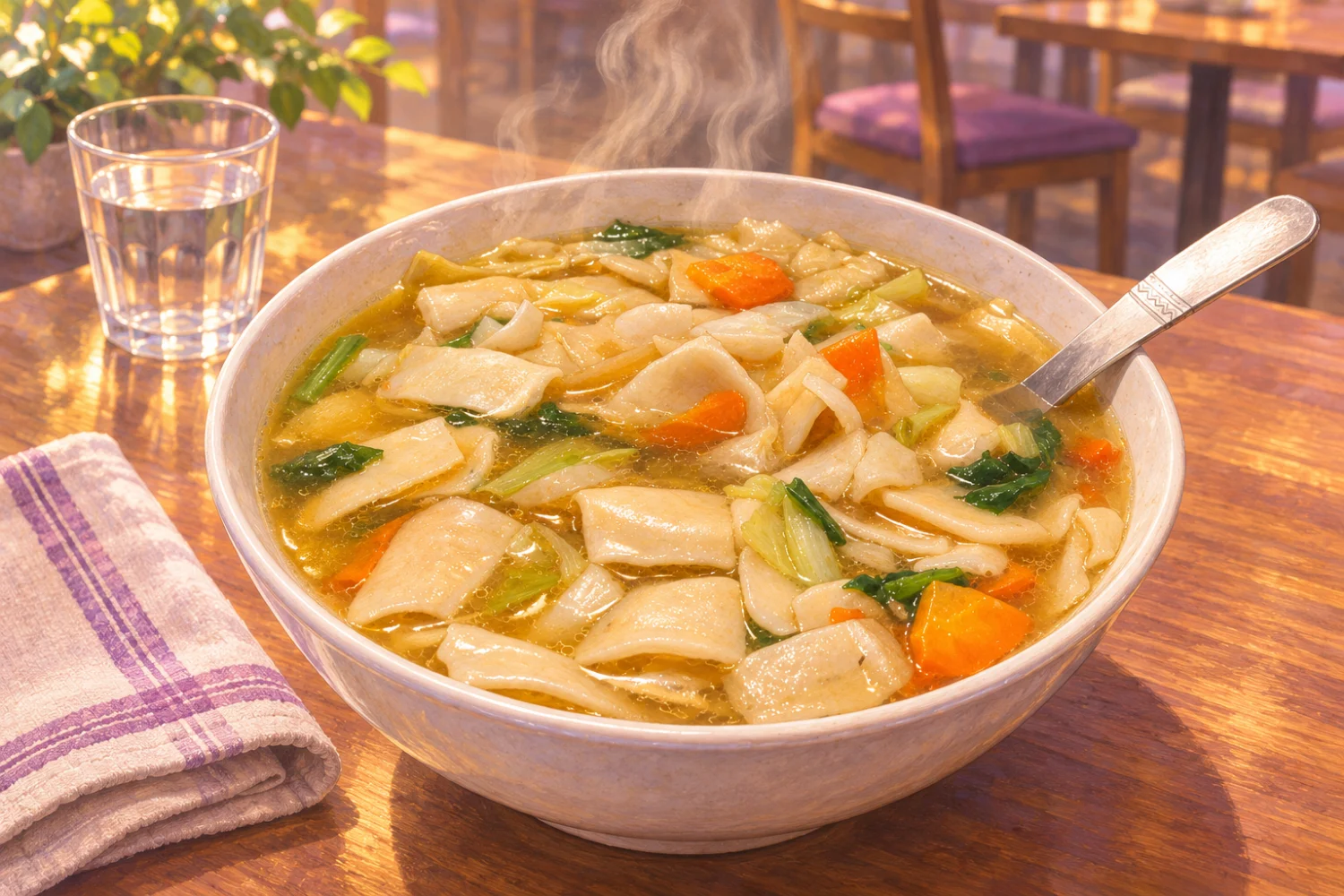
For a current location, KBS’s October 30, 2026 restaurant information identifies Yeti on the first floor at 20 Wausan-ro 18-gil and lists thukpa alongside a lunch set.32 Thukpa is a noodle soup; India’s official tourism food guide describes it among Himalayan dishes.41 The restaurant’s own menu is the place to choose your particular serving, whether you want a bowl of soup or a meal organized around curry and bread.
Share a pan, or choose a different table
On the same Wausan-ro 18-gil, Dak Kko Yam (닭꼬얌) offers another chicken-meal lead. A current Diningcode listing places it at 29 Wausan-ro 18-gil.46 A November 2022 Harim feature describes grilled chicken ssam, with perilla leaves, vegetables, bossam kimchi, and pickled radish, alongside bulgogi-seasoned chicken and an individual chicken, rice, and soup set.47

Music is part of the appeal, too. A local contributor to this guide remembers the woman running Dak Kko Yam as someone who had lived abroad and loved reggae and Caribbean music. That soundtrack is part of what made this chicken stop memorable in Seoul.93
The wrapping format makes the accompaniments part of the meal: a little chicken and a choice of vegetables or kimchi become a bite assembled in a leaf. It offers a different table rhythm from a bowl of noodles or a shared griddle. The individual set described in the feature is another useful format to look for on the current menu when you want a full meal without organizing an order around a large shared pan. You can give this part of the university-side food streets its own dinner stop, rather than treating every chicken dish as something to eat between destinations.
For a shared Korean meal, Shin Migyeong Hongdae Dakgalbi, at 31-10 Wausan-ro 21-gil, offers a different format. Its menu describes chicken, vegetables, and rice cakes cooked on a griddle, cheese-fondue accompaniments, and a fried-rice finish using the remaining sauce. It states a minimum order of two portions.34 That last detail is useful: this is a meal to plan with company rather than assume will work as an individual snack.
The shared-pan format gives dinner its own rhythm. Decide together how much you want to eat and whether you want to leave room for the fried rice. It makes a different kind of stop from buying one item while walking. If a show is the evening’s anchor, put the meal before it with enough time to sit down; there is little pleasure in ordering a shared dinner while everyone is watching the clock.
Haha & Kim Jong-guk’s 401, listed by Visit Seoul at 23 Jandari-ro, brings a recognizable entertainment connection to Korean barbecue. The listing describes a group set with ogyeopsal, moksal, and hangjeongsal, accompanied by fermented-anchovy and house sauces.35 The set format lets a table share several cuts rather than choose only one. For fans, the entertainer connection adds another layer to the meal without needing a celebrity encounter to make it worthwhile.
The cut names are useful menu vocabulary. Korea Tourism Organization glosses ogyeopsal as skin-on pork belly and moksal as pork shoulder, and describes hangjeongsal as a marbled neck-to-shoulder cut.48 The mixed set puts different parts of the pig on the same table, giving a shared meal variety within one main ingredient.
On the university side, the existing SLUNCH FACTORY option at Art & Design Valley, 94 Wausan-ro, gives the group another direction. Visit Seoul describes vegan cooking drawing on Italian and Korean dishes, including pizza and spinach gnocchi.9 A plant-based meal belongs in the same discussion as barbecue or dakgalbi: choose a table and menu that suit the people visiting with you, rather than treating one dining style as compulsory.
Noona Holdak: oven-baked and roasted chicken
On the station-side stretch of Eoulmadang-ro, Noona Holdak adds another chicken format. The full Korean brand name is 누구나홀딱반한닭, useful for recognizing the sign or a search result. Its operator’s Hongdae branch page lists 129 Eoulmadang-ro.74 The location connects it with the northern commercial and walking streets, rather than making another reason to cross into a different neighborhood.
The distinction is in the cooking method. The brand’s bake menu describes 바사칸닭 as crispy-style chicken cooked in an oven.75 Its separate roast menu includes the original oven-roasted 촉촉칸닭, along with other preparations.76 This gives the chicken meal a different starting point from Dak Kko Yam’s grilled ssam or the shared dakgalbi pan. The menu’s bake and roast categories are worth reading as methods, not treating every golden chicken dish as the same fried-chicken order.

Saemaeul Sikdang: seven-minute pork and kimchi stew
Saemaeul Sikdang brings pork and kimchi into the same part of the visit. The current operator branchfinder lists its Hongdae Seogyo branch, 홍대서교점, on the first floor at 144 Eoulmadang-ro.77 That specific branch name and address help distinguish it from older Hongdae listings.
Its signature 7분돼지김치, or seven-minute pork and kimchi stew, is a jjageuli of pork and ripe kimchi. The brand’s own description says the ingredients are simmered for at least seven minutes to develop a rich broth.78 The other signature, yeoltan bulgogi, is pork barbecue with the brand’s gochujang-based sauce.79
A bowl of soup at Boseung Hall
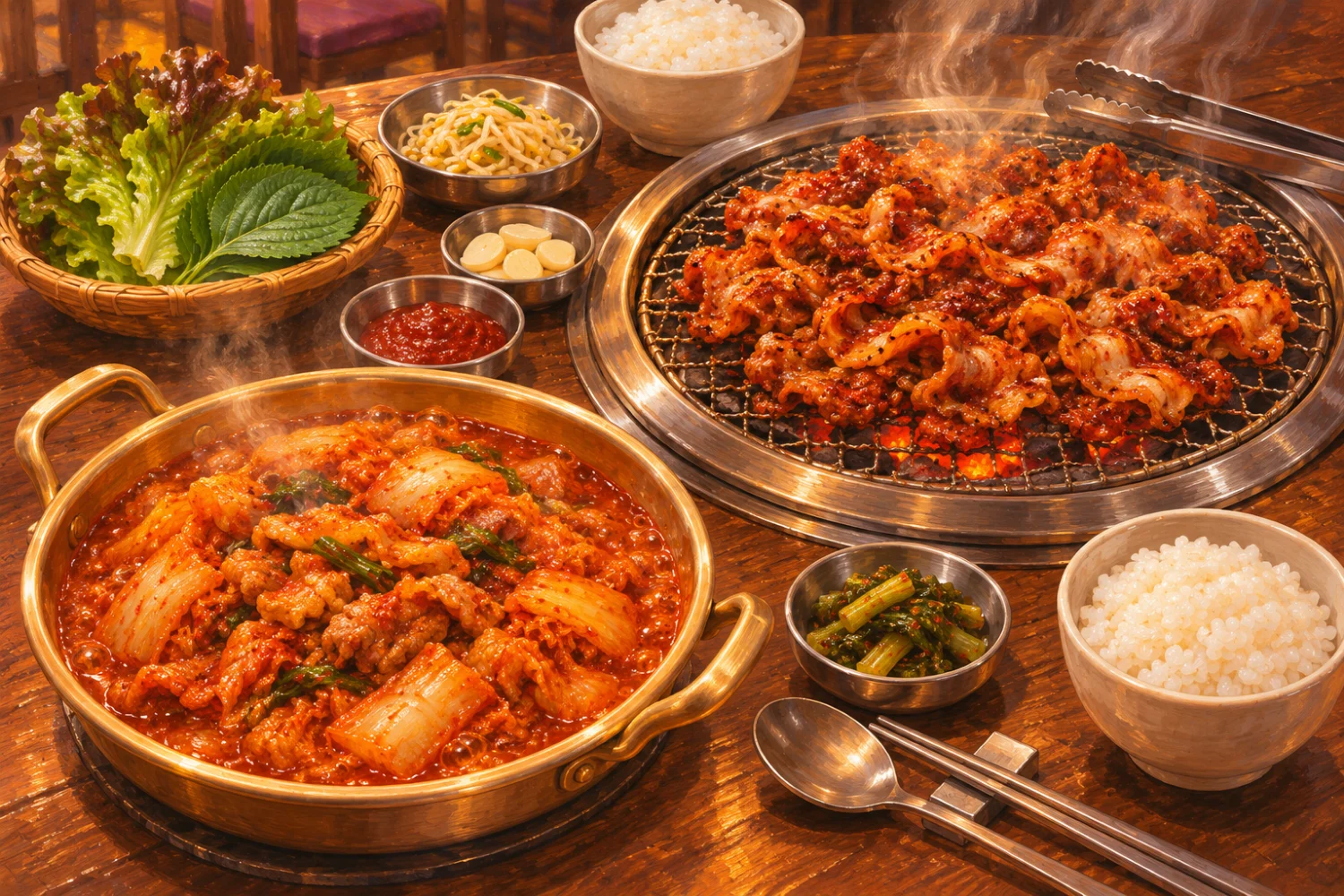
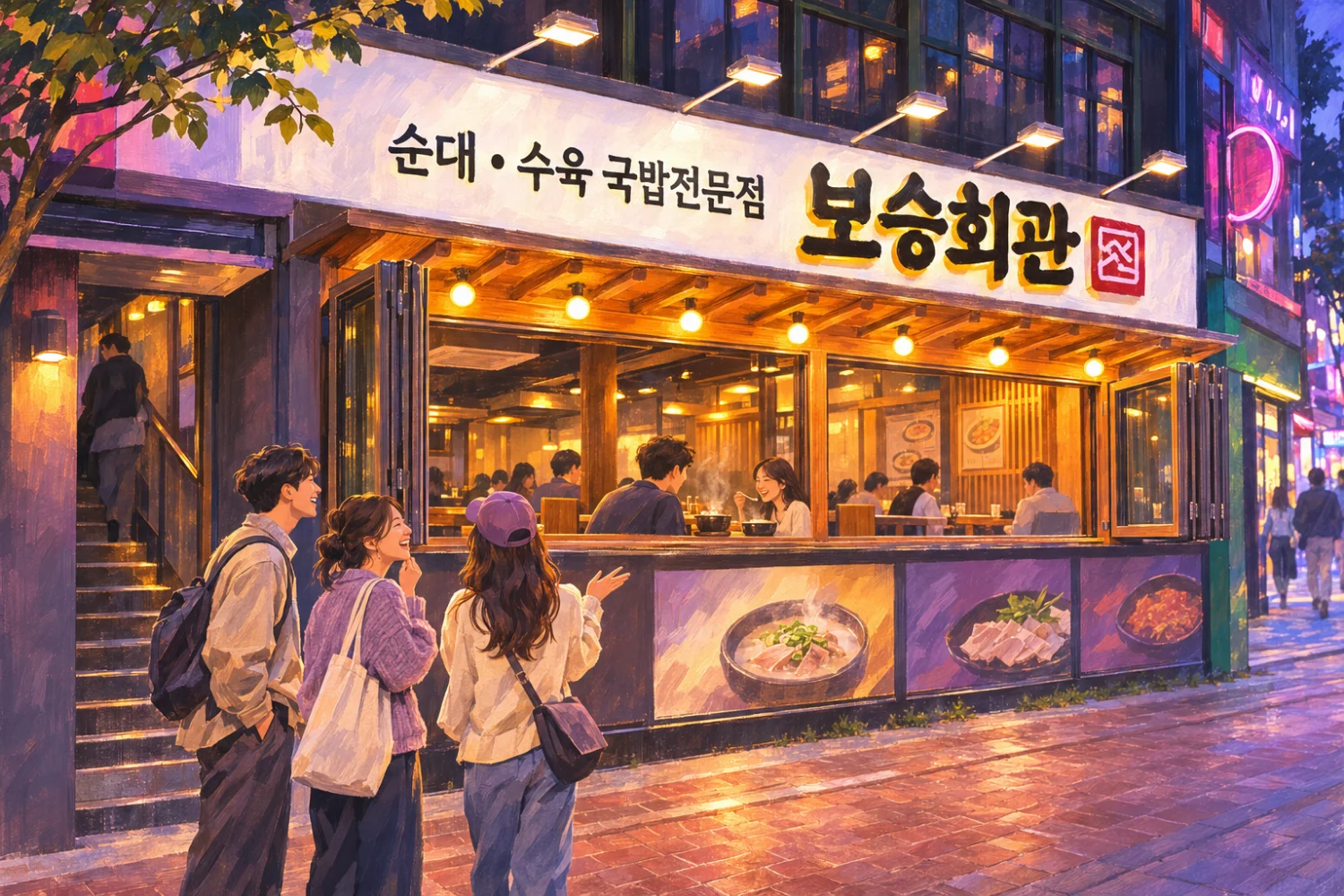
Boseung Hall (보승회관) gives the later part of an evening a more substantial meal option. A current business listing identifies its Hongdae branch, 홍대직영점, at 131 Eoulmadang-ro.82 The operator’s menu presents the brand around sundae and boiled-pork rice soups, with pork-bone haejangguk and haejang ramyeon also listed.80
The dish names help explain the meal. Suyuk gukbap combines a boiled-pork preparation with rice soup; sundae gukbap brings Korean blood sausage into that format. Korea Tourism Organization’s pork-and-rice-soup guide describes variations in broth and in the meat, offal, or sundae served with it.81 A rice-and-soup meal gives the table a different center from another shared chicken order or a street snack.
The operator advertises its Hongdae station branch as 24-hour.80 Check the current branch schedule before a late visit. A bowl of soup and rice can make a substantial meal after a program, with each person ordering rather than organizing the table around one shared pan.
For a dated firsthand look, Greysuitcase’s review, published April 1, 2026, looks back on an earlier trip to Boseung Hall. Its photographs include the storefront, menus, and meals, offering a way to recognize the branch and see one visitor’s order alongside the operator’s current information.84
Leave some appetite for the walking street
For something smaller, learning a few menu words is more useful than chasing one famous stall. Korea Tourism Organization’s guide to Korean street food explains bunsik, the quick-meal and snack category that includes tteokbokki, fried items called twigim, and Korean blood sausage called sundae. The familiar combination is shortened to “tteok, twi, sun.”36 These are options to recognize on a menu, not instructions to order everything.
There is variety within those familiar names too. The same food guide distinguishes rice-based and wheat-based tteok and different tteokbokki sauces.36 Knowing that makes a menu more interesting than a single photograph of red rice cakes suggests. Choose the texture or preparation that appeals to you, and ask about the particular dish when ingredients matter. A recognizable food name can be the beginning of a choice rather than a complete description.
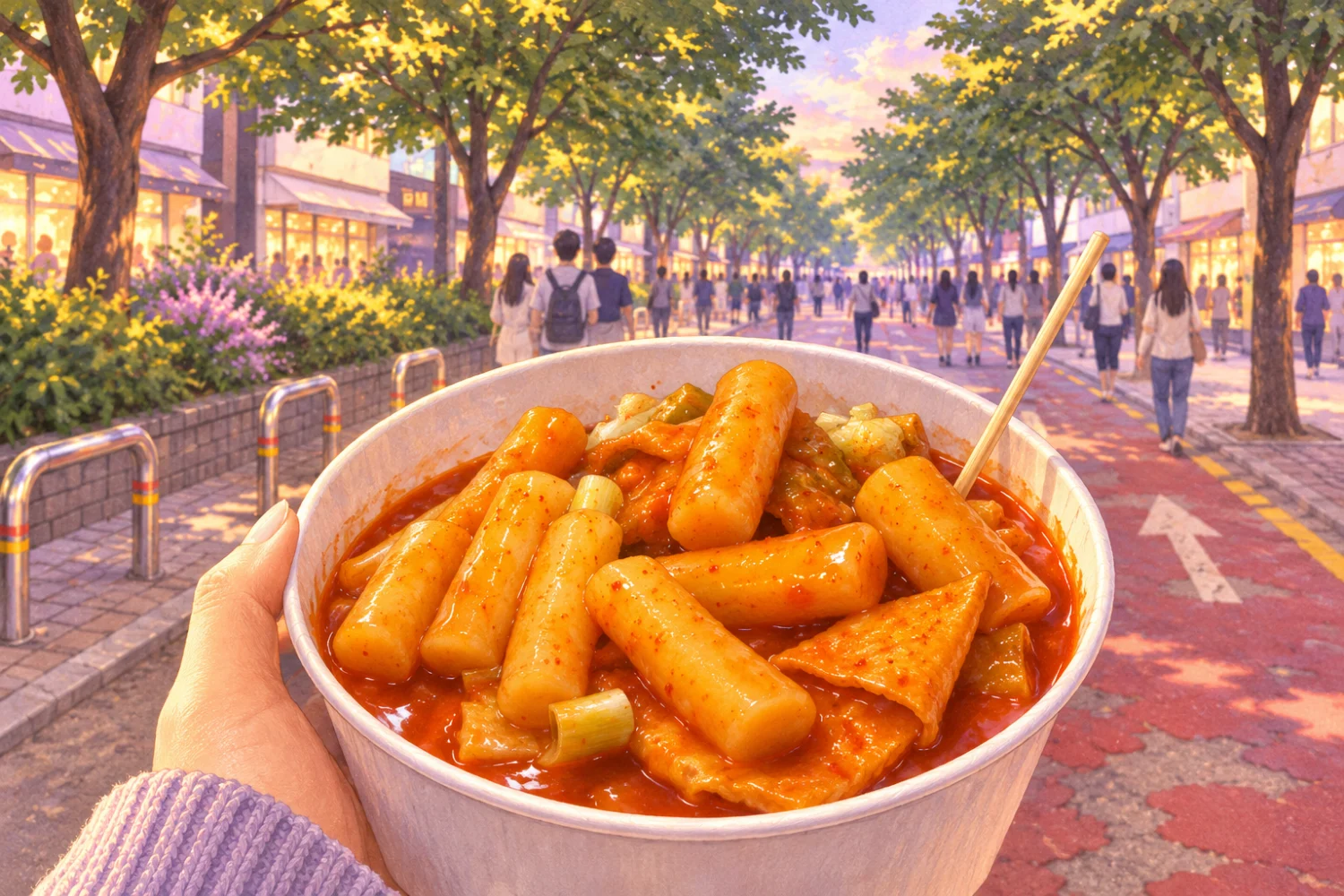
The tourism board’s 2025 winter street-food feature points readers toward Hongdae’s pedestrian-friendly street near Exit 9 for changing snack trends, including toasted-marshmallow ice cream and seasoned jjondeugi.37 The latter is a chewy snack made with flour, cornstarch, and sugar, prepared by grilling or frying and given different seasonings. A street-food walk can include both an established bunsik order and a newer snack format.
Season also changes the foods worth recognizing. The same feature describes fish-shaped bungeoppang, filled pancakes called hotteok, and fish cake called eomuk among winter options.37 These are useful names for reading what is actually on sale, rather than a promise that a particular Hongdae stall always carries the full set. A smaller order can bridge an exhibition and dinner without turning the afternoon into a succession of full meals.
Festivals connect the rooms
Seoul Fringe Festival: independent arts across rooms and streets
The connections between Hongdae’s spaces become especially visible in a festival. A Seoul city report on the 2004 Seoul Fringe Festival described a program spread across small theaters, clubs, galleries, and streets, with the live-club association participating.38 It is a historical example of people organizing across rooms and disciplines, rather than a schedule to carry forward to the present.
That report counted more than 20 sites and 123 bands in the music program, with all ten members of the live-club association involved.38 The scale came from cooperation between many spaces. It is a useful way to picture a neighborhood festival: the streets connect the places presenting the work, while the identity of each room remains part of what an audience discovers.

Zandari Festa: a neighborhood of showcases
Zandari Festa’s 2026 edition was listed for September 4–6 at MUSINSA Garage and nine other Mapo venues. The festival began in 2012 and takes its name from an older name for Seogyo, meaning “small bridge.” Its showcase format connects artists, listeners, and music-industry participants.11 Moving between venues can make the neighborhood’s musical relationships tangible: the same evening can introduce both an unfamiliar act and a room you had not considered entering.

Live Club Day: one ticket, several live-music rooms
The Koreana music history also traces Sound Day, begun in 2004, and its later return as Live Club Day in 2015.7 The original Club Day, documented in the museum’s research from 2001, belongs to the earlier club-culture story.40 Similar names can hide different histories, organizers, and formats.
Live Club Day is still running. When checked on November 6, 2026, its official November programme described a monthly event held on the last Friday, with one ticket letting audiences move between participating live-music venues. The 85th edition was advertised for November 27 at 8 p.m. Korea time, with a ₩40,000 general ticket and seven rooms: Club Evans, Vel.R, Club FF, Prism Hall, Freebird, MUSINSA Garage and KT&G Sangsangmadang.92 The format gives listeners a way to discover unfamiliar acts and rooms in the same evening.

For a future visit, let an actual announced edition guide the plan. Read the participating-venue list and the ticket conditions, then choose a few performances you would like to hear. A festival pass is a way into a program, with each room’s capacity and entry arrangements still part of the evening. You can enjoy the connections without trying to see every artist or turn the streets between them into a race.
Putting an afternoon and an evening together
A first visit can begin on the southern side of Hongik University Station. Visit Seoul’s Red Road directions identify the station’s Line 2, Airport Railroad, and Gyeongui–Jungang connections, with Exit 9 as a reference for the central cultural area.10 Exit 8 is useful for the R2 approach shown on our map. Rather than walking every block, choose the part of the afternoon you want to give real time to.
For an art-led visit, move through the walking streets toward the university frontage, then follow a chosen exhibition or Drawing Village program. Continue to Sangsangmadang if there is something there you want to see. For a music-led visit, choose the show first and work backward: give yourself dinner time, a way to find the room, and enough space to arrive before the part of the bill you care about.
The direction can change with the day. A meal near campus may fit before an exhibition; a concert near Sangsu may be a reason to finish farther south. Visit Seoul’s Rolling Hall directions identify Sangsu Station on Line 6 at that end.12 There is no need to return to the same entrance just because it is where you arrived.
If the evening continues into dancing or a pub, decide what you want to share with your companions before making the next stop. Check the particular venue or event’s arrangements, and look up your journey home for the time you expect to leave. A late-night plan should have its own transport decision, rather than borrowing an afternoon estimate. For specific access needs, check the exhibition, performance room, or restaurant you intend to use, not only the nearest station.
You can leave an entire layer for another day. Choosing one exhibition, a meal, and a live set can be a satisfying visit; so can a quiet look at the university frontage followed by dinner with friends. Hongdae’s history does not require you to recreate somebody else’s version of its best years. It gives you a reason to pay attention to the people making, presenting, cooking, and playing here now, and enough different ways to meet their work to make a visit your own.
Sources and further reading
This feature is based on desk research. Original sources and geography were checked November 6, 2026; expanded campus, music, and food research was checked November 7. Dated historical accounts remain identified as such.
- Korea Foundation, “Cultural Hub Adapts to Changing Times,” Koreana, Autumn 2024. Cultural geography and the area’s arts ecosystem. ↩ Back ↩ Back
- Hongik University, “History”, undated institutional chronology. The university’s 1955 relocation. ↩ Back
- Seoul Metropolitan Government, “Hongdae’s Now and then, from a luxury residential area to a cultural powerhouse”, July 13, 2018. Summary of Seoul Museum of History research. ↩ Back ↩ Back
- Seoul Tourism Organization, “Hongik Cultural Park,” Visit Seoul, updated October 20, 2026. Drawing Village, facilities, and location. ↩ Back
- KT&G Sangsangmadang, Hongdae venue and current program, ongoing operator information, including the Hongdae address. ↩ Back ↩ Back
- Seoul Tourism Organization, “KT&G Sangsang Madang,” Visit Seoul, updated October 30, 2026. Location and general opening hours. ↩ Back
- Kim Hak-seon, Korea Foundation, “The Heart of Korea’s Indie Music,” Koreana, Autumn 2024. Drug, early live music, and venue-based events. ↩ Back ↩ Back ↩ Back
- Korea Tourism Organization, “Rolling Hall,” VISITKOREA, undated venue listing. Location and performance-specific hours and fees. ↩ Back
- Seoul Tourism Organization, “SLUNCH FACTORY,” Visit Seoul, updated June 30, 2026. Cuisine and university-frontage location. ↩ Back
- Seoul Tourism Organization, “Hongdae R1 Red Culture Market,” Visit Seoul, updated October 17, 2026. Red Road, programming types, and station connections. ↩ Back ↩ Back
- Seoul Metropolitan Government, “2026 Zandari Festa,” FUN SEOUL, 2026 event listing and program. This is a dated past edition, not a future festival schedule. ↩ Back
- Seoul Tourism Organization, “Rolling Hall,” Visit Seoul, updated October 28, 2026. Sangsu Station and venue location. ↩ Back
- Korea Tourism Organization, “KT&G Sangsangmadang Hongdae,” Open Tourism / Travel for All, updated October 12, 2026. Building-specific accessibility information. ↩ Back
- Image reference: lumoplank, Hongdae street photograph, dated before September 16, 2024; CC0 1.0. The hero is an AI-illustrated adaptation, with simplified signage and anonymous people. ↩ Back
- Map geography: OpenStreetMap contributors, geographic data checked November 6, 2026, with the official Hongik University campus map used for campus context. The opening map shows schematic terrain and approximate activity areas; its geographic master preserves source-mapped streets and landmark positions. ↩ Back ↩ Back
- Seoul Tourism Organization, “Hongdae R2 Busking Street,” Visit Seoul, updated August 31, 2026. Walking Street, registered busking and the Exit 8 approach. ↩ Back ↩ Back
- Illustration reference: Striker9498, Hongdae Red Road street photograph, August 29, 2026; CC0 1.0. Used for the map and conceptual busking/nightlife scenes; people, lighting and visual details changed. Map terrain and building appearance are illustrative. ↩ ↩ ↩
- Hongik University, Korean institutional chronology, undated; campus milestones. ↩ Back
- Hongik Museum of Art, Museum introduction, undated; exhibition rooms and educational role. ↩ Back
- Hongik Museum of Art, Exhibition calendar, ongoing. ↩ Back
- Hongik Museum of Art, Visitor guide, undated. ↩ Back
- Hongik University, New Hongik campus development, February 2, 2024. ↩ Back
- Seoul Tourism Organization, Hongdae Mural Street, September 2, 2026. ↩ Back
- Club FF / Eddie Hwang, 20th-anniversary statement, republished by Indistreet, August 2024. ↩ Back
- Indistreet, Club FF calendar, November 2026 listings. ↩ Back
- Unplugged, Operator site and musician cocktails, ongoing. ↩ Back
- Unplugged, Performance calendar, November 2026. ↩ Back
- Unplugged, Jumok program announcement, November 14, 2026 program. ↩ Back
- Seoul Tourism Organization, Club NB2, Korean edition, updated May 5, 2026. ↩ Back
- Corner Pub, Operator profile, indexed text checked November 7, 2026. ↩ Back
- Thursday Party, Operator archive, indexed 2019 Hongdae-branch material. ↩ Back
- KBS, October 30 broadcast information, 2026; Yeti address and listed dishes. ↩ Back
- TENANT News, Yeti profile and owner interview, March 10, 2020. ↩ Back
- Shin Migyeong Hongdae Dakgalbi, Operator menu, ongoing. ↩ Back
- Seoul Tourism Organization, Haha & Kim Jong-guk’s 401, updated June 3, 2026. ↩ Back
- Korea Tourism Organization, Street Food Loved by Koreans, December 4, 2023. ↩ Back ↩ Back
- Korea Tourism Organization, Winter Street Food Battle, November 19, 2025. ↩ Back ↩ Back
- Seoul Metropolitan Government, 2004 Seoul Fringe Festival report, August 19, 2004. ↩ Back ↩ Back
- Seoul Metropolitan Government, From Art to Music, from Alleys to the World, Seoul Sarang, September 2026. ↩ Back
- Seoul Museum of History, Hongdae neighborhood research, July 5, 2018. ↩ Back ↩ Back ↩ Back
- India Ministry of Tourism, Leh culinary guide, undated; thukpa description. ↩ Back
- NB2, Official venue account, linked by Visit Seoul; indexed filming-location claim checked November 7, 2026. ↩ Back
- Hongik College of Fine Arts, Printmaking curriculum, undated. ↩ Back
- Hongik College of Fine Arts, DECKLE charity-exhibition report, October 10, 2025. ↩ Back
- Indistreet, Club BBang calendar and venue profile, November 2026 listings. ↩ Back
- Diningcode, Dak Kko Yam listing, current directory checked November 7, 2026. ↩ Back
- Harim, Restaurant feature describing Dak Kko Yam, November 2, 2022. ↩ Back
- Korea Tourism Organization, Kkupdang menu vocabulary (undated) and Hangjeongsal (October 19, 2023). ↩ Back
- Campus illustration reference: Meredith, “Hongik univ gate.jpg”, June 9, 2007; public domain. AI adaptation; architecture follows the archive source, with illustrative people and surroundings. ↩
- Performance illustration reference: Modamoda, “Crying Nut at Festival in Hanyang University.jpg”, October 2009; CC BY 3.0. AI adaptation with anonymous musicians; original photograph depicts Hanyang University, with no artist endorsement implied. ↩
- Food illustration reference: taylorandayumi, “Thupka close-up”, July 11, 2010; CC BY 2.0. Photographed in McLeod Ganj, India. AI adaptation represents the dish, with a new setting and lighting; it does not document Yeti’s serving. ↩
- Street-food illustration references: 최광모 (Choe Kwangmo), “Tteok-bokki.jpg”, October 25, 2015, and Striker9498, Hongdae Red Road photograph, August 29, 2026; both CC0. AI composite combines the dish and street references; original dish photograph was made in Gwacheon. ↩
- Historical playground reference: Michaela den, “Hongdae Playground.JPG”, September 20, 2012; CC BY-SA 3.0. Korea Unboxed’s AI-assisted night recreation retains the old layout and imagines adult social groups, soju, buskers and new mural textures. The adapted illustration is also licensed CC BY-SA 3.0. ↩
- Tiffany Kim, DJ Mag Asia, MWG 25th-anniversary owner interview, October 30, 2019. ↩ Back ↩ Back
- AFP, MWG closure report, September 2020 dispatch, reprinted by The Edition. ↩ Back ↩ Back
- Psytonic / Goabase, Innertrip Psytrance Party at MWG, March 11, 2017 organizer listing. ↩ Back
- JAMJARI / Resident Advisor, Club Temple Grand Opening, August 9, 2019. ↩ Back
- Jamjari, Artist biography, Resident Advisor, undated. ↩ Back
- PSYTONIC / Resident Advisor, Hard Maker 4th Anniversary, November 22, 2024. ↩ Back
- UNDERCITY CULTURE / Resident Advisor, LAST DANCE: Temple and 999PROJEKT for PSYTONIC, July 10, 2026. ↩ Back
- Jungle Julie, Artist-managed CONNECT archive, Bugs, September–October 2018 Hippytokki/Garrison posts. ↩ Back
- Hippytokki, Hippytokki Compilation Project, December 10, 2021; recording credits April–May 2021. ↩ Back ↩ Back
- Hippytokki, Punk Time Capsule, May 30, 2023. ↩ Back
- Jamie Finn, The Korea Times, Delay Relay returns for second year, January 5, 2026; interview with James. ↩ Back ↩ Back Official updates: @delay_relay.
- Indistreet, Goinmool/Hippytokki venue archive, historical address and 2022 bills. ↩ Back
- Seoul Metropolitan Government, Seoul Music Spots 48: Gopchang Jeongol, 2020. ↩ Back
- Go Jong-seok / Homilbat, Sinchon Woodstock and Hongdae Gopchang Jeongol, August 28, 2020; publisher excerpt on YES24. ↩ Back
- Choi Yi-jeong, OSEN, CosmosRUBY opening announcement, October 29, 2026; reports Ruby Records’ announced November program. ↩ Back
- Shin Eun-kyung, Firsthand Nabi account, May 28, 2017, revised February 2020. ↩ Back
- Kim Sora, Marie Claire Korea, Seoul bars feature: Nabi, April 27, 2026. ↩ Back
- LifeShare / InnerCity, Nabi event page, February 21, 2026; address and linked venue account. ↩ Back
- Nabi, Current operator gallery, venue account linked by LifeShare; undated. ↩ Back
- Trazy, Historic Nabi photo gallery, undated photographs; reviews include 2014 and 2019. ↩ Back Original Nabi illustrations use room cues from the historic gallery, which gives partial photo credit to garlic_k; individual capture dates are unverified. ↩ pool image ↩ lounge image
- Noona Holdak, Hongdae branch record, operator, checked November 7, 2026. ↩ Back
- Noona Holdak, Bake chicken menu, ongoing operator information. ↩ Back ↩ image
- Noona Holdak, Roast chicken menu, ongoing operator information. ↩ Back ↩ image
- Saemaeul Sikdang, Operator branchfinder, Hongdae Seogyo result checked November 7, 2026. ↩ Back
- Saemaeul Sikdang, Meal menu and brand description, ongoing operator information; minimum seven-minute simmer described on the homepage. ↩ Back ↩ meal image
- Saemaeul Sikdang, Barbecue menu, ongoing operator information. ↩ Back ↩ meal image
- Boseung Hall, Operator menu and Hongdae station branch information, checked November 7, 2026. ↩ Back ↩ Back
- Korea Tourism Organization, Pork-and-rice-soup guide, February 20, 2025. ↩ Back
- Diningcode, Boseung Hall Hongdae branch listing, checked November 7, 2026. ↩ Back
- Msk / indiemutesick, Firsthand October 2014 music-night account, October 6, 2014, section 7. ↩ Back
- Greysuitcase, Boseung Hall Hongdae review, April 1, 2026 publication, describing an earlier trip. Storefront photograph used as a factual façade/signage reference for an original AI illustration with new viewpoint, lighting and people. ↩ illustration ↩ Back
- MWG room reference: Jung Yeon-je / AFP photograph, September 26, 2020, via The Edition. New composition, anonymous dancers and conceptual décor; no photographed event recreated. ↩
- Temple room reference: undated venue-labelled interior photograph; photographer unknown. Used for concrete ceiling, faceted booth and projection-wall cues. People, lighting and added décor are imagined. ↩
- Artist Instagram profiles: Psytonic and Jamjari, crosslinked from their Psytonic and Jamjari artist pages on Resident Advisor. ↩
- Wawa19 / 와와19, Dak Kko Yam meal review and photographs, July 8, 2025. Food-reference details inform the original illustration; plating and setting are imagined. ↩ image
- Live Seoul / Seoul Metropolitan Government, Fringe performance report, reporter Choi Jin-a, August 22, 2011. Visual reference for an original AI illustration; performers and setting imagined. ↩ image
- Daehanmindecline, Drinking Boys and Girls Choir at Club Steel Face, Zandari Festa, October 6, 2018; CC BY-SA 4.0. Korea Unboxed’s AI adaptation is also CC BY-SA 4.0, with new viewpoint, performers, audience and lighting. ↩ image
- Company F photographs via TENASIA / Kstyle’s Live Club Day report, March 7, 2015, covering February 27. Original illustrated viewpoint, people and programme. ↩ image
- Live Club Cooperative / FIG, 85th Live Club Day official Melon Ticket listing and programme graphic, November 27, 2026 edition; checked November 6, 2026 (America/New_York). ↩ Back
- Local contributor’s recollection supplied for this guide, November 6, 2026: the Dak Kko Yam owner’s time abroad and reggae/Caribbean soundtrack; visits undated. ↩ Back
- Jamie Finn, The Korea Times, Delay Relay Festival to highlight Seoul’s burgeoning shoegaze scene, January 6, 2025. Public interview with James; dated first-edition programme and Youthlim/Club Bbang connections. ↩ Back
- zzzaam / POCLANOS, requiem#1 catalogue and artist history, digital listing January 22, 2023; text dates formation to approximately 1997–98 and original albums to 2000, 2002 and 2004. ↩ Back
- Electric Muse, Vidulgi OoyoO — Aero, April 3, 2008; label’s artist history, release notes and track list. ↩ texture paragraph ↩ Back
- Parannoul, To See the Next Part of the Dream, February 23, 2021; artist’s release page, titles and credits. ↩ Back
- Parannoul, After the Night, March 25, 2023; credits record January 14, 2023 at KT&G Sangsangmadang Live Hall and list the performers. ↩ Back
- Ghost Bookstore, Ghost Bookstore EP, October 7, 2024; artist’s track list, production/publishing credits and genre tags. ↩ Back
- Post Inner Circle, Artificial Sun, October 13, 2025; artist’s release credits, self-description and album statement. ↩ Back
- Damnably, Say Sue Me — The Last Thing Left, May 13, 2022; label’s release account and Busan recording/production context. ↩ Back
- Hippytokki / Mirrorball Music, THE POST-ROCK, February 10, 2022 digital release; distributor-supplied album statement and formal production credits on Bugs. Authorized listening: Spotify. ↩ Back
Korea Unboxed further reading
For the university area east of Hongdae, read our Yonsei University profile. It covers study routes and campus life, rather than a complete Sinchon neighborhood guide.
Around Hongdae
Select an area on the map for orientation or a preview of a published Korea Unboxed article.
Yeonnam. North of Hongik Univ. Station, Gyeongui Line Forest Park leads into Yeonnam. Exit 3 is a useful arrival point for this stretch of the park.
Hapjeong. Hapjeong lies southwest of the central Hongdae streets. Subway Lines 2 and 6 meet at its station, the area anchor shown here.
Mangwon. Mangwon lies west of the central Hongdae streets. Its Line 6 station is shown here as a starting point for exploring the neighborhood.
Sangsu. At the southern end of the Hongdae streets, Sangsu Station connects Line 6 with the lanes around the south side of Hongik University.
Sinchon. Continue east for the Sinchon university district. Our published Yonsei article covers international study, programs and campus practicalities. Read the Yonsei University for International Students article.