South Korea celebrates Hangeul Day on October 9 to commemorate the promulgation of its alphabet in 1446. The holiday honors a writing system created under King Sejong and the idea behind it: more people should be able to put their own words into writing.
That is a striking thing to celebrate. An alphabet is usually the unnoticed equipment of everyday life, somewhere behind the message you send, the sign you read, or the form you fill out. Hangeul Day brings that equipment into view and asks what changes when writing becomes easier to access.
In 2026, the holiday carries two anniversaries: 580 years since Hangeul was promulgated and 100 years since the first modern commemoration. If you are in Seoul, there are public activities and a special exhibition to help connect that history with the city around you.
Why did Korea need a new alphabet?
Korean was spoken long before Hangeul existed. People also wrote before Hangeul. Chinese characters were central to written life, and Korean speakers developed ways to adapt them to their own language, including systems known as idu, hyangchal, and gugyeol. The National Hangeul Museum’s account of earlier writing explains these borrowed systems.
The difficulty was that Korean and Chinese are different languages. Learning the established writing systems demanded substantial study, and access to that education was limited. Being able to speak clearly did not necessarily mean being able to write down a complaint, a request, or something you wanted another person to understand.
Sejong’s stated purpose addressed that gap. As the National Institute of Korean History explains, the king wanted people who struggled with existing writing to have letters they could learn and use in daily life.
That purpose gives the holiday its human scale. Think about the difference between explaining your problem aloud and being able to record it yourself. A written message can travel beyond the person standing in front of you. It can be kept, copied, answered, and referred to later. Sejong’s project concerned who could participate in that exchange.
1443 and 1446 refer to different milestones
Hangeul was created in 1443; the explanatory book was published in 1446. Both dates matter, which is why short accounts of the alphabet can appear to disagree.
The original name was Hunminjeongeum, commonly rendered in English as “The Proper Sounds for the Instruction of the People.” The name can refer to the new writing system and to the book explaining it. The National Hangeul Museum’s introduction distinguishes the first record of the letters in 1443 from the book published three years later.
Sejong is credited with creating the script. Scholars working under his direction helped explain its principles in the 1446 book. It is useful to keep those roles clear: the alphabet’s invention and the production of its detailed explanation were connected stages of the project.
October 9 commemorates the 1446 promulgation. That means the 2026 celebration marks 580 years from that milestone. It does not mean the first letters were invented 580 years ago.

How does Hangeul work?
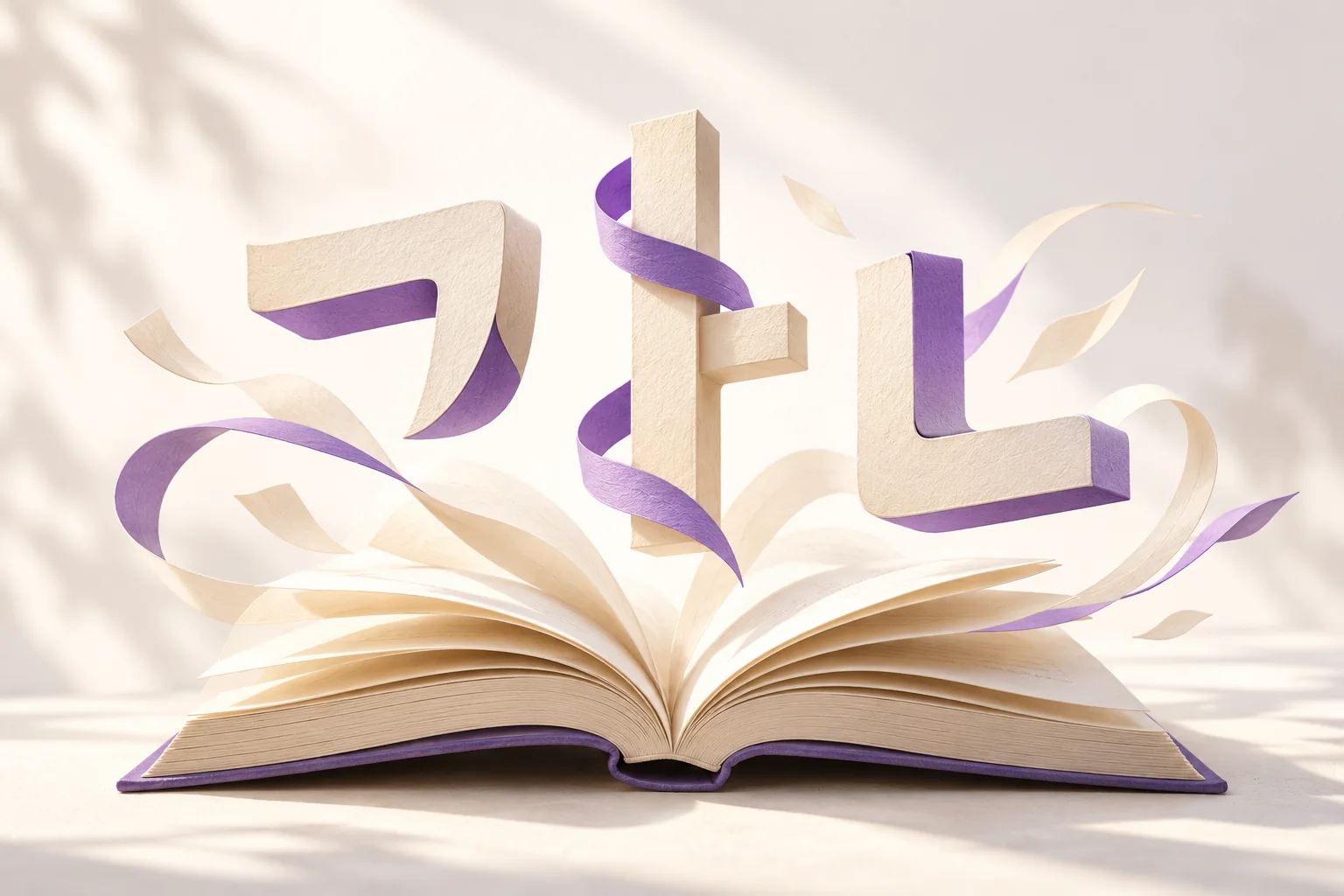
Hangeul is an alphabet whose consonant and vowel letters are arranged into syllable blocks. A block can look like a single compact character, but it is built from letters. The National Institute of Korean Language’s guide explains this combination of alphabetic letters and syllabic organization.
For an English speaker, that layout can be the first surprise. You are used to seeing letters follow one another along a line. In Hangeul, learning the letters also means learning how they fit together inside a block. The written word Hangeul, for example, contains two syllable blocks, corresponding to han and geul.
The original system had 28 letters. Modern Hangeul has 24 basic letters, alongside combinations that learners also encounter. Some original letters are no longer part of the modern basic set, so the two numbers describe different stages of the alphabet.
Its shapes have a deliberate logic. According to the National Hangeul Museum’s explanation of the design, the basic consonant forms reflect speech organs, while the original vowel design drew on heaven, earth, and the human being.
That structure gives you something to notice when you start learning. Letters are related to one another, and blocks have an arrangement you can practice. You can begin recognizing how a word is put together before you understand what the whole sentence means.
You can see that logic in a few small patterns. An extra stroke turns ㄱ into ㅋ, a consonant with a stronger puff of air. A second short stroke turns the vowel ㅏ (a) into ㅑ (ya). The National Institute of Korean Language’s consonant guide and vowel guide explain these relationships.
Try one block yourself: ㄴ and ㅏ combine into 나 (na). In 글 (geul), ㄱ sits above ㅡ, with ㄹ at the bottom. Practice these arrangements to begin recognizing new blocks.
Learning the alphabet and learning Korean are separate tasks. Recognizing letters is a valuable first step; vocabulary, grammar, pronunciation, and listening take further practice. If you can slowly sound out a station name, that is already a useful achievement. You do not need conversational fluency for those first reading skills to help.
A useful script still needed time to spread
Creating an alphabet did not instantly change every school, official document, or social habit. Existing writing practices had deep roots. The National Hangeul Museum’s exhibition account traces Hangeul’s use in translations, practical knowledge, letters, and other forms of everyday writing, alongside the continued importance of Chinese characters.
The museum also describes a wide range of users, from members of the royal family to people at the bottom of the social hierarchy. Hangeul’s history includes women’s correspondence and many other uses; it should not be reduced to one group’s private script.
Adoption is an important part of the story. A system can be carefully designed and still need people to teach it, print it, write to one another with it, and make room for it in public life. The holiday celebrates an invention that became part of those ordinary activities over generations.
Why October 9, and why a centenary in 2026?
The modern holiday began in 1926, when the Korean Language Society’s predecessor organized a commemoration called Gagya Day. The name referred to syllables associated with learning the alphabet. It became Hangeul Day in 1928.
The date went through calendar conversions and revisions. The National Folk Museum’s holiday history explains how the discovery of an original Hunminjeongeum manuscript in 1940 helped establish the October 9 date, which was confirmed after liberation in 1945.
This is the distinction behind the two anniversaries in 2026: the promulgation is 580 years old; the modern holiday is 100 years old. The centenary concerns the decision to commemorate the alphabet publicly, rather than the age of the alphabet itself.
Today, Seoul’s official 2026 holiday calendar lists Hangeul Day on October 9. This year it falls on a Friday.
What can you do in Seoul on Hangeul Day 2026?
The following dates and hours were checked on October 9, 2026, Korea Standard Time. All event times below are in Korea Standard Time. Recheck the organizer’s notice before setting out.
Join the public activities at Gwanghwamun Square
Seoul’s official Hangeul Day event listing schedules activities at Gwanghwamun Square on Friday, October 9, from 11:00 a.m. to 4:00 p.m. The program includes exhibitions about Korean spelling and attractive Korean signage, letter-themed activities, postcard stamping, and Korean music performances.
This is a useful choice if you would rather take part in something than begin with a long historical explanation. Check the program on arrival and choose the activities that interest you. An event window is not a guarantee that every activity runs continuously or that supplies remain available all afternoon.
See the holiday’s first hundred years at a museum
The National Museum of Korean History is presenting From 1926 to Infinity, a centenary exhibition about Hangeul Day. It runs from October 2, 2026, through February 9, 2027, in the third-floor thematic gallery, with free admission.
The museum lists regular hours of 10:00 a.m. to 6:00 p.m., with later closing on Wednesdays and Saturdays. Last admission is one hour before closing, so plan to enter by 5:00 p.m. on Friday, October 9. The exhibition also gives you an option after the holiday if October 9 is already busy.
Check the museum name carefully. The National Hangeul Museum is a different institution. Its current website carries a construction-related closure notice, so we would not plan an on-site visit there without a confirmed reopening announcement.
Keep the rest of the day flexible
Choose one event or exhibition as the anchor for your day, then confirm any restaurant, shop, or appointment you want to build around it. A public holiday does not tell you the opening hours of an individual business.
For a venue visit, save the exact place name and entrance information before leaving. Our guide to which map to use in Korea can help you prepare the journey. If you have routine administrative errands, check their holiday arrangements separately.
A small way to mark the day yourself
You can also use Hangeul Day as a reason to learn one manageable piece of the alphabet. Work through a few letters, look at how they form a block, or practice reading a place name you already know. Keep the goal small enough to finish.
That gives the history a practical connection. A sign that previously looked like an unfamiliar shape becomes something you can begin to read. The next time you see it, you have one less thing to ask someone else to decode for you.
For another perspective on how a holiday carries cultural meaning, read our explanation of Chuseok, family, ancestors, and duty. Hangeul Day offers its own point of entry: the everyday importance of having words you can put on the page yourself.
Frequently asked questions
When is Hangeul Day in South Korea?
It is October 9 each year. In 2026, it falls on a Friday and is a public holiday.
Was Hangeul created in 1443 or 1446?
The letters were created in 1443. The explanatory Hunminjeongeum book was published in 1446, the milestone commemorated by Hangeul Day.
Are Hangeul and Korean the same thing?
Korean is the language. Hangeul is the alphabet used to write it. Learning the letters is one part of learning the language.
What does the 2026 centenary celebrate?
One hundred years since the first modern commemoration in 1926. The same year also marks 580 years since the alphabet’s promulgation.
Sources and further reading
National Hangeul Museum: writing before Hangeul: Chinese characters and borrowed notation systems.
National Institute of Korean History: Hunminjeongeum: Sejong’s purpose, creation, and the explanatory book. Korean-language source.
National Hangeul Museum: About Hangeul: the 1443 and 1446 milestones.
National Institute of Korean Language: Hangeul’s basic principles: letters, combinations, and syllable blocks.
National Institute of Korean Language: consonant design: related shapes and added strokes, including ㄱ/ㅋ and ㄷ/ㅌ.
National Institute of Korean Language: vowel design: the ㅏ/ㅑ and ㅗ/ㅛ shape and sound relationships.
National Hangeul Museum: the design of Hangeul: the original letters and their forms.
National Hangeul Museum: exhibition account: Hangeul’s purpose, users, and spread. Online historical information; on-site access is affected by closure.
National Folk Museum: Hangeul Day: the holiday’s origins and calendar history.
Seoul Metropolitan Government: 2026 holidays: October 9 in the current calendar.
Seoul’s official Gwanghwamun Square event listing: October 9, 2026, hours and activities. Korean-language source.
National Museum of Korean History: From 1926 to Infinity: exhibition dates, location, admission, and hours.
National Hangeul Museum: current visitor notice: temporary closure information.
Korea Unboxed: Does Google Maps Work in Korea in 2026?: related reading for planning a visit.
Korea Unboxed: What Chuseok Reveals About Family, Ancestors and Duty in Korea: related cultural reading.