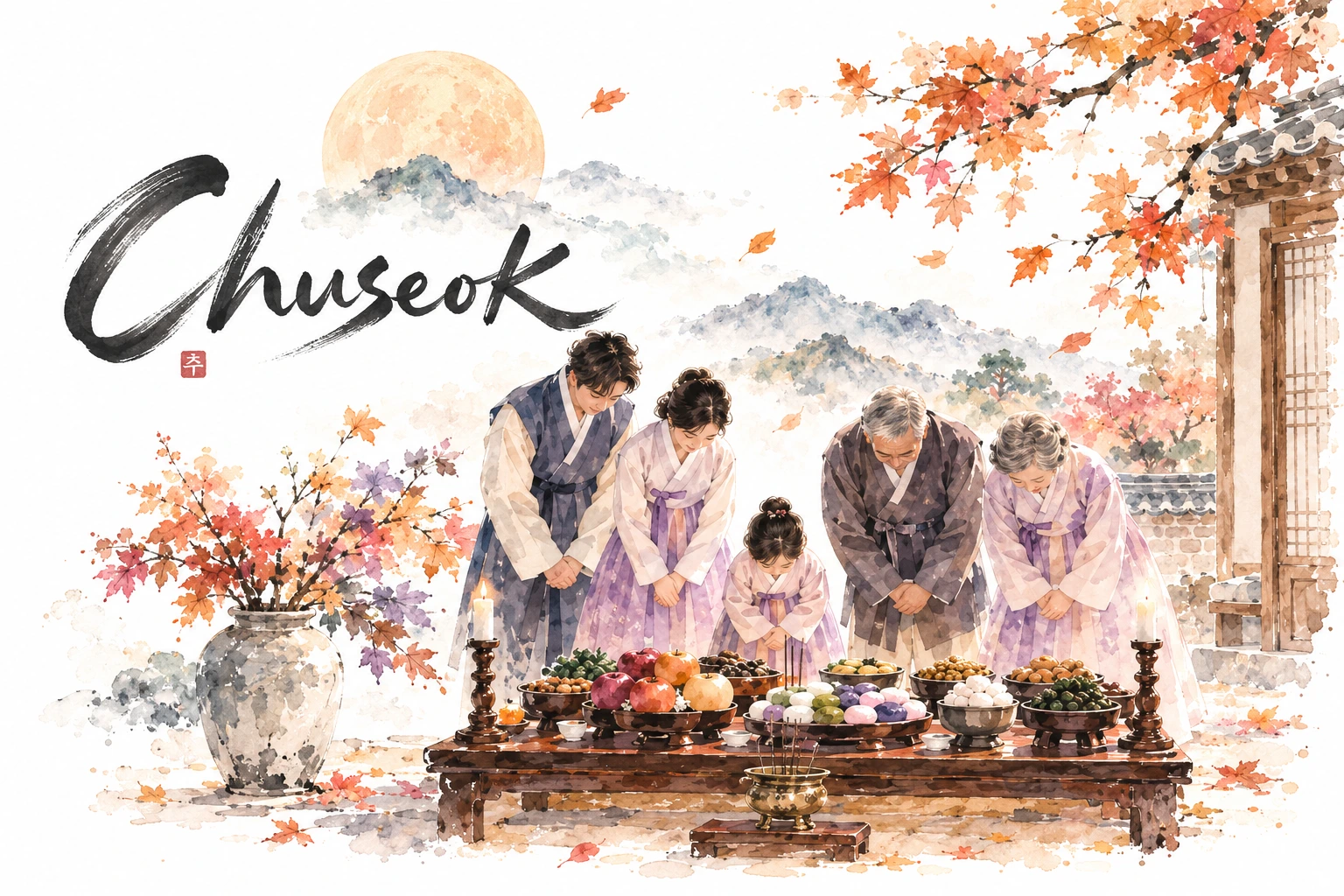
Chuseok begins with the harvest
Chuseok falls on the fifteenth day of the eighth month of the lunar calendar, close to the autumn full moon and traditionally near one of the most important moments of the agricultural year. By then, much of the difficult work of planting and tending crops was behind people, and the results of that work were finally becoming visible.
Rice was being harvested. Fruit was ripening. Food could be made from the year's new crops. After the uncertainty of weather, summer heat, rain and months of agricultural labor, this was naturally a time for celebration.
Korean historical sources connect Chuseok with harvest celebrations and communal festivities stretching far back into the country's past. One of the earliest traditions associated with the holiday is Gabae, a Silla-era celebration described in the Samguk sagi, although it would be too neat to say that Chuseok simply “started” there. Like many old seasonal holidays, its origins are better understood as a mixture of agricultural customs, communal celebration and practices that developed over a long period of time.
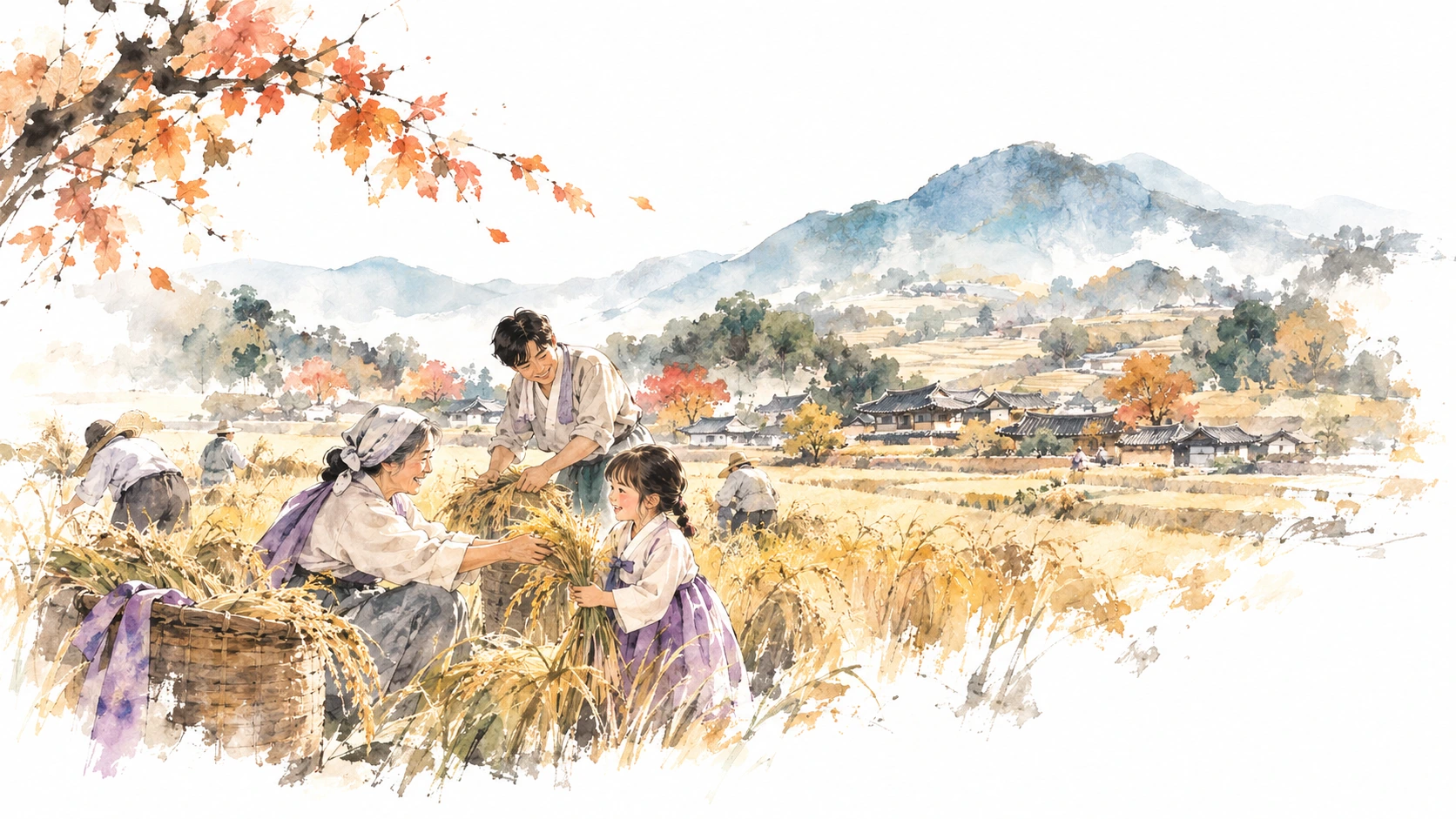
The harvest context matters because it makes the ancestral offerings more understandable. When the first good rice and fruit of the season arrived, the family did not necessarily regard that abundance as something created entirely by the people who happened to be alive that year. Their household, land, knowledge, family relationships and ability to continue as a family were inherited from generations before them.
Offering part of the new harvest to ancestors was therefore not only a religious action. It could also express gratitude toward the people whose lives had made the present generation possible.
That basic idea does not require an ancient worldview to understand. Most of us live inside systems we did not create. We inherit languages we did not invent, knowledge we did not discover ourselves, communities we did not build from nothing, and relationships that began before we arrived. Chuseok ritual gave that dependence on previous generations a visible place at the table.
In Korean tradition, family did not necessarily end with death
Modern people often separate remembrance from social interaction quite sharply. A family member dies, and we may keep photographs, visit a cemetery, celebrate their birthday or tell stories about them, but we generally think of their active place within the family as having ended.
Traditional Korean ancestral rites draw that boundary differently.
The broader Korean term 제사, jesa refers to rites commemorating deceased ancestors. Charye is a holiday form of ancestral ceremony traditionally associated with occasions such as Chuseok and Seollal. In Confucian ritual practice, ancestors were treated with a kind of continuing social respect. Food was placed before them, drink was offered, descendants bowed, and the dead were addressed through ceremony almost as though they remained participants in family life.
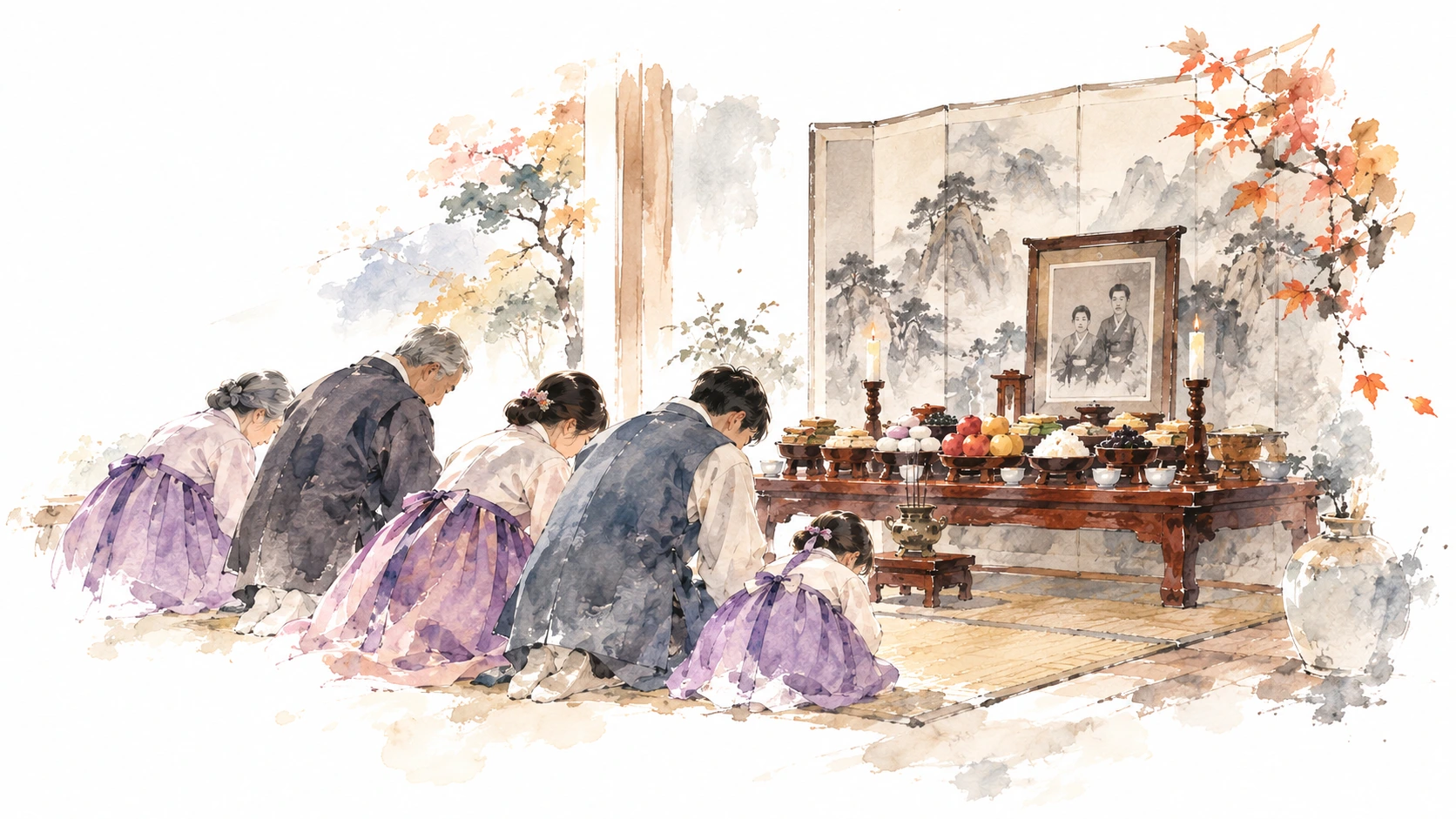
That is one reason the English phrase “ancestor worship” can be both understandable and misleading.
Historically, Korean ancestral rites could absolutely involve spiritual beliefs about the continued presence or influence of ancestors. It would be equally misleading to pretend that the rites were purely symbolic or secular. At the same time, describing everything as ancestor worship can suggest that every Korean who participates in a ritual holds an identical theological belief about spirits.
Modern Korea is much more complicated than that.
One person may genuinely understand the ancestors as spiritually present. Another may see the ceremony primarily as an act of remembrance. Somebody else may participate because their parents or grandparents care deeply about it. A family may perform only a simplified memorial, while another family may have stopped performing ancestral rites generations ago.
Ritual and personal belief do not always line up neatly.
That is true almost everywhere. People celebrate Christmas without being Christian, attend religious funerals without sharing the religion of the deceased, visit graves while holding very different ideas about the afterlife, or cook a grandmother's recipe long after anyone believes that she is somehow physically present at the meal. Human beings frequently use ritual to maintain relationships with people who are no longer alive.
Korean ancestral rites gave that human impulse an unusually structured form.
Confucianism gave family obligation a moral system
Many of the ancestral practices now associated with Korean tradition were reshaped and formalized through Neo-Confucianism, particularly during the Joseon dynasty.
At the center of Confucian family ethics was 효, hyo, normally translated as filial piety. In English, that phrase can sound rather severe, as though it means little more than children obeying their parents. Historically, however, filial piety described a much broader set of responsibilities between generations.
Parents were expected to care for children. Children were expected to recognize that care and eventually support their parents. Older family members had responsibilities toward younger ones, just as younger people had obligations toward elders. Respect for parents did not automatically disappear when the parents died, which is one reason ancestral rites could be understood as the continuation of filial responsibility.
The deeper principle was that an individual belonged to a chain of relationships extending backward and forward through time.
Your life did not begin with you.
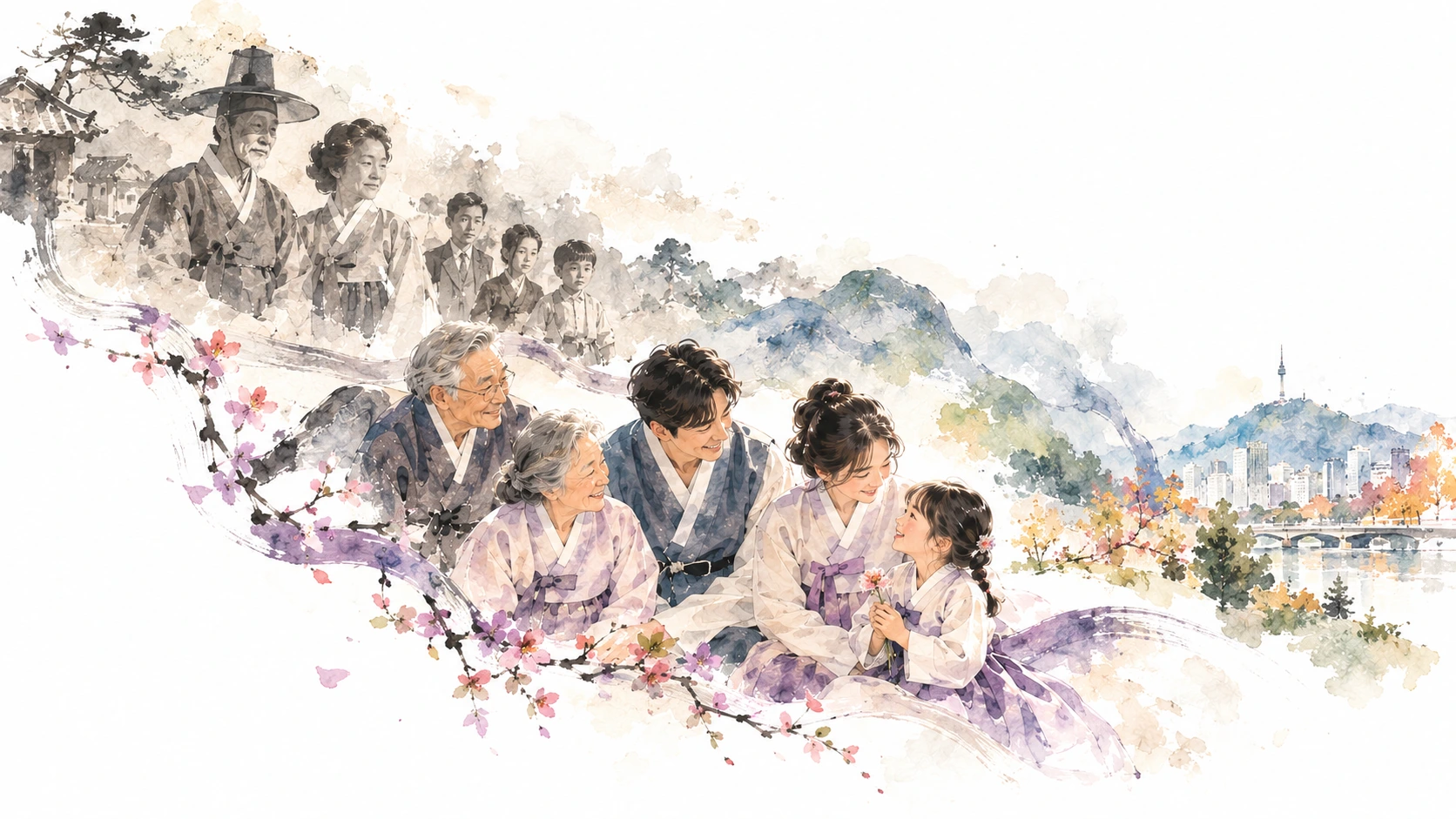
You had parents, and they had parents. Before you were capable of feeding yourself, somebody fed you. Before you understood the world, other people taught you how to navigate it. Your surname, family stories, traditions, social connections and often your material circumstances arrived through people who lived before you.
Eventually, you might become the older generation yourself. The family would not stop with you either.
That view of human life naturally produces a different emphasis from one that treats adulthood primarily as the achievement of complete independence. Neither model exists in a pure form in the real world, but traditional Korean society placed unusually strong moral weight on the relationships connecting generations.
Ancestral rites made those relationships visible.
This also helps explain the importance of age
Once family relationships are understood as structured rather than interchangeable, some features of Korean social life become easier to understand.
Age historically communicated more than the number of years somebody had been alive. Within Confucian society, age could help locate a person within a network of obligations and expectations. The same was true of family position and, later, professional rank.
This is one of the historical reasons Korean language developed such sensitivity to relationship and status. Forms of address, titles and speech levels are connected to the question of who is speaking to whom. Age alone does not determine every interaction, and modern Korean society is considerably more flexible than older Confucian society, but the cultural memory of these distinctions remains strong.
The same structure influenced the traditional family itself. Elders were expected to receive respect, while senior family members also carried responsibility for the household. The eldest son historically acquired particular ritual obligations within a patrilineal family system, including responsibility for maintaining ancestral rites.
Real families were never as orderly as philosophical ideals suggested. Some elders abused authority. Some younger relatives ignored expectations. Families argued, separated and disappointed one another just as they do everywhere.
But the framework mattered because it provided a shared idea of what people were supposed to owe one another.
Chuseok concentrates many of these relationships into one holiday.
Why offer the first food to people who have died?
Once Chuseok is viewed through the ideas of harvest and family continuity, the ancestral meal becomes less mysterious.
The foods associated with the holiday traditionally reflected the season's abundance. Newly harvested grain could become rice and liquor. Fresh fruit appeared on the table. Songpyeon, the half-moon-shaped rice cakes strongly associated with Chuseok, were made from rice harvested during the agricultural cycle.
Before the family enjoyed that abundance themselves, some of it was offered to the ancestors.
One way to interpret this is religiously. Another is relationally.
If an honored guest came to your home, you would feed them. If somebody had given you something important, gratitude would normally require some form of acknowledgement. In the traditional Korean family, ancestors occupied a position worthy of that recognition because the present family existed through them.
The ritual therefore linked food with memory.
The harvest was not simply “what we have this year.” It was part of a continuing family story. The ancestors were thanked, the living shared the meal afterward, and another generation participated in something that older generations had done before them.
The theology behind that act could vary.
The human impulse is easier to recognize.
Most cultures have ways of saying: we have not forgotten the people who made our lives possible.
Chuseok also takes the family to the graves
The relationship between the living and the dead does not stop at the household table.
Another traditional Chuseok practice is 성묘, seongmyo, visiting ancestral graves. Families may also perform 벌초, beolcho, cutting back grass and vegetation around burial mounds in preparation for the holiday.
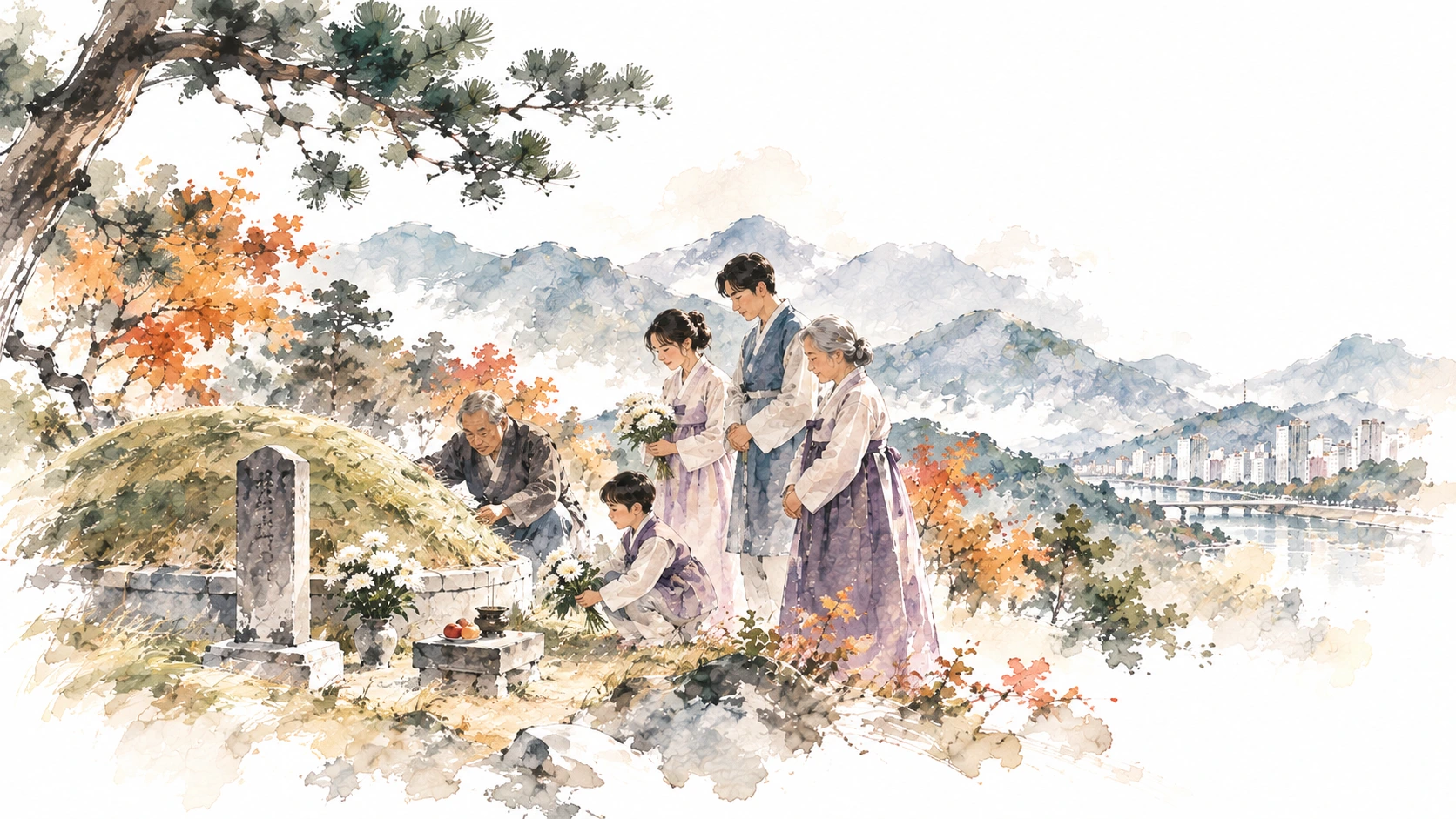
At first glance, clearing weeds from a grave can look like little more than property maintenance. But there is meaning in the fact that somebody continues to maintain it.
A tended grave belongs to somebody whose descendants still know where they are buried.
The family returns.
The grass is cut.
The site is cleaned.
People bow or spend time there.
In that sense, grave care performs the same kind of work as the ancestral table. It prevents death from becoming complete social disappearance.
This is hardly unique to Korea. Cemeteries around the world contain flowers replaced by living relatives, polished headstones, photographs and small objects left by people unwilling to let somebody they loved become merely a name carved into stone.
Human beings have always had difficulty accepting that the physical end of a person must also mean the end of their place within a family.
Korean ritual created a formal language for maintaining that place.
Graves also tied families to geography
Traditional Korean graves were often located on hillsides near the region where a family had lived. For families rooted in one area across generations, this meant that ancestry was not only an abstract idea.
Family history existed in the landscape.
Relatives lived nearby. An ancestral home might remain in the same region. Graves could mark the places where previous generations had been born, lived and died.
Then twentieth-century Korea changed extraordinarily quickly.
Industrialization and urbanization moved enormous numbers of people away from rural communities. Seoul expanded into a megacity. Regional cities grew. Children who might once have lived near their parents and grandparents now moved for education and work. Families became geographically scattered.
The tradition of returning home remained.
This is where one of the most visible modern features of Chuseok begins to make cultural sense.
Every year, train tickets become difficult to obtain and highways fill with people travelling back toward hometowns and family homes. From the perspective of a visitor, the Chuseok traffic jam can look like an unfortunate side effect of a national holiday.
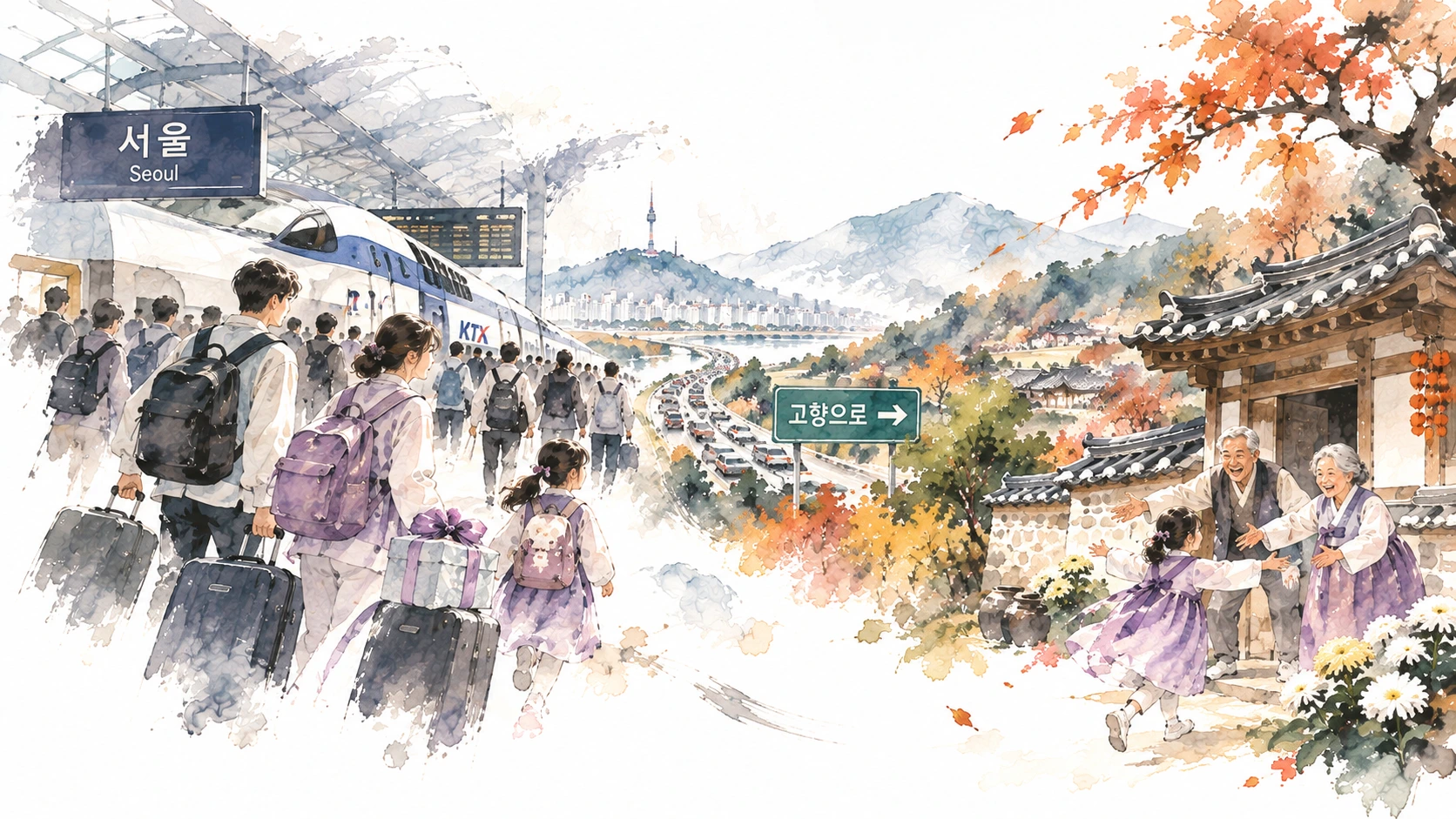
Historically, however, it represents something more interesting.
A family system that developed when generations lived relatively close together survived into a society in which those generations might now live hundreds of kilometres apart.
The ancient movement toward family became a modern transportation phenomenon.
Millions of people reproduce the same basic direction:
back home.
What “home” means becomes important
This is another point where the comparison with American Thanksgiving begins to lose some of its usefulness.
There are obvious similarities. Both holidays happen around harvest time. Both involve large meals, family gatherings, difficult journeys, traditions people enjoy, traditions people complain about and enough family tension to generate decades of comedy.
But Chuseok historically carries a particularly strong connection between family, ancestors and place.
The family gathering is not only horizontal, connecting siblings, cousins and relatives who are alive at the same time. Traditionally, it is also vertical.
Grandparents connect to parents.
Parents connect to children.
The living connect to the dead.
The present family exists between its ancestors and its descendants.
Most Koreans are not sitting around the Chuseok table consciously analysing this structure. Cultural traditions rarely work that way. People experience holidays through ordinary life. Somebody worries about traffic. Somebody complains that the food preparation is taking too long. Somebody falls asleep watching television. An uncle drinks too much. A teenager would rather be somewhere else.
That ordinariness does not erase the deeper structure.
Traditions can carry ideas that people do not articulate every time they participate in them.
Duty can be meaningful and burdensome at the same time
There is a temptation, especially when writing about traditional culture for an international audience, to make everything sound beautiful.
The family returns beneath the autumn moon. The ancestors are remembered. Food is shared. Generations come together.
There is beauty in that.
There is also work.
Traditional ancestral rites required substantial preparation. Ingredients had to be purchased, cleaned and cooked. Ritual tables could become elaborate. Families had to travel. Graves required maintenance. Procedures had to be remembered and repeated.
Much of that labor was historically shaped by gender.
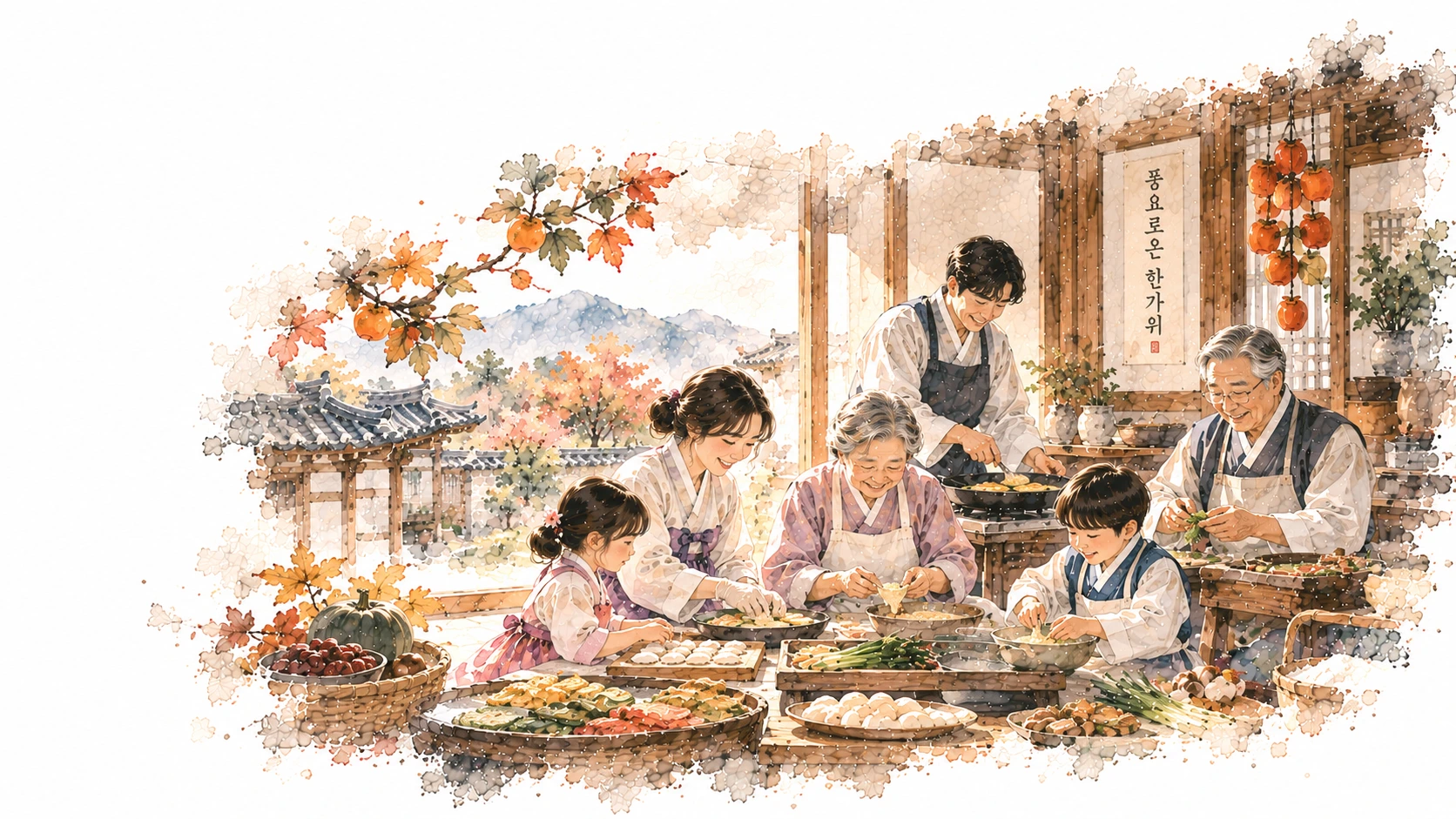
Korean Confucian family structure became strongly patrilineal, meaning that ancestry and ritual authority were often organized around the male line. At the same time, women frequently performed a large portion of the cooking and physical preparation necessary for family rituals.
That contradiction became one of the major tensions surrounding traditional holidays in modern Korea.
Who prepares everything?
Whose family does a married couple visit first?
Who spends the holiday working while everyone else sits down?
Who is expected to maintain traditions that they had little role in designing?
These questions became increasingly important as women's education, employment and social roles changed dramatically during Korea's modernization.
For some Koreans, reducing or abandoning elaborate ancestral rites is therefore not a rejection of family itself. It can be a rejection of the unequal burden historically attached to a particular form of family tradition.
Understanding this tension makes modern Chuseok more human.
People can love the idea of family and resent the obligations attached to it at the same time.
Chuseok in 2026 is not Chuseok in Joseon
That distinction should always be kept in mind when talking about Korean tradition.
A visitor to Seoul today should not imagine that every Korean family wakes up on Chuseok morning and performs an elaborate Confucian ceremony.
Many do not.
Recent surveys show a substantial decline in the number of households preparing traditional charye tables. Families have become smaller, lifestyles have changed, ritual practices have simplified, and younger generations often have different ideas about how much effort should be devoted to formal ancestral rites.
Some families still perform a detailed charye.
Others prepare only a few representative foods.
Some bow and remember ancestors without following old ritual procedures.
Some visit graves.
Some simply gather for a meal.
Some travel overseas.
Some treat the holiday mainly as a long weekend.
Religion has also changed the landscape.
Christianity, in particular, created a difficult relationship with traditional ancestral rites because some Christians interpreted bowing and offerings to ancestors as a form of worship incompatible with Christianity. Korean Christian communities therefore developed alternative memorial practices that allowed families to honor the deceased without reproducing the religious elements of traditional jesa.
Buddhist, Catholic, Protestant, secular and traditionally oriented households can therefore experience the same national holiday very differently.
There is no single modern Korean answer to the question, “What do you believe happens to your ancestors during Chuseok?”
There probably never was.
So do Koreans actually believe their ancestors are present?
The most accurate answer is that it depends who you ask.
A very traditional person may speak about ancestral spirits in ways that sound quite literal.
Another person may participate in charye while understanding everything symbolically.
Someone else may regard it as something they do because their father or grandmother cares about the tradition.
Another Korean may have never participated in a charye ceremony at all.
The mistake is assuming that participation tells you exactly what somebody believes.
That becomes easier to understand if we compare it with familiar behavior elsewhere.
A person can talk to their father's grave without believing their father literally hears every word. Someone can keep a dead spouse's clothes because throwing them away feels like losing the person again. A family can cook the same recipe every Christmas because it belonged to a grandmother who died thirty years earlier.
None of these actions are irrational once you understand the emotional relationship behind them.
Death removes a person physically.
It does not remove their influence.
A grandfather can shape a family decades after his death through the values he taught his children. A grandmother can remain present in the way everybody makes kimchi. A parent's sacrifices can determine the education and opportunities available to children they will never see grow old.
The dead stop acting.
The consequences of their lives continue.
Ancestral ritual gives that continuing influence a visible form.
This is also why the idea of duty deserves some sympathy
Foreigners sometimes encounter Korean family obligation from the outside and find it difficult to understand.
Why should an adult child be expected to spend every major holiday with parents?
Why should age create obligations?
Why should somebody feel guilty because they did not visit relatives?
Those questions are reasonable, especially because family expectations can become controlling or unhealthy.
But the underlying logic becomes easier to understand if you begin from a different question.
Instead of asking only, “Why should somebody else have a claim on my time?”, imagine asking, “What do I owe the people whose sacrifices made my life possible?”
The second question does not automatically produce the right answer either.
Some parents give enormous amounts to their children.
Some families also cause enormous harm.
Some adult children care for aging parents for years. Others have good reasons to become estranged.
No cultural philosophy can solve those relationships cleanly.
But traditional Korean family ethics placed more emphasis on the second question than many strongly individualistic societies do.
That emphasis helps explain why family duty can remain emotionally powerful even among Koreans who reject many older social hierarchies.
It is not always simple obedience.
Sometimes it is gratitude.
Sometimes it is love.
Sometimes it is guilt.
Usually it is several of those things mixed together.
Perhaps Chuseok is changing more than it is disappearing
It would be easy to look at declining charye participation and conclude that traditional Chuseok is simply fading away.
Part of it probably is.
Cultures lose practices.
Younger generations decide that some rituals no longer make sense. Families become smaller. Religious beliefs change. People move abroad. Procedures that once seemed essential become optional.
But cultural values do not always disappear at the same speed as the rituals that once expressed them.
A family may stop preparing an enormous ancestral table but still spend hours travelling to see elderly parents.
Nobody may believe an ancestor literally visits the house, but the family still visits the cemetery.
A daughter may reject the expectation that she spend two days cooking for her husband's relatives while still feeling strongly that Chuseok should involve family.
A Christian household may replace traditional jesa with a memorial service.
A younger family may skip ceremony entirely but still call grandparents, exchange gifts and eat together.
Tradition can survive by changing shape.
Sometimes the ritual disappears while the emotional instinct underneath it remains.
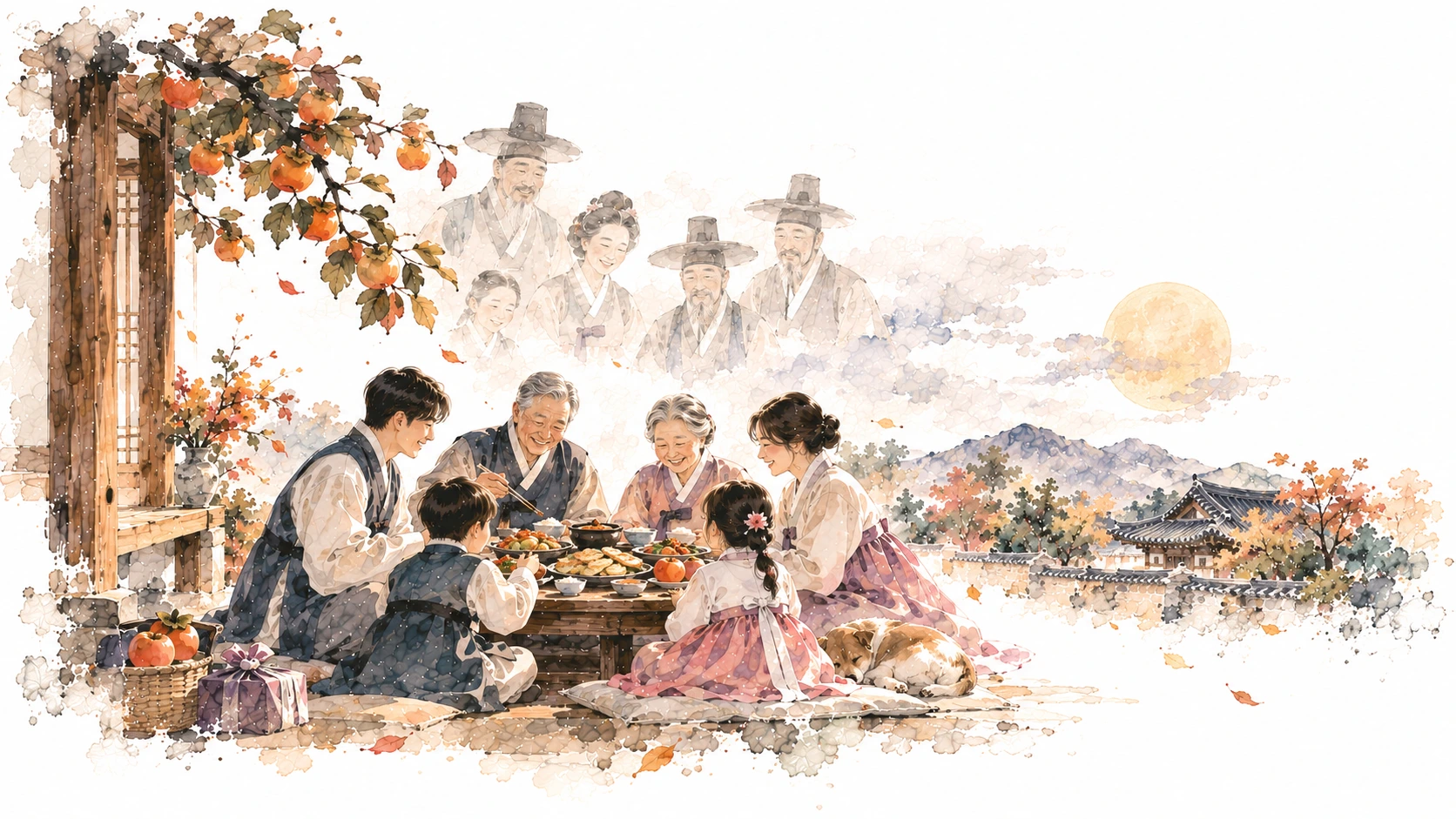
The ancestors are only half of the story
Ancestral culture can sound as though it is entirely concerned with the past.
But the traditional family structure also points forward.
If you stand between your grandparents and your children, you are not only somebody's descendant.
You may eventually become somebody's ancestor.
That possibility changes the direction of responsibility.
You receive something from earlier generations, then decide what to pass on.
Perhaps that is property.
Perhaps it is education.
Perhaps it is a surname.
Perhaps it is a recipe, a story or simply the memory of somebody your children never met.
There is something quietly powerful in this way of thinking about human life.
Most of us spend relatively little time on earth, but we live inside relationships that extend far beyond the boundaries of our own lives.
Someone planted before we harvested.
Someone cared for us before we could care for ourselves.
Someone taught us words we did not invent.
Eventually, if we are fortunate, somebody else will inherit something from us.
Chuseok places that continuity on the calendar.
Why this still matters in modern Korea
South Korea today could hardly look more different from the agricultural society in which many of these traditions developed.
It is highly urbanized, technologically advanced and globally connected. Family sizes have fallen dramatically. Young adults marry later or not at all. Traditional gender roles are contested openly. Many people live far from the towns their grandparents called home.
And yet Chuseok still changes the rhythm of the entire country.
Train tickets disappear.
Highways fill.
Gift sets stack up in department stores.
Families negotiate travel plans.
Parents wait for children to arrive.
People complain about the journey and then make the journey anyway.
Not everybody does. Modern Korean families are far too diverse for that.
But enough people still participate that Chuseok temporarily makes an older layer of Korean society visible beneath the modern one.
That is what makes the holiday so interesting.
Chuseok is not simply an ancient tradition surviving untouched in a modern country.
It is an ongoing negotiation between the Korea that existed and the Korea that exists now.
Chuseok is ultimately about continuity
Return, finally, to the table.
Food from the new harvest sits in front of people who are no longer physically present.
The living bow.
The ancestors are remembered.
Then the food returns to the family and everyone eats.
Children watch adults perform rituals they may eventually simplify, abandon or reinterpret. Parents who once stood beside their own parents have become the older generation themselves. Somewhere on a hillside are graves belonging to people the youngest family members may know only from photographs and stories.
The meaning of all this is not identical for every Korean family.
For some, it remains spiritual.
For others, it is cultural.
For others, it is simply what family does.
Yet beneath those differences lies an idea that is easy to recognize once you stop treating ancestral tradition as something exotic.
Human beings do not like the thought that love, sacrifice and memory disappear completely when somebody dies.
We carry people forward.
Korean ancestral culture gave that instinct a particularly elaborate form. Agricultural life connected gratitude to the harvest. Confucianism connected it to duty. Family lineage connected it to identity. Industrialization pulled families apart geographically. Modern Korea simplified the rituals. Religion changed them. Gender equality challenged some of their older assumptions.
And Chuseok continues in the middle of all those changes.
So perhaps the most interesting question is not whether modern Koreans still “believe in ancestors.”
A better question is what people believe they owe their past.
For one family, that may still mean charye, carefully prepared food and formal bows. For another, it may mean cleaning a grave. For another, calling a parent. For another, enduring hours of traffic because there are only a few days each year when everyone will be together.
And for some, it may mean nothing more elaborate than remembering.
The ancestors stand at one end of the family story.
The children stand at the other.
Everyone alive today is somewhere in between.
That is the deeper world inside Chuseok.
Visiting Korea during Chuseok?
If your trip overlaps with the holiday, our practical companion guide covers transportation, closures, food, events and what travelers should expect during Chuseok 2026.
Visiting Korea During Chuseok? What Tourists Need to Know in 2026
References & further reading
These sources are useful starting points if you would like to explore the history and traditions behind this article in more detail.
National Folk Museum of Korea: What Is Jesa?
An English-language introduction to Korean ancestral rites, their historical development and their relationship with filial duty.
National Folk Museum of Korea: What Is Charye?
A detailed explanation of holiday ancestral rites, offerings, ritual sequence and eumbok.
National Folk Museum of Korea: A Year in Korea
Background on Chuseok as an autumn harvest festival and on the modern movement of Koreans back toward their hometowns.
National Folk Museum of Korea: Chuseok Charye Ceremony in the Kwon Household of Yugok-ri
A detailed case study of one traditional lineage household. It is particularly useful for understanding food preparation, ritual sequence and the labor involved, but should not be treated as representative of every Korean household.
Academy of Korean Studies: Ancestral Rites and Family Moral Spirituality
English-language scholarly material on Confucian family ethics, filial piety and ancestral rites.
Korea Rural Economic Institute survey reported by Yonhap
Contemporary data on the decline in households planning to prepare traditional Chuseok charye tables.
Encyclopedia of Korean Culture: 추석 (Chuseok)
A Korean-language scholarly overview of Chuseok's history, agricultural traditions, ancestral customs and communal practices.
Fact-checked: September 22, 2026. Chuseok practices vary significantly by family, generation, region, religion and personal belief. Historical descriptions in this article explain traditions and their development rather than implying that every modern Korean household observes them in the same way.