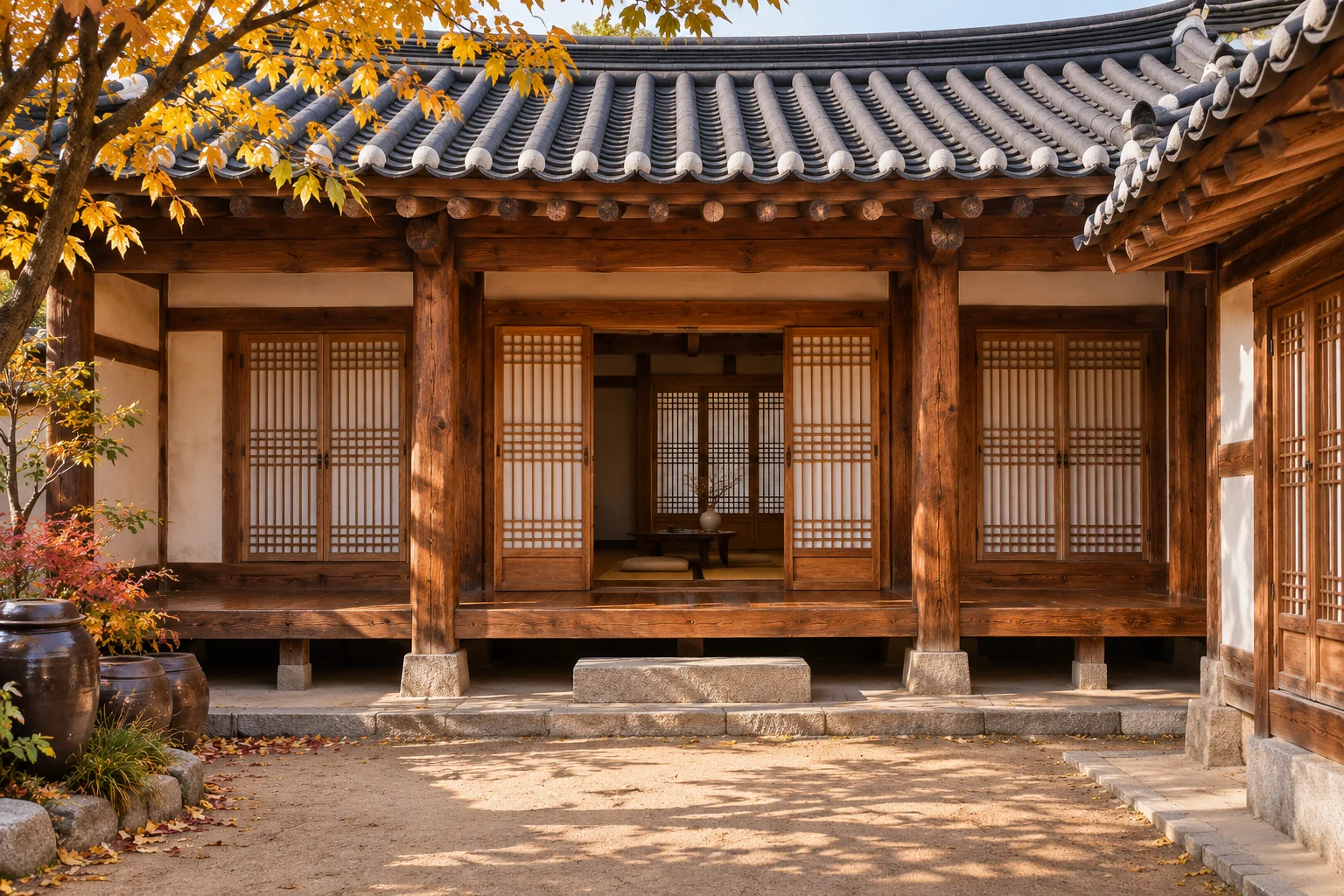
A tiled roof is usually the first thing you notice about a Korean hanok. Stay a little longer, though, and the more interesting questions are closer to the ground. Why is one floor raised? What happens in the open courtyard? How do these rooms work through a cold winter and a humid summer?
This guide explains a few details to look for, then helps you choose between three different Seoul visits: Namsangol's historic houses, a public cultural centre in Bukchon, and the converted cafés and shops of Ikseon-dong. You can enjoy the architecture without turning the day into a race between famous photo spots.
Sources checked: November 6–7, 2026, Korea Standard Time. Check the linked visitor pages again before travelling, especially for opening days, access arrangements and Bukchon's visitor restrictions.
What makes a house a hanok?
A hanok is a traditional Korean house. Its character comes from the wooden structure and the way its rooms, floors and outdoor spaces work together. The familiar tiled roof is part of the picture, but a roofline alone cannot tell you a building's age, history or present use.
Seoul's official hanok portal explains that the term covers changing architectural traditions, with different forms across regions and periods. It also describes modern hanok designed for today's homes, workplaces and public spaces. A newly built hanok and a carefully preserved older house can both be worth visiting, for different reasons. Seoul Hanok: definition and modern uses
Start by asking a simple question: what is this particular building? A house museum should help explain its history. A café may tell you about its renovation. A guesthouse listing should describe the room you will actually sleep in. “Traditional” is a useful starting word, but you will learn more from the details.
Look for the courtyard, the wooden floor and the heated room
The courtyard gives the rooms a relationship
The yard or courtyard is called a madang. Think of it as working space within the home rather than an empty patch waiting for decoration. Courtyards connected buildings and accommodated domestic work and family activities. National Institute of Korean History: hanok
From an area open to visitors, follow the route with your eyes. Which door opens towards the yard? Which rooms face each other? Where would someone cross from one part of the home to another? Those questions make a small courtyard more revealing than another photograph of the roof.
The wooden floor creates an in-between space
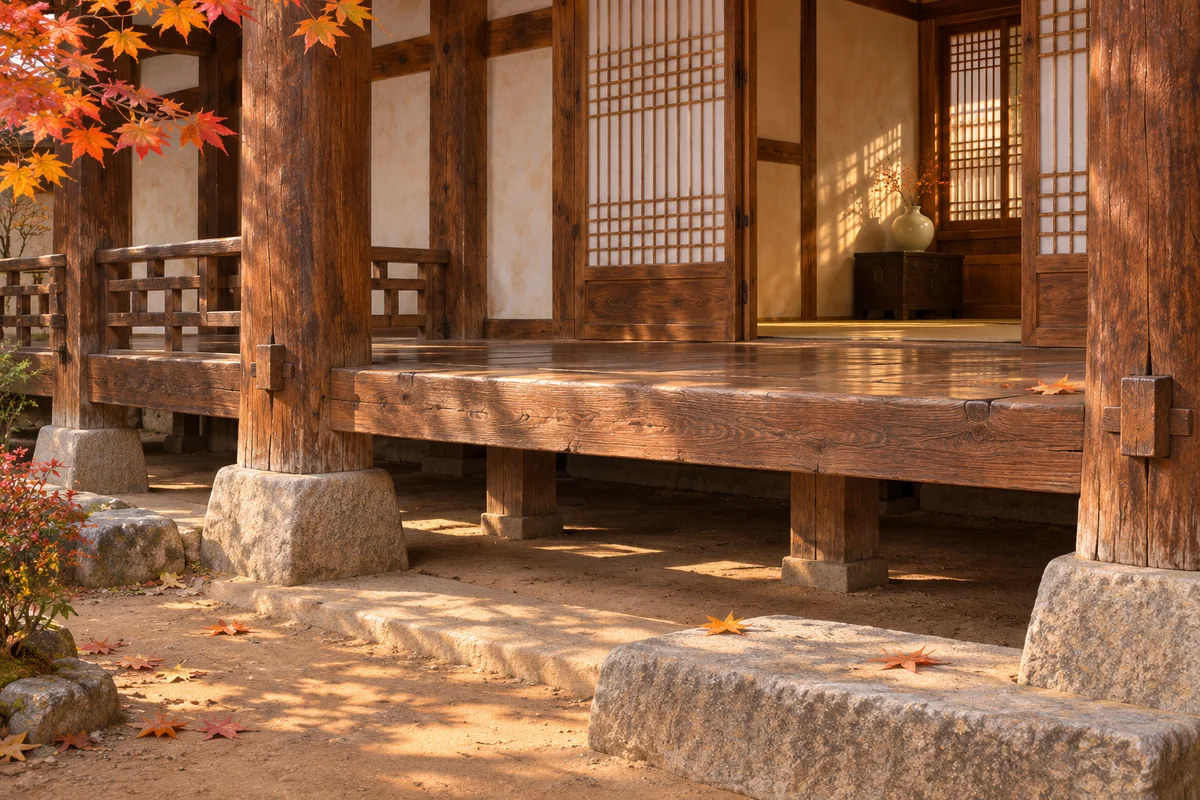
A maru is a wooden-floored space; a larger central hall is often called a daecheong. Raised wooden floors allow air to circulate underneath, while the hall connects rooms and outdoor space. Look for the change in level and the exposed wood above and below. These features helped the house respond to the seasons. Hanok floors and ventilation
You do not need to identify every beam. Notice how the structure frames the view into the courtyard, and whether doors can open the room towards it. Follow the site's signs about shoes and entry rather than assuming every inviting wooden platform is somewhere visitors may sit.
The heated room has a different job
Ondol means underfloor heating. In the traditional system, heat from a hearth travelled through channels beneath the floor before leaving through a chimney. It warmed the living surface from below. This helps explain why the floor matters so much in the arrangement of a Korean home. How traditional ondol worked
At a historic house, look for an explanation of the heating system rather than expecting to see it operating. If you book a hanok stay, ask what “ondol room” means in that property's listing: floor bedding or a bed, which heating controls you have, and what is included. The architectural term does not answer those booking questions.
Different houses tell different stories
Hanok do not all follow one floor plan. Seoul's architecture guide describes straight, L-shaped, U-shaped and enclosed layouts, influenced by climate, household circumstances and use. Wealthier households could have several buildings separating different members and functions; more modest homes had different priorities. Seoul Hanok: structure and layouts
Labels such as anchae (inner family quarters) and sarangchae (men's and reception quarters) describe historical household arrangements. Look at the explanation for the particular house rather than assuming every Korean family lived in the same way. Historical room uses
Bukchon adds another useful layer. Much of the closely packed urban hanok landscape developed during the 1930s, when larger plots were divided into smaller housing sites. Its houses adapted traditional construction to a changing city, including the use of newer materials. An old neighbourhood does not mean every house has stood unchanged for 600 years. Seoul's history of Bukchon
With that in mind, choose a visit by what you want to understand.
Choose Namsangol to compare historic houses
Namsangol Hanok Village, at 28 Toegye-ro 34-gil in central Seoul, is our suggested starting point if your main interest is how houses were arranged and used. It brings together five traditional houses whose histories reveal different households and approaches to building.

Read the individual building histories. They include relocation, restoration and reconstruction. The Ogin-dong house, for example, was newly constructed to reproduce the original because its old materials were too damaged to relocate. Describing every building here as an untouched house moved intact would miss an interesting part of the story. Namsangol's individual house histories
Choose two houses and compare them. Find the courtyard, look for the wooden hall, and see how the rooms connect. Then read the labels again. The names and plans become easier to remember once you have something specific to look for.
The current visitor guide lists free admission to the hanok area, with opening hours of 9 a.m. to 9 p.m. from April through November and 9 a.m. to 8 p.m. from December through March. It normally closes on Mondays, with an exception when Monday is a public or substitute holiday. Check the same page for English guided tours and participation arrangements. Namsangol's official visitor guide
Accessibility needs a closer look. The operator says some house entrances have narrow ramps and identifies two houses where ramps could not be installed. An accessible restroom is listed by the main entrance. Contact the venue about the specific spaces you want to enter and your mobility needs; access to the grounds does not establish access to every room. Namsangol access information
Find Namsangol Hanok Village: Open the verified Google Maps pin for 28 Toegye-ro 34-gil, Jung-gu, Seoul.
Choose a public hanok for a more thoughtful Bukchon visit
Bukchon is a residential neighbourhood as well as a place visitors come to see. A useful first stop is the Bukchon Traditional Culture Center at 37 Gyedong-gil, a former home now used for community activities, visitor information and traditional-culture programmes. Its public role gives you somewhere to learn about the neighbourhood before exploring its streets. About Bukchon Traditional Culture Center
Use the centre's current information to choose a public exhibition or activity that interests you. Confirm opening arrangements and whether a programme requires registration. An open cultural centre and a private home have very different invitations attached to them, even when their roofs look similar.
Check the restricted zone before planning a Bukchon walk. Seoul's official notice prohibits tourist visits in the designated red zone around Bukchon-ro 11-gil between 5 p.m. and 10 a.m. the following day, with a stated fine of ₩100,000. This is a mapped zone, not a statement that every part of Bukchon closes at 5 p.m. The city also asks visitors to respect Sunday as a rest day for the alleyways. Official restrictions and zone map
Keep voices low, leave doorways clear and avoid photographing into homes. When a lane is crowded, move on instead of waiting outside someone's entrance for an empty frame. A public courtyard, exhibition or workshop can offer a much better encounter with hanok than a queue on a residential street.
Choose Ikseon-dong to see hanok used differently
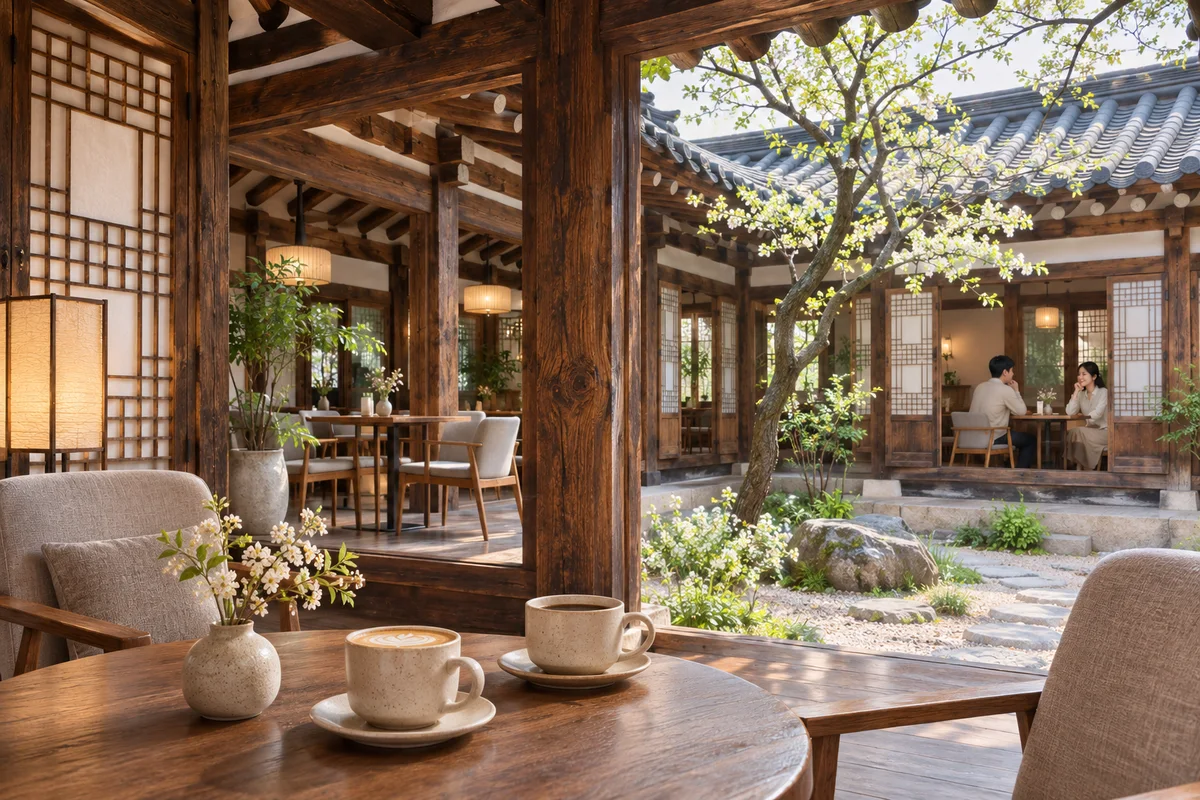
Ikseon-dong offers another kind of visit. Seoul's tourism guide describes a network of hanok lanes occupied by cafés, restaurants and shops. Come here if you would enjoy seeing how older architectural forms accommodate contemporary businesses. Visit Seoul's Ikseon-dong introduction
Choose somewhere whose menu, prices and seating suit you, then notice what the conversion has kept or changed. Is the courtyard still open? Can you see the timber structure? Has a former domestic room become a dining space? A pleasant coffee stop can give you time to look more closely than a quick walk past several façades.
Individual businesses set their own opening hours and customer rules. If you need a chair with a back, a step-free entrance or an accessible toilet, ask the business directly before making it your main stop. A photograph of a beautiful courtyard cannot tell you the whole route to your seat.
For help choosing a drink rather than a building, continue with our guide to your first Korean tea house.
Build one satisfying visit
For a first encounter, we would choose one of these experiences and leave room to linger. Pick Namsangol for comparing house layouts, a public hanok in Bukchon for neighbourhood context, or Ikseon-dong for a meal or drink inside an adapted building.
Save the exact venue in your map app, check its current visitor information and plan the approach that suits your pace. Our Korea map-app guide can help with that part.
Then give yourself a small task: notice one courtyard, one floor and one doorway. You will leave with a better sense of how the building works.
Sources and further reading
Seoul Hanok: definition, structure and layouts, and Bukchon's history.
National Institute of Korean History: Hanok, explaining floors, courtyards and household spaces.
Namsangol house histories and official visitor information; Bukchon Traditional Culture Center; Bukchon visitor restrictions; Visit Seoul: Ikseon-dong.