Ewha is worth considering when you can name the kind of study you want to do there. A full undergraduate degree, a graduate program, a semester abroad, and an intensive Korean course lead to different classrooms, costs, and admissions offices. Even the question “Can I study at Ewha in English?” has more than one answer.
This guide focuses on the Seoul campus at 52 Ewhayeodae-gil and the routes available to international students. The most useful starting point is the program that matches your goal, followed by its teaching language and entry requirements. Those details will tell you more about your future week than a university name alone.
Source check: October 2, 2026. Degree admissions below refer to the Spring 2027 guides. Tuition estimates retain the period stated by Ewha, which is often Fall 2026 rather than a confirmed 2027 bill.
Choose your route into Ewha
The Spring 2027 international admissions guide covers undergraduate freshman and transfer entry, plus the General Graduate School. For this particular track, the applicant and both parents must hold non-Korean nationality, and the guide accepts female applicants only. Its detailed rules about dual nationality, former Korean nationality, educational qualifications, and authentication are part of eligibility, rather than optional paperwork.
Professional and special graduate schools have their own admissions processes. The Graduate School of International Studies, or GSIS, is a useful example: its separate Spring 2027 guide also specifies female applicants, but sets its own academic, language, document, and scholarship requirements. A rule from the General Graduate School should therefore stay attached to that school.
Incoming exchange and visiting study have a different eligibility statement. Ewha’s Office of International Affairs explicitly accepts full-time male and female undergraduate and graduate students at accredited universities. Standalone Korean study is administered by the Ewha Language Center, or ELC, through another application. Keeping these routes distinct makes the university much easier to navigate.
Undergraduate degrees: understand the first year
Ewha offers undergraduate entry across humanities, social sciences, natural sciences, engineering, business, arts, nursing, and computing-related fields, with the available freshman and transfer programs listed separately in the admissions guide. Read the table for your entry type before choosing a major. Transfer eligibility, recognized prior study, and later curriculum requirements can affect how long a degree actually takes.
For most international freshmen, the first year has a specific structure. Students enter the Global Scholars Program in HOKMA College of General Education for at least two semesters, taking Korean language and foundational general education courses before proceeding to their major curriculum. The guide excludes the Division of International Studies and College of Nursing from this arrangement. For students in the program, progression requires completing the year and reaching TOPIK Level 3 or an equivalent qualification; students below Level 3 face restrictions on major courses.
That is an important distinction for a beginner. The general freshman route does not set an initial language proficiency requirement, but Korean becomes part of academic progression after admission. This can suit someone ready to devote a substantial part of the first year to language development. It also means you should ask how the first-year curriculum connects to your intended major and how placement or recognized language qualifications affect your course choices.
International Studies and Global Korean Studies
The Division of International Studies contains International Studies and Global Korean Studies. The guide says all major courses in these two majors are taught in English, while some mandatory liberal arts courses may be taught in Korean. Applicants must meet the division’s English requirement. For Spring 2027 freshmen, accepted options include IELTS 6.0, the specified TOEFL or New TEPS threshold, or completing high school entirely in English. Check the guide’s revised TOEFL scale against the date of your test.
For other majors, the guide says the proportion of English courses varies and that more courses may be taught in Korean than English. Undergraduate students generally must achieve TOPIK Level 4 before graduation, including those admitted using English proficiency; the Division of International Studies is the stated exception. Ewha also requires undergraduate chapel credits. These are practical curriculum details to understand before committing to a degree.
Graduate study: start with the department and teaching language
The General Graduate School offers master’s, doctoral, and combined programs, but the availability of each degree varies by department and major. The Spring 2027 guide includes fields such as women’s studies, psychology, education, life sciences, artificial intelligence and software, engineering, and the arts. Some programs have additional requirements based on previous study or professional experience. A research interest should lead you to a department’s actual degree offering and academic expectations.
English proficiency is one possible way to satisfy the General Graduate School’s language requirement. It does not establish an English-taught degree: the guide explicitly says most General Graduate School courses are taught in Korean, with the proportion varying by department. Before applying, ask about the language of required courses, seminars, examinations, supervision, and thesis work. A supervisor who can discuss research in English is one piece of that picture.
GSIS offers a more clearly defined English route. Its Spring 2027 guide states that all Department of International Studies classes are in English, across International Trade, International Business, Development Cooperation, and International Relations. It lists master’s, doctoral, and combined degrees. The Department of Korean Studies, also within GSIS, is different: most classes are in Korean, with a few Korean Culture classes in English. That department includes Korean Culture and Teaching Korean as a Foreign Language. Choose between them by the work you want to study and the language you can use academically.
Exchange and visiting students: build a workable semester
Exchange students need nomination from an Ewha partner institution before applying. Students without nomination, including those at non-partner institutions, can apply to the fee-paying Individual Visiting Program. Both routes require at least one completed semester at the home university and a cumulative GPA of at least 2.5 out of 4.0, or 75 out of 100. Graduate applicants must provide a graduate-level transcript; the Fall 2026 fact sheet clarifies that they must have completed at least one semester of graduate study.
Ewha expects the ability to take courses in English or Korean, although the fact sheet does not require a language certificate for exchange applications. Its semester course load is 9–18 credits for undergraduates and 6–18 for graduate students. Your home university may have its own minimum load and credit-transfer rules, so confirm the courses it will recognize before you settle on a plan.
The incoming course-offerings page provides English-course search links and explains restrictions. Nursing, medicine, and pharmacy courses are unavailable to incoming exchange and visiting students. Restrictions may also apply in arts, music, engineering, education, and the Scranton Honors Program. Graduate access includes the General Graduate School, some GSIS courses, English-taught law courses, and business graduate courses for graduate students only. Other professional and special graduate schools are generally excluded.
Course lists usually appear in mid-January for spring and mid-July for fall. Until then, a previous list from the same season can help you explore possibilities, but offerings can change. Prepare alternatives around the credits your home university needs. Korean-language courses also appear in the undergraduate course search. These semester courses belong to the academic timetable; the ELC’s daily intensive program has its own registration and tuition.
Tuition and scholarships: use the right set of figures
The Spring 2027 general admissions guide labels its degree tuition figures as estimates based on Fall 2026 rates. For undergraduates from the second year onward, it gives approximately KRW 4.64–5.56 million per semester for the listed humanities, social sciences, business, and International Studies groupings, with higher ranges for other fields. Its first-year HOKMA figure is approximately KRW 6.31 million per semester, with admission fee included as printed in the table. First-year International Studies and Nursing have a separate estimate. Use the exact category and enrollment bill for your situation.
The General Graduate School table also separates the first semester, including an admission fee, from later semesters. GSIS uses its own table, with different amounts by department and within-quota or out-of-quota status, plus an entrance fee. This is why a single “Ewha tuition” figure is not a useful budget. Degree tuition is only part of the cost alongside housing, meals, books, transport, insurance, and personal spending.
For a semester abroad, the Fall 2026 fact sheet quotes KRW 4.7 million tuition and a KRW 100,000 application fee for visiting students. Both Ewha charges are waived for exchange students. Housing and optional campus health-center charges remain separate, and your home institution’s payment arrangements still matter. The same sheet lists insurance requirements; follow the instructions sent for your actual semester.
What scholarships cover, and what continues
The general admissions guide lists the Ewha Global Partnership Program, or EGPP, for selected applicants from developing countries with recognized leadership potential. It covers full tuition including the admission fee, dormitory housing fees for dormitory residents, and a stipend. Maximum support varies by degree and entry type, and continued funding requires the applicable academic conditions. International Students Scholarships include full-tuition awards of different durations, while undergraduate TOPIK awards range from partial to full first-semester tuition.
These awards have distinct selection and renewal rules. In particular, a qualifying TOPIK score submitted after the application period can satisfy admission eligibility without qualifying you for a TOPIK scholarship. Most incoming scholarships in this general admissions guide require uploading the scholarship application during the admissions period. GSIS separately states that its merit awards are generally selected automatically, with an exception requiring an ISS application; work-based awards use a later process. Read the award instructions for your school and budget around confirmed funding. Our scholarships guide can help you compare university support with other routes.
Korean study at the Ewha Language Center
The ELC intensive program runs four times a year. Each term lasts ten weeks, with 200 class hours: 20 hours a week, Monday through Friday, in the morning. There are six levels and a placement process. The program integrates reading, writing, listening, and speaking, with cultural classes connected to the curriculum. ELC says classes are taught in Korean and that complete beginners can start with the alphabet.
From Winter 2026, published intensive tuition is KRW 1.85 million per term, plus a KRW 120,000 application fee for new enrollment. Textbooks are extra. The registration guide says program insurance is included in tuition and describes document screening before payment and enrollment. Applicants seeking the program’s D-4 documentation must register for at least two terms and follow the document list applicable to their circumstances. ELC screening and consular visa decisions are separate steps.
An ELC course can support a longer plan to study in Korean, but degree admission remains a separate selection process. It is also a substantial daily commitment for an exchange student already carrying university credits. ELC publishes a tuition reduction for qualifying Ewha degree and exchange students in its program FAQ; confirm eligibility, timing, and the combined workload before enrolling.
Housing, campus access, and settling into a routine
Housing rules follow your student route. Spring 2027 international undergraduate degree entrants can apply during the general housing application period and receive priority. International General Graduate School entrants may request first-semester priority placement through the International Student Affairs Team, but requests can be declined when rooms are unavailable. The guide limits residence through priority placement to a maximum of one year from admission.
For orientation, the degree guide lists an I-House double room at KRW 1,976,490 for 123 nights in Spring 2027, while warning that the fee is based on 2026 rates and may change. Meal plans are excluded. Incoming exchange and visiting students apply for housing within their online application; the Fall 2026 fact sheet says rooms are assigned first come, first served and are not guaranteed. Its prices cover that exchange semester and should not replace the degree housing table.
ELC has its own dormitory process, tied to enrollment in the corresponding course. The page limits intensive-program residence to two terms, subject to internal circumstances, and directs students to term notices for prices. Apply through that route rather than assuming a degree-student housing priority applies. If you look off campus, our Korean apartment guide explains deposits and the rental process.
The campus is reached from Ewha Womans University Station on Seoul’s Line 2. The university’s directions page places the main gate about 300 meters from Exit 2. Housing near a station and housing near your particular building can make different daily journeys, so compare the complete route. Our transport guide is useful once you have an address.
Incoming exchange students can join the optional Peace Buddy program for help from Ewha students. Degree students work with the International Student Affairs Team, while ELC students have their own office and published counseling options for classes and life in Korea. Let those smaller points of contact help you establish a routine. The arrival setup guide covers the everyday tasks that sit alongside university orientation.
Who Ewha may suit
Ewha may suit an undergraduate who wants its particular major and is ready for the first-year language structure, a student seeking the English-major curriculum in International Studies, or a graduate applicant whose department matches their research and language abilities. Exchange students should give course access the same attention as campus location. Korean learners should decide whether a weekday morning intensive program matches the pace they want. A clear answer to those questions will make your shortlist feel much more personal and much more useful.
Student questions about Ewha
Can male international students study at Ewha?
Yes, the incoming exchange and Individual Visiting Program explicitly admit male and female students. The Spring 2027 international undergraduate and General Graduate School guide accepts female applicants only, and the separate Spring 2027 GSIS guide also specifies female applicants. Those degree rules should not be extended to every Ewha program.
Can I complete an undergraduate degree entirely in English?
The Division of International Studies teaches all major courses in English, but some required liberal arts courses may be in Korean. Other majors have varying English-course availability. Check the whole curriculum, including graduation language requirements, rather than only the admission test you can submit.
Do I need TOPIK before applying as a freshman?
The general freshman route has no initial language proficiency requirement in the Spring 2027 guide. Most entrants then study in the Global Scholars Program and need TOPIK Level 3 or equivalent for major progression. International Studies has its own English requirement, and the guide identifies Nursing as another exception to the first-year program.
Does an exchange place include a dormitory room?
No. Exchange and visiting housing requires an application, and the Fall 2026 fact sheet describes first-come, first-served allocation without a guarantee. Confirm your own housing assignment and dates before relying on a campus room.
Will ELC Korean study give me a degree place?
No automatic degree place is promised. ELC is a separate language program, while degree applicants must satisfy and complete the relevant admissions process. From Winter 2026, its intensive program costs KRW 1.85 million per ten-week term, plus the new-student fee and books.
Sources and further reading
Ewha Spring 2027 international admissions guide: undergraduate and General Graduate School programs, eligibility, language requirements, admissions process, scholarships, tuition estimates, and degree housing.
Ewha GSIS admissions and Spring 2027 guide: separate graduate eligibility, teaching languages, programs, fees, and scholarship procedures.
Incoming exchange and visiting eligibility; Fall 2026 incoming fact sheet; and course offerings: nomination, fees, course loads and restrictions, housing, and Peace Buddy support.
ELC intensive program; registration guide; ELC FAQ; ELC benefits and student services FAQ; and ELC dormitory information: course structure, beginner instruction, revised tuition, screening, housing, and student support.
Ewha GSIS directions: campus address and the walking approach from Line 2. Older transport fare examples on that page were not used here.
Korea Unboxed related reading
Scholarships in Korea for international students helps you compare funding routes. How moving into a Korean apartment actually works explains the rental process.
Transportation in Korea covers getting around, and Getting set up after you land supports your arrival planning.
Image credit
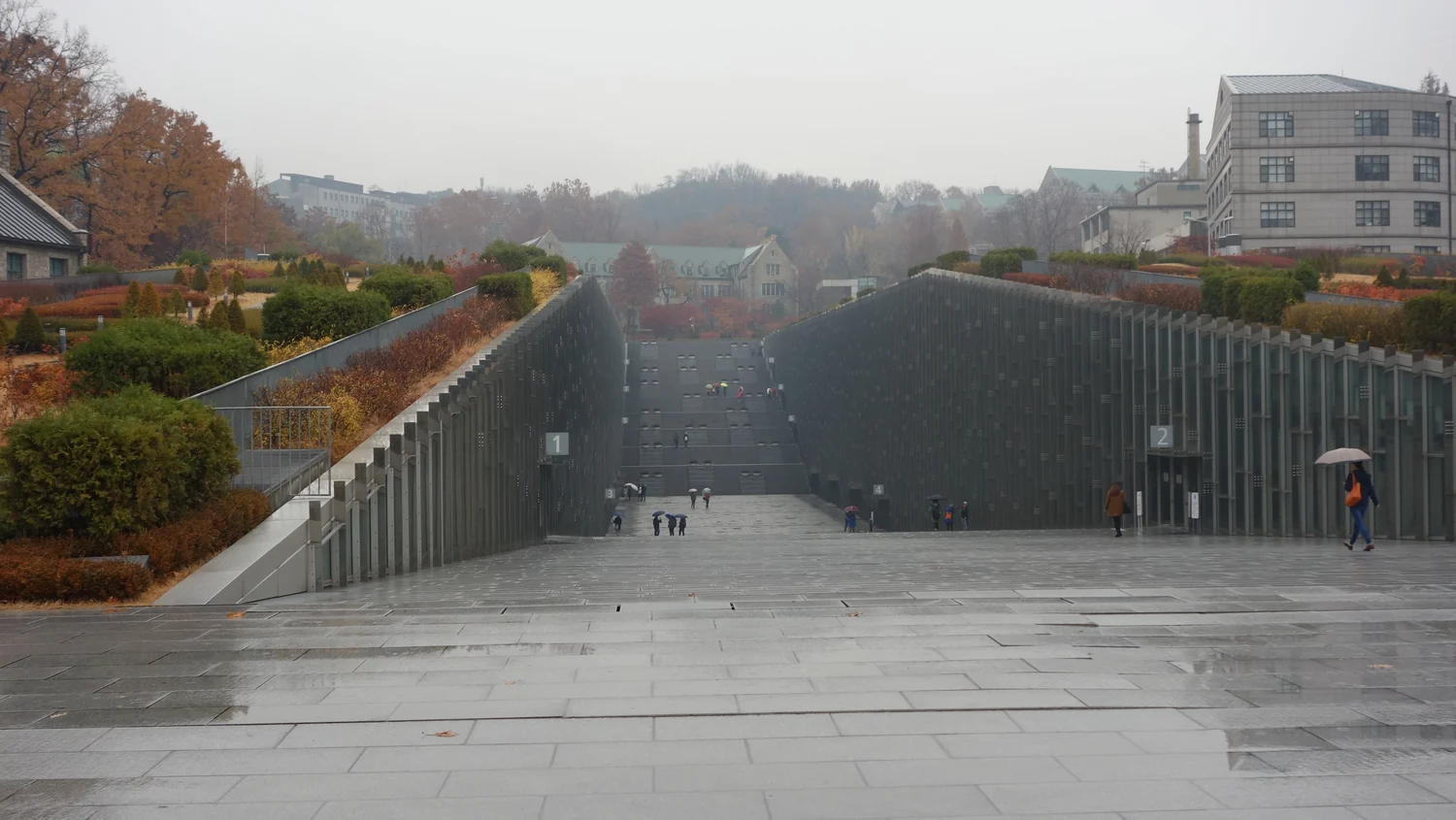
Ewha Campus Complex, photographed by Ken Eckert on November 22, 2014, via Wikimedia Commons, licensed under CC BY-SA 4.0. Resized and cropped for display; the adapted photograph retains the same license.