
You can study in English in Korea, but the answer needs a program name beside it. An English-language university website, an accepted IELTS score or a long list of English electives does not establish that you can finish a particular degree in English. For an exchange semester, even a genuinely English-taught class may be unavailable to your student category.
The useful question is more specific: can you enter this program, complete its compulsory work in languages you can use, and obtain the courses or supervision you need? That question turns a broad search into something you can check. It also helps you distinguish an English-focused degree from a Korean-taught degree that happens to accept English evidence at admission.
Before you apply: check the teaching language, the complete graduation requirements and your access to the required courses. For graduate research, add supervision and lab communication. For exchange, add the actual semester schedule and home-university credit approval.
Official sources checked October 2, 2026. The programs below are selected examples of different arrangements, not an exhaustive directory or a ranking. Requirements belong to the stated program, student category and entry cohort.
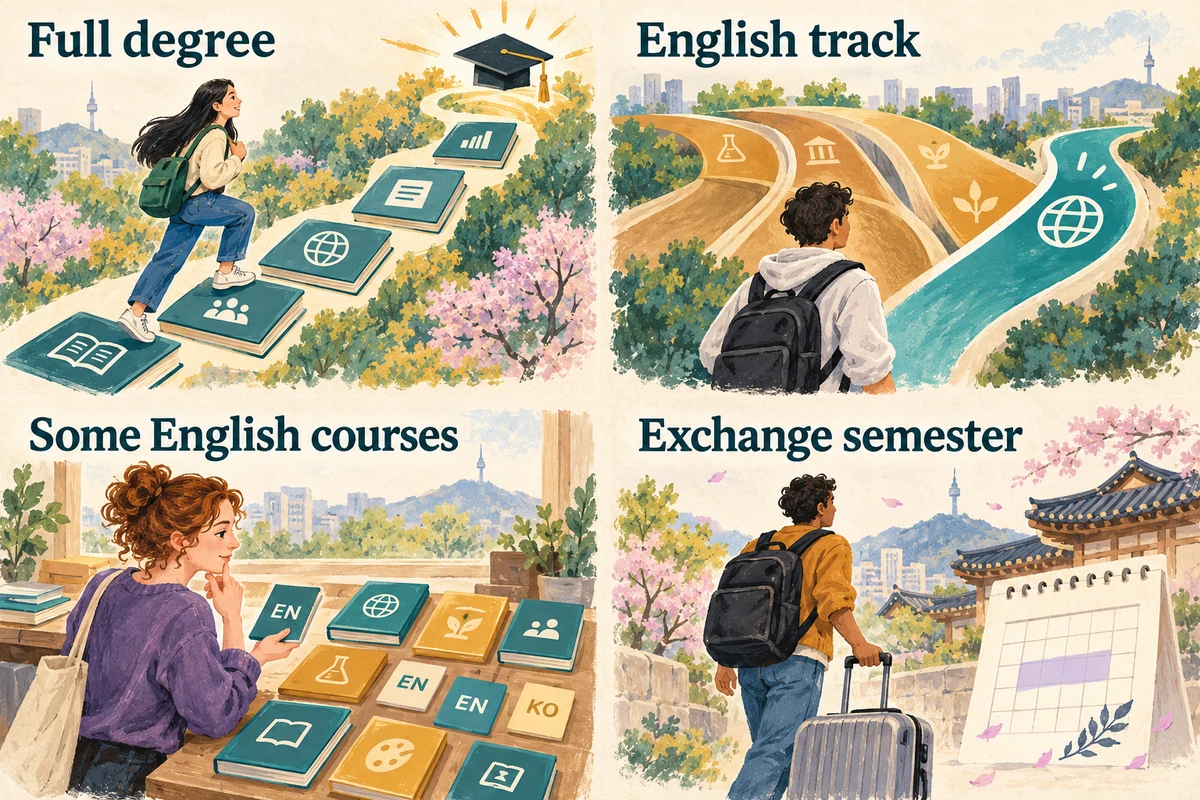
Four different things can be called English study
A complete English-medium degree is the most substantial claim. To evaluate it, read the institution’s explicit description together with the curriculum and graduation rules. Look beyond lectures to required general education, laboratories, project work, language courses, examinations and any thesis or dissertation. Check the rules for your entry year rather than relying on a current student from another cohort.
An English track can be a defined pathway within a larger university. Its teaching arrangements may differ from the neighboring major with a similar name. Establish the exact track, campus and application category. If the program has a foreign-language requirement, an English-medium description does not necessarily mean that English is the only language you will study.
A degree with some English courses is another arrangement. It may be useful if you also have the Korean needed for the remaining curriculum. Counting English electives across the university does not tell you whether the required courses in your chosen major are available in English or offered often enough to finish on time.
An exchange semester involves a course selection rather than a full degree. Your goal is a viable timetable of accessible classes that meet your home institution’s requirements. An English-taught department can still restrict exchange enrollment, apply prerequisites or offer fewer suitable classes in your semester than an old catalog suggests.
Selected undergraduate routes worth checking closely
Yonsei: Underwood International College
Yonsei’s Underwood International College overview describes a four-year English-language liberal arts college with three divisions. That is program-level evidence, rather than an inference from Yonsei’s international branding. UIC has its own admission information, curriculum and degree requirements.
Begin with the Common Curriculum and the degree-requirement materials for the major and entry year. Then establish the teaching campus over the course of the degree. An English-medium route can involve campus arrangements that matter for housing and travel; it should not be treated as proof that every Yonsei degree follows the same language or location pattern.
For exchange, use the exchange registration instructions instead of assuming admission to UIC’s degree curriculum. A full-degree student’s academic route and a visiting student’s permission to take individual courses are different questions.
Korea University: International Studies English Track
Korea University’s spring 2027 Seoul undergraduate guide explicitly labels International Studies an English Track. For other majors, it directs applicants to check the curriculum and English-course provision. The distinction is useful: English admission evidence elsewhere in the guide does not establish an English-taught degree.
The department’s curriculum for international students entering in 2025 sets out a 130-credit structure, including English and foreign-language credit requirements and secondary foreign-language study. It exempts DIS students from the listed certified Korean-language graduation requirement, while requirements belonging to an additional major can still apply.
Use the current graduation-requirements page to establish the rules for your own cohort and major combination. This is an English-focused route to investigate, with a defined curriculum to read. It is not a basis for describing all KU undergraduate majors as English-only or for promising that every combination of majors will avoid Korean requirements.
Sogang: Geppert School of International Studies
Sogang’s Geppert School of International Studies program description explicitly describes an all-English undergraduate curriculum with International Relations, International Commerce and Asian Studies tracks. It is a separate undergraduate route from the university’s Graduate School of International Studies.
Use that curriculum as a program-level lead, then obtain the current admission and complete graduation requirements for your entry cohort, including any required language work or additional major. The English curriculum description should not be expanded into an English-only claim for every Sogang degree.
Busan National University: Global Studies
Busan National University’s spring 2027 undergraduate guide says most courses are taught in Korean and identifies Global Studies as taught entirely in English. The same guide allows an English-score alternative in AI Computer Science but explicitly labels that arrangement not an English track. The admission document itself therefore gives a clear reason to distinguish entry language from teaching language.
The fall 2026 international student guidebook treats Global Studies differently from the general undergraduate Korean graduation requirement and lists English graduation-test standards for it. That supports a program-specific language distinction. It does not replace the department’s full required-credit map, which you should obtain for your entry year before choosing a major or an additional specialization.
For other Busan undergraduate departments, examine both admission and graduation requirements. An English test accepted at entry does not remove a Korean language requirement later in the degree. Nor does an English-capable supervisor make every required undergraduate course English-taught.
Hanyang ERICA: Economics and Business Administration English tracks
Hanyang ERICA’s spring 2027 undergraduate guide explicitly describes all courses in the Economics and Business Administration English tracks as taught in English. It also exempts English-track students from the mandatory intensive Korean program and the TOPIK graduation requirement. The guide gives freshman and transfer eligibility separately. Start with the current English PDF on the official ERICA undergraduate guide board, then map your required credits and any intended additional major.
The same guide lists a Computer Science English Track for third-year transfer applicants. That is a narrower route to investigate, not evidence of a four-year freshman English option. Seoul has its own named English tracks and admissions guide. Keep campus, track and admission category together rather than combining separate offerings into a university-wide promise.
KAIST offers a distinct graduate English environment
KAIST’s graduate admissions overview states that English is the official language of written and spoken communication and that graduate students do not need to learn Korean to fulfill graduation requirements. That is a direct institutional statement for graduate study, not merely an English-language admissions webpage.
Its graduate eligibility page separately sets out English proficiency and waiver rules. Read those for your test, qualification and circumstances. A waiver is an admissions provision; it does not eliminate the need to understand your research group’s actual communication and assessment practices.
For a master’s or PhD, ask about supervision, group meetings, written work, qualifying assessments and the thesis or dissertation. If your research involves fieldwork, local organizations or participant interviews, establish whether Korean is needed for the research itself. A graduate program can operate in English while the project you want to undertake needs additional language ability.
The distinction also works in the other direction. A graduate admissions page accepting an English test, without a statement about instruction and graduation, is incomplete evidence of an English-medium program. Ask the department for its compulsory-course list and assessment rules before deciding that a possible research fit is an accessible degree.
KAIST’s statement should retain its graduate scope. Undergraduate curricula, exchange registration and scholarship conditions need their own checks. In particular, a scholarship can impose language study independently of the degree’s teaching arrangements.
Sogang GSIS is a separate English-taught graduate route
Sogang’s Graduate School of International Studies program page states that all courses are taught in English. It describes graduate study in international relations, international trade, international finance, and Korea and East Asia, with no evening courses. This is evidence for GSIS, rather than every Sogang undergraduate or graduate department.
Read the current GSIS admission and degree requirements for your level, including the thesis or non-thesis path where applicable. Confirm the full graduation language requirements, timetable and funding separately. An English-taught graduate school can offer a clear lead without establishing the language or scholarship arrangements of the university’s General Graduate School.
For exchange, a course list is only the first check
Start with the exact semester and campus. Filter the official catalog by language, then record the course code, section, credit value, prerequisites and teaching time. A course title written in English is not sufficient evidence of instruction language. A translated syllabus is also different from an English-taught class.
Korea University’s fall 2026 registration instructions illustrate how precise the check needs to be. Its official list distinguishes courses marked as English from ES courses, which use Korean instruction with automatic English subtitles. Subtitles are an aid within a Korean-taught course; they should not silently be counted as English instruction.
The same instructions impose academic-access restrictions and credit limits. Visiting students take undergraduate-level courses, even when they are graduate students at home. Some departments are closed to exchange or visiting enrollment and some courses are difficult to obtain because of demand. Confirm both the language label and your permission to register.
KAIST’s fall 2026 exchange fact sheet restricts registration across degree levels and excludes certain programs. It describes an initial course plan based on prior offerings, followed by registration against the finalized semester list. That distinction matters if a class is essential for graduation at home.
Busan National University’s 2026–27 exchange fact sheet similarly identifies closed departments and registration constraints. An agreement between universities gets you into an application process; it does not guarantee every course in the university directory.
Prepare enough alternatives to survive a timetable clash, canceled section or full course. Ask your home university to approve the syllabus and credit treatment before departure, then establish its process for approving replacements. Keep the actual semester registration instructions with your plan instead of treating an old student blog as the final authority.

Check the full degree, not just the first semester
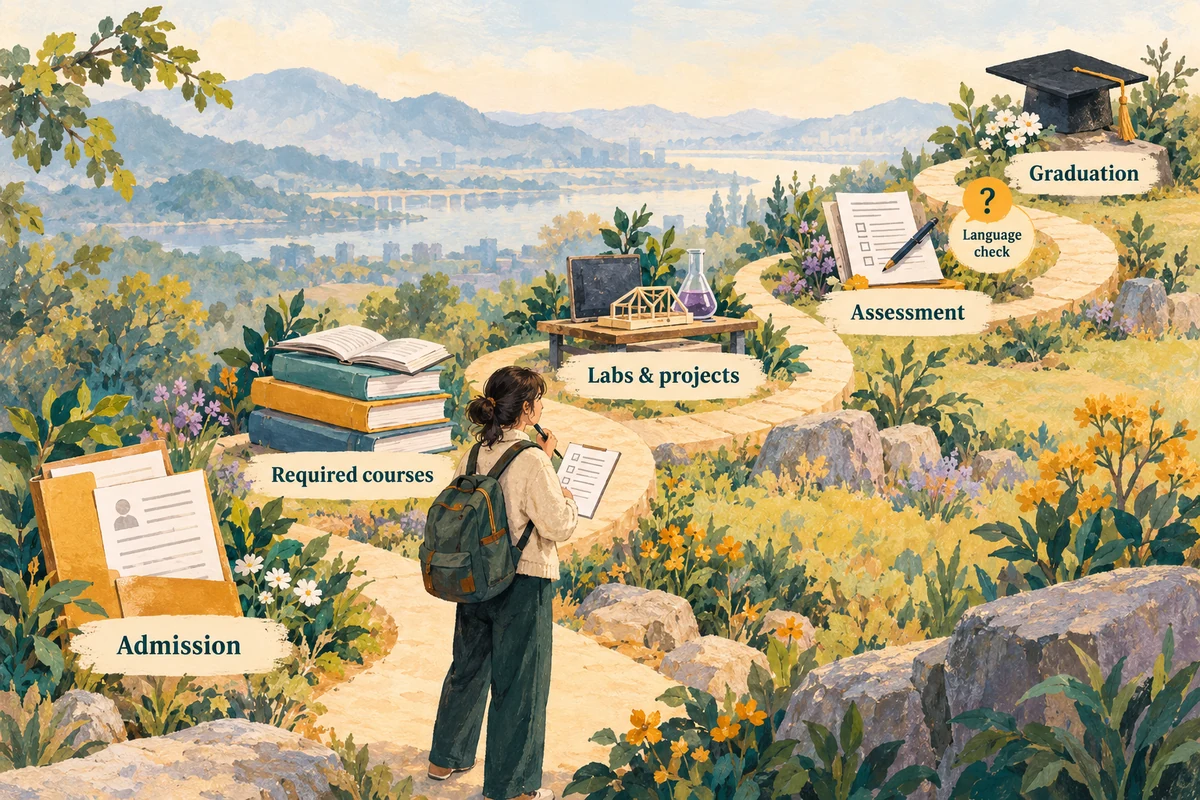
For a degree, map the required work from admission to graduation. Start with general education and the major’s compulsory courses. Then check laboratories, practical placements, capstone projects, seminars, examinations and the final research requirement. A small Korean component can have a large effect if it blocks progression into later classes.
Ask how often required English sections are offered and whether international students have access to them. If a compulsory module appears only once a year, a missed section may affect more than one semester. Establish whether an alternative course or an approved substitution exists, and which office can authorize it.
Major combinations deserve separate scrutiny. A program may exempt its own students from a Korean certification requirement while a double major imposes additional rules. Transfer admission can also create a different remaining-credit problem from freshman admission. Use the rules for your actual route and cohort.
Keep teaching, assessment and administration visible as separate areas. You may be able to write an essay in English while a required presentation has different rules. An English syllabus may coexist with Korean safety instruction or a placement arranged through Korean-speaking organizations. Ask about the work you personally must perform, rather than only whether international students have enrolled before.
Studying without Korean is different from living without support
A verified English-medium academic route can make study possible before you have strong Korean. It does not tell you how a private landlord, clinic, phone provider or neighborhood service will communicate. Consider which tasks the university helps with and which you will handle independently.
Look for international student services, an orientation in a language you can use, clear housing instructions and a contact for academic difficulties. If your program has bilingual support, ask what that support covers and when it is available. A buddy program can help you meet people, but should not be treated as the only solution to a complicated enrollment or accommodation issue.
Korean learning can be part of the plan without becoming a condition the degree does not impose. A credit-bearing language elective, an evening community course and a full-time university language term have very different workloads. Choose an arrangement that fits your academic schedule, and check whether it carries an additional fee.
If you want to work, intern or pursue further study after graduation, investigate the language requirements of those specific plans. Completing a degree in English is evidence about the degree; it cannot establish access to every later workplace, professional qualification or immigration route.
Send questions that a department can answer
Instead of asking whether a university is “English-friendly,” identify the program, degree level, campus, intake and your intended major combination. Ask for the curriculum and graduation rules applying to that cohort. Then name any compulsory course or requirement whose language remains unclear.
For a degree, ask whether all required courses and assessments can be completed in English, whether Korean proficiency is required at entry or graduation, and whether any placement or additional major changes the answer. Request the policy or document that supports the response. Keep the answer with your application materials.
For exchange, give the actual semester and course codes. Ask which courses accept your student category, what the language labels mean and what alternatives exist if a preferred section is full. Your home university should separately confirm credit recognition and any minimum academic load.
For graduate research, ask about the proposed group’s supervision and meeting language, required taught courses, research tasks and final assessment. A specific question about your planned work is more useful than an institution-wide promise that cannot describe every lab.
Build a shortlist you can actually complete
The best English-study shortlist has a complete route beside each name. You should know the program, the campus, your admission category, the required language work and the evidence supporting the plan. For exchange, you need a feasible timetable and approved alternatives; for research, you need a workable supervisory and academic arrangement.
When something remains unclear, keep it as a question rather than turning it into a positive claim. An English score, an international label and a few English electives are useful clues. The curriculum and the rules for your own enrollment decide whether you can finish.
Related reading
Read Scholarships in Korea for International Students to separate degree language from funding conditions. Our first-week setup guide covers practical tasks beyond admission, and moving into a Korean apartment explains the private rental process.
Sources and further reading
Yonsei UIC: overview, Common Curriculum and degree requirements. Korea University: spring 2027 Seoul undergraduate guide, International Studies curriculum, graduation requirements and fall 2026 course-registration instructions.
Hanyang ERICA: spring 2027 undergraduate admission guides. Sogang: Geppert undergraduate curriculum; GSIS: graduate programs and instruction language.
Busan National University: spring 2027 undergraduate guide, fall 2026 international student guidebook and 2026–27 exchange fact sheet. KAIST: graduate language overview, graduate eligibility and fall 2026 exchange fact sheet.
Korea Unboxed related reading
Scholarships for international students in Korea; Getting set up after arrival; How moving into a Korean apartment works.
Image note
The hero is an AI-generated conceptual illustration.