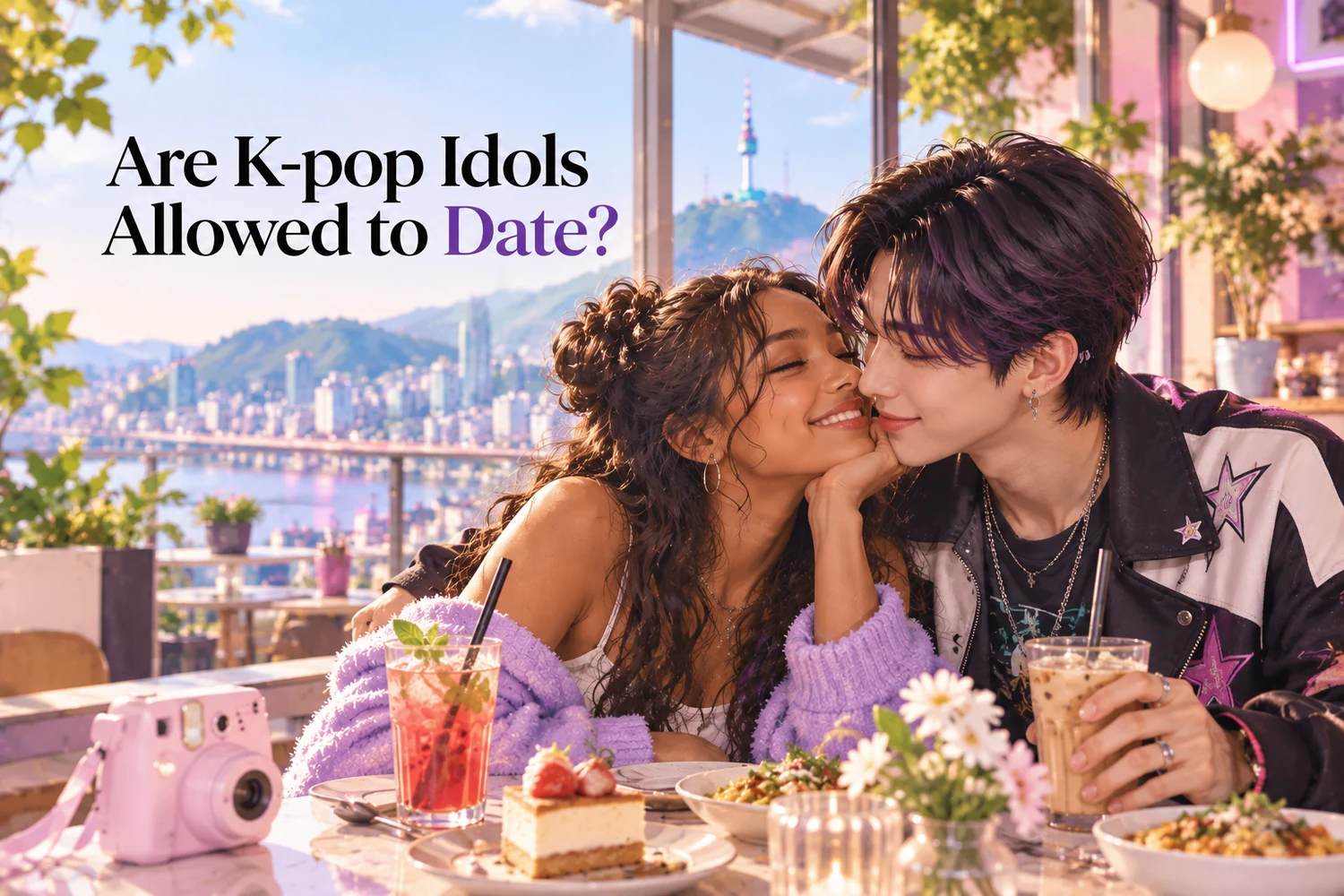
K-pop idols do date. Some relationships are publicly acknowledged, and artists sometimes announce plans to marry. When 2PM member and actor Taecyeon announced marriage plans in November 2025, his agency discussed both his relationship and his intention to continue working. It also asked for privacy for his non-celebrity partner. The agency statement is reproduced in Soompi's coverage.
The answer to “Are K-pop idols allowed to date?” therefore depends on whose situation you are asking about. Company expectations, an artist's circumstances, and the consequences of going public are separate questions. Being able to have a relationship does not necessarily mean being comfortable having dinner together in a busy restaurant.
That difference is what interested us in an account a friend shared with a Korea Unboxed team member. She described a past relationship with a prominent idol in which dinner, movies, and spending time with friends sometimes required unusually private surroundings. A restaurant could be booked for the couple alone; a movie could mean having a screening room to themselves. Her account has not been independently verified. We have kept it separate from the public reporting, first looking at dating expectations, then her experience as it was relayed to us, and finally what the available evidence does and does not support.
Public sources reviewed September 30, 2026. Historical statements below are dated and should not be read as confirmation of current private contracts or company policies.
Part 1: Are K-pop idols actually allowed to date?
A dating ban is not one universal rule
There is a reason people ask about dating bans. Artists and company founders have discussed them publicly. In April 2015, JYP Entertainment founder Park Jin-young clarified that he told newly debuted artists not to date during their first three years, while distinguishing them from artists who had become established after that period. Xports News reported his statement at the time.
That was an expectation described at a particular company and time, not a rule governing every idol in Korea. It does not establish what appears in anyone's contract today.
Even artists discussing the same company have described the expectation differently. During a January 2016 television appearance, TWICE's Nayeon referred to a three-year dating ban, while GOT7's Jackson characterized the restriction more as the company's preference that they not date. Soompi's report preserves that distinction.
A written contractual restriction is different from advice from management or an understanding about focusing on work. All three are different from an artist choosing to keep a relationship private. These older statements help explain where the idea of a dating ban comes from, but they are not a current rulebook. We have not reviewed the private contracts of the people discussed here.
Going public can be a separate problem
A company acknowledging a relationship does not prevent people from reacting badly to it. In March 2024, aespa's Karina posted an apology after her relationship with actor Lee Jae-wook became public. Some fans had demanded an apology and threatened to withdraw support. Others defended her and questioned why having a relationship required an apology at all. Sky News reported both the backlash and the supportive responses.
That example helps explain why someone might worry about being seen dating even without a blanket prohibition. It also shows why the backlash is only part of the story: supportive fans appeared in the same reporting. Neither reaction tells us how an entire fandom feels, and neither should be treated as a description of Koreans as a whole.
It is also worth separating acknowledgment from access. A person can confirm that they have a partner without agreeing to have their dates photographed, their partner identified, or their evenings followed. Keeping those details private is not the same as denying the relationship exists.
The business includes a feeling of closeness
Music is not the only point of contact between an idol and a fan. DearU describes Bubble, one of its products, as a private messaging service connecting artists and fans through messages and artist-specific content. That is the company's own description of the experience it offers, not proof of an exclusive personal relationship between an artist and each subscriber. See DearU's explanation of Bubble.
In a December 2025 examination of dating controversies, The Korea Times connected the industry’s paid messaging and fan-event businesses with the commercial value of sustained emotional closeness. The article also recorded disagreement among fans about privacy and entitlement. Its analysis looks beyond the conduct of any one fandom.
A fan can enjoy that closeness without believing an artist is romantically available, just as an artist can genuinely appreciate fans while keeping a relationship private. The commercial setup does not make either side insincere. It does help explain why dating can become a question about public image as well as a private decision between two people.
Those public debates rarely tell us much about an evening together. The account below describes what privacy meant for one relationship, as recalled to a friend.
Part 2: One woman's account of dating an idol
This account was relayed by a Korea Unboxed team member who heard it from a friend. We have not interviewed her directly or independently verified the relationship, bookings, or gatherings. The retelling may be incomplete. Identifying details are omitted, and no dialogue or direct quotations have been reconstructed.
Dinner and a movie, without everyone else
The activities she described were not particularly unusual: dinner, a movie, or joining friends for the evening. The venues and the scale of the occasion varied. What made it different, in her telling, was the effort required to keep those ordinary plans out of public view.
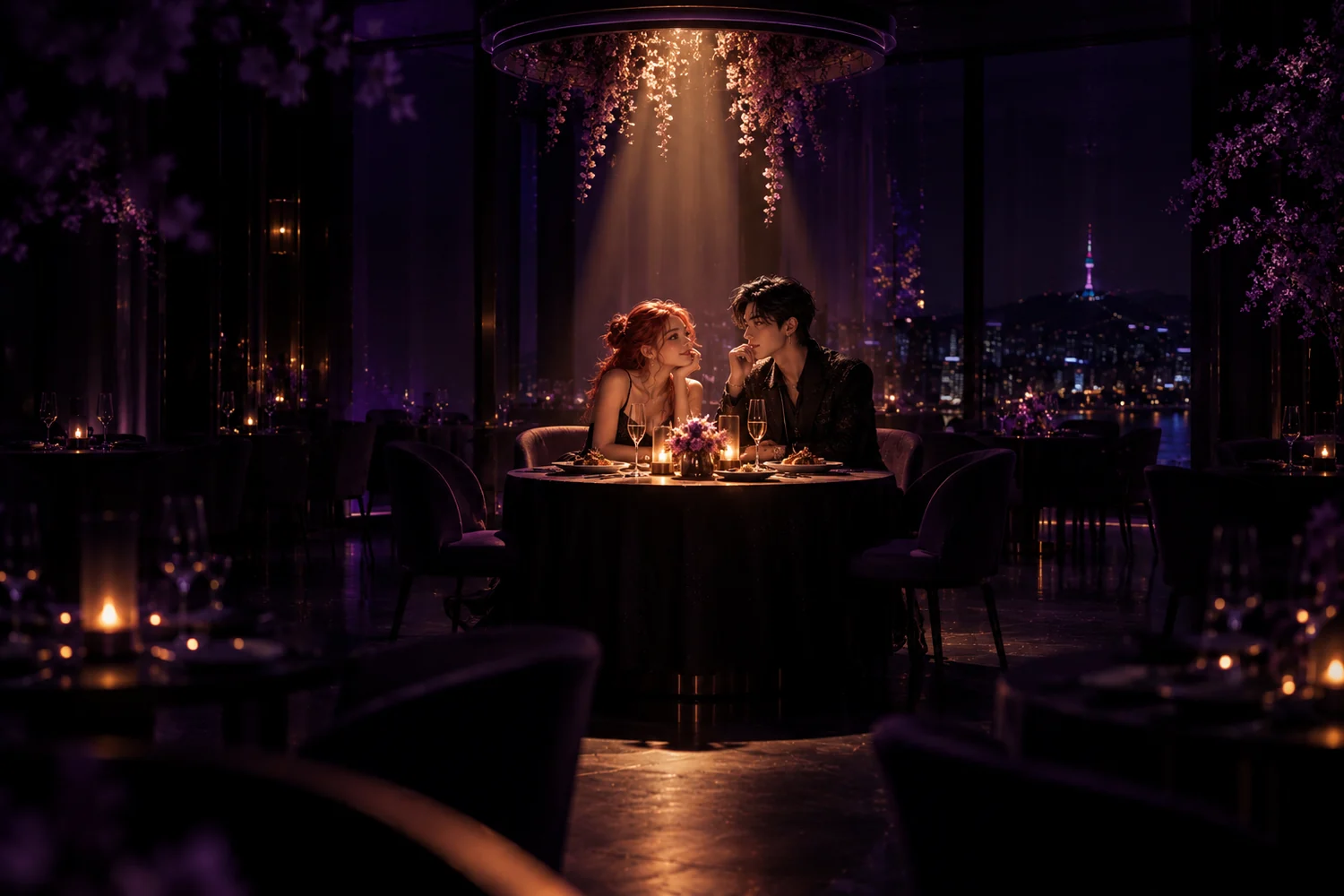
She described having a restaurant booked for a private meal and a screening room reserved so they could watch a movie without sharing the audience with strangers. At larger venues, a private room could provide separation without hiring the entire business. For smaller gatherings, she described places being taken over for exclusive use, sometimes after normal opening hours.
There is an obvious luxury to those arrangements, but her account also suggests something stranger than an expensive night out. Restaurants and cinemas are places most people experience alongside other people. Having one to yourselves changes the atmosphere before anything else happens. To imagine the contrast, think of a normally busy station with nobody in it: the place is familiar, but the absence of a crowd makes it feel strangely unreal. For the dates she described, the activity was still dinner or a film. The unusual part was who could be there.
In her account, the extra privacy was not an occasional romantic flourish. Being seen together was treated as a risk, so public dates were not a realistic option for their relationship. We do not know whether that expectation came directly from him, from management, or from how she understood the situation.
Private hangouts, not official events
The larger gatherings were described as social evenings rather than company functions being conducted in secret. Guests included other celebrities, people around them, friends, and partners or plus-ones. Some gatherings happened after hours; others used private areas within larger venues. There was no single setting or format.
The point, as the story was relayed to us, was to spend time together without having to worry constantly about recognition or unwanted attention. The expensive surroundings could make it feel exclusive, but the reason for gathering was much less exotic: people wanted to see friends and relax.
Her account describes invited social circles, not a formal organization or a single set of organizers. The gatherings were not presented as elaborate productions. They were private hangouts, with the surroundings and arrangements changing according to what people wanted to do.
Phones were there; photographing the gathering was not acceptable
She did not describe guests handing over their phones. Instead, she described an understanding that photographs, videos, and social posts from the gatherings were not acceptable. People could keep their phones without turning the evening into something for an outside audience.
As the account was relayed to us, discretion depended on the guests understanding why they were there. Photographing or posting the gathering would defeat its purpose. That does not establish a written rule or a particular penalty for breaking it, but it explains the expectation described: people wanted an evening away from public attention, and everyone present had a part in keeping it that way.
Being included privately, but not acknowledged publicly
The part she found difficult was not simply the inconvenience of arranging dates. She described struggling with being unable to have the relationship acknowledged publicly. She could be included in private social gatherings while still being absent from the version of his life visible to everyone else.
That distinction matters. Being known to someone's friends and being publicly recognized as their partner are not the same thing. For her, the unusual access and the secrecy were part of the same experience. The relationship could feel exciting because it was unlike anything ordinary, and tiring because ordinary ways of being together remained unavailable.
She was also a foreign woman entering gatherings she described as predominantly Korean, where many people already knew one another. She found that socially difficult at times. That feeling belongs in her account, but it does not tell us what the other guests thought or whether her nationality made the relationship riskier to acknowledge.
This is not evidence that celebrity relationships are inherently unhappy or that keeping one private makes it dishonest. It describes the tension in one account: the privacy that made spending time together possible also limited how the relationship could exist outside those rooms.
Part 3: What does the public evidence actually support?
There are two different questions here. Could someone arrange dates and gatherings in the ways she described? And did this particular relationship and its reported events happen? Public reporting and business information can help with the first. They do not settle the second. Nor does an example of another idol dating openly disprove her account; it challenges the idea that every idol faces the same restrictions.
Documented: Providers advertise private screenings and restaurant buyouts. Public reporting also records dated comments about dating restrictions and relationships acknowledged by agencies.
Reported in this account: Private restaurant and cinema dates, invited gatherings, no-photo expectations, and difficulty with not being publicly acknowledged as a partner.
Not independently verified: This relationship, the bookings and gatherings, management's involvement, or what would have happened had the couple been seen together.
Private screening rooms are a real commercial service
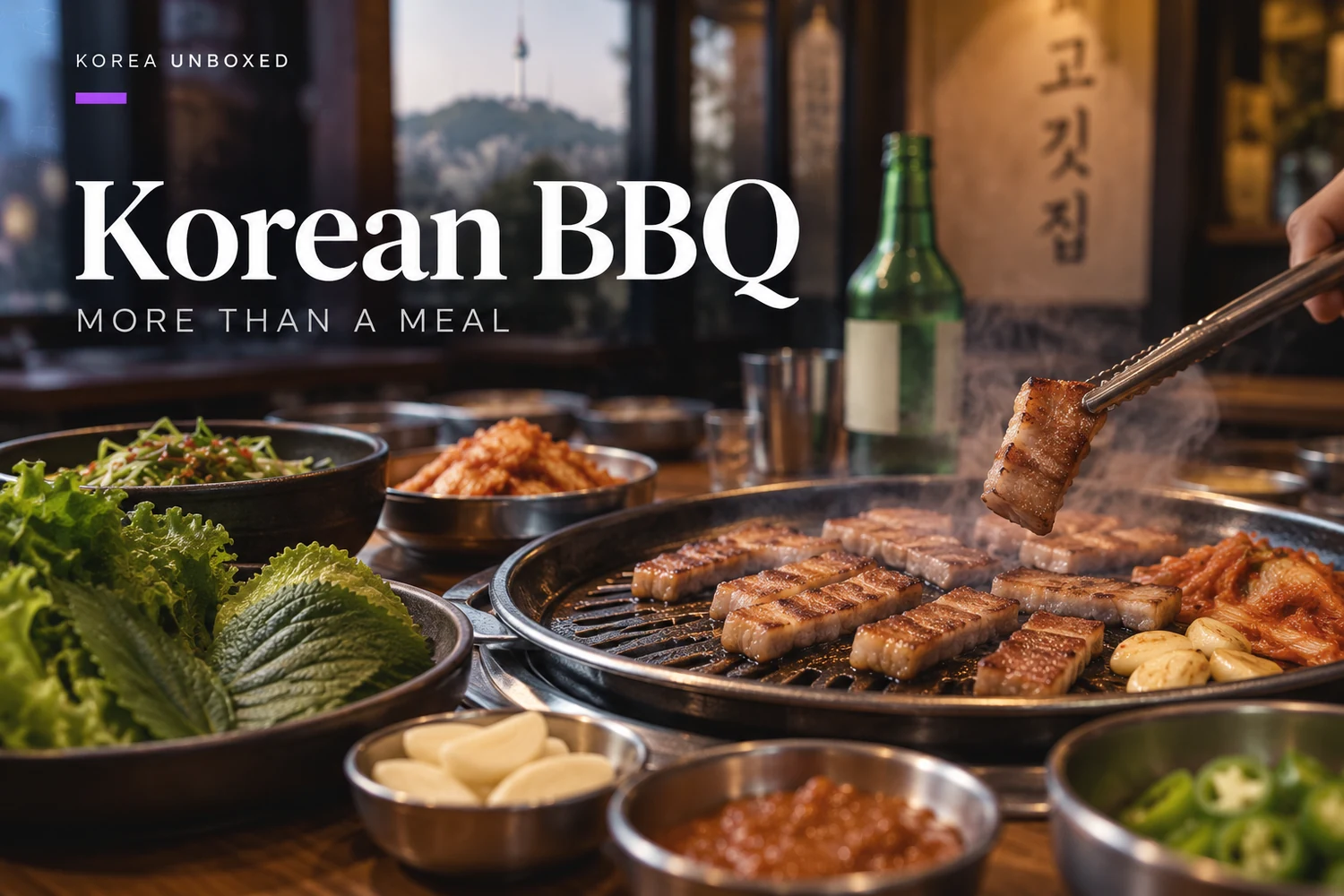
The cinema example has a straightforward counterpart. Megabox's official booking page offers The Boutique Private, including eight-seat and ten-seat screening rooms with exclusive lounge time. A private screening is a product someone can book, rather than an arrangement that requires an entertainment company to invent it. The service is listed on Megabox's own website.
This is not a newly imagined possibility. In 2022, Korea JoongAng Daily reported on private-screening options at Megabox, CGV, and Lotte Cinema. That article is useful as a historical record of the market, not a source for current prices or availability at every cinema it mentioned. Read its overview of private moviegoing.
These services make the screening-room detail plausible. They do not establish where she went, who made a reservation, or whether anyone in her account used those particular businesses.
Restaurants also sell exclusive use and private space
Four Seasons Hotel Seoul explicitly advertises restaurant buyouts, meaning exclusive use of a dining outlet, and presents privacy as one of their benefits. Fairmont Ambassador Seoul separately advertises private dining rooms at Gallery 7. Four Seasons' event-dining page and Fairmont's private-dining information establish that both forms of arrangement are commercially available.
These are examples of services, not venues identified in her story or recommendations for finding celebrities. The businesses' own descriptions do not tell us who their customers are or what proportion of bookings involve dates, famous people, or small private gatherings.
They do support a narrower observation: paying can change who shares a space with you. A private room separates a group from the main dining room; a buyout reserves the venue itself. Whether someone chooses that for romance, a family occasion, business, discretion, or several reasons at once is a separate question.
What these examples establish is a market for privacy outside the home. They do not show that Korea lacks private spaces, that paying is the only way to find them, or that most celebrities choose these arrangements. For someone who wants a restaurant or cinema experience without sharing the room, however, exclusive use is something businesses offer.
Entertainers have described looking for places away from public attention
In May 2021, The Korea Economic Daily reported on former Click-B member Kim Sang-hyuk discussing dating during an earlier era of idol life. He described older fellow idols using cars because they offered an enclosed space for two people to talk, and said he had heard about regular bars that served as private-feeling hangouts. He also recalled his own meetings in more ordinary outdoor places. Read the Korean report on his recollections.
His account is relevant because it describes the practical search for privacy. Its limits are relevant too: it looks back at an earlier period, and some of his comments about other people were things he had heard rather than witnessed. It does not establish a standard way of dating for today's idols.
There is also a useful counterpoint within it. Not every date he recalled involved a rented venue. Different circumstances could produce different arrangements. The friend's account may describe one person's unusually restricted situation without describing an entire profession.
Public acknowledgment and privacy can coexist
Taecyeon's November 2025 marriage announcement offers a different model from a relationship that cannot be acknowledged at all. His agency confirmed his plans while withholding details to protect his non-celebrity partner, and said he intended to continue his professional activities. That distinction appears in the agency's published statement.
It does not mean every artist has the same options or that public acknowledgment removes all pressure. It does show why we should not turn one person's account into a rule that famous idols can never recognize a partner publicly. A relationship can be acknowledged while much of it remains private.
The support reported alongside the criticism of Karina is another reason not to assume the worst reaction is inevitable. Her experience demonstrates that pressure can exist, not how every fan feels or what would have happened to the unnamed idol in this account.
What remains unverified
We cannot confirm the relationship itself, the individual bookings, who paid, how the gatherings were organized, or who knew about them. We also cannot confirm whether the expectation of secrecy was imposed by an agency, chosen by the idol, negotiated between the couple, or understood differently by each person.
The sources reviewed here do not establish a standardized network of agency-arranged private parties, a universal no-photography policy, or a guaranteed career penalty for being seen on a date. Those should not be added to the story simply because they would make it sound more complete.
The public material makes parts of the setting plausible. It does not authenticate the friend's account, and it does not give us a basis to rule it out. Readers can weigh the story against the evidence, provided the distinction remains clear: a setting that could exist is not confirmation of the events described within it.
A relationship is more than whether it is allowed
The detail that stays with us is the empty restaurant. Having a place to yourselves can sound like an extravagant romantic gesture. In this account, it was also a way to share a meal when an ordinary public date did not feel possible. That is what makes the luxury interesting: it offered an experience most people associate with privilege, while also revealing something the couple felt they could not do.
K-pop idols do have relationships, and some acknowledge them publicly. The dated examples in this article show why neither “idols cannot date” nor “famous idols can never admit to having a partner” is a useful blanket answer. What remains harder to see is how a private relationship works for the two people involved. In the account relayed to us, private rooms made time together possible but did not resolve the strain of remaining publicly unacknowledged. The public evidence helps explain how those arrangements could work. It cannot tell us whether every detail happened as remembered, or how another couple would experience the same circumstances.
Sources and further reading
Dating expectations, public relationships, and fandom
Xports News: Park Jin-young clarifies JYP's dating expectation. April 22, 2015; Korean. Contemporaneous reporting of a public statement, not evidence of current individual contracts.
Soompi: Jackson and Nayeon discuss JYP's three-year dating restriction. January 23, 2016; English. Reporting on a television conversation, including different descriptions of the expectation.
Sky News: Karina's apology after her relationship became public. March 7, 2024; English. Includes both critical and supportive fan reactions.
DearU: Bubble service description. Official provider information; English. Explains the messaging product, not the attitudes or intentions of every user.
The Korea Times: Why dating rumors still shake K-pop, even as it goes global. December 25, 2025; English. Reporting and analysis of paid fan interaction and privacy debates. Unconfirmed relationships discussed in that source are not treated as facts here.
Soompi: Taecyeon's November 2025 marriage announcement. November 1, 2025; English. Reproduces 51K's statement acknowledging the relationship while requesting privacy.
Private venues and entertainers' public recollections
Megabox: The Boutique Private booking information. Official operator information; Korean. Evidence that private screening rooms are commercially offered, not of any particular person's booking.
Korea JoongAng Daily: Korean theaters offer a new kind of moviegoing experience. March 14, 2022; English. Historical reporting on private cinemas; old prices and operating details have not been presented as current.
Four Seasons Hotel Seoul: Event dining and restaurant buyouts. Official operator information; English. Establishes an exclusive-use offering without identifying its customers.
Fairmont Ambassador Seoul: Private dining at Gallery 7. Official operator information; English. Establishes the availability of private dining rooms.
The Korea Economic Daily: Kim Sang-hyuk's recollections of earlier idol dating. May 26, 2021; Korean. Mixes his own experiences with observations and information about other entertainers; not a survey of current practice.
About the personal account
Part 2 is based on an account relayed to this publication through a friend, not a directly conducted interview. No public source listed above independently verifies that relationship or its specific events. Named public figures elsewhere in the article are separate examples, not clues to the identity of the unnamed person.