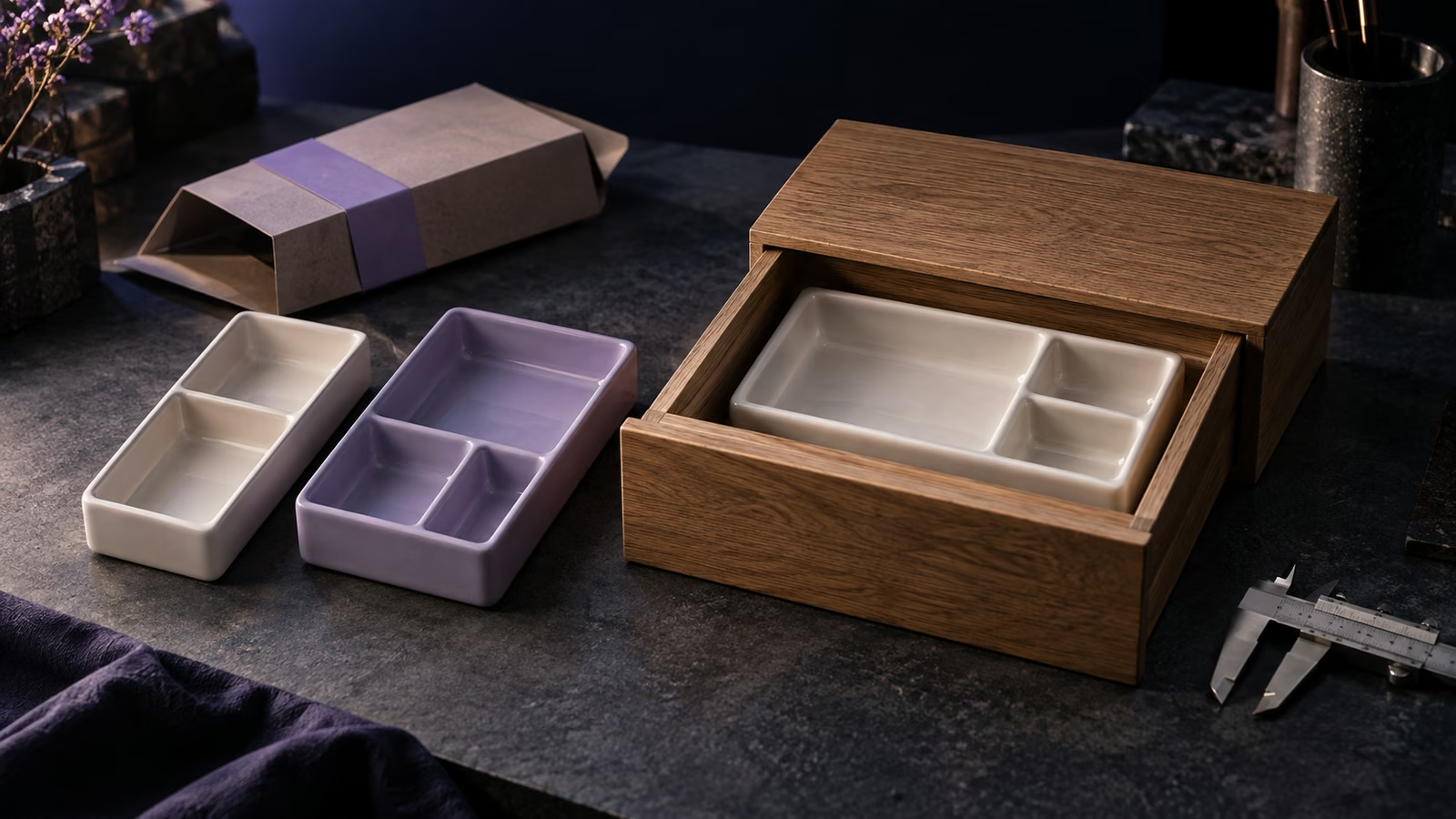
An overseas maker of modular storage trays starts receiving comments from Korean viewers. People ask about colours, dimensions and shipping. The founder begins looking at incorporation services and Seoul office space.
There is another useful expense to consider first: finding out what those people would actually use, what they would pay and how the product would reach them.
In this hypothetical example, interest has opened a promising line of enquiry. It has not yet established which customers the business should serve or whether a Korean company would help serve them. Our discussion of creators and entrepreneurs explores that move from audience response to responsibility for delivery.
Validation gives you a way to investigate the opportunity while the commitments are still manageable. It should change a decision: the customer, product, price, channel, operating model or whether to proceed.
Choose the uncertainty that could change your plan
“Will this work in Korea?” is too large a question for one test.
The tray maker might start with a narrower hypothesis: renters who have recently reorganised a small apartment struggle to find storage that fits their space and can move with them. That is a proposed customer group and problem, not a statement about Korean households generally.
The founder needs to learn whether the difficulty occurs, what people already use, what they spend and why an alternative would be worth choosing. The answer could change the tray dimensions before any marketing begins.
Official data can help describe the surrounding market. KOSIS provides Korean statistics on subjects including population, housing, income and consumption. Check the date, geography and definition of a table. A count of households may help size a possible segment; it cannot tell you how many want your tray.
Write the next decision beside the question. If product fit is uncertain, test a prototype. If the buyer is uncertain, conduct interviews. If acquiring a customer would probably cost more than the order contributes, investigate the channel and economics before taking a lease.
Research the alternatives customers already have
Begin with the words a potential buyer would use in Korean, including the problem and use case. A literal translation of your overseas category name may miss relevant alternatives. Ask a fluent researcher or prospective customer how they would search.
Look at Korean businesses, international brands already serving Korea and substitutes outside your expected category. For the tray maker, that could include inexpensive boxes, fitted furniture or simply reorganising existing storage.
Build a compact comparison of delivered price, dimensions, materials, availability, returns, customer complaints and the promise each seller makes. Record when you checked it. Separate list prices from temporary offers, and distinguish what a brand claims from what a customer reports.
Reviews can suggest problems to investigate. They do not form a representative customer survey. Look for recurring specifics, such as awkward cleaning or a size mismatch, then ask people about those experiences directly.
This attention to indirect alternatives is also part of the SBA's market-research guidance. An empty competitor list should prompt more investigation: perhaps you searched the wrong term, missed a substitute or found a problem people do not consider worth paying to solve.
Ask about the last time the problem happened
Recruit people who plausibly face the problem, including some outside your followers and personal network. An existing audience is useful access, but it may overrepresent people who like your work.
For the storage example, ask someone to describe their last reorganisation. What triggered it? What did they buy? Where did they look? What did it cost? What disappointed them? If appropriate and with permission, ask them to show the current setup.
“Would you buy an attractive modular tray?” encourages an easy answer. A discussion of an actual purchase reveals constraints you can work with. The UK Government's interview guidance recommends open questions and real examples, with participants who are current or likely users.
If you are researching a business customer, identify the user, budget holder and approver. Enthusiasm from someone without purchasing authority can be useful product feedback while leaving the commercial question unresolved.
Capture contradictions. One person may dislike their storage but care too little to replace it. Another may have bought an expensive solution already. Those differences help refine the segment. Do not smooth them into a single story of demand.
Design a test with an interpretable result
A Korean-language landing page can test whether people understand an offer and want a next step. A content or advertising test can help compare messages. A creator collaboration can introduce the product to a relevant audience. Choose the method according to the question and the audience you can actually reach.
Keep the offer truthful. If the product is a prototype or unavailable for purchase, say so and offer an appropriate research or notification action. Avoid presenting a functioning shop when you cannot fulfil an order.
Decide in advance what each action will establish:
- Someone clicks a product explanation. Useful evidence: The presentation attracted their attention. Still unresolved: Whether they understood the offer or would pay.
- A qualified prospect joins a waitlist after seeing price. Useful evidence: Interest at the stated terms. Still unresolved: Whether they will complete a purchase.
- A buyer requests a scoped proposal. Useful evidence: A relevant commercial conversation may be possible. Still unresolved: Budget, approval and final agreement.
- A customer completes a lawful paid pilot. Useful evidence: Commitment to that offer under those conditions. Still unresolved: Sustainable acquisition, delivery and wider demand.
Track who responded, where they came from and what they saw. Ten enquiries from your closest supporters mean something different from ten enquiries from unfamiliar customers who found a clear offer at full price.
If you compare messages, keep the audience, offer and test conditions as similar as practical. Otherwise you may be comparing different traffic rather than different explanations. A weak result also deserves diagnosis: the problem could be relevance, price, confusing information or a broken action button.
Our guide to how Korean consumers discover businesses online helps frame the channel investigation. No single test on one platform represents the whole market.
Put a realistic price in front of people
Return to the tray maker. A photograph may attract people who would never buy the product at its delivered price. Introduce that price while there is still time to change the design or supply model.
Show what the amount includes, the expected delivery timing and the relevant service or return terms. For a business service, specify scope, implementation and ongoing costs. An appealing headline price with the expensive parts missing produces misleading feedback.
A stated willingness to pay remains a statement. Where legally possible, a clearly defined paid pilot can provide stronger evidence about a particular offer. If you cannot yet transact, record that limitation and use a price-visible enquiry or proposal discussion instead.
Then work backwards through the economics. Allow for the product or service itself, acquisition, fulfilment, payment charges, support, returns and applicable tax. A test that attracts buyers only at a price the business cannot support has identified a problem to solve.
Check the legal boundary before a pilot
“Testing” is not a general exemption from business requirements. Research conversations, advertising, collecting contact details, taking deposits and supplying a regulated service can raise different obligations.
Before accepting money or providing the proposed activity, confirm the appropriate seller, tax registration, licences, product requirements and the founder's permission to undertake the work. NTS registration guidance ties registration to business operations. Calling transactions a pilot does not settle their treatment.
Online selling can also bring reporting and consumer-information duties. Korea's electronic-commerce consumer-protection law addresses seller reporting, with exceptions, and information about price, supply and returns. A preorder deserves this assessment before collection begins.
For interviews and waitlists, collect only information you need and arrange the appropriate notices and permissions. Data minimisation is required by Article 16 of the Personal Information Protection Act. A free test can still involve personal data or regulated activity.
These legal boundaries were checked on 22 September 2026. The requirements for a particular test need assessment against its actual activity and participants.
Test what happens after someone says yes
The tray maker can investigate sample dimensions, packaging and delivery damage, and ask a potential fulfilment partner about storage and returns. A Korean-speaking customer should be able to understand the product information and get help with a problem.
A suitable local partner might support a compliant initial pilot. Agree who contracts with the buyer, imports or supplies the product, takes payment, handles complaints and retains the relevant records. A partner's involvement does not automatically resolve every responsibility.
Test those handoffs as carefully as the product. For a software company, the equivalent might be onboarding, billing and support. For a service business, it might be scheduling, staffing and cancellations. Record the actual time and cost, including the founder's manual work.
The banking guide and tax orientation explain obligations that become part of this operating model.
Let the evidence specify the structure
At the end of a research round, write down what changed and what remains uncertain. Name the customer, tested offer, credible price, route to buyers and delivery requirements. Keep evidence from actual commitments separate from assumptions in the forecast.
The findings might justify a Korean company because the business needs local stock, employees, contracts or direct control. They might support an initial distributor relationship, a revised product or another research round. Our business-establishment guide helps connect those requirements to the setup process; the sole proprietor versus corporation comparison examines the choice of structure.
The next commitment should answer to what you have learned. If a narrower tray fits the customer better, change the tray. If the economics depend on an unrealistic delivery cost, revise the model. If the evidence supports a local operation, incorporation now has a defined job to do.
Cover: Test the product’s fit, price and delivery before committing to a larger operation. Cover illustration created with AI for PIN Insights.