
Hero: AI-generated illustration of a fictional creator.
A fictional creator named Daniel makes short videos about working comfortably in a small apartment. He has an idea for a Reel showing how to stop a charging cable from slipping behind a desk. He can explain the solution, but he is unsure how to begin.
One opening names the problem: “The charging cable keeps falling behind this desk.” The other shows the result first: “This clip keeps the charging cable within reach.” Both can lead into the same useful explanation. Daniel wants to learn which kind of opening helps people stay for that explanation before he makes a whole series.
A small test gives him a specific decision to make. It can show which approach deserves another attempt and what viewers still find confusing. It cannot promise that a winning post will keep winning when the audience, subject or timing changes.
One question keeps the test manageable
Daniel writes down his question before editing: “Does showing the result first help viewers stay longer than opening with the problem?” The opening few seconds are often called the hook. Its job here is to tell viewers why the rest of the video may be useful.
He keeps the intended viewer and lesson steady: people with a small desk who want their charging cable to stay within reach. The explanation shows where the clip goes, how the cable moves and a limitation if the clip does not fit a thicker cable. Neither opening promises a benefit the finished video cannot demonstrate.
This focus also tells him what to postpone. A different topic, a new music style and a much faster edit might each be worth exploring later. Changing them together would leave him unsure which change helped.
Two openings need comparable videos
Daniel makes two short, original demonstrations with the same structure and similar duration. In one, the cable falls before he introduces the clip. In the other, he shows the cable held in place and then explains the setup. Both move promptly into the demonstration.
He keeps the filming conditions, caption style, explanation and closing invitation as similar as practical. The intended difference is the opening approach. Because these are separate posts with different footage and distribution, the comparison will still have limits.
A quick check before posting helps him avoid testing a basic production error. He watches each version on a phone, with and without sound. The text must be readable, the opening must match the explanation, and the useful action must be visible. An unreadable caption could make an otherwise effective opening look weak.
There is no need to upload near-identical copies repeatedly. A more useful continuing test applies the two opening approaches to a few comparable, original episodes. Daniel can learn whether a result-first opening keeps helping across the series, rather than chasing a single unusual result.
Trial Reels are an option when the account has access
Instagram’s Trial Reels can introduce a video to people who do not follow the creator before it is shared more broadly. Meta’s Trial Reels explanation describes a Trial switch before posting, initial engagement information after roughly 24 hours, and an option to share the Reel with everyone later. Some followers can still encounter a trial through sharing or other surfaces.
Daniel checks the options actually available in his account. He also checks whether automatic sharing is enabled. If one Reel is shared with followers while the other stays in trial distribution, he notes that change rather than treating their later totals as a like-for-like comparison.
Trial Reels do not create a randomized experiment in which two identical audience groups receive different openings. Different viewers may see each post, and Instagram may distribute them differently. The results remain useful clues.
If the Trial option is missing, Daniel can use ordinary Reels. He posts comparable episodes through his normal schedule and records that they were ordinary posts. He does not compare an ordinary Reel’s totals directly with a trial and attribute the difference to the opening.
A step-by-step Trial Reels walkthrough
This illustrated guide summarizes the workflow. Use the controls shown in your own account; availability and labels can vary.
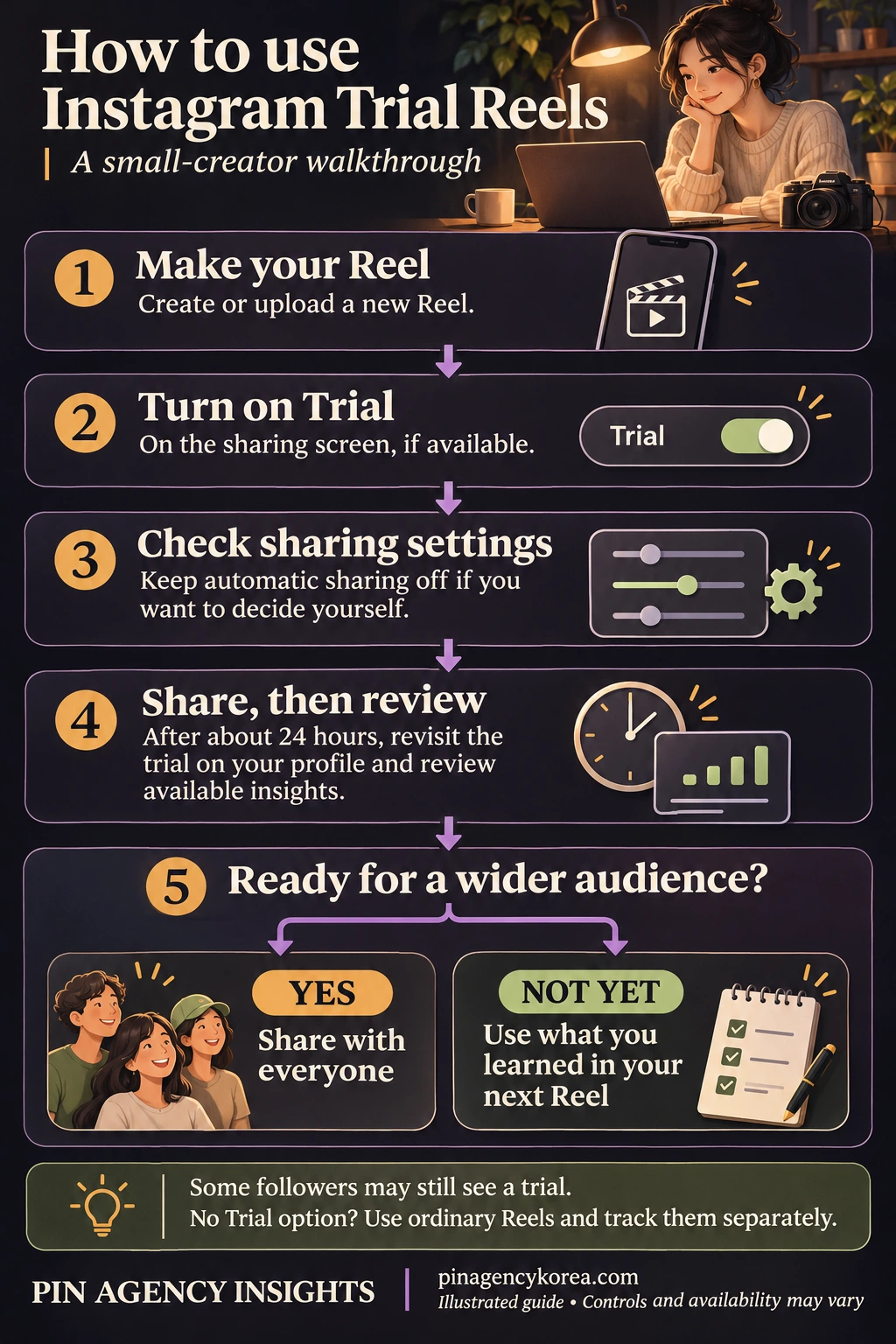
- Make your Reel. Create or upload a new Reel.
- Turn on Trial. Before sharing, enable Trial if the option appears.
- Check automatic sharing. Keep it off if you want to make the wider-sharing decision yourself.
- Share, then review. After about 24 hours, revisit the trial on your profile and review the available insights.
- Choose your next step. If you want a wider audience, share the trial with everyone. Otherwise, use what you learned to plan your next Reel.
Some followers may still encounter a trial through sharing or other surfaces. If Trial is unavailable, use ordinary Reels and record them separately. The Meta workflow explanation supports these steps; check Instagram’s current Help guidance and your account settings for current eligibility and controls.
The measure follows the question
Because Daniel wants people to stay for the explanation, he chooses watch time as his main measure where his account provides it. Meta’s explanation of Reels insights describes total watch time, including replays, and average watch time. The two videos need similar lengths for their average watch times to be a useful first comparison. Average watch time alone does not show that viewers reached a particular explanation, especially when replays contribute to viewing.
He also records shares, saves and comments if those figures are available. They answer different questions. Someone may watch a clear demonstration without saving it; someone else may save an idea to try later. These actions add context but do not prove a purchase, a completed task or a satisfied customer.
If the selected measure is unavailable, Daniel changes his plan before declaring a winner. For example, if his real question is whether people find the tip worth passing on, he can compare shares against the same reported exposure measure for both posts. He records the exact labels shown in the app rather than treating views and accounts reached as interchangeable.
A short results log makes the comparison honest
Daniel checks each Reel at the same age, first after about one day and again after three days. These are his chosen review points, not a rule that a Reel stops circulating after 72 hours. Recording elapsed time prevents a three-day-old post from being compared casually with one posted that morning.
His log contains the post link, opening, duration, posting time, distribution type and the figures available at each check. He adds any event that could affect the result, such as a large account sharing the post or a change to its distribution. A missing figure stays blank.
The following figures are invented to show how Daniel might read a result. They are not an account report, a platform benchmark or a test performed by PIN.
| Three-day check | Problem first | Result first |
|---|---|---|
| Video length | 24 seconds | 24 seconds |
| Accounts reached | 400 | 600 |
| Average watch time | 9 seconds | 13 seconds |
| Shares | 4 | 9 |
| Saves | 9 | 18 |
The result-first video has longer average watch time in this example. That makes its opening worth trying again. Its larger share count also needs context because more accounts saw it. Four shares across 400 accounts reached is 10 share actions per 1,000 accounts reached. Nine across 600 is 15 per 1,000. These are rates of recorded actions, not percentages of unique people who shared.
The difference still comes from only four and nine shares. It would be easy to overstate a few actions as a dependable pattern. Daniel records “promising result-first opening” rather than announcing that he has found the best hook.
The next post checks the explanation as well as the opening
Daniel reads the comments for a reason someone might stay or leave. Suppose two viewers ask whether the clip fits their cable. That question points to missing information he can show in the next demonstration. It does not establish what all viewers wanted.
For the next comparable episode, he keeps the result-first opening and shows the cable’s thickness clearly. He records that the explanation has changed too. This second post helps improve the series, but its result cannot be credited only to the hook.
If Daniel wants a cleaner comparison of opening styles, he can instead keep the lesson structure steady across several comparable episodes, alternate the two approaches and look for a repeated direction. He will still have changing subjects, audiences and timing. The purpose is to make a better editorial choice with limited time, not to claim scientific proof from a handful of posts.
A weak or mixed result also gives him a sensible next step. If both openings attract little viewing, the next question may concern the subject or clarity of the demonstration. If one post receives far more exposure for an unexplained reason, he can mark the comparison inconclusive and try the approach again rather than force a winner.
The useful outcome is the next decision
At the end of the first comparison, Daniel has a working choice: try the result-first opening again, keep showing the actual solution and answer the cable-size question. He also has a record of what supports that choice and what remains uncertain.
That is a manageable result for a small creator. One question, a comparable set of posts and a simple log can turn “this Reel did better” into an explanation of what to try next.
Sources and further reading
- Meta — Test Content With Non-Followers Using Trial Reels, published December 10, 2024 and updated June 26, 2025. Checked November 5, 2026. Describes the trial workflow and initial reporting; account controls and availability should be checked in the app.
- Meta — New Features on Instagram Reels: Trends, Editing and Gifts, published April 14, 2023 and updated October 19, 2023. Checked November 5, 2026. Explains total and average watch time.
- Related PIN reading: Find Your Next Video in the Questions People Search For helps a creator choose a question worth answering before planning a test.
Prepared with AI assistance. Daniel, his videos and the example figures are fictional.
