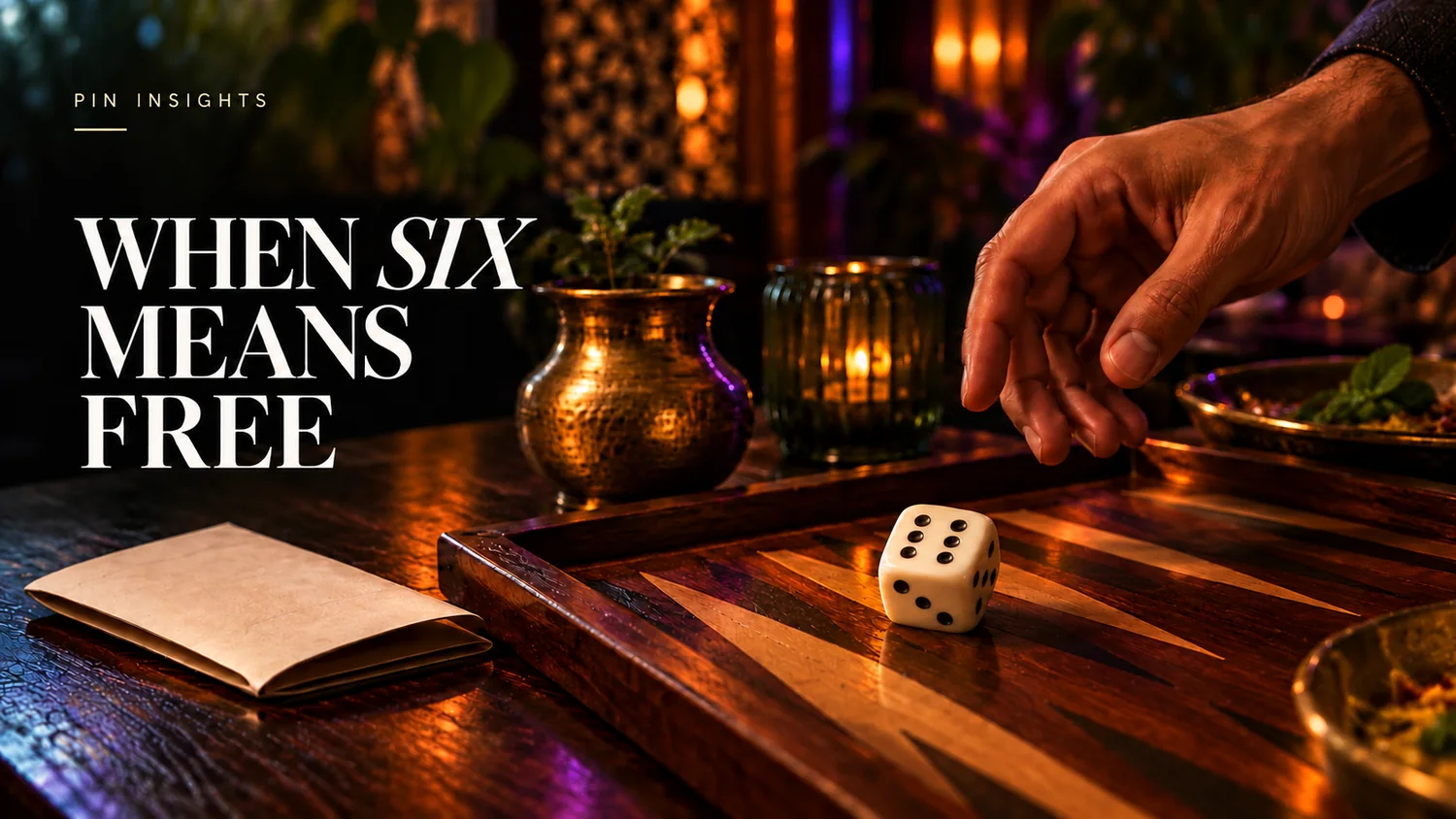
Matka is the dice promotion at Dishoom and its sister business, Permit Room. It takes its name from an Indian lottery; the word means “pot” in Hindi. An eligible table presents a Matka token and rolls a die. A six means the restaurant covers the whole bill.
The UK restaurant businesses have made a price offer into a short event at the table. The guests have one result to watch together. The bill becomes part of the story of the meal.
That gives Matka two possible roles: a reason to choose a visit and a shared moment at its end. The case offers a useful way to think about sales and customer experience, even without a published sales figure.
A clear offer gives the game its shape
Permit Room’s Matka terms set out the basic rules: a token, weekdays before 6 p.m. and a table of up to 12 guests. A roll of six covers the whole bill. Guests can ask for a token on arrival, and the page says it can be used at Permit Room and Dishoom cafés.
The time limit matters to the offer. A guest who knows about it before choosing a restaurant may decide that an earlier meal is worth trying. At the table, the roll adds a short pause as the group waits for the same result.
The meal and service still carry the experience. A table that does not roll a six pays its bill, so the game needs to feel like an optional extra to a meal worth buying. Clear terms help keep the result from becoming an unpleasant surprise.
A chance of a free bill feels different from a small discount
The numbers are simple in a hypothetical example. Suppose every eligible bill is £60 and the die is fair. Each roll has a one-in-six chance of winning.
Across many rolls, the average bill value covered would be £60 ÷ 6 = £10 per roll. This average is called the expected value. It does not mean every sixth table must win.
A fixed £10 discount would also take £10 off each bill. It gives every table a small saving. The dice offer gives a few tables a much larger saving and leaves the rest paying the full amount. The average saving is the same in this example, but the experience is different.
The £10 average is not a spending cap. Three tables might each roll a six on £60 bills. The restaurant would then cover £180 across those three rolls. Across many sets of three eligible rolls, the average would be £30. A business needs a budget that can handle a run of wins.
The £10 is the value taken off the bill, not the restaurant’s cost or profit. Food and staff still cost money. The mix of bills and the number of people who would have visited anyway also affect the result.
Waiting for the result can be part of the appeal
Research gives one reason to consider that brief wait. Researchers Luxi Shen, Ayelet Fishbach and Christopher Hsee studied how hard people worked for uncertain rewards. A University of Chicago summary describes experiments in which people put in more effort when they focused on finding out what they would receive.
Those were tasks and auctions, rather than a test of Dishoom’s sales. In Matka, the shared wait offers a possible explanation for the game’s appeal: the group takes part in a small event instead of only seeing a lower number on a bill.
That event may become something a guest tells a friend about. Whether it leads to another visit or a new booking is a separate question for the business to measure.
A café can give an offer its own small moment
A fictional neighborhood café wants more sandwich orders between 2 and 4 p.m. For a one-week trial, it plans to include one free hot Americano with each sandwich bought for dine-in during that window.
The café uses a fixed benefit. Its owner borrows Matka’s broader pattern: a simple offer, a clear time to use it and a pleasant moment when staff deliver it. A business considering a chance-based version would also need to check the local rules before launching it.
A customer choosing a late lunch sees a sign by the entrance. It shows the sandwich price, the included coffee and the hours. The customer can see the cost of the meal before ordering. If that meal suits their plans, the coffee may give them an extra reason to choose the café.
At the counter, a staff member confirms that the coffee is included. When the order is ready, the drink arrives with the sandwich. The benefit advertised at the door is the benefit the customer receives.
In this example, the offer ends as promised. The customer receives a useful extra without having to ask for a hidden deal or discover a new condition at payment. It also gives them a simple story to pass on: an afternoon sandwich came with a coffee.
The owner needs an offer the café can afford
The café’s trial has a short operating plan:
- Purpose: more sandwich orders during the quieter afternoon window.
- Benefit: one free hot Americano with each eligible dine-in sandwich.
- Staff rule: explain the offer before payment and apply the same order-time cutoff.
- Review: count sandwich orders, coffees provided, ingredient costs and any added staff work.
The owner also needs to allow for customers who would have bought both items at full price. Giving those customers free coffee reduces what they pay. Extra orders have to be worth the cost of the offer.
A comparison with similar afternoons can help the owner decide whether to continue. Changes in weather, prices or advertising still need to be considered. A busy week alone will not show which change caused the extra orders.
Matka makes a familiar business choice easy to see. A promotion can affect when a customer buys and give the purchase a moment worth remembering. A useful version pairs that moment with clear terms, good service and costs the business can sustain.
Sources and image note
Source checks: October 28, 2026. Company terms can change. The sales and customer-experience paths above are analysis; the café and £60 calculation are hypothetical.
- Permit Room: Matka participation conditions.
- Dishoom: café FAQs.
- University of Chicago Booth: summary of Shen, Fishbach and Hsee’s reward research, October 13, 2014; research published in 2015.
Researched and drafted with AI assistance under PIN-AGENCY KOREA’s editorial direction. Images are AI-generated conceptual illustrations, not photographs of Dishoom, its equipment or customers.

