Imagine leaving a late dinner in Seoul. The subway has stopped, the taxi estimate is higher than you expected, and the first driver you approach does not want the trip. Then a stranger offers to drive you for cash. Three different problems have arrived at once: price, availability and trust.
They often get bundled together as “Korea’s taxi problem.” But understanding why the experience can feel frustrating requires looking beyond the meter. Higher fares have changed passenger behavior, taxi companies are struggling to retain drivers, and competing apps cannot simply recruit anyone with a car.
For the fare bands, booking steps and payment basics, use our practical guide to taking taxis in Seoul. This article looks at the pressures behind the ride, why Uber works differently here, and where a confusing journey becomes a genuine concern.
Passengers want a calmer, more courteous ride
The Seoul Institute’s September 2026 report draws on surveys conducted in October and November 2023, after Seoul’s fare increase. It includes a satisfaction survey of 4,000 taxi users and a separate perception survey of 1,038 Seoul residents.
In the resident survey, reckless driving topped the list of disliked driver behavior at 20.8%, followed by passenger refusal at 19.1%, rudeness at 16.8%, unpleasant odors at 13.5%, and unnecessary conversation at 12.7%. Respondents were ranking their frustrations, not counting how often each occurred. Survey findings
The taxi-user survey’s overall satisfaction score rose by 0.6 points to 82.8. In the separate resident survey, only 8.5% felt service had improved after the fare rise. A ride can be satisfactory without feeling noticeably better value for money. Seoul Institute report
Shorter waits can hide a less comfortable trade-off
The report found that average app waits fell from 8.02 minutes in 2022 to 5.04 minutes in 2023. Meanwhile, 55.1% of respondents to the resident survey reduced their taxi use, and 44.5% adjusted their journey-home time.
More drivers and fewer requests can both shorten a wait. Faster pickups alone do not show whether passengers can comfortably afford the journey.
Seoul’s regular-taxi fare schedule took effect in February 2023. Its higher prices still shape the journey home: leaving earlier, staying until morning, sharing a ride, or choosing a night bus. Current Seoul fare schedule
A taxi license is not a driver on the road
Seoul had 20,501 corporate taxi drivers in January 2026, compared with 30,527 in 2019. The workforce has recovered slightly from 20,358 in 2024, but remains about one-third smaller than before the pandemic. Seoul’s driver statistics
In its 2025 driver-support announcement, the city identified pay relative to working conditions and high turnover as recruitment problems. Seoul’s recruitment measures
A fare increase does not automatically persuade former drivers to return or make a long shift attractive. It also does not guarantee that a vehicle with a license will be operating when you need it.
In January 2026, Seoul had 71,615 taxi licenses and 64,933 registered vehicles, but only 46,021 taxis operated on an average day. A license represents permission to operate, not a car available for your journey. Seoul taxi statistics
For passengers, availability comes down to a driver being nearby, at the right hour, and willing to take the trip.
Why Uber works differently in Korea
Visitors sometimes ask why Korea cannot simply bring in Uber. Uber Taxi is already here. The difference is that it connects passengers with taxis, rather than offering the unrestricted private-car model familiar in many other countries.
Korea’s Passenger Transport Service Act generally prohibits carrying passengers for payment in ordinary private cars, including arranging those rides. There are narrow exceptions, such as certain weekday commuting carpools, but they do not create an all-day marketplace in which anyone can start accepting fares. Licensed platform-transport businesses are possible, with permission and other requirements. Passenger Transport Service Act, Articles 81 and 49-3 onward
This is a dispute over the business model, not simply the nationality of the company. Taxi-industry opposition has centered on livelihoods and whether new competitors should face comparable obligations. Korean startups have encountered the same conflict. The OECD’s account describes how these pressures shaped Korea’s regulatory response. OECD case study
Tada illustrates why the history matters. Its original rental-van service was curtailed after a 2020 law change. In 2023, the Supreme Court upheld acquittals over its earlier operations, but that ruling did not restore the old model under the amended rules. Yonhap’s court report
There is also the challenge of competing with an established booking network. A new app needs both drivers and passengers. More app choices can improve payment, language support and booking, but when they largely draw from licensed taxis, they do not automatically add a new pool of private-car drivers on a busy night.

Expensive, confusing, or actually wrong?
The distinction matters because genuine misconduct and legitimate extra charges require different responses. A meter rising in slow traffic can be normal time charging. A nighttime ride costs more under published tariff bands. Airport road tolls can be separate from the meter.
An app can also make a ride more expensive without the driver cheating. For example, k.ride’s paid-service terms list a 10% service fee and service-dependent dispatch or other charges. Its displayed fare is generally an estimate; some reserved products use different arrangements. The useful comparison is the selected service and fee breakdown, not just the app’s name.
Airport journeys offer another example. Incheon Airport and Seoul are part of a joint taxi operating area, so crossing the city boundary on that route does not automatically justify an out-of-area surcharge. That exemption does not make the journey toll-free. Incheon Airport taxi guidance
For an ordinary metered taxi, an unexplained demand to abandon the meter and pay a large cash fare deserves scrutiny. Authorized airport fixed-price, charter and premium services can have different pricing. Our taxi fares and apps guide explains those distinctions before you book.
Do not accept unsolicited rides from strangers
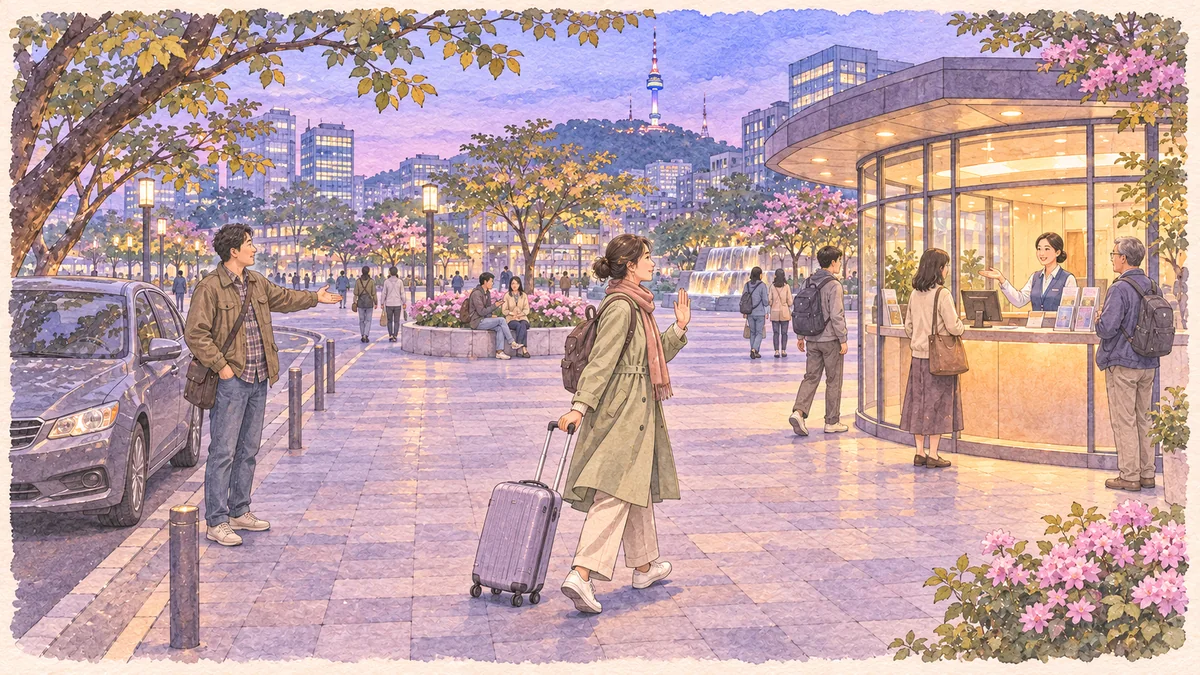
A stranger approaching you aggressively with an offer to drive you is a different situation from choosing a taxi or meeting a driver you booked. Decline the ride. Do not follow the person to a parking area or hand over your luggage. Use a designated taxi stand, an established booking app, or transport arranged by your hotel.
Incheon Airport explicitly warns about illegal solicitation and call vans posing as taxis. With an unverified operator, the fare can be unclear and tracing the journey afterward can be harder.
A missing taxi roof sign alone does not prove a vehicle is illegal. Some legitimate premium services use unmarked cars, and authorized call-van services also exist. What matters is whether you arranged the service independently and can match the driver and vehicle to that booking, rather than relying on a stranger’s assurances.
If someone keeps following you, move toward airport staff or a busy, staffed business. If they threaten you, block your way or prevent you from leaving, call 112 for police assistance.
Why reporting can be difficult, and what helps
Seoul identified 345 violations through 7,435 foreign-passenger interviews in its 2024 enforcement work, including overcharging, unmetered fares and operating-area violations. These were targeted inspections rather than a representative survey of tourist journeys. Seoul enforcement report
Enforcement has also faced criticism. In a November 9, 2026 response, Seoul addressed media reports that only about 3% of more than 6,000 foreign-passenger overcharging complaints had led to administrative action. The city said investigators must compare passenger accounts with routes, meter information, payment records and driver statements. It cited missing evidence and language barriers among the obstacles.
Seoul reported administrative action in 204 of the 583 cases referred to an external review committee over six years. That 35% figure covers the smaller group reaching committee review, while the roughly 3% figure covers all complaints. A complaint records an allegation; an administrative penalty follows a finding. Neither percentage alone shows how many passengers were overcharged. The criticism and Seoul’s response
Before leaving the taxi, keep the receipt and full vehicle plate. Save the app record, trip time, pickup, destination, amount and any relevant screenshots. Write a short account while you remember the details. Specific records give an investigator something to compare.
For Seoul complaints, use the official multilingual online form or email taxi120@seoul.go.kr. These are useful with a data-only travel SIM. The city lists telephone English assistance through 02-120, then 9, then 1, from 9 a.m. to 6 p.m. Korea time. Seoul reporting instructions
What a better taxi experience would require
Passengers should not have to choose between an affordable journey, a driver willing to take it, and a ride that feels comfortable. Improving that experience involves several separate jobs: retaining drivers, making charges understandable, discouraging selective refusals, and investigating misconduct with usable evidence.
For visitors, knowing the system helps you separate a costly but legitimate trip from an offer worth declining. For Seoul, the bigger test is whether the service feels dependable at the moment people need it, not simply whether an average score rises.
Planning your next ride? Start with our Seoul taxi guide, or compare airport transport in the Incheon Airport to Seoul planner.
The key takeaways
- Higher fares have not solved every problem. Driver retention, affordability and passenger trust need different solutions.
- Uber Taxi already operates in Korea. It uses licensed taxis rather than an unrestricted pool of private cars.
- Choose a verified ride. Decline unsolicited offers and match an app-booked vehicle to its booking.
- Keep the trip record. The full plate, receipt and route details make a disputed fare easier to investigate.
Sources and further reading
Seoul Institute taxi-service research; Seoul corporate-driver support and workforce figures; Seoul taxi statistics; official fare schedule.
Passenger Transport Service Act; OECD regulatory case study; Uber Taxi Korea; k.ride paid-service terms.
Incheon Airport taxi guidance; Seoul passenger and complaint guidance; Korea Tourism Organization complaint center.