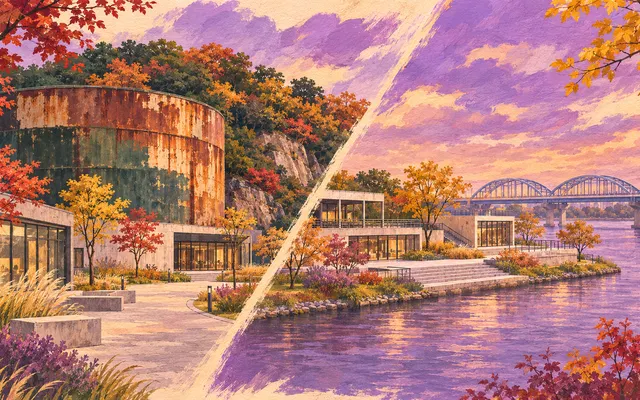
Sandbox in Start-Up is a fictional accelerator, but you can visit two real Seoul locations used to bring it to life. Go to Oil Tank Culture Park in Mapo for the building associated with Sandbox. Go to Nodeul Island for the Han River setting shown in Episode 1. They’re in different parts of the city, and neither works as a walk-in tour of the drama’s offices.
If you only have time for one, choose the oil tank park to see the architecture or Nodeul Island for a riverside walk. Here’s what you can actually visit and what to put into your map app.
Oil Tank Culture Park
What you’ll recognize: The industrial architecture associated with Sandbox.
What you can visit: Outdoor grounds and public paths; no routine access inside the tanks.
Nodeul Island
What you’ll recognize: The Han River setting from Episode 1.
What you can visit: The cultural complex and waterfront, subject to venue hours and temporary closures.
Oil Tank Culture Park: The Sandbox building
Visit Seoul’s filming guide identifies Oil Tank Culture Park as the site used for the Sandbox building.

How a fuel reserve became a park
After the 1973 oil crisis, Seoul built five tanks at the foot of Maebongsan between 1976 and 1978 to keep a reserve of petroleum. Together they could hold about 69 million liters. The depot was a restricted facility, and it closed in 2000 as the city prepared for the 2002 World Cup at the stadium next door.
In 2017 the site reopened to the public. The former parking area became the Culture Yard, and the city reused steel from dismantled tanks to clad a new community building, T6. From the yard, look for the contrast between the round tank walls and the open space in front of them. The park kept the scale of the depot even as it changed what people could do there.
On a regular visit, start in the open Culture Yard (T0) and look toward the tanks and the hillside. The yard gives you room to see how the structures sit in the landscape. Then follow the open public paths for a closer look. The filming guide identifies the site, but it doesn’t establish which tank appears in every shot or where each office scene was filmed.
Getting to Oil Tank Culture Park
Korean name: 문화비축기지
Address: 87 Jeungsan-ro, Mapo-gu, Seoul
서울 마포구 증산로 87
Subway: Line 6 to World Cup Stadium Station (월드컵경기장역). Use Exit 2 or 3 and allow about 10 minutes on foot, following the signs toward the stadium’s west gate and the park.
Find the park on Naver Map · Find the park on Google Maps · Seoul’s official park map
Access: Seoul Parks lists the outdoor park as open around the clock. The T1–T6 tank interiors have not been open for routine viewing since April 2025. If you’re considering a ticketed exhibition or performance, check the event listing for its specific venue and admission rules. Outdoor access doesn’t mean you can walk into a tank or onto a closed stage.
Nodeul Island: The Han River setting
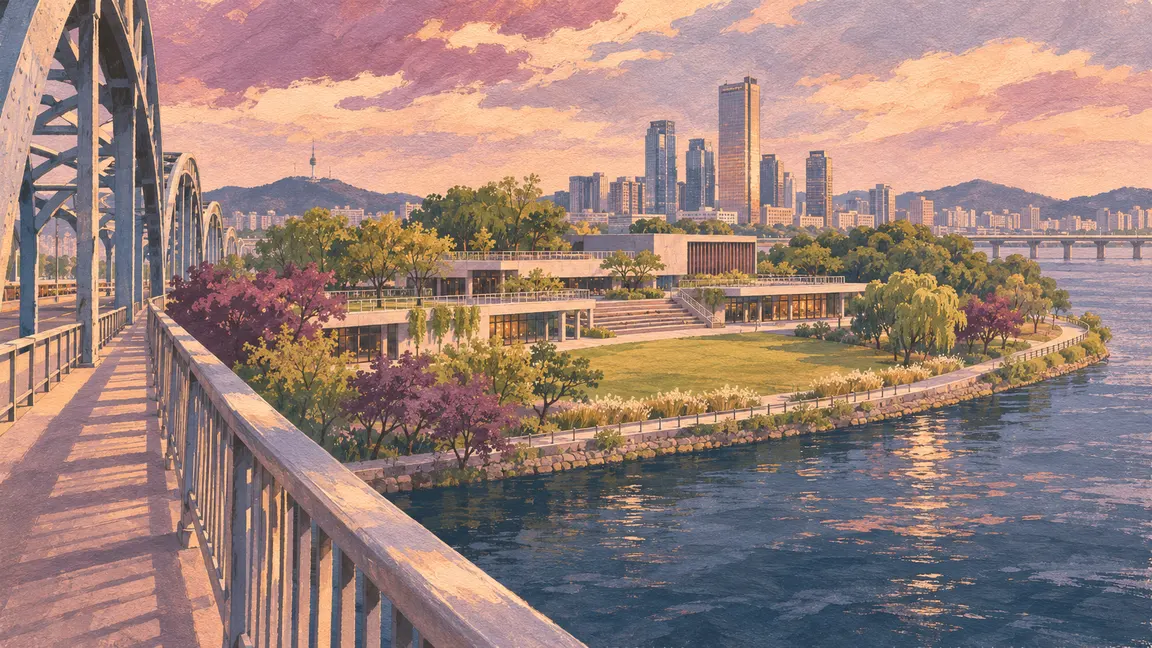
In Episode 1, the river and modern terraces give Sandbox a setting that feels removed from the rest of the city. Visit Seoul identifies Nodeul Island, which sits midway along Hangang Bridge, as the filming location for that riverside scenery.
From a sandbank to a music venue
Nodeul’s history is tied to the bridge above it. When a pedestrian bridge crossed the Han River here in 1917, builders raised part of the sandbank beneath it. In the following decades, Seoul residents came to the sandy stretch to cool off in summer and skate in winter. Later river and road works reshaped the shoreline and the broad beach disappeared.
Nodeul reopened in September 2019 as a public arts space, with a live music hall, exhibition spaces, and a lawn. The island’s role as a place to spend time by the river came back in a different form: where people once gathered on sand, visitors now gather on terraces and paths beside the water.
For a visit today, start on the west side and head toward the waterfront. Seoul reopened the renewed riverside area in September 2026, with a loop of about 1.5 km and small gardens along the way. You can look across the water toward Yeouido, but don’t expect a frame-for-frame match with the show: the waterfront has changed since filming, and further work is planned.
Getting to Nodeul Island
Korean name: 노들섬
West-side address: 445 Yangnyeong-ro, Yongsan-gu, Seoul
서울 용산구 양녕로 445
Subway: Line 9 to Nodeul Station (노들역), Exit 2. Follow the pedestrian route toward Hangang Bridge for about 700 m. If you’re starting near Yongsan, the operator lists a bus connection from Sinyongsan Station stop 03-004 to Nodeul Island stop 03-340.
Naver Map directions · Google Maps directions · Official arrival guide
Access: The winter notice lists the outdoor areas as open around the clock, with general indoor hours from 10 a.m. to 8 p.m. Tuesday through Sunday (November–February) and no indoor access on Mondays. Individual venues can keep different hours. Check the island’s current notices before making a special trip for a specific exhibition, path, or viewpoint.
Can you visit both in one afternoon?
Yes. I’d set aside a half day and do the oil tank park first, while there’s enough daylight to see the buildings clearly. Save Nodeul Island for later if you want river views as the light changes. If you’re going in winter, start earlier so you can do both walks before dark.
- Start in Mapo. Give yourself 45–60 minutes for the Culture Yard and open paths. Don’t build the schedule around a tank interior unless you’ve booked a specific event there.
- Check the transfer before you leave the park. One subway option is Line 6 from World Cup Stadium to Gongdeok, Line 5 to Yeouido, then Line 9 to Nodeul. Take a Line 9 local train; express trains skip Nodeul. Use your map app for the best connection that day.
- Finish by the river. Allow 45–60 minutes for the island itself, plus the walk back to the station. If a section is cordoned off, stick with the open public viewpoints and follow on-site signs.
Where to go from here
Setting up maps for the trip? Our guide to map apps in Korea explains how to look up a venue by its Korean name and save the right entrance.
Cover: AI-generated editorial illustration inspired by the two venues.
Sources
- Visit Seoul: Start-Up filming locations (scene attribution; use the operators below for current visiting information).
- Seoul Parks: Oil Tank Culture Park (site history, transit, and current access).
- Seoul Metropolitan Government: the depot’s construction and 2017 reopening; tank capacity and reuse.
- Nodeul Island: Visitor information and official directions (addresses, station exit, and bus stops).
- Nodeul Island: site history; Seoul Metropolitan Government: the sandbank, bridge, and 2019 reopening (Korean).
- Seoul Metropolitan Government: Nodeul Island waterfront reopening (waterfront route and visitor context).
- Nodeul Island: Winter operating hours and 2026 notices (current visitor updates).