You look at a Korean word, recognize it, turn the card over, and feel reasonably pleased with yourself. Ten minutes later, the word is gone. At the café, the sentence you practiced suddenly has a hole in the middle.
That gap between recognition and recall is a useful place to start. Learning Korean becomes more manageable when you give new words memorable connections, practice bringing them back, and use them in situations you care about.
One unusually interesting example comes from a U.S. Army research report published in 1980. Its subject was Korean vocabulary. Its tool was a mental picture. We can borrow that exercise, combine it with newer memory research, and build a routine that reaches beyond the flashcard.
The Army experiment that makes Korean vocabulary memorable
In Douglas Griffith’s Army Research Institute report, 60 enlisted personnel learned the English meanings of 15 Korean words. Half received training in the keyword method: connect the unfamiliar sound to a familiar word, then connect that cue to the meaning through an image.
The keyword group finished with an average of 11.4 correct answers out of 15, compared with 7.5 for the comparison group. They also spent less time studying. The original report includes the instructions given to participants, making it possible to examine the exercise itself.[1]
The appealing part is how ordinary the technique feels. You give your memory something vivid to grab onto. A door becomes easier to remember when something absurd is happening in the doorway.
Try it: a moon in the doorway
Start with 문, meaning door. Listen to its pronunciation in a Korean learner dictionary. Now imagine an enormous moon wedged in your front doorway, making it impossible to get outside. The English word “moon” is your sound cue; the doorway supplies the meaning.
Close your eyes and recall the image. Then look at 문 again and say its meaning. Finally, look at a real door and try to say the Korean word without looking at the text. Keep the Korean recording as your pronunciation model: English sound associations are approximate.
This moon example and the exercises below are our own applications of the research. You can change the image to something that sticks better for you. The goal is a quick connection you can retrieve.
For your next five words, choose ones you actually need. Spend a little extra attention on a stubborn word; let an easy word stay easy. If you find yourself remembering an elaborate story but repeatedly losing the Korean sound, simplify the association and practice the sound again.
Make the memory work: retrieve it, then return later
A good mnemonic gives you an entry point. Retrieval practice gives you repeated opportunities to find the word yourself. In foreign-language vocabulary experiments, attempting recall has helped later retention; further research has examined combining keyword imagery with retrieval.[2] [3]
A small study in an intermediate Korean class offers a classroom example. Words practiced in retrieval quizzes received higher scores on a sentence-completion test two weeks later than words omitted from those quizzes.[4] You can try a similar prompt by covering a useful word in a sentence from your lesson, recalling it, then checking the complete sentence.
Use a flashcard in both directions. On one side, place the Korean word with audio. On the other, use its meaning, a picture or a simple situation. Before revealing the answer, make an attempt. After a mistake, check the correct answer, hear it and try again later.
Separate the skills you want to build:
- Hear → understand: listen to the Korean without reading it, then recall the meaning.
- See → say: look at an object or English prompt, then produce the Korean.
- Use → respond: put the word into a short exchange and understand the reply.
These prompts reveal different gaps. If you can recognize a written word but miss it in conversation, add listening practice. If you understand it but cannot say it, give yourself more opportunities to produce it.
Return to the same material across days. A meta-analysis of second-language practice found meaningful benefits from spacing learning sessions.[5] You can begin with a review tomorrow, another a few days later, and another the following week. Bring missed words back sooner and let reliable ones wait longer.
A spaced-repetition app can manage those reviews, or you can use a small paper stack. Keep the system light enough that you spend your time learning Korean. Put the missed words near the front of tomorrow’s review.
Three more ways to give words a place to stick
Give actions a matching gesture
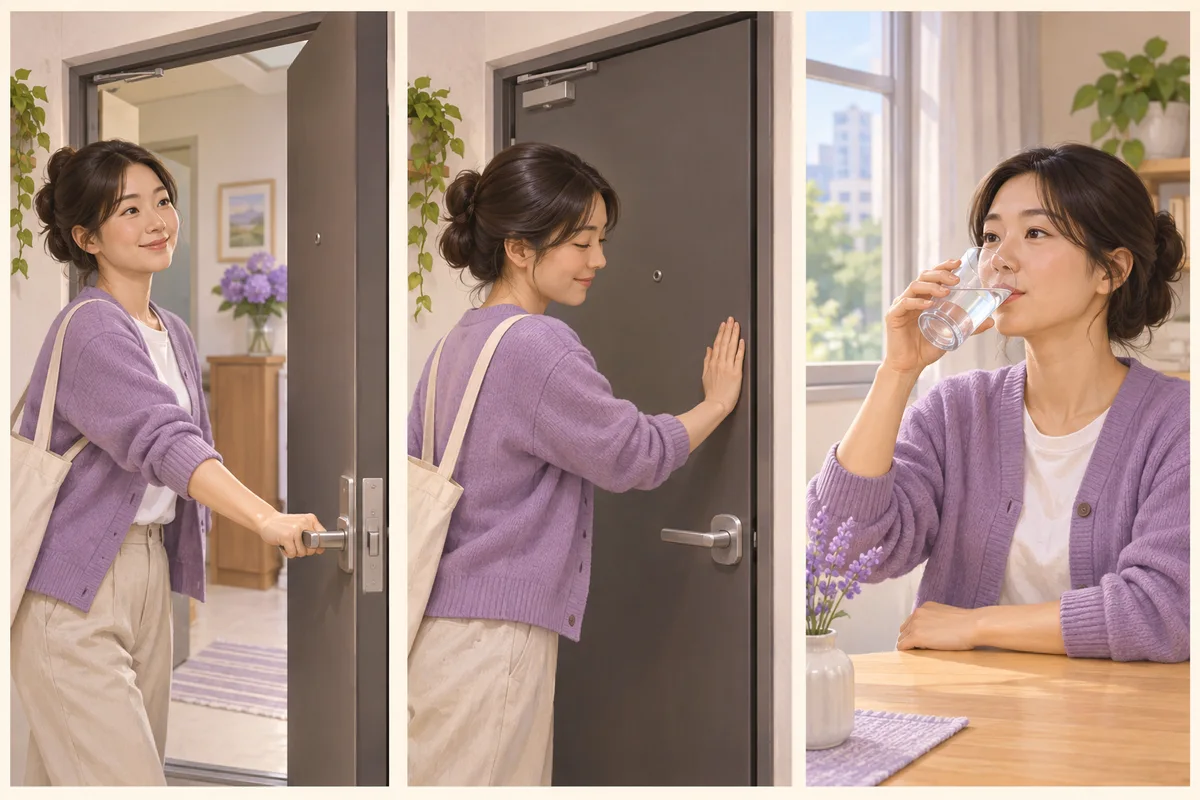
For 열다 (to open), mime opening a door. For 닫다 (to close), close it. For 마시다 (to drink), lift an imaginary cup while listening to and saying the word.
Experiments with foreign-language nouns and verbs have found benefits from gestures that match a word’s meaning.[6] This gives you another cue for a concrete action. Try it with a few verbs from your lesson, then practice their useful spoken forms with a teacher or course recording.
Dictionary forms help you find a word. Everyday sentences show you how it changes. Alongside 마시다, for example, practice 물 마셔요 (“I drink water” or “I’m drinking water,” depending on context). Say it while taking a sip, then recall it the next day.
Build a small memory palace
A memory palace uses a familiar route as a set of mental storage locations. Research on the method of loci has shown substantial improvements in word-list memory after training.[7]
Try a tiny version in your home. Picture an enormous 우산 (umbrella) opening at the entrance, a mountain of 신발 (shoes) in the hallway, and a 책 (book) flapping its pages on your desk. Learn each word’s sound and meaning first. Then walk through the locations in your imagination and retrieve the Korean at each stop.

This can be enjoyable for a small set you keep mixing up. Once the words become familiar, test them in a different order and use them in sentences. That helps you check whether you can reach the word directly when you need it.
Practice the form you want to recognize
Korean offers a good reason to give both your ears and eyes a job. In a 2025 experiment with learners unfamiliar with Korean, saying words aloud and copying them produced different recognition advantages: spoken practice helped auditory recognition, while copying helped visual recognition.[8]
For a word you want to hear at a station or shop, listen without the transcript, repeat it, and check what you heard. For a word you want to recognize on a menu, look closely at its Hangul and try writing it from memory. Then meet it in a phrase.
Learn Hangul early and keep it visible on your cards. Pair it with reliable audio so that the written word, its sound and its meaning develop together. The National Institute of Korean Language’s Korean-English Learners’ Dictionary is a useful place to check meanings, examples and pronunciation.[9]
Borrow the task-based approach of professional language training
Professional language programs also offer a practical idea: build practice around something you need to accomplish.
The Defense Language Institute describes one-to-three-day immersion events conducted entirely in the target language, including Korean. Students work through realistic situations and decisions, such as choosing a study-abroad destination through telephone inquiries.[10]
The CIA’s public description of its language institute similarly connects language instruction with cultural knowledge and phrases tailored to the work officers do.[11] For an ordinary Korean learner, that suggests starting with your own version of a mission: order a drink, ask about a class, explain a preference, or arrange to meet a friend.
Your weekly Korean mission
Choose one manageable task and prepare three things: your opening sentence, a likely reply, and a way to ask for clarification. Rehearse with a tutor or willing language partner, then change one detail and repeat the exchange.
For a café task, you might practice 아이스 아메리카노 한 잔 주세요 (“One iced Americano, please”). Then work on recognizing a question about having it here or taking it away. If you lose the thread, 다시 말씀해 주세요 politely asks the speaker to say it again.

Afterward, write down the part that stopped you. Perhaps the opening was easy, but a number in the answer disappeared. That gives you a precise target for the next session. Ask your tutor to repeat the task with different numbers, sizes or choices.
Living in Korea supplies opportunities to try these tasks during your normal day. Keep real interactions considerate: prepare beforehand, choose an unhurried moment and make a genuine inquiry. A busy employee has a job to do. Practice longer conversations with someone who has agreed to help you learn.
Outside Korea, recreate the same task with a tutor, a language partner or a course dialogue. Change the details on the second attempt so that you have to listen and respond.
A realistic routine you can start this week
Here is our suggested 30-minute routine. It combines memory work with input and use, and you can adjust the balance to your course and weak points.
- 5 minutes: retrieve old material. Try yesterday’s words before opening your notes. Check errors and set them aside for another review.
- 8 minutes: learn a small amount of useful Korean. Use a structured lesson or short dialogue. Hear the pronunciation, check the meaning and make a mnemonic only where it helps.
- 7 minutes: listen and read. Replay a short section you can follow. Notice how the new words behave in the sentence. Read along, then listen with the text covered.
- 7 minutes: produce something. Answer a question, describe an object or rehearse the weekly mission aloud. Record a short attempt if you want to compare it with a corrected version.
- 3 minutes: choose the next step. Note one useful correction and when you will revisit the material.
Once a week, add a conversation or feedback session. Bring the words and sentences you have been practicing. Ask for corrections to the few things that repeatedly block your meaning, then try the exchange again while the correction is fresh.
If you have an hour, use the extra time for a fuller lesson, more listening and meaningful conversation. Keep review proportional to your needs. A growing deck should still leave room to encounter the language beyond its cards.
Optional: a seven-day memory experiment
Curious which cues work for you? Choose ten useful words from your lesson. Give the slippery ones an image, gesture or familiar location. Try recalling them tomorrow, a few days later and at the end of the week, then bring a few into your next conversation.
At the end of the week, keep the cue that helped you recall each word and simplify any that got in the way.
So how long does it take to learn Korean?
Start by naming the outcome. Reading a menu, chatting with a friend, following a lecture and working professionally in Korean place different demands on you. A practical plan can have separate milestones for listening, speaking, reading and writing.
Course schedules give you one concrete benchmark. Seoul National University’s regular Korean program describes 200 teaching periods over ten weeks, with each period lasting 50 minutes.[12] That intensive schedule puts Korean into your week almost every day. Your own calendar will depend on the time you can give it consistently.
For planning your own study block, divide the hours by the weekly time you can realistically protect. A 100-hour block takes about 29 weeks at 30 minutes a day, 14 weeks at an hour a day, or seven weeks at two hours a day. These are time-budget calculations. Use a teacher’s assessment, a suitable practice test and real tasks to decide what you have learned during that time.
If TOPIK is your goal, prepare for its assessed skills. Standard TOPIK I assesses listening and reading; TOPIK II adds writing, while TOPIK Speaking is a separate test.[13] Pair exam progress with conversation practice when speaking is also important to you.
For your first month, choose a modest, observable target: read the Hangul in your beginner lessons, introduce yourself, or complete one familiar exchange with a follow-up question. Revisit that target after four weeks and adjust the next month to what you can actually do.
Give yourself more chances to remember
The doorway image might be what gets 문 into your memory. Hearing it tomorrow, recalling it next week and using it in a sentence give that memory more places to live.
Pick a small amount of Korean that matters to your life, give it a memorable connection, and bring it back before you add another pile. Then take it into a real task. Progress becomes easier to see when you can point to something you understand or do today that was difficult last week.
If you are considering a structured course in Korea, our university Korean-language program guide explains how the programs work. For more practical learning and everyday-life guides, explore Korea Unboxed.
Sources and further reading
Research checked November 15, 2026. The practical routines and Korean examples are our suggested applications; individual study details appear below.
[1] Douglas Griffith, U.S. Army Research Institute, The Keyword Method of Vocabulary Acquisition: An Experimental Evaluation (January 1980). The experiment used 60 enlisted participants and 15 spoken Korean military terms, with immediate Korean-to-English testing. The keyword group received supplied cues and practice. Its reported 79% advantage is an efficiency ratio combining final correct answers and study time. It does not establish a universal learning-speed gain, long-term retention or adoption as standard Army training. Original participant instructions begin on PDF page 26. ↩
[2] Karpicke and Roediger, The critical importance of retrieval for learning (2008). Foreign-language vocabulary experiments examining repeated retrieval and later retention. ↩
[3] Miyatsu and McDaniel, Adding the keyword mnemonic to retrieval practice (2019). Three experiments; the combination’s benefits depended on the learning condition. The article’s exercises adapt the principle for Korean rather than reproduce the experimental materials. ↩
[4] Song and Oh, The Effects of Retrieval with Different Cues on Second Language Vocabulary Learning (2017). Classroom quasi-experiment: 23 intermediate Korean learners participated; 21 were included in the analysis. The two-week retention test used sentence completion with a word bank. The overall retrieval advantage was statistically significant there; the overall difference on sentence writing, tested two months after the retention test, was not significant. Our covered-word exercise is an adaptation. ↩
[5] Kim and Webb, The Effects of Spaced Practice on Second Language Learning: A Meta-Analysis (2022). The synthesis covered 48 experiments and 3,411 participants. Equal and expanding intervals were statistically equivalent overall; the suggested review dates in this guide are a starting routine, not a uniquely optimal schedule. ↩
[6] García-Gámez and Macizo, Learning nouns and verbs in a foreign language: The role of gestures. Experiments compared gesture conditions, including gestures matching or mismatching meaning. The Korean actions here are our illustrative adaptations. ↩
[7] Dresler and colleagues, Mnemonic training reshapes brain networks to support superior memory (2017). Six weeks of method-of-loci training improved word-list recall relative to comparison groups. This was a memory-training study rather than a Korean-language course; our small home route is an introductory exercise. ↩
[8] Kim, Tran and Fernandes, 2025 experiment on spoken and written encoding of Korean words. Participants unfamiliar with Korean completed recognition tests. Its task-specific findings inform the practice suggestions here. ↩
[9] National Institute of Korean Language, Korean-English Learners’ Dictionary. Reference for word meanings, pronunciation and usage examples. ↩
[10] Defense Language Institute Foreign Language Center, Immersion Language Office. Official description of target-language simulations. The café mission in this article is our civilian adaptation. ↩
[11] CIA, Language Empowers Mission: The Intelligence Language Institute (June 22, 2022). Institutional description of mission-tailored language and cultural instruction. ↩
[12] Seoul National University Language Education Institute, Regular Program. Classroom hours describe a program structure; homework, prior knowledge and learning conditions also affect progress. Self-study calculations in the article are arithmetic, not equivalence claims or TOPIK outcome estimates. ↩
[13] National Institute for International Education, TOPIK overview. Official assessment structure, including the separate speaking test. ↩
Korea Unboxed related reading
Studying Korean in Korea: University Language Programs Explained · More Korea Unboxed articles