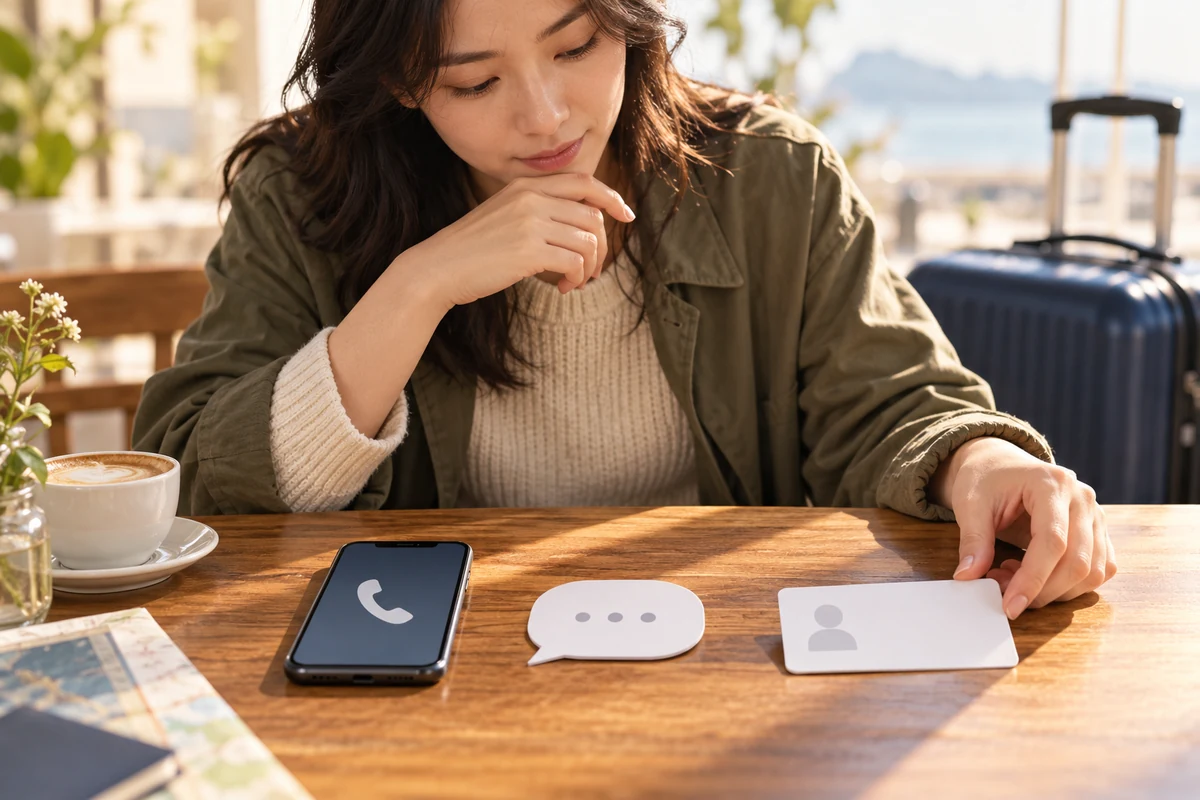
Some Korean tourist eSIMs provide a Korean phone number, but what you can do with it depends on the plan. Receiving a text, making a call and passing Korean identity verification are separate capabilities. The number alone does not promise all three.
Before comparing prices, write down what you need the phone to do: maps and messaging, a restaurant callback, an SMS code, or an app’s identity check. That short list will make the product descriptions much easier to read.
Four features that are easy to confuse
- Mobile data: internet access for maps, websites and apps.
- Phone calls: incoming and outgoing calls may have different conditions.
- SMS: ordinary incoming texts, outgoing texts and a particular app’s verification messages are not necessarily supported in the same way.
- Korean identity verification: an identity-checking process, rather than simply proof that you can receive a code.
KISA describes identity verification as identification and authentication provided through designated methods, including mobile phones. Receiving an SMS alone therefore does not establish that your subscription can complete that identity check. Read KISA’s explanation of identity verification.
A concrete example: KT’s visitor eSIMs
KT advertises 010 numbers for its visitor eSIMs and separates Data eSIM from a calls-and-SMS product. Here is the distinction in its published comparison, not a comparison of every Korean carrier.
| Function | KT Data eSIM | KT eSIM with calls/SMS |
|---|---|---|
| Mobile data | Included | Included |
| Incoming calls/SMS | Free after required entry verification | Free after required entry verification |
| Outgoing calls/SMS | Unavailable | Additional charges; verification required |
| Korean personal authentication | Not supported | Not supported |
KT states that its data-only product cannot be topped up for voice service. Check the current KT product page before purchasing; do not assume a cheaper plan can be upgraded later.
KT’s passport/entry check for enabling services is separate from the personal authentication its tourist products do not support. Follow the current verification instructions for your purchase: do not assume that completing one check makes the other available. KT’s service conditions also describe the entry-check requirement.
Will it work for a restaurant or booking app?
Ask what the service actually needs. A restaurant asking for a contact number may simply want to call you. An app may send a one-time code. Another service may require Korean mobile identity verification. These are different problems, even if the form looks similar.
For an important reservation, ask the business whether it accepts an international number or another contact method. If you need a particular app, check that app’s current eligibility rules as well as the eSIM terms. A plan that receives ordinary messages is not a guarantee that every app will accept its number or deliver a verification code.
Here is a useful question for a seller: “Does this exact plan receive ordinary SMS after activation, and does it support Korean personal authentication? I need it for [service name].” Also check the named app or booking service’s own requirements. Avoid buying on the strength of “works with Korean apps” without those details.
Choose around your actual trip
- You mainly need maps, translation and internet messaging: compare data allowance, speed limits, validity and device compatibility. A local phone number may be secondary.
- You expect local callbacks: confirm incoming calls and any passport or arrival check before leaving the airport or activation point.
- You need to make ordinary calls: choose a voice-capable product and check outgoing charges. Do not treat a data connection as included mobile voice credit.
- Your essential service requires Korean identity verification: confirm a legitimate eligible route with that service before buying. A different tourist eSIM may not solve the problem.
Check these details before paying
- Your exact phone model: confirm eSIM support and any carrier lock with your existing provider.
- When the clock starts: check whether validity begins at installation, activation or first use. Follow your product’s wording rather than a generic travel checklist.
- What needs verification: confirm the documents, method, timing and any nationality-specific instructions.
- The number’s permitted uses: separate incoming calls, outgoing calls, SMS and identity authentication.
- Refund and reinstallation rules: read them before scanning or deleting the profile. KT lists completed eSIM purchases as non-cancellable and non-refundable on its service conditions page.
Test the function you will rely on
Once setup is complete, test mobile data with Wi-Fi off. If your plan includes calls or texts, test those separately with someone you know. Keep the seller’s support details and your purchase reference available offline.
If maps work but a booking app rejects your number, first identify the failed step. Reinstalling the eSIM will not necessarily fix an app’s identity or eligibility requirement, and deleting a profile can create another problem. Contact the provider or app through its official support channel before changing the installation.
Checked 11/01/2026 (Asia/Seoul). This guide compares published conditions, not a purchased or activated test. Carrier terms and app requirements can change. Verify the exact product and service before paying.
Sources and further reading
KISA: Identity verification services. Explains identity verification, which is distinct from having mobile data or receiving an SMS.
KT: Visitor eSIM products. Product-specific data, calling, SMS and activation conditions.
KT: SIM and eSIM service conditions. Purchase, cancellation, refund and service conditions.