Korea’s winter pastimes have taken shape on frozen village waterways, snowy mountain paths, city plazas, and Olympic slopes. A low wooden sled pushed with two short poles still makes sense on level ice; a pair of wide snowshoes solves a very different problem in deep snow. The story of winter in Korea is partly about what the ground lets you do, and partly about how people turned that into play.
What winter looked like before ski resorts
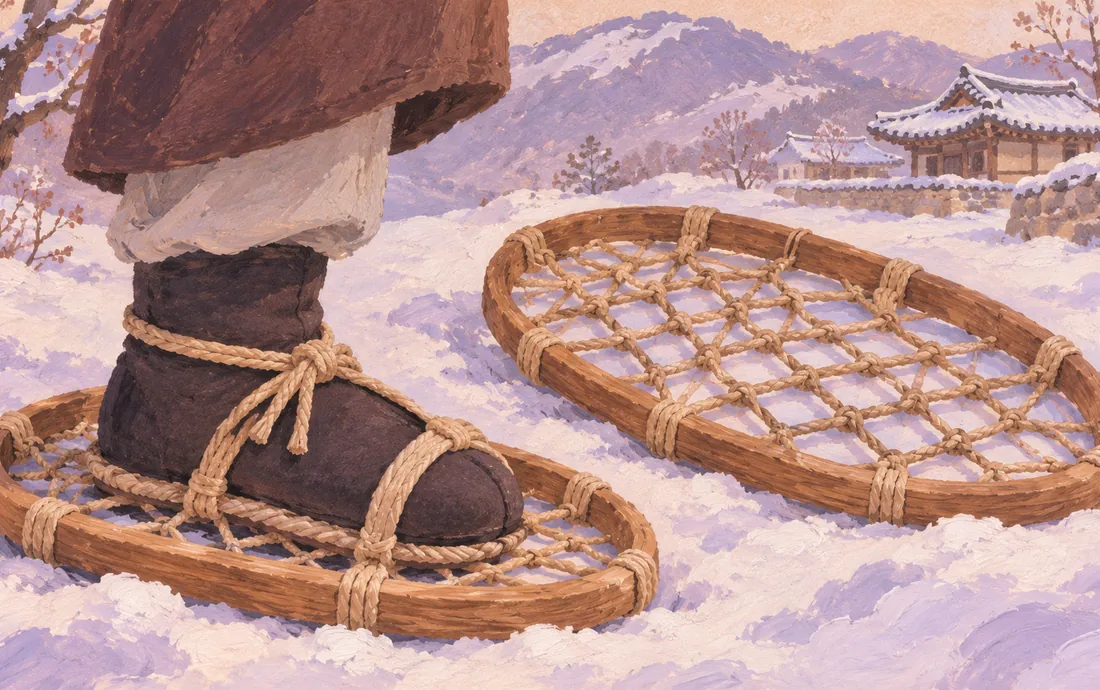
In mountain areas, snow was an obstacle before it was a weekend destination. Seolpi (설피) were snowshoes worn under ordinary footwear. A broad frame spread the wearer’s weight over a larger area, making it easier to travel over deep snow without sinking at every step. Accounts of winter hunting also distinguish them from ski-like wooden gear used to slide downhill. One helped you climb or cover ground; the other helped you move downhill. The National Folk Museum of Korea shows both in its account of traditional winter life.1
Another object, the sseolmae (썰매), could be a low sled for play. The museum documents regional variations, but the version you may recognize is a board on runners with a rider sitting low and pushing against the ice with two pointed sticks. For a child on a frozen flat surface, those sticks are the engine. Unlike a snow tube on a hill, an ice sled needs no slope to get moving.2

How old is the game? Historical records show that sleds were used to move materials during construction, including work at the Suwon fortress and royal palaces. That tells us that people knew how to build and use sleds. It does not give us a birthday for children’s ice sledding. The museum describes the pastime and the historical evidence separately, and that is a useful distinction to keep.2
There was more to winter play than sledding. The museum also records spinning tops on ice and flying kites on hills. Those activities suggest how much play depended on the places a child already knew: a patch of ice, an open slope, or somewhere with enough wind to get a kite airborne.1
How skiing became a competitive sport and a weekend trip
Traditional ways of traveling on snow are part of the history, but modern competitive skiing has its own timeline. The Korea Forest Service records a ski championship near Wonsan in 1930, during the Japanese colonial period. Wonsan is now in North Korea. After liberation, the Korea Ski Association was founded in 1946, and the national championships followed at Nogodan on Jirisan in 1947, according to the Academy of Korean Studies.3

The mountain getaway came later. Yongpyong’s operator dates the opening of its ski area and hotel to December 1975. A hotel at the slope changed what a ski trip could look like: you could turn a day on the snow into a weekend, and people traveling together did not all have to spend their time on the same run. This resort milestone is decades removed from the early races near Wonsan.4
What PyeongChang added
At the 2018 Winter Olympics, audiences saw very different kinds of winter sport in a single region: snow events in the mountains and ice events in Gangneung. PyeongChang also hosted the Olympic debut of snowboard big air, a competition built around a single large jump. The board, jump, and scored tricks reflect a modern competitive discipline, rather than an extension of traditional ice sledding.5

The Olympic chapter did not end in 2018. The 2024 Winter Youth Olympics reused several venues from the earlier Games. That is a tangible example of how infrastructure built for one global event can carry on serving winter sports. It also helps explain why the 2018 venues still appear in accounts of winter recreation in Gangwon.5
How people play in winter now
Traditional ice sledding at a festival
The Hwacheon Sancheoneo Ice Festival in Gangwon is known for fishing, but the Korea Tourism Organization also lists ice sledding among its activities. It is a way to encounter a traditional form of winter play in a managed venue. Ice sledding and snow sledding are listed separately: if you want the flat-ice experience, look for eoreum sseolmae (얼음썰매). As with other activities on ice, check organizer announcements and use designated areas rather than assuming frozen water is safe.6
Skating in the center of Seoul
At Seoul Plaza, the winter rink turns a civic square into somewhere you can get on the ice without making a trip to the mountains. The city dates the rink’s first opening to 2004. It is an urban winter tradition in its own right: rented boots and scheduled sessions make skating part of a city outing rather than something that depends on finding a frozen waterway.7

Resort snow days for mixed groups
Contemporary resorts can separate winter activities that might once have shared the same patch of ground. At Sono’s Snowy Land in Hongcheon, designated sledding runs sit within a snow park designed for play. A group can choose an outing around sledding rather than paying for a ski day that only some people want. When comparing venues, check what each ticket actually covers: access to a snow park and access to a ski lift are different things.8
Three winter experiences worth telling apart
- Ice sledding: You sit low and push yourself along a flat surface. Start with a festival or venue that explicitly lists ice sledding.
- Snow sledding or tubing: A slope does the work. Look for a dedicated run and check the operator’s age, height, and equipment rules before going.
- Skiing and snowboarding: You steer on a slope using the edges of skis or a snowboard. For a first outing, look for beginner terrain, rentals, and a lesson rather than choosing by the longest run.
Winter play in Korea has changed as the places for doing it have changed. A wooden sled still fits a patch of level ice, a downtown rink makes an evening on skates possible in the middle of Seoul, and the mountains offer a full day learning a new sport. Which version you choose depends less on how adventurous you are than on what kind of winter day you want.
Planning a winter day out? Our winter sports venue guide covers where to go, what to book and how to get there.
Sources and further reading
- National Folk Museum of Korea: winter life and games; Academy of Korean Studies: seolpi.
- National Folk Museum of Korea: sledding; museum’s expanded Korean entry and historical references.
- Korea Forest Service: early ski history; Academy of Korean Studies: skiing.
- MONA YongPyong: resort chronology.
- International Olympic Committee: snowboard event history; PyeongChang 2018 venues and their later use.
- Korea Tourism Organization: Hwacheon Sancheoneo Ice Festival; Hwacheon County: festival overview.
- Seoul Metropolitan Government: Seoul Plaza ice rink.
- Sono Hotels & Resorts: designated sled runs and rules; Snowy Land operating status.