If you are booking Korea for 2027, check the date on any advice saying you can skip K-ETA. The current temporary exemption ends on December 31, 2026, Korean Standard Time. We have not found a later official extension into 2027 in the notices and government sources checked for this guide.
Do you need K-ETA for Korea in 2027?
The practical answer depends on your passport, age, purpose of travel and existing documents. If the temporary country exemption expires as scheduled, the ordinary K-ETA requirement would apply to affected visa-free travelers unless another exemption applies. Plan for that possibility while checking for a new announcement.
Sources checked: October 16, 2026 KST (October 15 EDT). This guide provides general immigration information, not personal legal advice. The editorial team is not acting as your lawyer. Check the official rules for your passport and travel date before departure.
Confirmed under the currently published rules
The Ministry of Justice's December 23, 2025 extension notice covers the existing temporary exemption through December 31, 2026 KST. Separate age and status exemptions also exist. The exemption concerns the K-ETA application requirement; visa-free eligibility and the permitted length of a visit are separate checks.
Pending changes for 2027
No later extension was found in the official K-ETA notice list and official-domain searches reviewed. That finding does not predict the government's next decision. The post-expiry requirement described here is an interpretation of the existing framework if no further change is announced, rather than a new announcement that every foreign visitor will need K-ETA.
Start with the document decision guide
Work through these checks for each person traveling. A family sharing one booking can still have different document requirements.
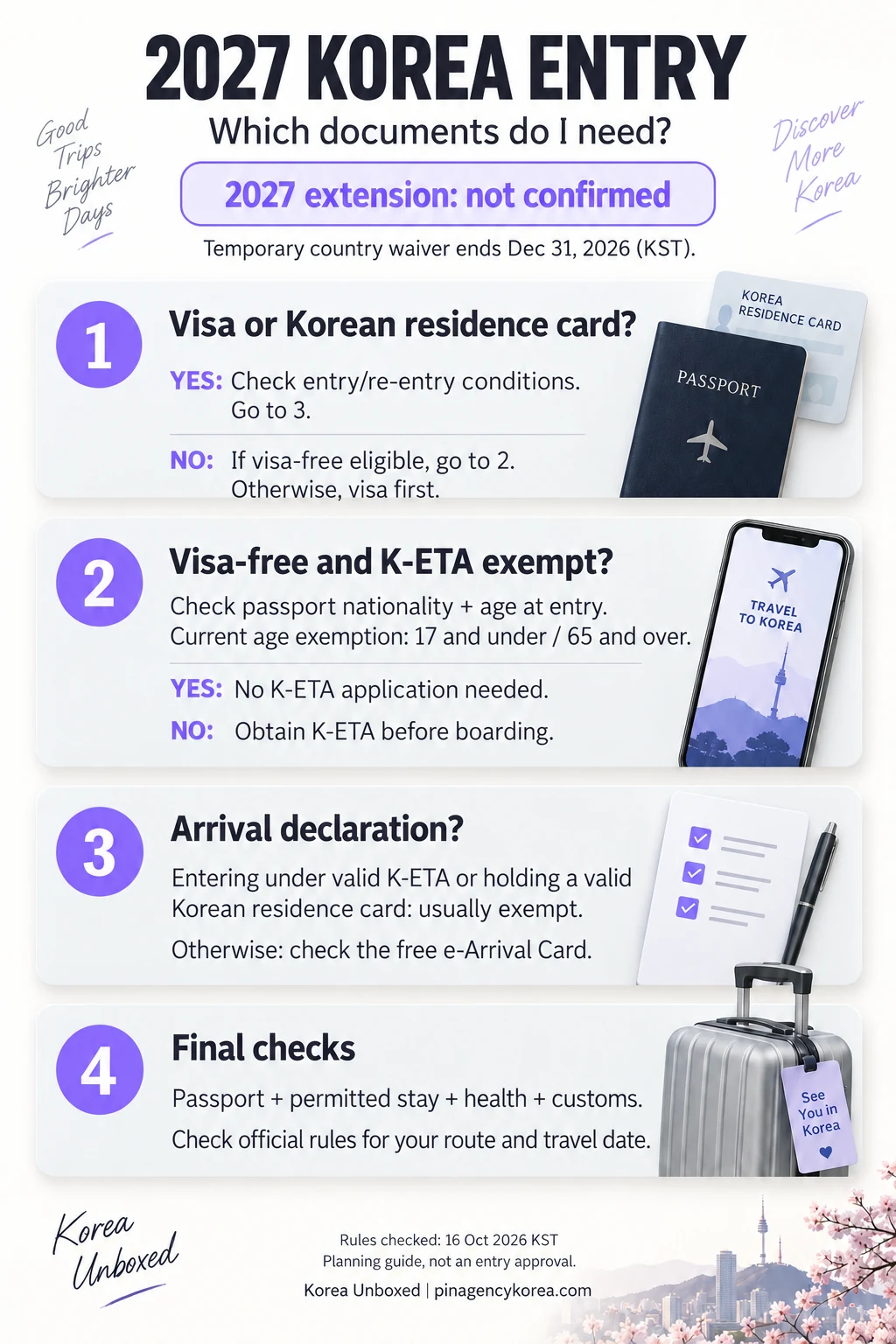
First, check your entry route. If you have a Korean visa or residence status, check its entry or re-entry conditions. Otherwise, establish whether your passport, visit purpose and intended stay qualify for visa-free entry. Someone who needs a visa cannot substitute a K-ETA application.
Then check K-ETA exemptions. Eligible visa-free travelers should check the current nationality, age and other exemptions. If none applies, obtain approval before boarding. An exemption from applying still leaves the separate arrival-declaration question.
Check the document you will actually enter under. Entry using valid K-ETA or a valid Korean residence card normally removes the arrival-declaration requirement. Other travelers should check the free e-Arrival Card's eligibility guidance. Finally, check passport validity, permitted stay, health requirements and anything you must declare to Customs.
What does the December 2026 exemption cover?
The Korea Tourism Organization's Visa & Travel Requirements page, updated September 18, 2026, lists these 22 temporarily exempt countries and regions:
Asia: 🇯🇵 Japan, 🇹🇼 Taiwan, 🇭🇰 Hong Kong, 🇸🇬 Singapore and 🇲🇴 Macau.
North America: 🇺🇸 the United States, including 🇬🇺 Guam, and 🇨🇦 Canada.
Europe: 🇬🇧 the United Kingdom, 🇩🇪 Germany, 🇫🇷 France, 🇮🇹 Italy, 🇳🇱 the Netherlands, 🇪🇸 Spain, 🇵🇱 Poland, 🇸🇪 Sweden, 🇫🇮 Finland, 🇳🇴 Norway, 🇧🇪 Belgium, 🇩🇰 Denmark and 🇦🇹 Austria.
Oceania: 🇦🇺 Australia and 🇳🇿 New Zealand.
Keep the end date attached to that list. It is the published temporary list through December 31, 2026, not a confirmed exemption list for 2027. Living in one of these places does not make a different passport eligible. Use your actual nationality and passport when checking.
Visa-free stay lengths also vary. A friend's 90-day visit does not establish your allowance, and approval lasting several years does not authorize staying for that entire period. Check your route through the Korea Visa Portal and the relevant Korean embassy or consulate.
Who is exempt under the current framework?
The official age-exemption notice exempts eligible visa-free travelers aged 17 or younger and 65 or older. The current exception list specifies age on the date of entry. Both 17 and 65 are included; check each person's age at arrival rather than when you book.
Visa holders and registered foreign residents are also among those who do not need K-ETA. Their own immigration documents and conditions still govern the journey. The age exemption does not itself remove the need for an arrival declaration.
A transfer staying airside is different from a connection requiring immigration. If you must collect baggage or leave the transit area, check entry permission for that itinerary. The official exception list warns that transfer passengers needing to enter Korea may require K-ETA if otherwise applicable.
What if the exemption is extended, or expires?
If a new extension is announced: read its exact dates, covered passports and conditions. Update your plan from that notice. An earlier extension does not establish what another one would cover.
If the exemption expires without another change: the ordinary authorization framework would apply to affected visa-free travelers, subject to the separate exemptions. The Korea Immigration Service overview explains that travelers subject to K-ETA need approval before boarding. Do not wait for an arrival-card reminder to address it.
Consider a hypothetical flight leaving home on December 31 and arriving in Korea on January 1. The existing notice uses KST. Do not assume your departure date preserves a waiver for a next-year arrival. For a journey crossing the deadline, verify the operative notice and any boarding instructions before departure; the reviewed notice does not settle every year-end itinerary.
If you need K-ETA: fees, timing and passport checks
Use the official K-ETA application guide before applying. It currently describes assessment as usually taking 72 hours or less, with longer processing possible and no expedited service. Allow time for a delayed decision. Applying is not the same as receiving approval, which is required before boarding when K-ETA applies.
The current fee guide lists ₩10,000 per person, plus applicable online processing charges. The fee is nonrefundable regardless of the result. Recheck the amount when applying for a 2027 journey.
Already have approval? Check its actual expiry and the passport attached to it. Current approvals generally last three years or until passport expiry, whichever comes first. A reissued passport requires a new application. Update changed travel information through the official service. The temporary exemption ending does not, by itself, cancel an otherwise valid approval.
K-ETA approval does not guarantee admission; the immigration officer makes the entry decision. Use the government service directly. The Ministry's warning about unofficial websites and agencies is worth reading before entering passport or payment information.
Do you also need an e-Arrival Card?
The e-Arrival Card records arrival information. It cannot replace a visa or required K-ETA. The official declaration eligibility guide includes many visa holders and K-ETA-exempt travelers, while excluding people entering under valid K-ETA and holders of valid Korean residence cards.
Holding an old K-ETA while entering with a visa does not automatically remove the declaration requirement. Use the official Navigator for your documents. For the form walkthrough, see our Korea e-Arrival Card guide.
The service is free. The official FAQ illustrates a filing window that includes arrival day and the preceding two calendar dates in KST. This short declaration window is separate from K-ETA processing.
Paper-card guidance remains inconsistent across official pages. A Belgian embassy notice describes electronic submission as mandatory from 2026, while the central FAQ still permits paper completion before immigration. Complete the electronic version beforehand if you need a declaration, and recheck current guidance. We cannot confirm universal paper abolition or guarantee paper availability in 2027.
Other Korea entry checks before departure
Passport and permitted stay: check the rules for your entry route, visa, transit countries and carrier. Avoid applying another traveler's passport advice to a different nationality or visa category.
Health: KDCA's Q-CODE guidance and Q4 2026 official guide, PDF distinguish strict inspection areas from other designated areas. Travel through strict areas triggers a health declaration; symptoms also matter for the other category. Some designations are regional. Check current KDCA guidance for your route, including transit, rather than treating the late-2026 list as a 2027 rule.
Customs: the Korea Customs passenger guide covers reportable goods, restricted items and money. An immigration authorization does not resolve what you are allowed to carry.
A practical checklist for your 2027 booking
A family holiday: imagine a visa-free-eligible group containing two adults, a 17-year-old and a 65-year-old. Under the current framework, the younger and older travelers qualify for the age exemption. The other adults must check their own position, including whether a new country exemption has actually been announced for their travel dates. One person's exemption does not cover the booking.
A first arrival on a student visa: check the visa's conditions first, then the arrival declaration. A future residence-card application is different from already holding a valid Korean residence card. Follow the Navigator using the documents you currently have.
Before committing to the paperwork, check every traveler's passport and entry route, then identify any applicable K-ETA exemption. A 17-year-old or 65-year-old visa-free visitor currently has a different application position from an adult relying only on the temporary country waiver.
Next, check existing approvals against current passports. Keep the distinction between authorization and arrival declaration clear, particularly for a first-time visa holder who has not yet received a Korean residence card.
Recheck the official notice before departure, complete any required authorization early enough for assessment, and submit an applicable arrival declaration within its window. Keep confirmations accessible during travel. For a year-end itinerary or an unusual transit arrangement, resolve the exact conditions before reaching the airport.
Sources and further reading
Official immigration and travel sources
K-ETA temporary-exemption notice, December 23, 2025; current notice list; Immigration Service K-ETA overview.
KTO visa and travel requirements, updated September 18, 2026; Korea Visa Portal.
Age and validity reform notice, June 28, 2023; current exception list; application guide; fee guide; unofficial-site warning.
Arrival declaration eligibility; Navigator; FAQs; Belgium embassy electronic-card notice, January 1, 2026, modified April 10.
KDCA Q-CODE overview; Q4 2026 quarantine-area guide, PDF, effective October 1, 2026; Korea Customs passenger guidance.
Related Korea Unboxed reading
Korea e-Arrival Card: eligibility and form walkthrough. Related practical reading, rather than an independent immigration authority.