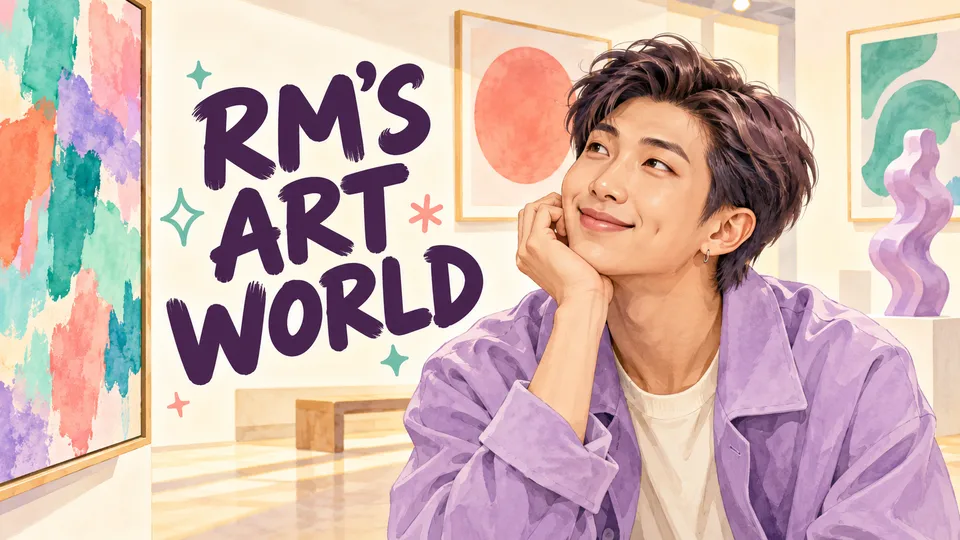
AI-generated editorial illustration of an imagined gallery.
RM changes the paintings in his bedroom with the seasons. In SFMOMA’s audio guide, he describes living with landscapes that bring different times of year into his home.[1]
His interest opens a route into Korean art, from Yun Hyong-keun’s dark, pared-back paintings to Kim Whanki’s experiments with abstraction. The artists’ lives are compelling in their own right, and their work offers another way to encounter Korea alongside its music, food and film.
RM x SFMOMA, co-curated with the San Francisco Museum of Modern Art, brings works from his collection into conversation with the museum’s holdings.[2] On the exhibition page, RM connects his interest in Korean artists with a desire to explore his roots.[2] Its official audio guide lets listeners hear him explain his choices himself.
A short introduction to Korea’s older art
Korean artists have worked with clay, ink, paper, wood and textiles for centuries. Five traditions offer a useful introduction to the objects and images you will encounter in museum galleries.
Goryeo celadon: color and craftsmanship
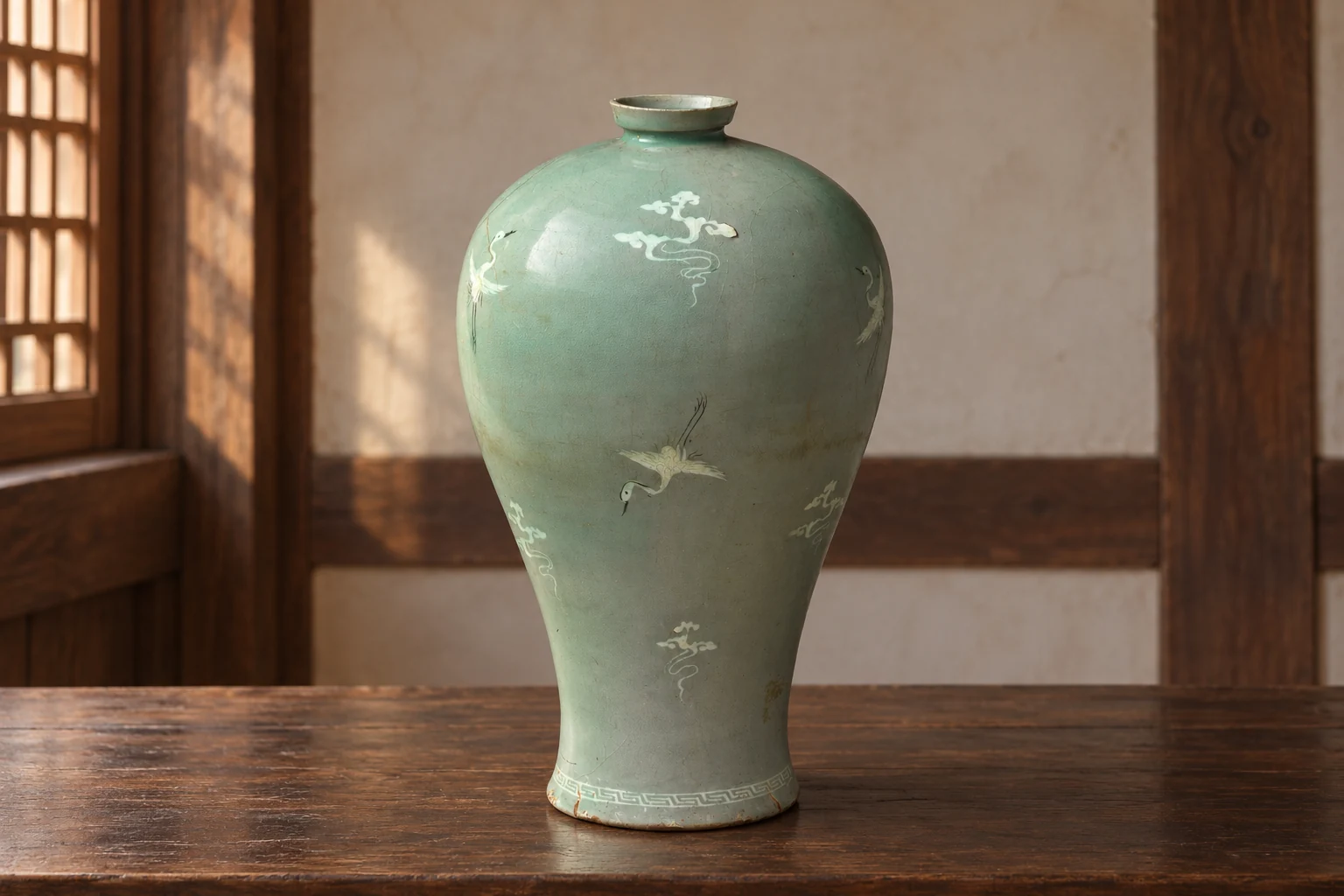
Goryeo potters produced ceramics with subtle blue-green glazes, building on techniques learned from China and developing distinctive forms and decoration. Celadon became a major part of Korean ceramic production during the Goryeo dynasty (918–1392), including refined vessels for the royal court.[12]
One celebrated technique is sanggam, or inlay. Potters cut a design into the clay, filled the recesses with white or dark slip, and applied a translucent glaze before firing. The pattern sits within the vessel’s surface. Cranes, clouds and flowers could appear in crisp contrasting colors beneath the green glaze. The craftsmanship brings surface decoration, silhouette and color together.[12]
Moon jars: the character of white porcelain
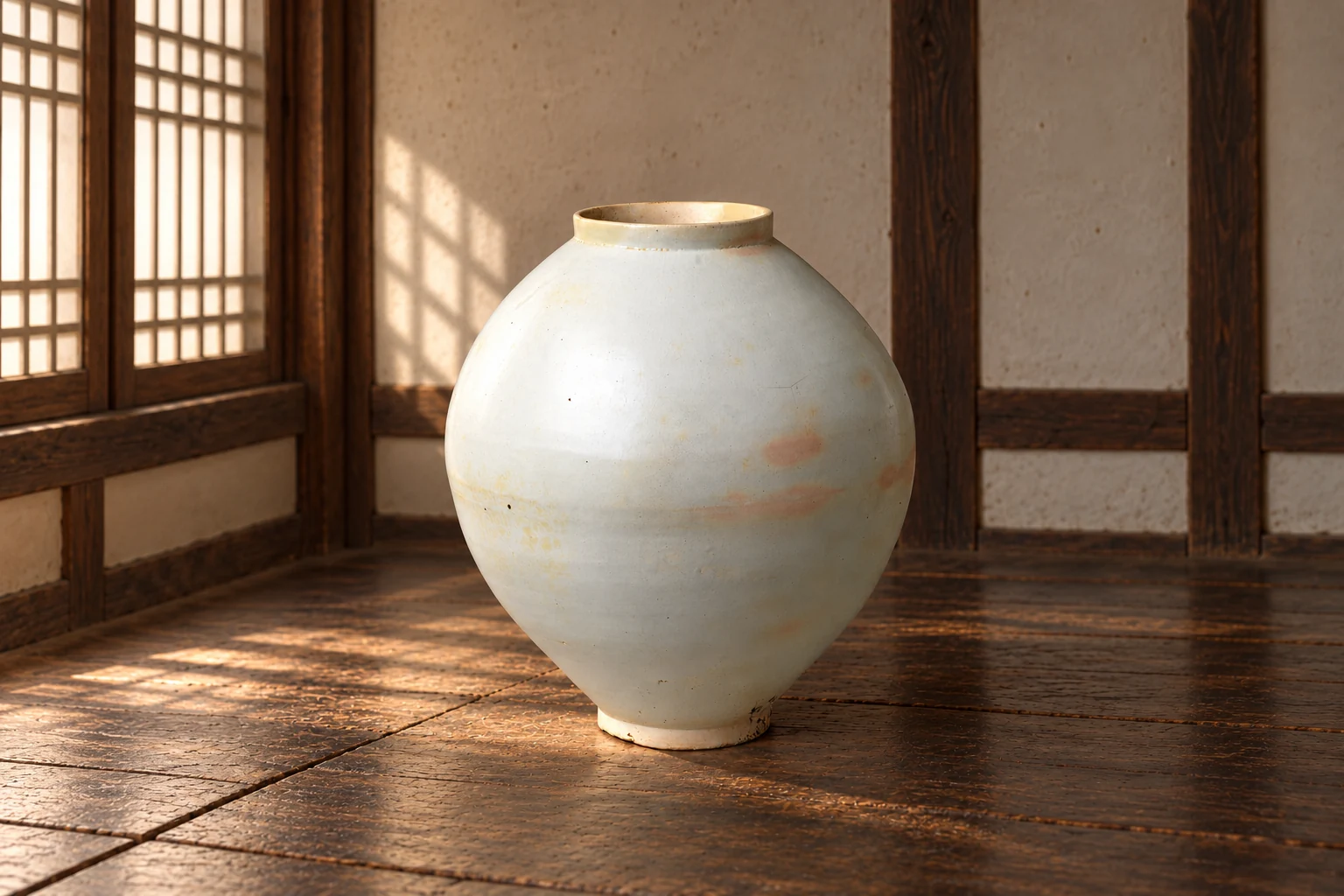
The large, rounded white jars made during the Joseon period take their modern name from their resemblance to a full moon. Their size required potters to shape the upper and lower halves separately, then join them. Small irregularities in the form and variations in the glaze give individual jars their character.[13]
White porcelain occupied an important place in Joseon culture. Museum research connects its restrained appearance with ideals of scholarship and self-cultivation associated with the period’s Neo-Confucian values.[14] Its appeal continued into modern art: Kim Whanki admired and collected white porcelain, finding inspiration in the distinctive forms of moon jars.[13]
Landscape painting: places, imagination and memory
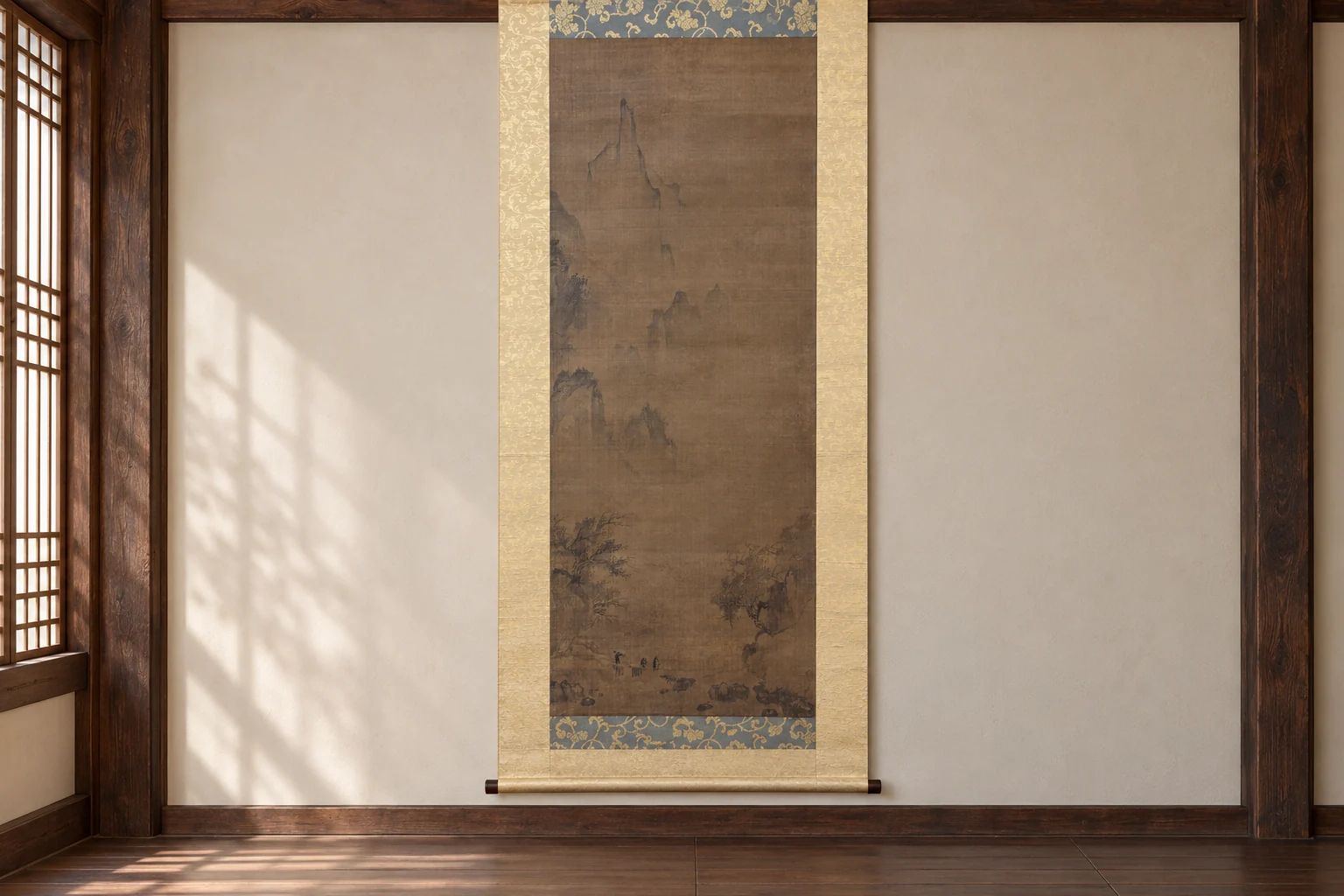
Mountains and water became central subjects in Korean painting. Some landscapes drew on literature, established painting traditions or imagined settings; others depicted recognizable places. Artists arranged peaks, paths and empty space to shape the experience of moving through a landscape.[15]
During the eighteenth century, jingyeong sansuhwa, usually translated as “true-view landscape painting,” flourished. Jeong Seon (1676–1759) became its best-known master. His paintings of Korean scenery combined a place’s distinctive features with expressive brushwork and composition. This tradition gave familiar mountains a powerful presence in art, while imaginative landscapes continued alongside it.[15]
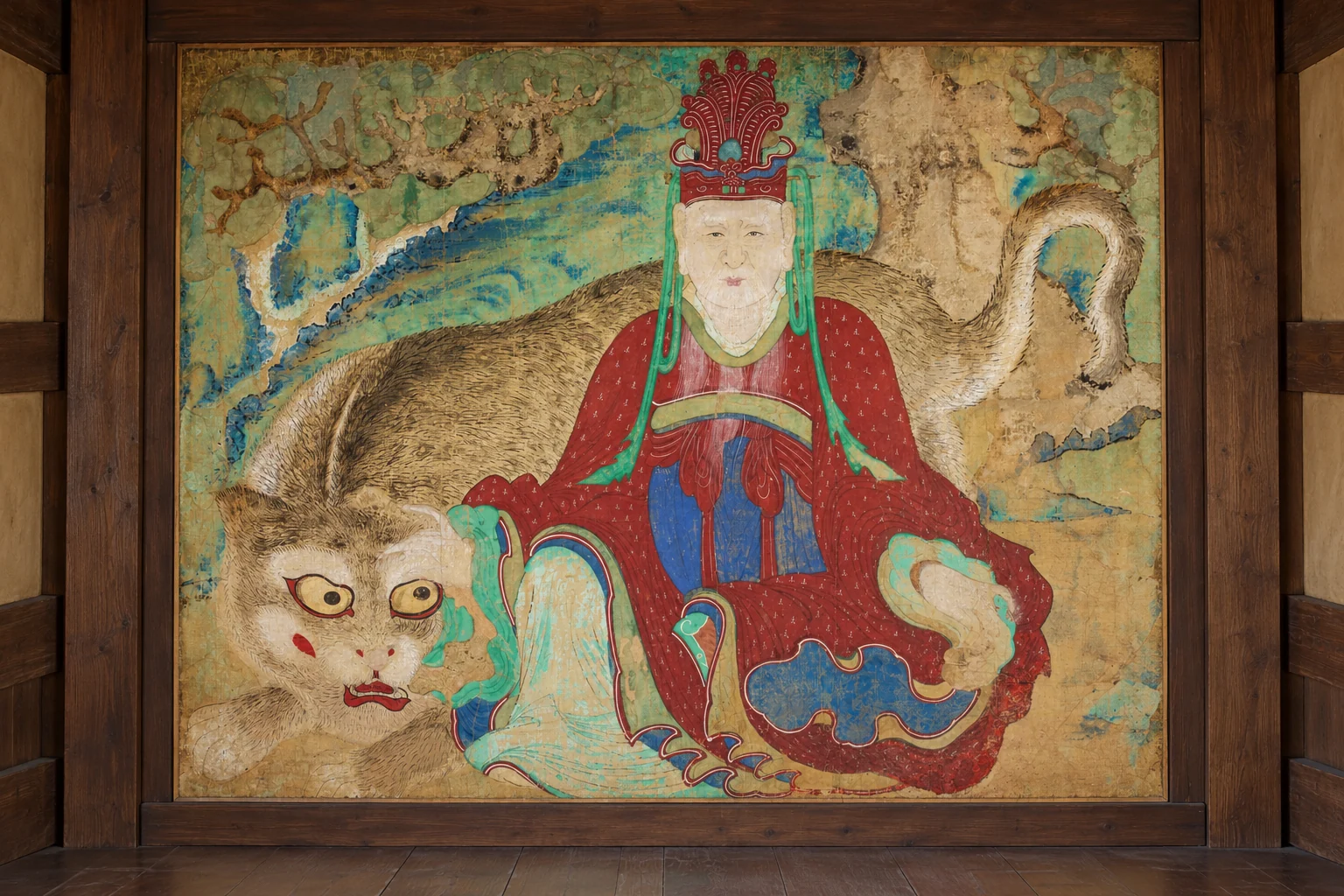
A mountain god and tiger: art and belief
In the late-nineteenth-century Mountain god with tiger shown here, an imposing figure sits beside a tiger beneath a pine tree. He is a sanshin, a mountain deity. The Met identifies the pine in this painting with longevity and integrity.[16]
Mountain spirits became part of Korean Buddhist worship alongside older indigenous beliefs. The museum suggests that this painting's size and fine execution indicate it probably belonged to a shrine within a Buddhist temple complex. Its importance lies in that meeting of traditions: images made for worship can reveal how religious practices developed together. The tiger serves as the deity's companion in this particular scene.[16]
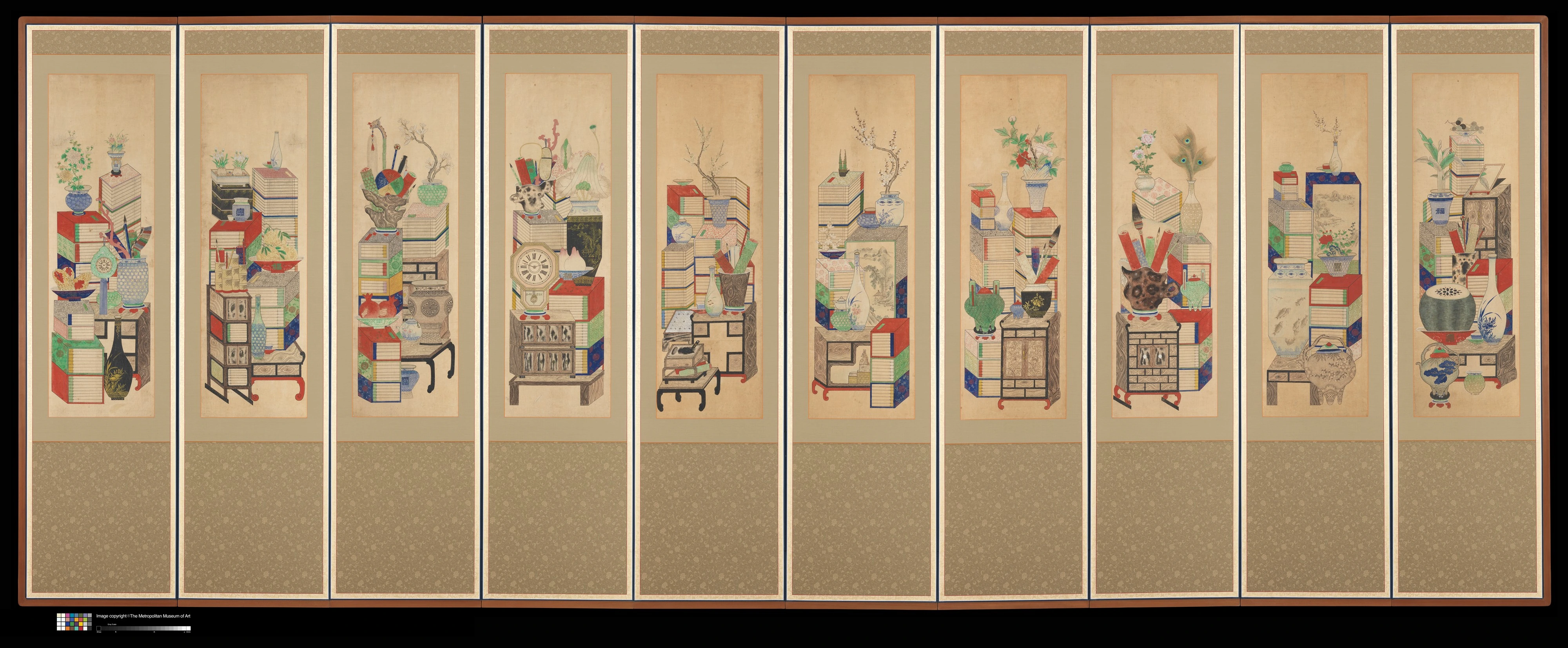
Books and scholars’ possessions
Chaekgeori means “books and things.” These paintings bring together stacked books, writing tools, ceramics, flowers and other possessions. The genre became popular at the Joseon court before spreading into scholars’ homes and other households.[17]
The Met describes the pictured screen as munbangdo, or a scholar’s-study painting.[18] The objects conveyed cultivated taste and aspirations toward learning. They also gave painters scope for playful compositions: shelves might seem to recede into the screen, while colorful objects compete for attention. A painted collection could express something about the person who displayed it. That connection between art and domestic identity is a useful thread to carry into the modern artists below.[17]
A few motifs to recognize
The original objects also introduce recurring decorative elements. Celadon potters repeated cranes and clouds across curved surfaces, using inlay to make their fine outlines legible beneath the glaze. In the mountain-god painting, the pine carries associations with longevity and integrity.[12][16]
The original books-and-objects screen adds written wishes to its decoration. The Met identifies two characters repeated on vessels: su (壽), for longevity, and bok (福), for good fortune.[18] These are useful clues to the hopes expressed through domestic objects.
Yun Hyong-keun: the artist RM calls a teacher
RM’s admiration for Yun Hyong-keun extends to the way the artist lived. In the exhibition audio, he talks about Yun’s character, paintings and life as an artist and father, describing him as “like a teacher.”[1]
Yun (1928–2007) developed an immediately recognizable language of dark forms and exposed canvas. According to MMCA’s retrospective research, he combined blue and umber—colors he associated with heaven and earth—and applied the mixture to unprimed cotton or linen. Paint spread into the fabric, leaving edges that could soften and bleed. The untouched cloth remained an active part of the composition.[3]
That restrained vocabulary emerged from a difficult life. Yun experienced political persecution and imprisonment. MMCA traces a decisive change in his painting to 1973, when his earlier, lighter palette gave way to the dark colors for which he became known.[3]
The edge of each broad band records how pigment met woven cloth. Differences in density and spacing give the paintings their particular weight.[3]
For background and examples, start with MMCA’s 2018-2019 Yun Hyong-keun retrospective.
Kim Whanki: a path into Korean abstraction
Kim Whanki was among the first Korean artists RM learned about. For the SFMOMA exhibition, RM brought a small painting from his living room to join a conversation with a work in the museum’s collection.[1]
Kim (1913–1974) helped establish abstract painting in Korea. Porcelain, mountains, the moon and other familiar subjects appeared in simplified forms in his earlier work. During his New York years, from 1963 until his death in 1974, dots became an increasingly important part of his painting.[4]
The Korean Cultural Center New York’s 2024 exhibition, developed with the Whanki Museum, traced that evolution through works on paper: early-1960s mountain and moon subjects gave way to increasingly abstract compositions. Its accompanying essay places his development within a career that included study in Japan and work in Korea, Paris and New York.[5]
Kim and Yun were connected personally, too: Kim was Yun’s teacher and father-in-law.[6] Following the two artists together reveals relationships within Korean modern art as well as strikingly different approaches to color and form.
Explore MMCA’s introduction to Kim Whanki for a museum example and further context.
What happens when you live with art
Another artist in RM’s collection, Son Sangki, brings the discussion into everyday urban life.
Son (1949–1988) developed his Artificial City series after settling in Seoul’s Ahyeon-dong neighborhood. SeMA’s collection research describes paintings concerned with urbanization: crowded hillside housing, shuttered shops and changing streets. His subjects give a human scale to the transformation of the city.[7]
RM says Son’s Artificial City—Irony hung in his living room. The painting’s depiction of an affluent interior made him reflect on his own wealth and how he uses his resources.[1] Here, a work’s significance includes the questions it introduces into the owner’s daily surroundings.
Son’s city paintings emerged from close attention to the neighborhood where he lived, recording a Seoul shaped by development and inequality.[7]
Listen to the Home section of SFMOMA’s RM audio guide for his discussion of the work.
Five places to explore Korean art in Seoul
These museums offer different starting points for your own visit. Exhibitions change, so check the official program and booking information before setting out; the suggestions below do not guarantee that a particular artist’s work will be on display.
National Museum of Korea: ceramics and historical art
For the older traditions introduced here, begin with the National Museum of Korea in Yongsan. Its galleries include celadon, buncheong ware and white porcelain, allowing you to explore different ceramic techniques within a wider historical collection. The museum’s online collection and gallery guides are useful for choosing what to see before a visit.[20]
Plan your visit: National Museum of Korea.
MMCA Seoul: contemporary art near Samcheong-ro
MMCA Seoul is a convenient starting point for exploring contemporary art in central Seoul. Its changing exhibitions make the current program the best guide to what you will encounter. Located at 30 Samcheong-ro, it also fits naturally into a day around the palace district. Choose an exhibition that interests you and give it room in your schedule.[8]
Plan your visit: MMCA Seoul visitor information.
MMCA Deoksugung: modern art inside a palace
MMCA Deoksugung offers a different setting for Korean modern art, inside Deoksugung Palace. The combination makes it an appealing choice for a day focused on Seoul’s history and culture. Museum exhibitions and palace entry have separate arrangements, so check both when planning your visit. Entry to the palace grounds is through Daehanmun Gate.[9]
Plan your visit: MMCA Deoksugung visitor information.
Seoul Museum of Art, Seosomun: another side of Korean painting
SeMA’s Seosomun main branch includes the Chun Kyung-ja Collection Gallery. Her collection encompasses portraits, travel paintings and drawings across decades of work, offering a different introduction to Korean painting from the abstract artists discussed above. The museum also hosts changing exhibitions. Its official branch guide explains the galleries and facilities before you arrive.[10]
Plan your visit: SeMA Seosomun branch guide.
Leeum: traditional and contemporary art in Hannam-dong
Leeum brings traditional Korean art, contemporary art and international work into the same museum. That breadth makes it useful if you want to explore several periods and media during one visit. Its buildings add an architectural dimension to the experience. Review the current exhibitions and reservation options first, then choose how much of the museum to include.[11]
Plan your visit: Leeum museum introduction and visitor information.
Sources
[1] SFMOMA, RM audio guide, sections Friendscape, Umber I, Blue Water and Home.
[2] SFMOMA, RM x SFMOMA exhibition.
[3] MMCA, Yun Hyong-keun retrospective and MMCA collection research on Yun’s materials and unprimed canvas.
[4] MMCA, Kim Whanki collection introduction.
[5] Korean Cultural Center New York, Whanki in New York.
[6] SFMOMA, A Private Collection of Korean Art Revealed.
[7] SeMA, Son Sangki: Artificial City—Red Roof, collection research. This source provides context for Son’s wider series, not the identity or ownership of RM’s painting.
[8] MMCA Seoul visitor information.
[9] MMCA Deoksugung visitor information.
[10] SeMA Seosomun branch guide.
[11] Leeum museum introduction and visitor information.
[12] The Met, Goryeo Celadon.
[13] Asian Art Museum, Moon Jar.
[14] National Museum of Korea, White porcelain moon jars, published by Smarthistory.
[15] The Met, Mountain and Water: Korean Landscape Painting, 1400–1800.
[16] The Met, Mountain god with tiger.
[17] The Met, Beauty and Learning: Korean Painted Screens.
[18] The Met, Books and Scholars’ Possessions.
[19] The Met, Rainy Landscape with Travelers.
[20] National Museum of Korea, Celadon Gallery and current gallery information.
Sources checked October 28, 2026. Draft prepared with AI assistance and checked against the official sources above.
Image credits
Original reference photographs: The Metropolitan Museum of Art Open Access, CC0.
Maebyeong (plum bottle) decorated with cranes and clouds, 11.8.1. Gift of Sadajiro Yamanaka, 1911.
Moon jar, 1979.413.1. The Harry G. C. Packard Collection of Asian Art, Gift of Harry G. C. Packard, and Purchase, Fletcher, Rogers, Harris Brisbane Dick, and Louis V. Bell Funds, Joseph Pulitzer Bequest, and The Annenberg Fund Inc. Gift, 1975.
Rainy Landscape with Travelers, 18.124.3. Rogers Fund, 1918.
Mountain god with tiger, 2024.89.2. Gift of the children of Lea R. Sneider, 2024.
Books and Scholars' Possessions, 2005.385. Purchase, Shelby White Gift, 2005.